
You finally finished the bonus room above the garage, dreaming of a cozy home office or a quiet playroom for the kids. But as the West Michigan lake effect snow starts to pile up, you realize the space feels more like a walk-in freezer than a living area. You find yourself constantly asking, “why is my bonus room so cold in winter?” while the rest of the house stays perfectly comfortable. It’s a common frustration for local homeowners who face high heating bills and drafty floors despite keeping the thermostat turned up. Often, the culprit isn’t your furnace; it’s a systemic failure in the thermal envelope that creates a “refrigerator effect” right under your roof.
We understand that a cold room is more than just an inconvenience. When walls stay chilled, they often become breeding grounds for mold and mildew, which can directly impact your family’s respiratory health and indoor air quality. This guide will help you discover the structural and insulation failures causing your bonus room chills and how to fix them for a warmer, healthier home. We’ll examine the critical role of air sealing knee walls under the 2021 Michigan Energy Code and how professional solutions like spray foam can stabilize your indoor environment for the long term.
Key Takeaways
- Understand why is my bonus room so cold in winter by identifying the structural failures and the “refrigerator effect” common in Muskegon and Grand Rapids homes.
- Learn how failing knee walls and improper air sealing allow cold attic air to bypass your insulation and compromise your comfort.
- Discover why the unconditioned garage below your bonus room acts as a heat sink and how to eliminate the “air gap” that makes your floors feel like ice.
- Identify how cold walls trigger condensation and hidden mold growth, which can compromise indoor air quality and your family’s respiratory health.
- See why professional assessments and closed cell spray foam provide the permanent, high-performance solution needed to lower energy bills and stabilize indoor temperatures.
Understanding the “Bonus Room Syndrome” in Michigan Homes
Many West Michigan homeowners in Muskegon and Grand Rapids struggle with a frustrating phenomenon known as “Bonus Room Syndrome.” This isn’t just a minor comfort issue; it’s a systemic failure where the room’s thermal boundaries simply don’t hold up against our harsh winters. While you might wonder why is my bonus room so cold in winter even when your thermostat is set to 70 degrees, the answer usually lies in how the room was built. These spaces are often exposed to the cold on three or more sides, including the roof above, the walls on the sides, and the unconditioned garage floor below. Under the 2021 Michigan Energy Code, modern homes require much stricter air sealing, but many older builds in our area fall short of these essential standards.
To visualize how these structural gaps impact your home’s comfort, watch this explanation of the “refrigerator effect”:
It’s a common mistake to assume your furnace is too small or your ductwork is blocked. In reality, pumping more hot air into a room that can’t hold it is like trying to fill a bucket with holes in the bottom. The structural design of a bonus room creates a “perfect storm” of heat loss that standard HVAC systems can’t overcome. When the room’s surfaces are freezing, the furnace simply can’t keep up with the rate of heat transfer through the walls and floor.
The Refrigerator Effect Explained
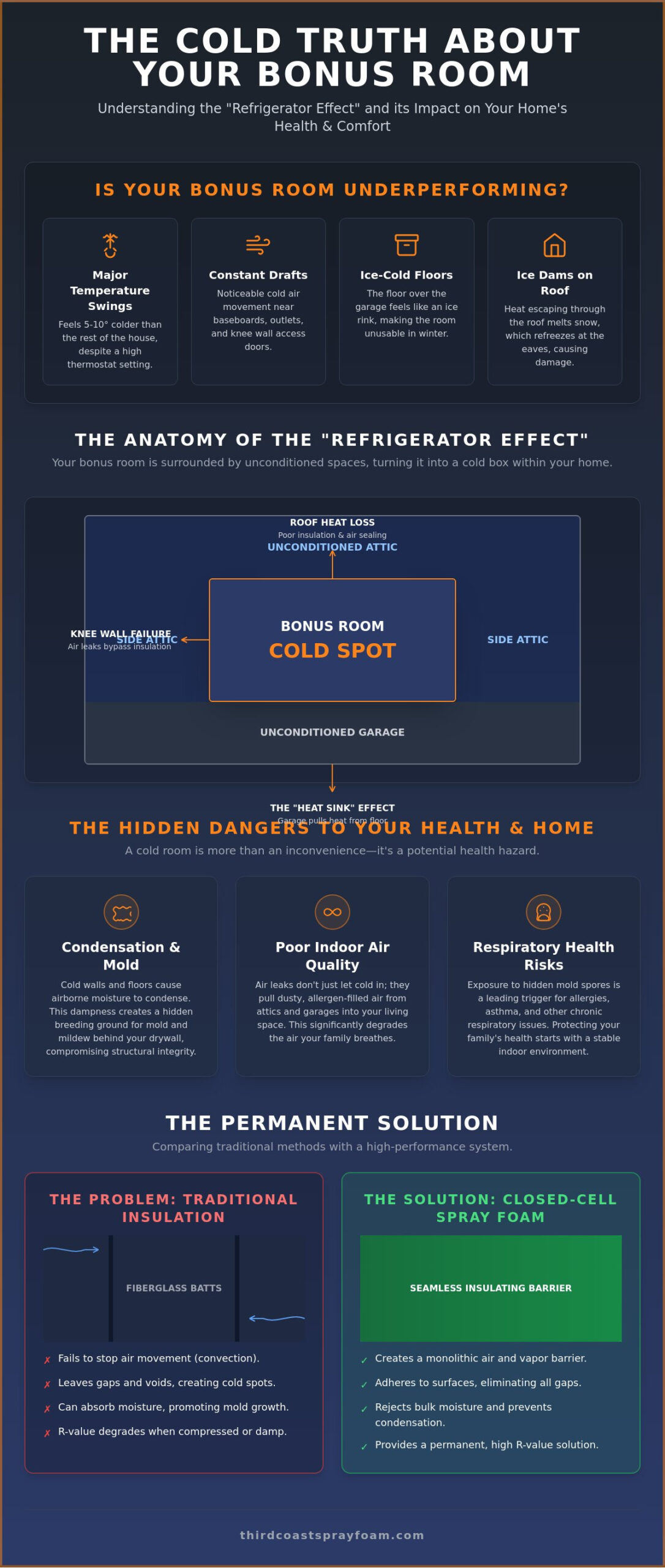
In a typical bedroom, most walls are shared with other heated rooms. A bonus room is different. It’s often surrounded by unconditioned attic space and a freezing garage. This creates a “refrigerator effect” where cold air encases the living space. Traditional materials like fiberglass batts often fail here because they don’t stop air movement. Even Cellulose insulation, while effective in standard attics, can struggle if the air barrier isn’t perfectly sealed. Thermal bridging also plays a role; the wooden studs carry the Lake Michigan chill directly through the wall, bypassing the insulation entirely. This constant cold causes moisture to condense on interior surfaces. This is a major concern for indoor air quality, as hidden mold behind knee walls can trigger respiratory health problems for your family.
Signs Your Bonus Room Is Failing
How do you know if your space is suffering from these structural failures? Look for these specific indicators:
- Temperature Imbalance: A difference of 5 to 10 degrees compared to your main floor.
- Drafty Perimeters: Noticeable air movement felt near baseboards, knee wall doors, or electrical outlets.
- Roofing Issues: Ice dams forming on the specific roof sections directly above the bonus room.
- Cold Floors: Walking across the room feels like stepping on an ice rink, even with carpet.
Identifying these signs early is the first step toward reclaiming your home’s comfort. Addressing these issues doesn’t just lower your energy bills; it protects your home’s structural integrity and ensures a healthy, mold-free environment for your loved ones.
The Hidden Culprit: Knee Wall and Air Sealing Failures
While the garage floor is a significant factor, the vertical knee walls are often the primary reason why is my bonus room so cold in winter. Knee walls are the short, upright walls typically found in finished attics that separate your living space from the unfinished, unconditioned “side attics” behind them. In many West Michigan homes, these walls were historically treated like interior partitions when they should have been treated like exterior walls. Because they sit directly against the freezing attic, any failure in their insulation or air seal allows the cold to migrate directly into your home. The 2021 Michigan Energy Code now mandates that these knee walls be sealed to create a continuous air barrier, acknowledging a critical structural detail that many older homes in Muskegon and Grand Rapids are missing.
Why Traditional Insulation Fails Knee Walls
Most builders traditionally used fiberglass batts to insulate these areas. Unfortunately, fiberglass is porous. It acts more like a filter for air than a barrier against it. We often see a phenomenon called “windwashing,” where cold attic air blows right through the batts, stripping away their thermal value before it ever reaches your drywall. Over time, gravity takes its toll as well. Without a rigid backing, these heavy batts begin to sag and pull away from the wooden studs. This creates large gaps where the “chimney effect” takes over. Warm air from your bonus room escapes through the top of the wall, while cold air is sucked in through the bottom. This constant air exchange doesn’t just make the room drafty; it brings in dust and outdoor pollutants that can compromise your indoor air quality and irritate those with sensitive respiratory systems.
The Importance of a Continuous Thermal Boundary
A truly comfortable bonus room requires a continuous thermal boundary where the insulation is in direct contact with a permanent air barrier. One of the most overlooked areas is the floor joist cavity directly beneath the knee wall. If these cavities aren’t “blocked” with a solid material, cold attic air flows freely under your floorboards, making the carpet feel like ice. This temperature drop also creates a health risk. When warm, humid indoor air meets these freezing wall surfaces, condensation forms. This hidden moisture behind your drywall is a leading cause of mold and mildew growth, which can lead to serious respiratory health issues for your family.
To fix this, we recommend moving toward a high-performance solution. Utilizing closed cell spray foam creates a seamless, airtight seal that fiberglass simply cannot match. It stays in place forever, provides its own air barrier, and prevents the moisture buildup that threatens your home’s safety. If you’re tired of wearing a coat in your own house, a professional air sealing assessment is the most reliable way to identify these hidden gaps and restore your home’s structural integrity.
The Cold Floor Problem: Insulation Over the Garage
When you walk into your bonus room and feel an immediate chill through your socks, you’re experiencing the “heat sink” effect of your garage. In West Michigan, an unconditioned garage can reach near-freezing temperatures, effectively acting as a massive block of ice sitting directly beneath your living space. If you’ve been wondering why is my bonus room so cold in winter, the answer often lies in the structural void between the garage ceiling and your floorboards. Many homeowners attempt to solve this by insulating their garage door, but this rarely fixes the room above. A warm garage door doesn’t stop the thermal transfer happening through the floor joists.
The most common failure we see is the “air gap” issue. Most builders install fiberglass batts between the floor joists above the garage. Over time, these heavy batts naturally sag away from the subfloor. This creates a pocket of dead air that quickly fills with freezing drafts. For insulation to work effectively, it must maintain “contact insulation” with the surface it’s protecting. When that bond is broken, the R-value of the material drops significantly, leaving your floor vulnerable to the frigid temperatures below. This temperature imbalance doesn’t just cause cold feet; it creates a prime environment for condensation. When warm indoor air meets the freezing floor surface, moisture can accumulate, leading to hidden mold growth that threatens your family’s respiratory health.
Rim Joists: The Gateway for Cold Air
The rim joist is the perimeter of your floor system, where the floor joists meet the exterior wall of the house. In coastal areas like Muskegon, winter winds hit the side of your home and push directly through the tiny cracks in your siding and rim joist. This creates a direct path for winter air to enter the floor system. Standard batts are powerless against this air pressure. We find that professional rim joist insulation is the only way to stop these drafts at the source. By creating an airtight seal at the perimeter, we prevent the “windwashing” that strips heat from your floor before it ever has a chance to reach the room.
Closing the Gap Between Floor and Ceiling
To achieve a truly warm floor, you must eliminate the air gap entirely. While blown in insulation can be a secondary option for certain attic floor scenarios, it often lacks the adhesive properties needed for a garage ceiling. Closed cell spray foam is the gold standard here because it expands to fill every nook and cranny, adhering directly to the subfloor. This eliminates the air gap, stops the drafts from the rim joists, and provides a permanent thermal break. Beyond comfort, this airtight seal prevents garage fumes and outdoor pollutants from migrating into your living space, significantly improving your indoor air quality and protecting your long-term health.
How a Cold Bonus Room Affects Your Health and Air Quality
Comfort is usually the first concern for homeowners, but the health of your family is the most critical reason to address your home’s thermal envelope. When you ask why is my bonus room so cold in winter, you’re also asking why your home’s surfaces are susceptible to moisture. Cold walls and floors aren’t just uncomfortable; they’re magnets for condensation. This occurs when warm, humid indoor air reaches its “dew point” against a freezing surface. In a bonus room, the high number of exterior-facing surfaces increases this risk significantly compared to a standard bedroom.
Hidden moisture behind knee walls or under floorboards is the primary catalyst for mold and mildew growth. These fungi release microscopic spores that degrade your indoor air quality (IAQ) and can lead to persistent respiratory health issues. For family members with asthma or seasonal allergies, these invisible triggers can cause year-round distress. Beyond mold, a poorly sealed bonus room floor acts as a gateway for “garage fumes.” If the air barrier between your garage and living space is compromised, carbon monoxide, gasoline vapors, and lawn chemicals can seep into your home. This is a serious environmental safety risk that goes far beyond a simple draft.
Condensation: The Silent Threat
You might notice “ghosting,” which appears as dark streaks or spots on your walls or ceilings. This isn’t just dirt; it’s often a sign that moisture is trapping dust and soot against cold studs or joists. Effective moisture management requires a holistic approach. Just as crawl space insulation protects your home’s foundation from dampness, high-performance insulation in your bonus room prevents the temperature spikes that cause condensation. By keeping wall temperatures above the dew point, we eliminate the water source that mold needs to survive.
Respiratory Health and Environmental Safety
A well-sealed home does more than lower energy bills; it acts as a health-protective barrier. Leaky attic bypasses and gaps in knee walls allow attic dust, insulation fibers, and outdoor allergens to circulate through your living areas. We treat the building envelope as an integrated system designed to safeguard your respiratory health. When we provide professional air sealing, we’re not just stopping the cold; we’re ensuring that the air you breathe is clean and free of environmental triggers. Schedule a health-focused home assessment today to ensure your bonus room is a safe environment for your loved ones.
The Solution: High-Performance Insulation for West Michigan
Solving the mystery of why is my bonus room so cold in winter requires moving beyond guesswork. We begin every project with a professional assessment that utilizes blower door tests and infrared cameras. This technology allows us to see exactly where the Lake Michigan wind is infiltrating your home’s thermal envelope. By identifying these specific failure points, we can develop a plan that addresses the root cause of your discomfort rather than just treating the symptoms. We view your home as a holistic system, ensuring that every gap in your knee walls and floor joists is permanently sealed to restore your home’s structural integrity.
Closed cell spray foam is the gold standard for bonus rooms in Muskegon and Grand Rapids. It provides a superior R-value and creates an airtight seal in one single application. This is vital for West Michigan homes where traditional materials often sag and fail. By sealing the building envelope, you can potentially recover your investment through energy savings; some insulation upgrades provide up to a 117% return on investment. Additionally, you can utilize the federal energy efficient home improvement credit, which offers a 30% credit up to $1,200 for insulation upgrades through 2032. This helps offset the cost of securing your home’s long term health and efficiency.
Why Spray Foam Wins for Bonus Rooms
Space is often limited in bonus room construction. Closed cell spray foam offers the highest R-value per inch, making it the perfect fit for tight 2×6 or 2×8 rafters where other materials fall short. It creates a permanent air seal that won’t degrade or settle over time. Most importantly, its moisture-resistant properties act as a powerful deterrent against mold and mildew growth. By keeping wall cavities dry and eliminating condensation, you’re making a pragmatic investment in your family’s respiratory health and ensuring superior indoor air quality for years to come.
Your 2026 Action Plan for a Warmer Room
Reclaiming your living space doesn’t have to be a complicated process. Follow this steady, logical path to a warmer home:
- Step 1: Schedule a professional insulation audit to identify exactly why is my bonus room so cold in winter.
- Step 2: Focus on air sealing the attic bypasses and knee walls to stop the “chimney effect” from stealing your heat.
- Step 3: Insulate the garage ceiling with high-performance closed cell spray foam to eliminate the “air gap” and warm your floors.
Ready to fix your cold bonus room? Contact Third Coast Spray Foam for a West Michigan estimate. We’re committed to providing the durable, honest solutions our neighbors deserve.
Reclaim Your Home’s Comfort and Safety
Understanding why is my bonus room so cold in winter is the first step toward a more efficient and healthy living space. We’ve explored how structural gaps in knee walls and the “refrigerator effect” from your garage create a systemic failure that traditional insulation can’t fix. By prioritizing a continuous air barrier and high-performance closed cell spray foam, you can eliminate icy floors and drafty corners once and for all. This proactive approach doesn’t just lower your monthly energy bills; it safeguards your family’s respiratory health by preventing the moisture buildup and mold growth that thrive in poorly sealed spaces.
Since 2013, our team has provided West Michigan homeowners with specialized expertise in high-performance insulation solutions. We take a health-first approach to every project, ensuring your indoor air quality remains a top priority. You don’t have to settle for a room that’s unusable half the year. When you’re ready to transform your bonus room into a warm, inviting part of your home, we’re here to help. Get Your Free Bonus Room Insulation Estimate and take the first step toward a more comfortable future. We look forward to helping you secure your home’s long term well-being and structural integrity.
Frequently Asked Questions
Is it normal for a bonus room to be 10 degrees colder than the rest of the house?
While many homeowners experience this temperature gap, it isn’t normal for a structurally sound home. A 10 degree difference indicates a failure in your thermal envelope and air barrier. These temperature swings often lead to condensation on cold walls, which can trigger mold growth and impact your family’s respiratory health. A properly insulated bonus room should maintain a consistent temperature with the rest of your living space.
Can I just add more fiberglass insulation to my bonus room attic?
Adding more fiberglass rarely solves the problem because fiberglass is a porous material that doesn’t stop air movement. Cold air simply blows through the batts in a process called windwashing. This strips away the thermal value of the material. Additionally, fiberglass can trap dust and outdoor allergens. These particles often circulate back into your living area, which can irritate those with sensitive respiratory systems or asthma.
How does garage insulation affect the room above it?
The garage acts as a massive heat sink that pulls warmth directly through your floorboards. If the garage ceiling isn’t properly sealed and insulated, your bonus room floor will stay freezing regardless of how high you turn up the furnace. Beyond comfort, a poor seal allows carbon monoxide and chemical vapors from the garage to migrate upward. This creates a significant environmental safety risk for anyone using the room above.
Will insulating my bonus room really lower my energy bills in Michigan?
Yes, professional insulation and air sealing provide a permanent reduction in your monthly utility costs. Research shows that air leakage can account for nearly 30% of a home’s heating and cooling expenses. In our West Michigan climate, securing the thermal boundaries of your bonus room prevents your furnace from running constantly to compensate for heat loss. This investment typically pays for itself through long term energy savings and increased home value.
Can poor insulation in my bonus room cause mold growth?
Poor insulation is a leading cause of hidden mold growth behind knee walls and under floors. When warm, humid indoor air meets a freezing, poorly insulated surface, it reaches its dew point and turns into liquid water. This moisture is the primary fuel for mold and mildew. These fungi release spores into your indoor air, which can cause persistent coughing, wheezing, and other serious respiratory health implications for your family.
What is the best type of insulation for a room over a garage?
Closed cell spray foam is the gold standard for solving the question of why is my bonus room so cold in winter. It provides the highest R-value per inch and creates a seamless air seal that traditional materials cannot match. This high performance solution adheres directly to the subfloor and rafters, preventing the sagging and air gaps that cause drafts. It also acts as a moisture barrier to protect your indoor air quality.
How long does it take to professionally insulate a bonus room?
Most professional insulation projects for a standard bonus room are completed within one to two days. This timeline includes the preparation of the space, the application of the spray foam, and a thorough cleanup. Because we focus on a precise and efficient process, we minimize the disruption to your daily routine. Once the application is finished, you will notice an immediate and permanent improvement in both the temperature and the air quality of the room.
Do I need to remove my old insulation before installing spray foam?
We typically recommend professional insulation removal before installing new spray foam. Removing old fiberglass or blown in insulation allows the new foam to adhere directly to the wooden substrate for a perfect airtight seal. It also removes years of trapped dust, rodent waste, and allergens that may be lingering in your attic. This step is essential for creating a clean, healthy environment and ensuring the highest standards of respiratory health for your household.
Disclaimer
Information provided is for general educational purposes. Individual needs and circumstances vary. Speak to an experienced professional to get the correct information for your situation.