
Imagine sitting in your West Michigan living room as a lake-effect blizzard howls outside, yet you still feel a sharp, cold draft cutting through your socks. For many local families, this chill is often accompanied by a faint, musty odor drifting up from the crawl space. You’re likely tired of watching your Consumers Energy or DTE bills climb while your home remains uncomfortable and potentially triggers respiratory issues. We understand that your house is an integrated system, and when it leaks air, it’s not just heat you’re losing; it’s your family’s well-being.
Professional air sealing with spray foam Michigan residents trust is the most effective way to lock out moisture and allergens while slashing energy waste. This guide explains how to secure your home’s envelope to improve indoor air quality and prevent mold growth. You’ll also discover the latest 2026 Michigan state rebates available to help make this permanent health and efficiency upgrade a reality for your household.
Key Takeaways
- Learn how a properly sealed home envelope prevents moisture-driven mold growth and directly protects your family’s respiratory health.
- Understand why professional air sealing with spray foam Michigan homes is the only permanent solution to stop the “stack effect” from pulling cold, musty air into your living space.
- Compare the superior R-values of closed cell spray foam against traditional materials to see how it effectively seals hidden leaks in rim joists and wall cavities.
- Discover why professional insulation removal is necessary to eliminate old contaminants and how to leverage 2026 Michigan state energy rebates for your project.
The Science of Air Sealing: Why Michigan Homes Leak
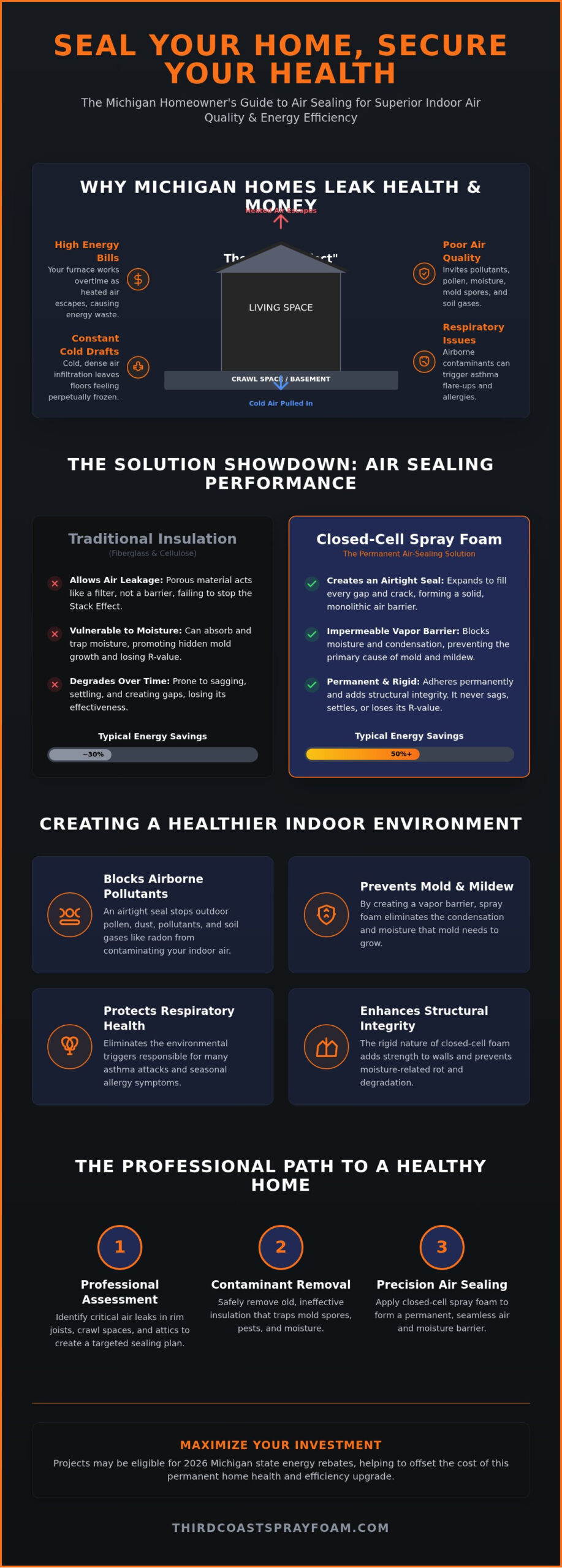
Air sealing is the technical process of identifying and closing the small gaps, cracks, and penetrations that allow expensive, conditioned air to escape while letting unconditioned outside air in. In our region, air sealing with spray foam Michigan homes is essential because our structures don’t just sit still; they act like giant chimneys. This phenomenon, known as the Stack Effect, is particularly aggressive during West Michigan’s lake-effect winters. Cold, dense air is drawn into the lower levels of your home through rim joists and crawl spaces, which then forces the lighter, heated air you’ve paid for out through the attic. This constant cycle of air exchange makes your furnace work overtime and leaves your floors feeling perpetually frozen.
To better understand this concept, watch this helpful video:
Traditional insulation like fiberglass often fails to stop this cycle. Because fiberglass is porous, it acts more like a filter than a solid barrier, allowing moisture and microscopic allergens to pass right through while only slowing down heat transfer. In contrast, Spray Foam provides a seamless, airtight seal that physically blocks the movement of air and the contaminants it carries. It fills every nook and cranny that traditional batts simply can’t reach, creating a permanent shield against the elements.
Indoor Air Quality and Your Respiratory Health
When your home leaks air, it also invites outdoor pollutants, seasonal pollen, and even soil gases like radon into your living spaces. These leaks create a direct path for lake-effect humidity to enter, which often leads to hidden condensation within your wall cavities or attic. This moisture is the primary fuel for mold and mildew growth, which can silently degrade your home’s structural integrity. By creating a truly airtight envelope, you effectively eliminate the environmental triggers that frequently cause asthma flare-ups and seasonal allergies for Michigan families.
Spray Foam vs. Traditional Materials for Air Sealing
Most West Michigan homes currently rely on fiberglass batts or blown-in cellulose for protection. While these materials provide some thermal resistance, they lack the physical density required to stop air movement. Closed cell spray foam offers a much higher R-value per inch than fiberglass, allowing for superior performance in tight spaces. Data shows that spray foam can lead to energy savings of 50% or more, while other insulation types typically offer around 30%. This efficiency is a result of the material’s ability to stop heat transfer and air leaks simultaneously.
The defining characteristic of air sealing with spray foam Michigan homeowners value most is its expansion property. Upon application, the foam expands rapidly to fill “hidden” leaks in wall cavities and rim joists that are impossible to reach with traditional batts. Unlike fiberglass, which often sags or pulls away from the frame, spray foam is a permanent investment. It won’t sag. It does not settle or lose its air-sealing properties over time, ensuring your home remains protected against drafts and outdoor pollutants for decades.
Critical Sealing Points: Rim Joists and Crawl Spaces
The rim joist is the primary source of air infiltration in Michigan basements. This area is where the wooden structure of your home meets the concrete foundation, often leaving gaps that invite lake-effect moisture inside. We utilize closed cell spray foam in these moisture-prone zones because it creates an impermeable vapor barrier. This prevents the condensation that fuels mold growth and degrades your indoor air quality.
Pairing this with professional crawl space insulation creates a comprehensive defense against respiratory irritants. By sealing off the foundation, you stop musty smells and soil gases from entering your living space. If you’re concerned about your home’s efficiency, our experts can help you identify critical air leaks during a professional assessment.
The Professional Path to a Healthy, Efficient Home
Achieving a truly healthy home requires more than just adding new material. It starts with professional insulation removal. Old fiberglass often acts as a sponge for lake-effect moisture, trapping mold spores and pest contaminants that compromise your family’s respiratory health. By clearing these pollutants, we ensure a clean, sterile surface for the foam to bond. This is a critical step that DIY kits often overlook, as they simply mask existing issues rather than resolving them.
Our installation process prioritizes safety and precision through calibrated application. We use specialized equipment to maintain the correct chemical balance and temperature, ensuring the foam cures properly without lingering odors. Proper ventilation is maintained throughout the project to protect your indoor air quality. This professional approach to air sealing with spray foam Michigan ensures the material performs as a permanent, airtight shield that stands up to our regional climate.
Navigating financial incentives is also part of our advisory role. Although the federal tax landscape changed recently, you can still leverage your knowledge of the energy efficient home improvement credit to navigate the 2026 Michigan Home Energy Rebates (MiHER). These state-level programs, alongside utility rebates from DTE and Consumers Energy, provide significant point-of-sale discounts that make high-performance upgrades more accessible for local families.
Choosing a Local West Michigan Specialist
Local expertise is vital because Michigan building codes, specifically the 2021 IECC, require precise R-values for basements and attics. We understand how our unique climate affects structural integrity in cities like Grand Rapids, Muskegon, and Holland. When you invest in the air sealing with spray foam Michigan specialists provide, you’re choosing a partner who prioritizes IAQ and respiratory health outcomes. This ensures your project is a long-term investment in your family’s security and physical well-being.
Secure Your Family’s Health and Home Comfort
Your house functions as a single, integrated system where every air leak impacts your indoor air quality. By stopping the stack effect and sealing out lake-effect moisture, you’re doing more than just lowering utility costs. You’re creating a secure, stable environment that actively protects your family’s respiratory health from mold and allergens. Professional air sealing with spray foam Michigan homeowners trust provides a permanent barrier that won’t sag or lose efficiency as the years pass.
Since 2013, our team has specialized in solving Michigan-specific condensation issues with a focus on long-term safety. We prioritize your well-being by including the professional removal of contaminated insulation to ensure a clean, healthy start for every project. Take the first step toward a draft-free, resilient home today.
Get Your Free Health-First Air Sealing Estimate in West Michigan
Frequently Asked Questions
Does air sealing with spray foam cause indoor air to become “too tight” or stale?
Air sealing with spray foam Michigan homes doesn’t make a house “too tight” in a negative way, but it does change how the building handles air exchange. While stopping uncontrolled leaks is vital for efficiency, we recommend balanced mechanical ventilation to ensure a constant supply of fresh air. This strategy provides a draft-free environment and superior indoor air quality for your family’s respiratory health.
How long does the off-gassing process take after spray foam installation?
The off-gassing process is typically complete within 24 hours when the material is applied by a professional using calibrated equipment. We prioritize your safety by ensuring proper ventilation during the curing phase. Once the foam has fully reacted and cured, it becomes an inert, stable material that doesn’t release vapors into your living space, making it a secure choice for long-term health.
Can air sealing with spray foam prevent mold growth in my attic or basement?
Yes, air sealing with spray foam Michigan properties is a primary defense against mold and mildew. By creating a seamless vapor barrier in areas like rim joists and attics, the foam stops warm, moist air from hitting cold surfaces and condensing. This elimination of moisture prevents the environmental triggers that lead to fungal growth, protecting your home’s structure and your family’s respiratory wellness.
Is spray foam air sealing worth the investment for older Michigan homes?
Older Michigan homes often benefit the most from this investment because they typically have the highest rates of air leakage. Many of these structures were built before modern energy codes and suffer from chronic drafts and high utility bills. Professional air sealing addresses these legacy issues permanently, providing a level of comfort and energy efficiency that traditional fiberglass batts simply cannot match for historic properties.
Disclaimer
Information provided is for general educational purposes. Individual needs and circumstances vary. Speak to an experienced professional to get the correct information for your situation.