
Did you know that your home’s foundation might be acting like a giant vacuum, pulling in frigid air and allergens directly from the Michigan soil? It’s incredibly frustrating to deal with ice-cold floors on the first story or a musty basement smell that seems to permeate every room. These issues are often rooted in the rim joist, a critical area where the house meets the foundation. Implementing professional rim joist spray foam insulation is the most effective way to seal these gaps, stopping the 15 to 25 percent of basement heat loss common in older regional homes.
By upgrading your home’s thermal envelope, you can finally eliminate stubborn drafts, slash your winter heating bills, and protect your family from mold-related respiratory issues. We’ll show you how this specialized air-sealing solution transforms your home’s efficiency and why it’s a permanent upgrade for your long-term well-being. From understanding the technical benefits of closed-cell foam to navigating the latest energy tax credits, this guide provides the clarity you need to secure a healthier, more comfortable living space.
Key Takeaways
- Identify the rim joist as a primary source of air leakage and learn how sealing this critical foundation area stops drafts at their source.
- Understand why professional rim joist spray foam insulation outperforms fiberglass batts by creating a permanent air and moisture barrier.
- Discover how proper insulation prevents mold growth and musty odors, significantly improving your family’s indoor air quality and respiratory health.
- Learn the technical importance of sealing the sill plate and preparing the wood surface to ensure long-term structural integrity and energy efficiency.
What is a Rim Joist and Why Does It Need Spray Foam?
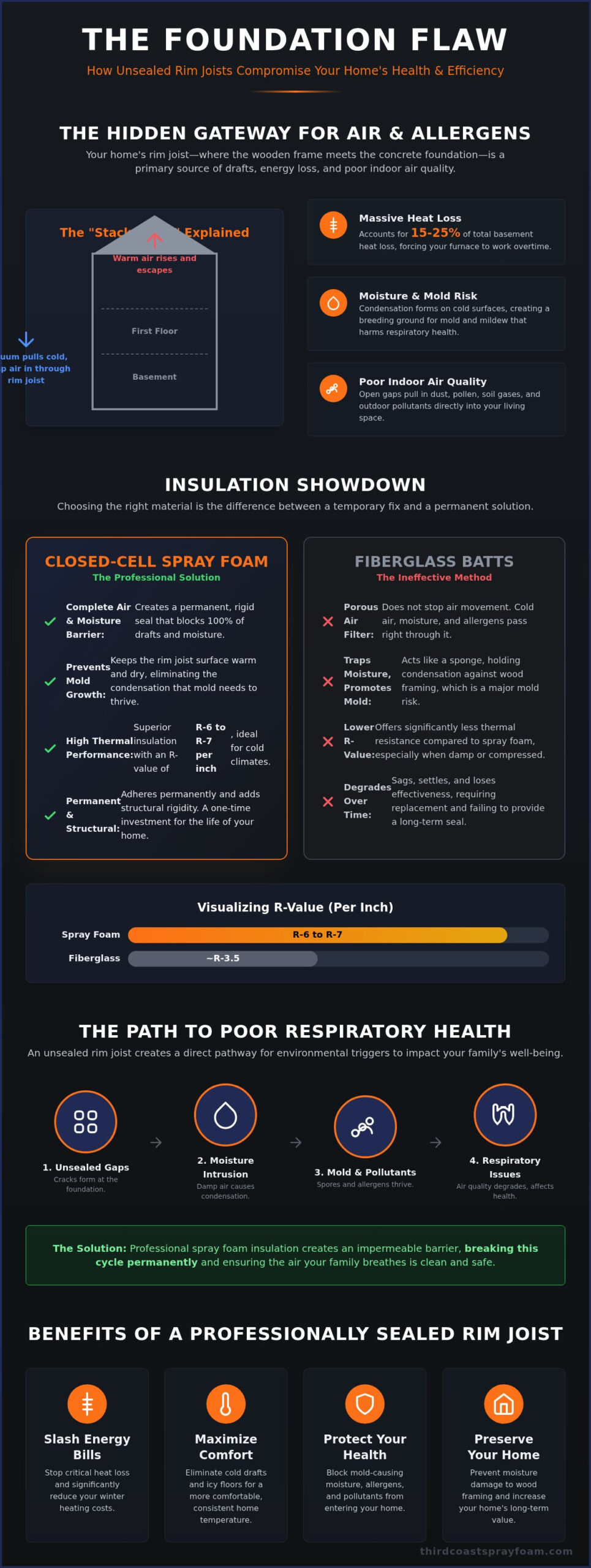
The rim joist is the perimeter board that rests directly on your foundation wall, supporting the floor joists of your home’s first story. In the volatile West Michigan climate, this specific area is often the largest contributor to energy loss and discomfort. Because wood and concrete expand and contract at different rates, gaps inevitably form where these materials meet. These openings allow outside air to bypass your home’s defenses. The ‘stack effect’ is a physical process where warm air rising through your attic creates a vacuum, pulling cold, damp air inward through these unsealed basement gaps. This cycle forces your furnace to work overtime while leaving you with uncomfortably cold floors.
Standard materials like fiberglass batts are porous and cannot stop air movement. Professional rim joist spray foam insulation is the only material that provides a high R-value while simultaneously creating a permanent, airtight seal. If you’re curious about the technical properties of this material, you can explore What is Spray Foam? to see how it expands into every hairline crack. This expansion ensures a custom fit that no other product can replicate. It’s a reliable, long-term solution for structural integrity and thermal performance.
The Critical Link Between Rim Joists and Respiratory Health
Unsealed rim joists act as an open door for outdoor allergens, particulates, and soil gases to enter your living environment. During a typical Michigan winter, the temperature difference between the cold exterior and your warm basement causes condensation to form on the wood. This moisture creates a breeding ground for hidden mold growth. Applying rim joist spray foam insulation stops this moisture cycle by keeping the wood surface warm and dry. By integrating crawl space insulation with rim joist sealing, we create a unified barrier that protects your indoor air quality. This holistic approach doesn’t just save money; it ensures the air your family breathes is filtered and safe.
Closed Cell Spray Foam vs. Fiberglass: Choosing the Right Barrier
Choosing the right material for your home’s foundation determines whether you’re making a temporary fix or a permanent investment. Traditional fiberglass batts are often marketed as a budget option, but they fail fundamentally at the rim joist. Fiberglass is porous; it acts as a filter for dust rather than a barrier for air. In contrast, closed cell spray foam offers a superior R-value of R-6 to R-7 per inch. This density is critical for Michigan’s Climate Zone 5A, where temperatures frequently drop below 10°F. According to the Building Science Corporation’s spray foam guide, closed-cell foam is uniquely suited for cold climates because it provides an integrated vapor retarder.
Our team explicitly refuses to use fiberglass for rim joists. We believe in providing solutions that last for the life of the structure. While fiberglass allows humid summer air to pass through, rim joist spray foam insulation remains impermeable. This prevents the wood from absorbing moisture during our humid West Michigan summers. If you’re ready to upgrade to a high-performance barrier, our specialists can evaluate your rim joist needs today. We focus on results that protect both your wallet and your home’s structural integrity.
Why Fiberglass Batts Pose a Mold Risk in Your Foundation
When warm, moist indoor air hits a cold rim joist insulated with fiberglass, condensation forms instantly. The fiberglass then traps this water against the wood framing. This creates a dark, damp environment where mold spores thrive. Because the rim joist is often hidden behind finished ceilings or storage, this growth can go undetected for years. Using an impermeable material like spray foam eliminates this risk entirely. It keeps the rim joist surface temperature above the dew point. This ensures your basement remains dry and your family’s respiratory health is protected from hidden allergens.
The Professional Installation Process in West Michigan
Professional installation begins with rigorous surface preparation. We don’t just spray. Our team ensures the wood framing is clean and free of debris to guarantee maximum foam adhesion. This is especially vital at the sill plate where the wood structure meets the concrete foundation. A precise seal here is what prevents stubborn drafts from entering homes in Grand Rapids, Muskegon, and Holland. Our technicians use professional-grade equipment to apply rim joist spray foam insulation with surgical accuracy, filling every hairline crack that a DIY kit would miss. We also take extensive precautions to protect your home’s interior, using heavy-duty drop cloths and active ventilation to ensure your basement remains pristine throughout the application.
What to Expect During Your Third Coast Installation
Our installation process is designed for your family’s peace of mind and long-term security. It starts with a comprehensive health-focused assessment. We identify existing moisture patterns or hidden air leaks before any material is applied. Once the rim joist spray foam insulation is in place, the material enters a brief curing phase. We manage this process according to strict safety protocols to ensure the environment is completely safe for you to occupy immediately after we depart. Every project concludes with a detailed final inspection to verify the continuous thermal barrier’s integrity. If you’re ready to secure your home’s foundation and improve your indoor air quality, you can get your free insulation estimate today. This simple step moves you closer to a warmer, more efficient home that stands up to West Michigan’s harshest winters.
Invest in a Healthier, More Efficient Michigan Home
Protecting your home from the ground up requires more than just standard insulation; it demands a permanent barrier against the elements. By choosing rim joist spray foam insulation, you eliminate the drafts caused by the stack effect and remove the moisture risks associated with outdated fiberglass batts. This proactive step ensures your basement remains dry and your indoor air stays clean for years to come. We bring a health-first approach and over a decade of experience to every foundation in Fruitport and the surrounding areas. Our team understands the unique challenges of West Michigan winters and provides the technical expertise needed for a lasting seal. Secure your home’s health with a professional rim joist assessment from Third Coast Spray Foam. You deserve a home that’s as comfortable as it is efficient.
Frequently Asked Questions
Is rim joist spray foam safe for my family’s respiratory health?
Yes, professional-grade spray foam is safe for your family once it has fully cured. By creating an airtight seal, it prevents outdoor allergens and soil gases from entering your living spaces. It also stops the condensation that leads to hidden mold growth. Our team uses specialized equipment to ensure the material is mixed and applied correctly, protecting your home’s air quality long-term.
Can I use a DIY spray foam kit for my rim joists?
We don’t recommend DIY kits for this critical application. Professional installation ensures the foam is applied at the correct temperature and thickness to achieve its rated R-value. DIY kits often lack the pressure needed for deep penetration into narrow foundation gaps. Our expert application ensures a permanent bond to the sill plate that temporary retail products simply cannot replicate.
How much does rim joist spray foam insulation typically cost in Michigan?
The investment for rim joist spray foam insulation depends on the total linear footage of your foundation and the complexity of the access points. While costs vary across different Michigan homes, the long-term energy savings often provide a return on investment within three to six years. We provide detailed assessments to give you an accurate picture of the investment required for your specific property.
Will spray foam on my rim joists really stop the musty smell in my basement?
Yes, sealing your rim joists is a primary step in eliminating basement odors. Those musty smells are usually the result of moisture reacting with organic materials like wood framing or old fiberglass. By installing rim joist spray foam insulation, you stop the moisture cycle and prevent mold growth. This creates a drier, fresher environment that improves the air quality of your entire house.
Does rim joist insulation qualify for the 2026 Energy Efficient Home Improvement Credit?
Yes, rim joist insulation qualifies for the 25C Energy Efficient Home Improvement Credit in 2026. Homeowners can receive a federal tax credit of 30 percent of the project cost, capped at $1,200 per year. This incentive makes it the perfect time to upgrade your home’s efficiency. You should consult with a tax professional to confirm your specific eligibility when filing Form 5695.
Disclaimer
Information provided is for general educational purposes. Individual needs and circumstances vary. Speak to an experienced professional to get the correct information for your situation.