Imagine walking into your barn on a freezing January morning only to find “indoor rain” dripping from the ceiling onto your expensive equipment. It’s a common frustration for many in West Michigan, where our humid summers and harsh winters create a constant battle against condensation. When you start researching the pole barn insulation cost Michigan contractors are quoting for 2026, it’s easy to focus solely on the bottom line. However, the true price of your insulation isn’t just the initial quote; it’s the long-term cost of managing moisture and protecting your indoor air quality.
We understand that you want a dry, temperature-controlled space that doesn’t harbor mold or threaten your family’s respiratory health. In this guide, we’ll break down the factors that influence pricing for 2026, including updated building codes and available agricultural tax incentives. You’ll learn why professional air sealing with closed-cell foam is a permanent investment that can yield a return of up to 117 percent. By the end, you’ll have a clear roadmap for creating a healthy, efficient environment that protects your lungs and your legacy.
Key Takeaways
- Learn how building dimensions and material selection determine the total pole barn insulation cost Michigan owners can expect for their 2026 projects.
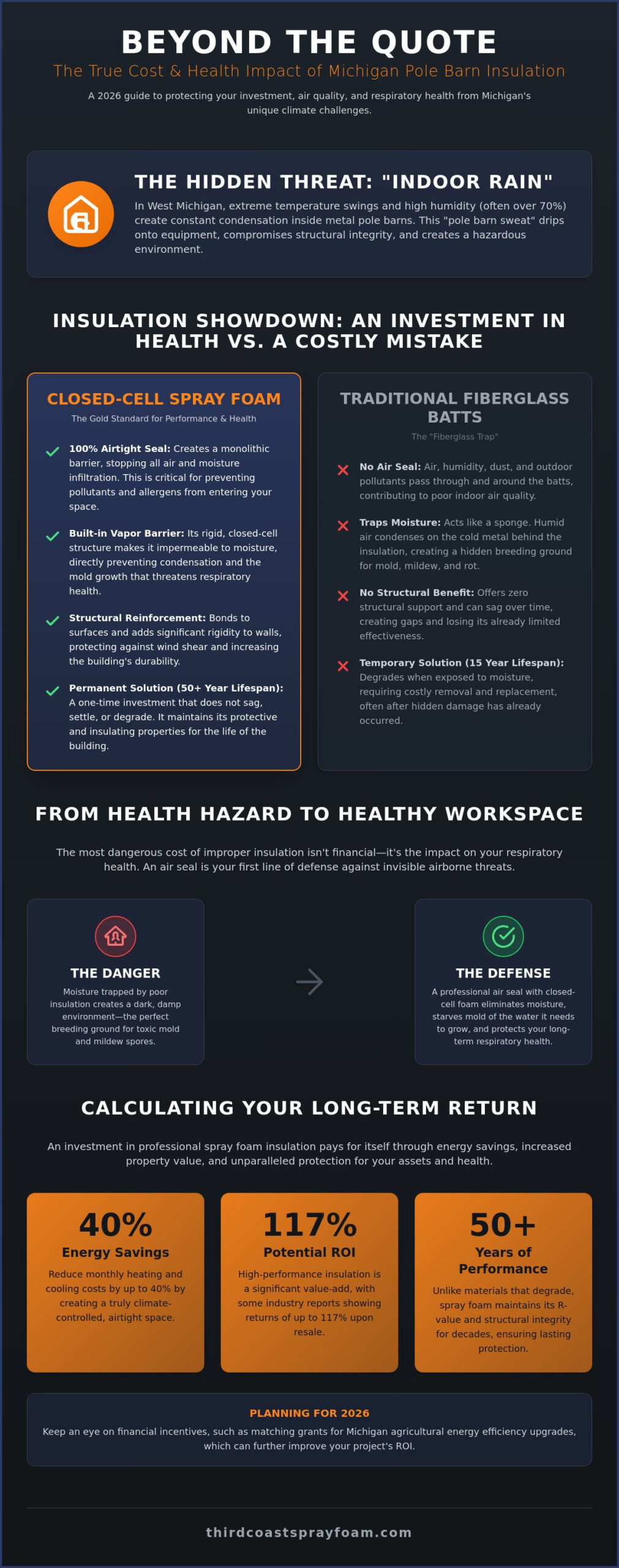
- Discover why closed-cell spray foam serves as a critical vapor barrier to prevent “indoor rain” and protect your building’s structural integrity.
- Understand the direct link between airtight insulation and your respiratory health by preventing the hidden mold growth common in poorly ventilated metal structures.
- Identify the 2026 landscape for financial incentives, including matching grants available for Michigan agricultural energy efficiency upgrades.
- Find out why a professional site evaluation is essential to ensure precise chemical ratios for optimal indoor air quality and long-term performance.
Factors Influencing Pole Barn Insulation Cost in Michigan
Calculating the pole barn insulation cost Michigan homeowners face involves balancing immediate expenses with long-term structural protection. While the total square footage of your walls and ceiling sets the baseline, the architectural complexity often dictates the final investment. High-pitched roofs, vaulted ceilings, or specialized interior framing require more precise application and specific safety equipment. These factors increase the labor time required to ensure every gap is sealed, which naturally impacts the total project price.
Material Choice: Why Closed-Cell Spray Foam is the Gold Standard
We focus on closed cell spray foam because it’s the only material that addresses the unique challenges of metal buildings. Unlike traditional Building insulation materials that rely solely on R-value, closed-cell foam provides significant structural reinforcement and a 100 percent air seal. R-value is a hollow metric if your building is still “breathing” humid air through every seam and fastener hole. Closed-cell spray foam is a rigid, high-density insulator that functions as a built-in vapor barrier to prevent moisture from ever reaching your metal panels. This dual-purpose performance is vital for maintaining healthy indoor air quality and preventing the respiratory irritants associated with mold growth.
Regional Climate Impact on Cost and Performance
In West Michigan, climate is the biggest driver of value and the overall pole barn insulation cost Michigan residents should plan for. Areas like Grand Haven and Muskegon experience Lake Michigan’s heavy moisture, where humidity often stays above 70 percent. This creates “pole barn sweat,” a condition where warm indoor air hits cold metal and rains down on your expensive equipment. If you find that moisture has already damaged an old vehicle beyond repair, click here to see how you can sell it for cash to help fund your barn upgrades. In Grand Rapids, harsh winters can lead to ice dams on metal roofs if there isn’t a sufficient thermal break between the heated interior and the exterior panels. Investing in a professional air seal prevents these issues, protecting your building’s longevity and your family’s respiratory health by keeping the environment dry and stable.
Comparing Insulation Methods: Upfront Price vs. Long-Term Health
When you evaluate the pole barn insulation cost Michigan contractors present, it’s tempting to choose the lowest upfront bid. However, traditional fiberglass batts often lead to what we call the “Fiberglass Trap.” These materials don’t create an air seal. In Michigan’s humid environment, moisture seeps behind the batts and condenses against the cold metal walls. This leads to hidden structural rot and a lifespan of only 15 years. In contrast, professional spray foam provides a permanent solution that lasts 50 years or more by bonding directly to the structure.
The Hidden Health Costs of Improper Insulation
The danger of improper insulation isn’t just to your building; it’s to your lungs. Trapped moisture creates a perfect breeding ground for mold and mildew. When you’re working in your barn, you’re breathing in those spores. This can lead to chronic respiratory irritation and poor indoor air quality, especially in enclosed workshops. For those concerned about safety and efficiency, the Michigan Weatherization Assistance Program provides excellent resources on how state standards prioritize healthy indoor environments. A professional air seal is your best defense against these silent pollutants and common allergens.
Calculating ROI: Energy Savings and Resale Value
Investing in high-quality pole barn insulation transforms your building from a simple shell into a climate-controlled asset. Some industry professionals report that professional air sealing can reduce monthly heating and cooling costs by up to 40 percent. This creates a dry, stable environment perfect for vehicle storage or a home workshop. Beyond monthly savings, the long-term value is found in the building’s durability:
- Longevity: Spray foam maintains its R-value for 50+ years without sagging or settling.
- Structural Protection: Closed-cell foam adds rigidity to the walls, protecting against wind shear.
- Dust Control: An airtight envelope prevents outdoor pollutants and dust from entering your workspace.
If you want to see how these benefits apply to your specific project, you can request a custom site evaluation from a local specialist who understands West Michigan’s unique climate challenges.
Investing in Your Michigan Barn: 2026 Credits and Next Steps
Moving forward with your project requires a strategic approach to both construction and financing. While the initial pole barn insulation cost Michigan owners encounter might seem high, 2026 offers specific financial advantages for agricultural structures. To protect your investment, start with a professional site evaluation. This step identifies existing moisture traps or structural weaknesses that could undermine your insulation’s performance. We look for signs of previous “indoor rain” and ensure the metal panels are clean for a permanent bond.
Once the structure is ready, your contractor must use precise chemical ratios during application. This isn’t just about the seal; it’s about the health and comfort of building occupants. Proper mixing prevents off-gassing and ensures the indoor air quality remains safe for long-term use. For those building out finished offices or workshops within their barn, finalizing a plan that includes crawl space insulation is essential for a fully controlled thermal envelope. You can also work with your tax professional to leverage the energy efficient home improvement credit alongside 2026 bonus depreciation rules for farm buildings.
Why Professional Installation is Non-Negotiable
Getting Your Free West Michigan Estimate
Our consultation process is straightforward and educational. We serve Kent, Ottawa, and Muskegon counties, bringing local expertise to every job site from Grand Rapids to Holland. During our visit, we’ll assess your specific environmental challenges and provide a transparent roadmap for your project. Protect your health and your building’s longevity by requesting a custom quote tailored to your West Michigan barn today.
Secure Your Building’s Future and Your Health
Protecting your property from the unpredictable West Michigan climate starts with choosing a high-performance moisture barrier. Understanding the pole barn insulation cost Michigan owners face in 2026 is about more than just numbers; it’s about the long-term security of your structural integrity and your respiratory health. By opting for a professional air seal, you’re preventing the “indoor rain” and mold growth that can compromise your building and your well-being.
Our team at Third Coast Spray Foam is locally owned in Fruitport. We specialize in creating airtight environments that withstand the unique humidity challenges of the lakeshore. We take pride in helping our neighbors build spaces that are dry, efficient, and safe for decades to come. Don’t leave your air quality to chance with inferior materials or DIY risks that can lead to inconsistent results and off-gassing.
Get Your Free Pole Barn Insulation Estimate Today and take the first step toward a healthier, more durable workspace. We look forward to helping you protect your investment with the precision and reliability your Michigan barn deserves.
Frequently Asked Questions
What is the best insulation for a pole barn to stop condensation?
Closed-cell spray foam is the most effective choice because it creates a continuous air and moisture barrier directly against the metal skin. In West Michigan’s humid climate, this prevents warm indoor air from touching cold metal panels, which is the primary cause of “indoor rain.” By keeping the structure dry, it also eliminates the moisture needed for mold growth, protecting your respiratory health and your building’s structural integrity.
How much does it cost to spray foam a 30×40 pole barn in Michigan?
The pole barn insulation cost Michigan residents pay for a 30×40 structure is primarily determined by the total square footage of the treated surfaces and the required thickness of the foam. For most metal buildings, we recommend a two-inch application of closed-cell foam on the walls to provide a true vapor barrier. Factors such as the height of the eaves and the presence of interior framing will also influence the final labor and material requirements for your specific project.
Is spray foam insulation safe for my respiratory health?
Professional spray foam insulation is safe and actually improves respiratory health by preventing the growth of mold and mildew. When our team in Fruitport installs foam using precise chemical ratios and proper ventilation, the material becomes inert and stable within hours. This airtight seal prevents outdoor allergens, dust, and moisture from entering your workspace, creating a much cleaner environment for anyone with sensitive lungs or asthma.
Does pole barn insulation qualify for the 2026 federal tax credit?
The federal Energy Efficient Home Improvement Credit (Section 25C) expired on December 31, 2025, and is not available for projects completed in 2026. However, agricultural owners can still leverage 100 percent bonus depreciation for farm buildings placed in service through the end of 2026. Additionally, the Michigan Department of Environment, Great Lakes, and Energy (EGLE) offers matching grants for energy efficiency projects in the agricultural sector that are completed by August 2027.
Disclaimer
Information provided is for general educational purposes. Individual needs and circumstances vary. Speak to an experienced professional to get the correct information for your situation.