
Last February, a homeowner in Muskegon watched their thermostat climb while their family’s allergies worsened, only to find that their traditional insulation was acting like a sponge for lakefront humidity. Most West Michigan residents accept drafty floors and musty smells as an unavoidable part of the winter season. However, understanding the debate of open vs closed cell foam is the first step toward reclaiming your home’s comfort. At Third Coast Spray Foam, we believe your insulation should do more than just block the wind; it should actively protect your indoor air quality.
You’ll learn how the right insulation choice impacts your energy efficiency and prevents the mold growth that triggers chronic respiratory issues. Since the EPA estimates that indoor air can be 2 to 5 times more polluted than outdoor air, sealing your thermal envelope is a matter of total home health. We’ll provide a clear comparison of R-values and moisture barriers to help you eliminate drafts and lower your monthly utility bills for the long term. This guide ensures you have the technical knowledge to create a dry, safe environment for your family.
Key Takeaways
-
Learn why the unique West Michigan climate requires a specific approach to air sealing to create a superior thermal envelope for your home.
-
Understand the critical technical differences between open vs closed cell foam and how each type impacts moisture control and structural integrity.
-
Discover how professional air sealing improves indoor air quality and protects your respiratory health by preventing mold and blocking outdoor pollutants.
-
Identify the best insulation choices for different structures, from residential attics to pole barns in Allegan and Holland.
-
Find out why professional installation is non-negotiable for achieving the correct chemical balance and ensuring long-term safety and efficiency.
Table of Contents
-
Open vs. Closed Cell Foam: Navigating West Michigan’s Unique Insulation Needs
-
Selecting the Right Foam for Your Project: From Attics to Pole Barns
-
Why Professional Installation is Non-Negotiable for Michigan Homeowners
Open vs. Closed Cell Foam: Navigating West Michigan’s Unique Insulation Needs
West Michigan homeowners face a climate that is notoriously difficult to manage. From the heavy snowfalls in Grand Rapids to the biting winds along the Muskegon shoreline, your home’s thermal envelope is under constant pressure. Traditional insulation materials like batt insulation or blown-in cellulose often fall short because they allow air to bypass the barrier. Spray foam insulation changes this dynamic by creating a custom-fit, airtight seal that eliminates drafts and significantly reduces energy waste. When comparing open vs closed cell foam, it is vital to understand how each material interacts with the specific environmental stressors found in our region.
Our team at Third Coast Spray Foam focuses on total home health rather than just filling wall cavities. We believe that professional-grade application is the only way to ensure safety and performance. DIY spray foam kits often result in improper mixing ratios, which can lead to lingering odors or compromised structural integrity. We utilize high-precision equipment to ensure the chemical reaction is perfect every time, providing you with a permanent solution that protects your family’s respiratory health and your long-term financial investment.
Understanding the ‘Third Coast’ Climate Challenge
In Ottawa, Muskegon, Allegan, and Kent counties, lake-effect humidity is a year-round concern. During the summer, relative humidity levels frequently exceed 70%, forcing moisture into your wall assemblies. If this moisture becomes trapped, it creates a breeding ground for mold and mildew. This is a significant health risk, as mold exposure is a primary trigger for asthma and other respiratory issues. Standard insulation often fails to prevent this moisture migration, leading to rot and poor indoor air quality. Furthermore, in Lansing or Kalamazoo and surrounding areas, freezing temperatures contribute to the formation of ice dams. These occurs when heat escapes through a poorly sealed attic, melting snow on the roof which then refreezes at the eaves. A precise application of open vs closed cell foam addresses these specific local problems by sealing the gaps where heat and moisture escape.
The Core Differences: Density and Structure
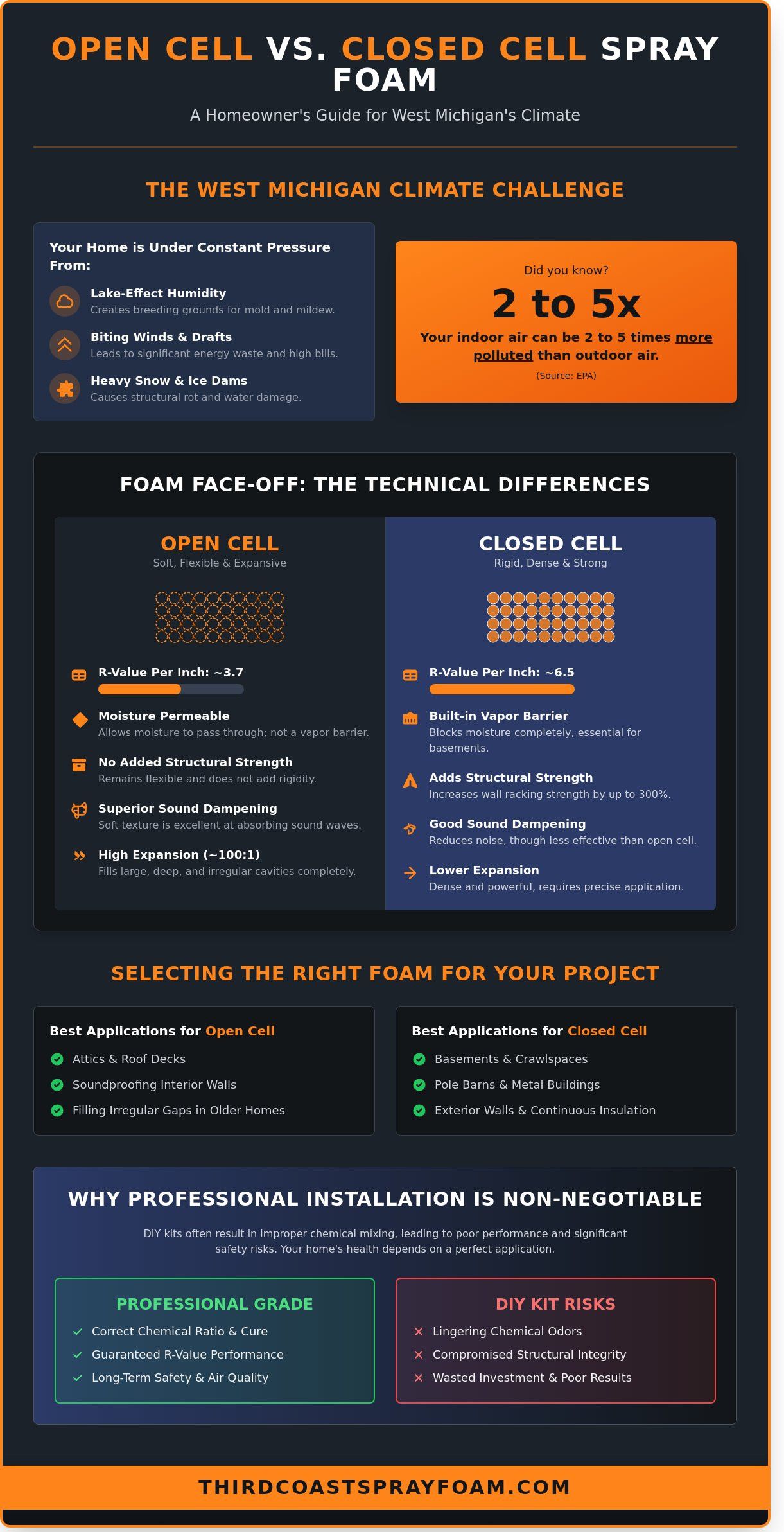
The term "cell" refers to the tiny bubbles that form the structure of the polyurethane foam. In open cell foam, these bubbles remain intentionally broken, creating a soft, flexible material that is excellent for sound dampening. In contrast, closed cell foam consists of completely encapsulated bubbles pressed tightly together. This density makes closed cell foam incredibly rigid. In fact, industry testing shows that closed cell foam can increase the racking strength of a wall by up to 300%, providing extra security for homes exposed to high winds.
-
Expansion: Open cell foam expands at a ratio of approximately 130 to 1, making it ideal for filling the deep, irregular gaps found in older Michigan farmhouses.
-
Moisture Control: Closed cell foam acts as a built-in vapor barrier, which is essential for below-grade applications like basements or crawlspaces.
-
Air Sealing: Both types provide a superior air seal compared to traditional materials, preventing outdoor pollutants and allergens from entering your living space.
Choosing the right density ensures that your home remains a dry, healthy environment. By sealing the building envelope effectively, we stop the cycle of moisture accumulation that threatens both your home’s structure and your family’s well-being.
The Technical and Health Differences Between Foam Types
Choosing between open vs closed cell foam involves more than comparing price points. It’s about understanding how the physical properties of these materials impact your family’s daily comfort and long-term respiratory health. At Third Coast Spray Foam, we evaluate insulation through the lens of "total home health." This means looking at R-value, density, and moisture permeability as a single system designed to protect your living environment. Proper air sealing is the first line of defense against poor indoor air quality (IAQ). By creating a continuous thermal envelope, we stop the 99% of air infiltration that carries outdoor pollutants into your bedrooms and living spaces.
Gaps in traditional insulation act as highways for respiratory triggers. Pollen, dust, and fine particulate matter from West Michigan’s changing seasons easily bypass fiberglass batts. Spray foam eliminates these pathways. Professional application is the only way to ensure the chemical reaction between the two-part liquid components completes safely. Our team monitors precise temperatures and pressures so the foam cures into a stable, inert barrier. This precision ensures your home remains free of the off-gassing or lingering odors associated with amateur installations.
Open Cell Foam: Flexibility and Sound Dampening
Open cell foam provides a typical R-value of 3.5 to 3.8 per inch. It’s a light, flexible material with a density of roughly 0.5 pounds per cubic foot. Its "sponge-like" cellular structure makes it an incredible asset for soundproofing between interior walls or theater rooms. It expands up to 130 times its initial liquid volume, sealing every crack to keep dust and allergens out of your ductwork. It becomes an air barrier at 3.5 inches. It does not block moisture or water vapor.
Closed Cell Foam: The Ultimate Moisture and Vapor Retarder
Closed cell foam is the heavyweight champion of the industry, boasting an R-value of 6.0 to 7.5 per inch. Because it’s so dense, it’s the perfect solution for maximizing energy efficiency in narrow 2×4 wall cavities. It does more than just insulate; it acts as a structural adhesive that "glues" a building together. Research indicates it can increase wall racking strength by 300%, which is vital for homes facing high wind speeds along the lakeshore. It’s the gold standard for Michigan walls, attics, crawl spaces and rim joists because it creates a total vapor barrier. This impermeable seal prevents the dampness and condensation that lead to toxic mold and mildew growth. If you want to protect your home’s foundation and your family’s health, sealing the envelope with closed cell is a permanent investment in peace of mind.
R-Value, Moisture Control, and Respiratory Health
R-value is the standard metric for insulation, but it only tells half the story for West Michigan homeowners. While high numbers indicate thermal resistance, they do not account for the air and moisture that migrates through microscopic gaps. In cities like Kalamazoo and Grand Rapids, the debate of open vs closed cell foam often centers on how a material handles water vapor. When warm indoor air hits a cold rim joist or a concrete foundation wall during a lake-effect snowstorm, it condenses into liquid water. This moisture fuels mold growth that eventually compromises your home’s structural integrity and your family’s lungs.
The science of condensation is unforgiving in our climate. Rim joists and basements are high-risk zones because they sit at the intersection of frozen soil and heated living spaces. Traditional fiberglass batt insulation often acts as a filter, trapping dust and moisture against wood framing. This creates a breeding ground for fungi. Choosing the right spray foam application stops this cycle by eliminating the dew point within your walls. This shift from simple heat retention to active moisture management is what defines a high-performance home.
Preventing Mold and Mildew with Proper Vapor Management
Closed cell foam is a game-changer because it functions as its own vapor retarder at specific thicknesses. Unlike traditional materials that let humidity pass through, closed cell spray foam creates an impermeable barrier that stops walls from "sweating." This is vital for wet Michigan foundations where groundwater pressure is constant. By sealing these entry points, the closed cell foam prevents mold spores from multiplying and entering your HVAC system. Once spores take root in your ductwork, they circulate through every room. This creates a persistent health hazard that’s difficult to remediate without a total system cleaning.
Indoor Air Quality and Your Family’s Wellness
Our team views insulation as a critical component of a "Total Home Health" strategy. A house that breathes too much isn’t just drafty; it’s an open door for radon, soil gases, and seasonal allergens. Utilizing open vs closed cell foam to create a custom air seal reduces the infiltration of ragweed and pollen. These are common triggers for the thousands of Michigan residents living with chronic asthma or seasonal allergies.
Professional installation ensures your home remains a respiratory safety barrier rather than a source of "sick building syndrome." We focus on the following wellness benefits:
-
Radon Mitigation: Sealing foundation cracks and bypasses helps keep soil gases out of the basement.
-
Allergen Reduction: A tight building envelope prevents outdoor pollutants from bypassing your air filters.
-
Humidity Control: Maintaining consistent indoor humidity levels between 30 and 50 percent discourages dust mite populations.
By treating the building as a holistic system, we provide more than just energy savings. We provide peace of mind that the air your family breathes is clean and protected.
Selecting the Right Foam for Your Project: From Attics to Pole Barns
Deciding between open vs closed cell foam isn’t just about the initial price tag. It’s about the specific environmental demands of each space in your West Michigan home. Our team evaluates every project through the lens of total home health, looking at how moisture, airflow, and temperature fluctuations impact your indoor air quality. While open cell foam is an excellent, cost-effective choice for soundproofing interior walls, certain areas of your property require the rugged density of closed cell foam to prevent long-term respiratory triggers like mold.
A common mistake homeowners make is using inferior DIY spray kits for large projects. These kits often lack the pressure and temperature controls necessary to ensure the foam cures correctly. When foam doesn’t cure properly, it can off-gas or pull away from the studs, leaving gaps in your thermal envelope. In West Michigan, where summer humidity levels often exceed 80%, these gaps allow moisture to seep in, leading to wood rot and degraded air quality. Choosing the right open vs closed cell foam application ensures your investment actually protects your family’s health.
The Best Choice for Michigan Pole Barns
For property owners in Allegan or Holland, pole barns often serve as critical hubs for equipment storage or livestock. Metal buildings are notorious for "sweating" when warm indoor air hits a cold metal ceiling. This condensation creates a breeding ground for mold and mildew, which can compromise the respiratory health of animals and humans. Closed cell spray foam is mandatory in these settings. It adheres directly to the metal, creating a seamless vapor barrier that stops condensation. This application keeps your expensive machinery dry and ensures your outbuilding remains a healthy, temperate environment year-round.
Rim Joists and Crawl Spaces: The Closed Cell Zone
The foundation of your home is often the primary entry point for allergens, moisture, and pests. Installing rim joist insulation using closed cell foam is one of the most effective ways to seal the envelope. Unlike fiberglass batts that sag and trap dust, closed cell foam provides an airtight seal that stops floor-level drafts and prevents wood rot. This is vital for maintaining high indoor air quality throughout the entire house.
In crawl spaces, this foam plays a vital role in encapsulation. By blocking ground moisture and outdoor pollutants, we significantly reduce the risk of mold spores entering your living areas. This proactive approach protects your family from respiratory irritants and keeps rodents from nesting in foundation gaps. Professional application ensures the chemical balance is perfect, providing a permanent solution that supports both your home’s structure and your family’s well-being.
Ready to secure your home against the Michigan elements? Contact the experts at Third Coast Spray Foam for a professional assessment of your property.
Why Professional Installation is Non-Negotiable for Michigan Homeowners
Deciding between open vs closed cell foam is only half the battle. The performance of your home’s thermal envelope depends entirely on the precision of the application. Many homeowners consider retail DIY spray foam kits to save money, but these often lead to expensive failures. If the two-part chemical components aren’t heated to specific temperatures, usually between 100 and 120 degrees Fahrenheit, and pressurized correctly, the foam may fail to cure. This results in "off-gassing," where lingering chemical odors compromise your indoor air quality and can trigger respiratory distress for sensitive family members.
Third Coast Spray Foam uses high-end, calibrated proportioners to ensure a perfect 1:1 chemical balance. This precision eliminates the risk of unreacted chemicals remaining in your walls. Our process prioritizes your family’s health by managing the environment during the spray. We focus on three critical safety areas:
-
Chemical Stabilization: We monitor ambient humidity and substrate temperature to ensure the foam bonds permanently without shrinking.
-
Advanced Ventilation: Our team uses high-CFM (cubic feet per minute) fans to exhaust fumes during the install, protecting your respiratory health.
-
Mold Prevention: By creating an airtight seal, we prevent warm, moist air from hitting cold surfaces, which stops mold and mildew growth before it starts.
The Third Coast Professional Standard
Our team brings local expertise to every job site in Grand Rapids, Lansing, and the surrounding West Michigan lakeshore. We don’t just spray foam; we help you navigate the financial side of home upgrades. We provide the documentation you need to claim the energy efficient home improvement credit. This federal incentive can cover 30% of your insulation costs, up to $2,000 annually. Choosing a warrantied, professional installation ensures your project meets the strict Department of Energy standards required for these credits while providing permanent peace of mind.
Getting Started with Your Free Estimate
Your journey to a healthier home begins with a comprehensive on-site insulation audit. We examine your attic, crawlspace, and rim joists to identify where your current system is failing. We don’t believe in a one-size-fits-all approach. Whether you need open vs closed cell foam depends on your specific goals for moisture control and structural reinforcement. We customize a plan that addresses your energy bills and your concerns regarding indoor allergens and pollutants. When evaluating your options, it helps to understand what separates qualified contractors from the rest; our guide to finding the best spray foam companies near me in West Michigan outlines the rigorous safety standards and technical qualifications you should look for before hiring. Contact our team today to schedule your assessment and take the first step toward a more efficient, breathable home environment.
Secure Your Home’s Health and Efficiency Today
Deciding between open vs closed cell foam is a critical step in maintaining a dry, mold-free environment. Since 2013, Third Coast has served families across Grand Rapids, Lansing, and Muskegon by prioritizing total home health. We understand that a properly sealed thermal envelope does more than lower utility bills; it acts as a primary defense against respiratory irritants. By preventing moisture buildup and blocking outdoor pollutants, our high-performance closed cell foam and crawl space encapsulation services help you maintain superior indoor air quality.
Our family-owned team brings over 11 years of local expertise to every project, ensuring your insulation performs exactly as intended. We take pride in helping our neighbors create living spaces that are both comfortable and medically sound. Taking the right steps now prevents the long-term structural and health costs associated with dampness and air infiltration. Protect your home and health; get a free spray foam estimate from Third Coast today!
You’re just one step away from a more secure, breathable home for your family.
Frequently Asked Questions
Is open cell or closed cell foam better for Michigan winters?
Closed cell foam is the superior choice for Michigan winters because it provides a higher R-value per inch and acts as a built-in vapor retarder. In West Michigan Climate Zone 5, winter temperatures often drop below 0 degrees Fahrenheit. While open cell works well in many applications, closed cell’s 7.0+ R-value per inch creates a rigid thermal envelope that prevents the 30 percent heat loss common in older, under-insulated homes.
Can spray foam insulation actually improve my family’s respiratory health?
Yes, spray foam significantly improves respiratory health by creating an airtight seal that blocks outdoor allergens, pollen, and dust from entering the home. Traditional fiberglass often traps particulates and allows 40 percent air leakage through gaps and cracks. By sealing these entry points, our team helps reduce asthma triggers and prevents the infiltration of outdoor pollutants. This creates a cleaner, more controlled indoor environment for your family.
How much does the R-value differ between open and closed cell foam?
The R-value difference is substantial when comparing open vs closed cell foam. Closed cell foam typically offers an R-value of 6.5 to 7.5 per inch, while open cell foam provides approximately 3.5 to 3.8 per inch. This means you’d need nearly double the thickness of open cell to achieve the same thermal resistance. This distinction is vital for West Michigan homeowners looking to maximize energy efficiency in limited wall cavities.
Will spray foam insulation prevent mold and mildew in my basement?
Closed cell spray foam is an effective tool for preventing mold and mildew in basements because it doesn’t provide a food source for fungi and blocks water vapor. According to the EPA, keeping indoor humidity below 60 percent is crucial for mold prevention. By sealing rim joists and walls, we eliminate the condensation that occurs when warm air hits cold concrete. This protection is a core component of maintaining total home health.
Is it safe to stay in the house during a professional spray foam installation?
Homeowners should vacate the property for 24 hours during and after a professional spray foam installation to allow for proper off-gassing. While the cured product is inert and safe, the chemical reaction during application requires high-grade ventilation and safety gear. Our team follows strict protocols to ensure that once you return, the indoor air quality is pristine. Following this 24 hour window ensures your family’s safety and long-term peace of mind.
Which type of foam is best for insulating a metal pole barn in Michigan?
Closed cell foam is the only choice for Michigan metal pole barns because it adds structural integrity and prevents condensation on metal surfaces. Metal buildings are prone to sweating when temperature swings occur. Closed cell foam’s 90 percent closed-cell structure creates a seamless vapor barrier that stops this moisture from forming. This prevents rust and protects equipment or vehicles stored inside a typical 2,400 square foot local barn. If you are searching for spray foam companies near me to handle a pole barn project, look for contractors who specialize in metal building applications and can demonstrate experience with commercial-grade closed cell systems.
Does spray foam insulation help with soundproofing between floors?
Open cell foam is the preferred choice for soundproofing between floors because its softer, flexible structure absorbs sound waves more effectively. When debating open vs closed cell foam for acoustic control, open cell’s lower density helps reduce the transmission of voices and footsteps by up to 40 decibels in some assemblies. It’s an excellent solution for media rooms or nurseries where quiet is a priority for the household.
How long does spray foam insulation last in the West Michigan climate?
Spray foam insulation is designed to last for the entire lifespan of your West Michigan home, often exceeding 80 years. Unlike fiberglass or cellulose, it doesn’t sag, settle, or degrade over time. It remains adhered to the substrate, maintaining its R-value and air-sealing properties regardless of seasonal humidity shifts. This makes it a permanent investment in your property’s durability and your family’s long-term comfort and financial well-being.
Disclaimer
Information provided is for general educational purposes. Individual needs and circumstances vary. Speak to an experienced professional to get the correct information for your situation.
One Response