
That lingering, musty scent in your basement isn’t just a sign of an old house. It is often the first warning of a compromised indoor environment that directly impacts your family’s respiratory health. Most homeowners in our state realize that Michigan’s damp climate and high humidity levels make maintaining a dry, comfortable home a constant battle. You have likely felt the chill of cold floors on the main level or worried about how hidden mold might be affecting the air your children breathe. Partnering with experienced basement insulation contractors Michigan residents rely on is about more than just comfort; it is a vital step in securing your home’s structural integrity and your family’s physical well-being.
Since basements can account for 15% to 25% of a home’s total heat loss, proper sealing is a pragmatic investment in long-term efficiency. In this 2026 guide, you’ll discover how professional insulation solutions like closed cell spray foam create a permanent moisture barrier and improve indoor air quality. We will walk through the latest Michigan energy standards and explain how a health-first approach to your foundation leads to a warmer, drier home and significantly lower monthly energy bills for the whole family.
Key Takeaways
- Learn how the “stack effect” causes basement pollutants and dampness to migrate upward, directly affecting your family’s indoor air quality and respiratory health.
- Discover why closed cell spray foam is the gold standard for Michigan foundations, providing a permanent moisture barrier that traditional materials cannot match.
- Use our professional checklist to evaluate basement insulation contractors Michigan homeowners trust for technical expertise and local environmental knowledge.
- Understand the critical role of rim joist insulation in stopping foundation-level drafts and sealing out common allergens and pests.
- Stay informed on the 2026 Michigan building codes and the specific R-value requirements needed to maximize your home’s energy efficiency and structural safety.
The Michigan Basement Challenge: Moisture, Mold, and Your Health
Many homes across West Michigan, especially in older neighborhoods in Grand Rapids and Muskegon, feature what locals call a “Michigan basement.” These spaces are often partially dug out with porous stone or cinder block walls that naturally allow ground moisture to seep inside. This dampness isn’t just a structural inconvenience; it is a direct threat to your home’s ecosystem. Because concrete and masonry are semi-permeable, they constantly breathe moisture from the surrounding soil into your foundation.
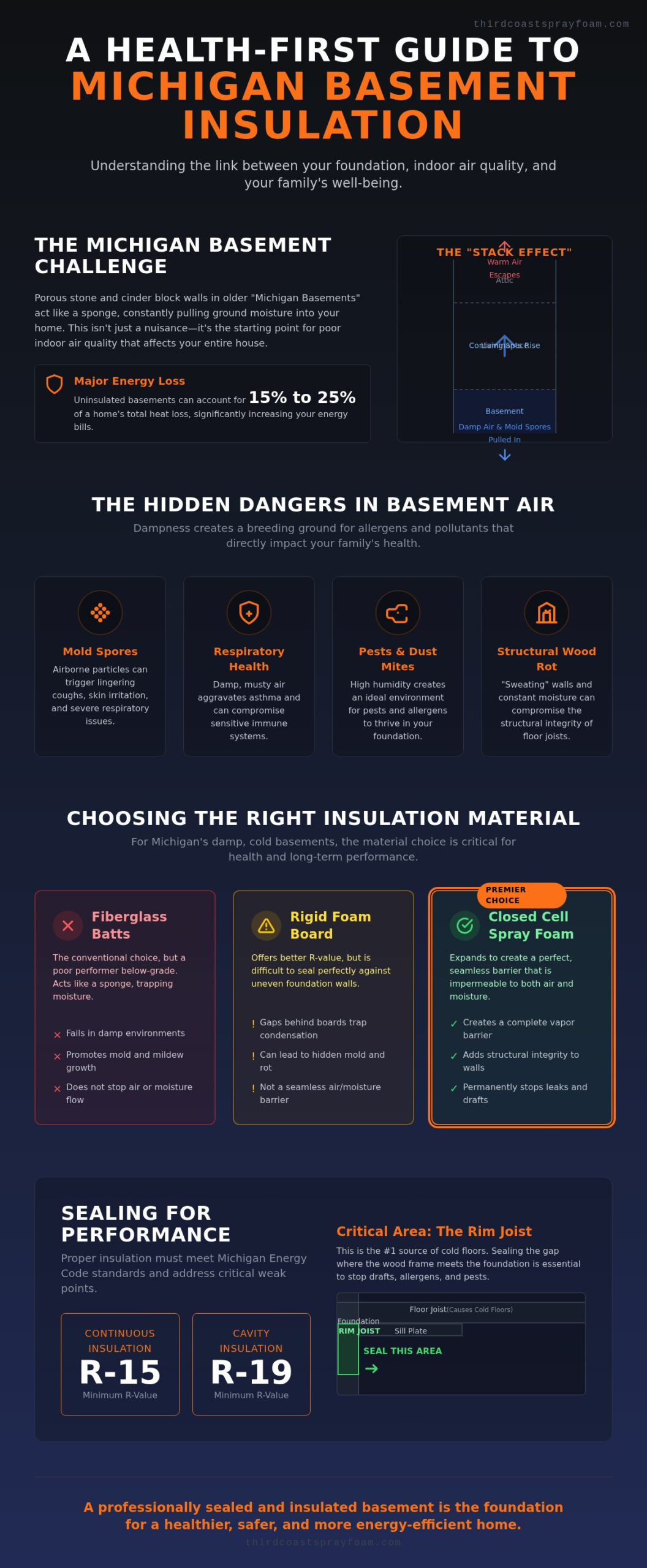
The real danger lies in a process called the stack effect. As warm air rises and escapes through your attic, it creates a vacuum that pulls air from the lowest point of the house upward. This means a significant portion of the air you breathe on the main floor originated in your basement. If that space is damp, you are effectively circulating spores and pollutants throughout your entire living area. Experienced basement insulation contractors Michigan residents rely on focus on stopping this upward migration by sealing the foundation at its source.
Traditional fiberglass batts often fail in these environments because they are porous and hold onto water. When moisture gets trapped behind fiberglass, it creates a dark, damp pocket where fungi flourish. Understanding the health effects of mold is critical for any homeowner, as these airborne particles can cause lingering coughs, skin irritation, and more severe respiratory complications over time.
Respiratory Health and Mold Prevention
Mold spores and dust mites thrive in the high-humidity conditions found in untreated foundations. For family members with asthma or sensitive immune systems, these biological triggers can make indoor life uncomfortable. Professional air sealing creates a healthy “envelope” that prevents these allergens from entering your home. By removing the moisture source, you effectively neutralize the environment these pests need to survive.
The Problem with Michigan Humidity
West Michigan’s lake-effect humidity contributes significantly to basement condensation and “sweating” walls during the summer months. This atmospheric moisture clings to cold surfaces, leading to standing water and saturated wood. High humidity levels in basements lead to long-term structural wood rot by providing the necessary conditions for wood-decay fungi to compromise your floor joists.
Comparing Basement Insulation Materials for Michigan Homes
Michigan basements present a unique challenge that standard materials often can’t handle. While some homeowners consider fiberglass for its lower initial cost, the failure of batt insulation in below-grade applications is well-documented. Fiberglass acts like a sponge, trapping humidity and promoting the very mold growth that threatens your family’s respiratory health. For the harsh winters in Grand Rapids and Lansing, material density is paramount. The 2021 Michigan Energy Code emphasizes high performance, requiring R-15 for continuous insulation or R-19 for cavity applications to ensure a stable thermal envelope.
When comparing rigid foam to spray foam, professional application becomes the deciding factor. Rigid boards are difficult to install on the uneven stone or cinderblock walls common in West Michigan. Gaps behind these boards allow condensation to form, leading to hidden rot and structural degradation. Professional basement insulation contractors Michigan families trust use spray foam because it expands to fill every crack and crevice, creating a seamless barrier that rigid boards simply cannot replicate.
Why Closed Cell Spray Foam is the Premier Choice
Closed cell spray foam is the gold standard for foundation work. This material is incredibly dense and moisture-impermeable, meaning it serves as its own vapor barrier. It effectively stops the “musty basement” smell at the source by preventing ground moisture from entering the home. Beyond moisture control, it adds significant structural integrity to older Michigan basement walls, essentially bonding the masonry together into a single, reinforced unit that resists shifting.
Don’t Forget the Rim Joists and Box Sills
The most common source of cold floors is actually the rim joist, where your home’s wood frame meets the concrete foundation. Applying rim joist insulation is a critical step in any basement project. This process involves air sealing the foundation-to-frame transition to eliminate drafts and prevent outdoor allergens or pests from entering your living space. By sealing these box sills, we ensure the entire home functions as a single, healthy system that maintains its temperature year-round.
Hiring the Right Basement Insulation Contractor in Michigan
Selecting from the pool of basement insulation contractors Michigan offers requires more than a simple price comparison. You need a partner who understands the high water tables of the Muskegon shoreline and the heavy clay soils found throughout Grand Rapids. A local expert will perform a comprehensive site assessment to identify existing moisture issues or structural vulnerabilities before any product is applied. This ensures that the insulation solves your dampness problems rather than masking them. Always verify that your contractor carries specialized equipment and maintains full insurance and licensing to protect your property during the installation process.
Financial planning is a vital part of any home upgrade. Smart homeowners can improve their long-term ROI by maximizing your energy efficient home improvement credit and stacking it with available 2026 utility rebates from providers like Consumers Energy or DTE. These incentives reward you for choosing high-performance materials that reduce the state’s energy load while securing your own home’s efficiency.
The Third Coast Professional Process
Our team prioritizes your home’s air quality from the moment we arrive. We utilize advanced ventilation and containment strategies to ensure your family’s respiratory health is protected during the application. We maintain a strict “no fiberglass” philosophy for below-grade projects. We focus exclusively on permanent, high-performance solutions that prevent mold growth and eliminate the biological triggers that often plague Michigan basements.
What to Expect: Timeline and ROI
A professional basement insulation project is a permanent investment that pays dividends through lower utility bills and increased property value. Most installations are completed within one to two days, providing immediate relief from cold floors and musty odors. To prepare for our crew, please follow this simple checklist:
- Clear a three-foot perimeter around all basement walls.
- Ensure all personal items are covered or moved to the center of the room.
- Verify that all pets are secured in a separate area of the home.
- Check that our team has clear access to your electrical panel.
Secure Your Home’s Foundation and Family’s Health
Securing your Michigan basement is a permanent investment in your home’s structural integrity and your family’s respiratory wellness. By choosing a solution that creates a true moisture barrier, you stop the migration of allergens and dampness into your primary living spaces. High-performance closed cell spray foam doesn’t just lower your energy bills; it transforms a problematic, musty foundation into a clean and dry component of a healthy home ecosystem.
The technical expertise required to manage West Michigan’s unique humidity levels makes selecting the right partner essential. Among the various basement insulation contractors Michigan homeowners can choose from, we stand out by prioritizing long-term health outcomes and precise application. We focus on the integrated system of your home, from rim joist sealing to full wall encapsulation. This ensures you meet the latest 2026 energy standards while maximizing your financial return through utility rebates and reduced consumption.
Don’t let another season of dampness affect your indoor air quality. Take the first step toward a drier, more efficient home today. Get Your Free Basement Insulation Estimate from Third Coast Spray Foam. We look forward to helping you create a safer, more comfortable environment for your whole family.
Frequently Asked Questions
What is the best way to insulate a Michigan basement?
The best way to insulate a Michigan basement is by using closed cell spray foam on the foundation walls and rim joists. This material provides a superior moisture barrier that traditional fiberglass cannot match. It effectively seals out ground-level humidity and prevents the condensation that leads to structural rot. By choosing this permanent solution, you secure your home’s thermal envelope and protect your family from the dampness common in West Michigan climates.
How much does it cost to insulate a basement in Michigan?
The cost of basement insulation in Michigan depends on the total square footage, the existing wall condition, and the specific material selected for the project. While high-performance solutions like spray foam require a higher initial investment than temporary materials, they offer superior long-term savings through reduced energy consumption. Many basement insulation contractors Michigan homeowners trust can provide a detailed assessment of your home’s needs to determine the most cost-effective approach for your foundation.
Can I use spray foam on stone or brick basement walls?
Yes, closed cell spray foam is the most effective solution for irregular stone or brick basement walls. Because it is applied as a liquid and expands into a solid, it fills the deep cracks inherent in older masonry. Professional basement insulation contractors Michigan residents rely on use this method to create a seamless, airtight seal. This process also adds a layer of structural reinforcement to aging foundation walls while preventing moisture seepage.
Does basement insulation help with mold and indoor air quality?
Basement insulation significantly improves indoor air quality by preventing the growth of mold and mildew. By sealing out foundation moisture, you eliminate the damp environment where fungal spores and dust mites thrive. This intervention is critical for maintaining respiratory health, as it stops pollutants from traveling upward into your living spaces through the stack effect. A dry basement is the foundation of a healthy home.
Will insulating my basement stop my floors from being cold?
Insulating your basement, specifically the rim joists and box sills, is the most effective way to stop cold floors on your main level. The rim joist is where the majority of outdoor air enters your home’s foundation. By sealing this transition with professional spray foam, you eliminate the drafts that chill your floorboards. This results in a more stable temperature throughout the house and lower monthly heating costs.
Is there a tax credit for basement insulation in 2026?
The federal 25C tax credit for insulation expired on December 31, 2025, and is not available for projects in 2026. However, Michigan homeowners can still access significant savings through the Michigan Home Energy Rebates (MiHER) program and utility incentives. For instance, DTE and Consumers Energy offer rebates of up to $50 for basement wall insulation through December 2026. Stacking these local incentives helps maximize your project’s financial return.
Disclaimer
Information provided is for general educational purposes. Individual needs and circumstances vary. Speak to an experienced professional to get the correct information for your situation.