Did you know the average monthly electricity bill in Grand Rapids reached $251 as of May 2026? With Consumers Energy peak rates hitting $0.245 per kWh during our humid West Michigan summers, improving home energy efficiency Grand Rapids families can trust has become a financial necessity. We all know the struggle of lake-effect winters that drive up heating costs, but the real danger often hides in the damp, unsealed corners of your house. High humidity and poor thermal boundaries don’t just drain your wallet; they fuel mold growth and aggravate respiratory health issues for everyone inside.
You likely agree that a home should be a sanctuary, not a source of drafts or allergens. We’ve designed this 2026 guide to help you reclaim that security by slashing your energy costs and purifying your indoor environment. You’ll discover how to leverage state-administered HOMES and HEAR rebates to fund critical upgrades like crawl space encapsulation and high-performance spray foam insulation. We will also explore the direct link between airtight structural integrity and the elimination of the airborne pollutants that compromise your family’s well-being, ensuring your home remains a stable, healthy haven for years to come.
Key Takeaways
- Discover the critical link between high-performance air sealing and the prevention of mold and mildew in crawl spaces and attics.
- Understand why traditional fiberglass often fails in our local climate and how modern materials create a more durable thermal envelope.
- Identify specific strategies for improving home energy efficiency Grand Rapids homeowners can use to stabilize indoor temperatures during lake-effect winters.
- Learn how to maximize your project’s ROI by stacking state-administered programs with local utility rebates for maximum savings.
- Explore why professional installation is vital for maintaining structural integrity and avoiding the health risks associated with improper DIY insulation.
The Grand Rapids Efficiency Challenge: Why Your Home Loses Energy
Grand Rapids homes are uniquely vulnerable to the harsh environmental cycle of West Michigan. Our lake-effect winters dump heavy, moisture-laden snow, while our summers bring a thick humidity that challenges even the most robust HVAC systems. When we talk about improving home energy efficiency Grand Rapids property owners often focus on the thermostat, but the true battle is fought within the building envelope. Most older homes in Kent County weren’t built with modern low-energy building design standards in mind. Instead, they rely on porous materials like fiberglass batts that simply can’t stop the relentless migration of humid air.
To better understand how your home might be losing energy through hidden gaps, watch this helpful video:
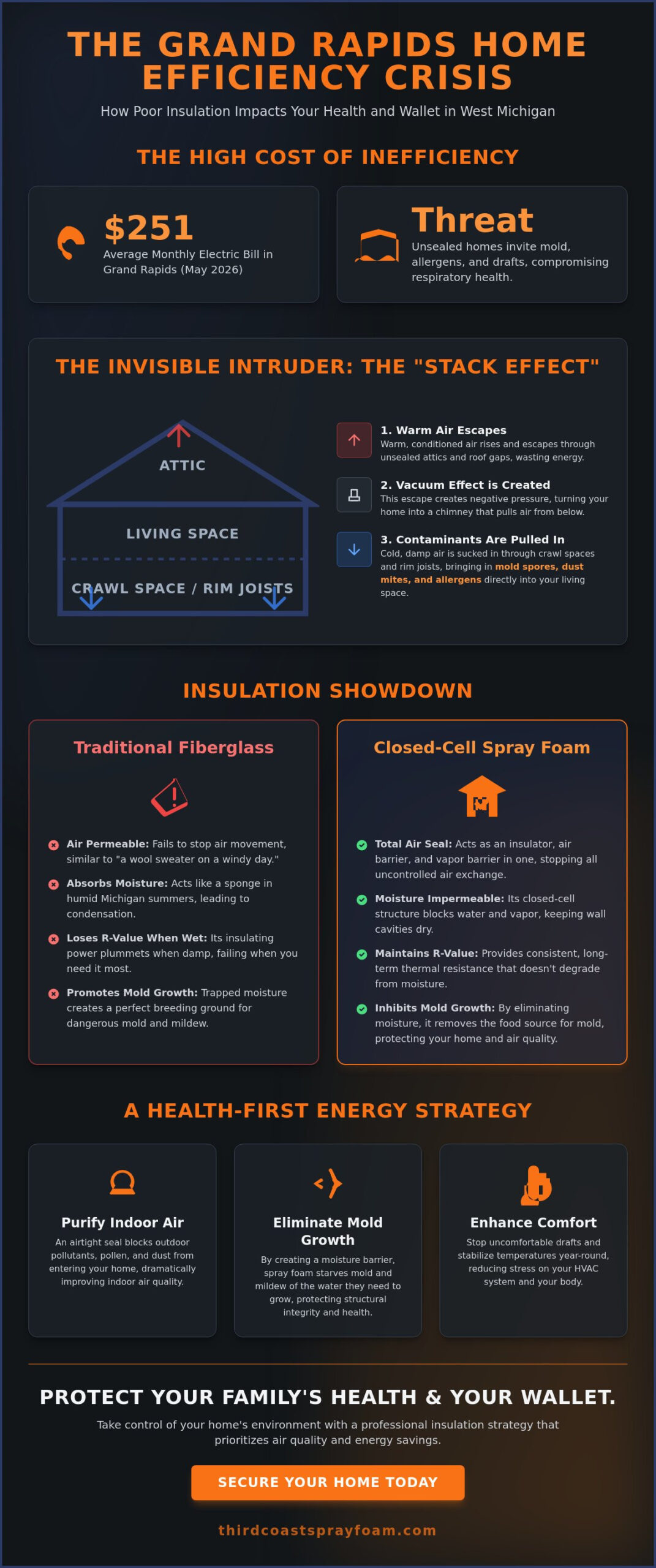
The most significant driver of energy loss is the “Stack Effect.” This process occurs when warm air rises and escapes through your attic, creating a vacuum that pulls cold, damp air in through your rim joists and crawl space. This isn’t just a comfort issue; it’s a health crisis. As air is sucked up from the ground level, it carries mold spores, dust mites, and radon directly into your breathing zone. If your Consumers Energy bills are skyrocketing, it’s likely because your home is acting like a chimney, constantly exhausting the air you’ve already paid to heat or cool.
Lake Michigan Humidity and Your Building Envelope
Humidity behaves like a persistent intruder. In West Michigan, moisture-laden air migrates through porous insulation until it hits a cold surface, reaching its dew point. This causes hidden condensation inside your walls and attics. When traditional fiberglass gets wet, it loses its thermal resistance and becomes a breeding ground for mold. If you see “sweating” on the walls of your pole barn or moisture on your attic rafters, your building envelope has failed. This moisture doesn’t just rot wood; it compromises the air quality your family depends on.
The Financial and Physical Cost of Inefficiency
With Consumers Energy peak summer rates at $0.245 per kWh, every air leak is a direct hit to your savings. When your rim joists and attics aren’t properly sealed, your HVAC system must work overtime to maintain a consistent temperature. This constant cycling leads to premature mechanical failure and uneven “hot spots” throughout the house—making it essential to partner with a reliable contractor like Crome Mechanical to maintain your heating and cooling systems. Beyond the financial drain, drafty homes are often synonymous with seasonal respiratory discomfort. Poorly sealed homes allow outdoor pollutants and allergens to bypass filtration, leading to itchy eyes, dry throats, and aggravated asthma symptoms for residents.
The Science of Air Sealing: Beyond Simple R-Values
When improving home energy efficiency Grand Rapids families often start by looking at R-values. This number measures a material’s resistance to heat flow, but it’s only half the story. If air can pass through the material, heat moves with it. Think of a wool sweater on a windy day; it’s warm, but the wind cuts right through. Air sealing is the process of eliminating that uncontrolled air exchange. It ensures that the air you pay to condition stays inside, while unconditioned, outdoor air stays out.
Closed-cell spray foam is the gold standard for this task. It functions as both a high-performance insulator and a vapor barrier. Unlike traditional materials, it doesn’t allow moisture or air to migrate through its structure. This creates a “sealed” environment where your indoor air quality is no longer at the mercy of exterior drafts. Instead, your home’s air is processed through your HVAC system, allowing for proper filtration and humidity control. With the average Grand Rapids resident using 1,174 kWh of electricity per month, stopping these invisible leaks is a critical financial and health-conscious move.
Closed-Cell Spray Foam vs. Traditional Materials
Using closed cell spray foam provides a level of protection that fiberglass simply can’t provide. Fiberglass is porous and susceptible to moisture, which often leads to mold growth in our humid climate. In contrast, closed-cell foam is air-impermeable. It also offers superior structural reinforcement. When applied to rim joists or box sills, it bonds to the substrate and hardens, strengthening the building’s skeleton. This is a key part of choosing the right insulation for Michigan homes. We focus on these critical transition points to stop the Stack Effect at its source.
Respiratory Health and Indoor Air Quality (IAQ)
A leaky home is often an unhealthy home. Foundation cracks and gaps in your attic floor act as vacuums, pulling in dust, pollen, and outdoor pollutants. These allergens bypass your home’s filtration systems and settle in your living spaces. Professional air sealing is a foundational step in improving home energy efficiency Grand Rapids residents can take to protect their families’ health. By sealing these gaps, you gain several health benefits:
- Reduced Allergy Triggers: Keeping pollen and outdoor dust from entering through the basement or attic.
- Mold Prevention: Blocking the humid air that fuels fungal growth in dark, unconditioned spaces.
- Consistent Air Purity: Forcing air through your HVAC filters rather than through dirty wall cavities.
Professional air sealing creates a predictable indoor environment. It prevents the “uncontrolled” air movement that carries mold spores from damp crawl spaces into your bedrooms. Maintaining this barrier is essential for long-term respiratory health. If you’re ready to secure your building envelope, you can request a professional assessment of your home’s current air leakage levels to identify your biggest risks.
Evaluating High-Efficiency Insulation for the Michigan Climate
Selecting the right insulation material in West Michigan requires more than just looking at a price tag. Our regional climate, defined by heavy lake-effect snow and high summer dew points, demands materials that can handle moisture without degrading. While fiberglass batts are a common sight in older Kent County homes, they often fail to provide the airtight seal necessary for improving home energy efficiency Grand Rapids families need. Fiberglass is porous, meaning it traps dust and allows humid air to pass through, which frequently leads to hidden mold growth and compromised respiratory health.
For a truly effective building envelope, we look toward materials that provide a continuous thermal and air barrier. This approach ensures that your indoor environment remains stable, regardless of the fluctuating temperatures outside. To help offset the cost of these high-performance upgrades, homeowners should consult the Michigan Home Energy Rebates Program. This state resource provides essential details on eligibility for programs like HEAR and HOMES, which can significantly lower the barrier to entry for professional insulation projects.
Grand Rapids Attic Strategy: Foam vs. Blown-In
If you’re working with a strict budget, blown-in insulation is an excellent choice for attic floors. It fills the irregular gaps and crevices that batts miss, creating a much more consistent thermal blanket. However, for those seeking maximum efficiency, we often recommend the “Hot Roof” concept. This involves applying spray foam directly to the underside of the roof deck. This method brings your attic into the conditioned space of your home, preventing the massive heat swings that stress your HVAC system. If your existing insulation is old or contaminated by pests or mold, professional insulation removal is a vital first step to ensure your home’s air remains pure and safe to breathe.
Moisture Control: Crawl Space Encapsulation and Rim Joists
The ground beneath your home is a constant source of moisture and soil gases like radon. Without specialized crawl space insulation and encapsulation, this “rising damp” fuels wood rot and mold colonies. By installing a heavy-duty vapor barrier and sealing the foundation walls, we stop these pollutants from entering your living areas. This process is especially critical for improving home energy efficiency Grand Rapids properties because it stabilizes the temperature of your floors. Sealing the rim joists is equally important. These perimeter beams are often the leakiest part of a basement, and sealing them stops the icy drafts that force your furnace to work overtime during a Michigan freeze-thaw cycle.
There is a common myth that a home needs to “breathe” through its walls. In reality, a leaky house is an unhealthy house. When air enters through cracks in the foundation or gaps in the attic, it brings in allergens and pollutants. A “tight” home allows you to control your ventilation through your HVAC system’s filtration. This creates a predictable, healthy indoor environment where the air you breathe is clean, dry, and free of triggers for asthma or allergies.
This commitment to a controlled, protected environment is a principle shared by specialists in other industries; for instance, Protek Films provides high-quality surface protection solutions to safeguard your most valuable assets from environmental wear and tear.
Maximizing Your ROI: Michigan Rebates and Tax Credits
Investing in your home’s thermal envelope is one of the few property improvements that offers a dual return on investment. You gain immediate relief from high utility bills while simultaneously protecting your family’s respiratory health by eliminating the damp conditions that favor mold growth. In 2026, improving home energy efficiency Grand Rapids homeowners find that the financial landscape has shifted toward state-administered programs. While some federal incentives for mechanical equipment expired in 2025, the focus has moved to robust rebates that prioritize high-performance insulation and air sealing. By stacking these incentives, you can significantly offset the initial cost of creating a “health-sealed” home.
The primary pathways for savings in West Michigan are the HOMES and HEAR rebate programs. For low-income households earning 80% or less of the Area Median Income, the HOMES program can cover 80% of project costs up to $8,000. Moderate-income households are eligible for 50% coverage up to $4,000. Additionally, the HEAR program provides up to $1,600 specifically for insulation and weatherization. These aren’t just financial perks; they are tools designed to help you stabilize your indoor air quality and prevent the structural decay caused by our humid lake-effect climate. You can contact our team today to see which rebate pathway best fits your household’s efficiency goals.
Federal Tax Credits for Insulation Upgrades
Despite changes to equipment-specific credits, the Energy Efficient Home Improvement Credit remains a vital resource for weatherization. Homeowners can typically claim a 30% credit for insulation materials, with an annual cap of $1,200. To successfully claim this on your taxes, we provide detailed documentation of the high-performance materials used in your project. This ensures you meet the stringent federal requirements for thermal resistance and air impermeability. Utilizing these credits in 2026 is a pragmatic move to secure your home’s value before potential policy shifts alter the incentive structure.
Local Michigan Incentives and Utility Programs
Local utilities are also playing a major role in improving home energy efficiency Grand Rapids residents’ bottom lines. Consumers Energy currently offers a $600 rebate for attic insulation upgrades, which can be combined with other state incentives. Beyond the immediate cash back, these upgrades have a profound impact on property resale value in the Kent County market. A home that features a documented, energy-efficient building envelope is a premium asset. Buyers are increasingly looking for properties that offer low monthly overhead and a guaranteed healthy indoor environment free from the risk of hidden mold and drafts.
Taking Action: Your Health-First Energy Strategy
Deciding to upgrade your home’s thermal envelope is a significant step toward long-term financial and physical security. While we have covered the science of air sealing and the financial incentives available in 2026, the success of these upgrades depends entirely on the precision of the installation. In the pursuit of improving home energy efficiency Grand Rapids homeowners might consider DIY spray foam kits, but these often present substantial risks. If the chemical components are not mixed at the exact ratios required, the foam can fail to cure properly, leading to persistent odors and off-gassing that compromise your indoor air quality and respiratory health for years.
The approach used by Third Coast Spray Foam focuses on eliminating these risks through technical expertise and specialized equipment. We treat every project as a unique structural challenge, recognizing that a 1920s home in Heritage Hill requires a different strategy than a modern build in Cascade. Our team conducts a thorough assessment of your building’s current state, identifying hidden moisture issues or structural gaps that a standard visual inspection might miss. We help you finalize a plan that balances your energy goals with the necessity of a healthy, mold-free indoor environment.
Why Professional Installation Matters
Professional installation is essential because it ensures the chemical reaction that creates the foam is completed safely and effectively. Third Coast Spray Foam technicians are trained to manage the delicate balance between creating an airtight seal and maintaining necessary structural ventilation. We use high-performance, health-conscious materials that are designed to be inert once cured, protecting your family from airborne pollutants. By ensuring a perfect bond to your rim joists or attic rafters, we provide a permanent solution that won’t sag or settle, maintaining your home’s air purity and thermal resistance for the life of the structure.
Start Your Grand Rapids Efficiency Journey
Preparing for a professional estimate is the best way to move from planning to execution. We recommend documenting areas where you notice persistent drafts or seasonal humidity spikes, as these are often the primary entry points for outdoor allergens. While many residents start with their primary living spaces, we also provide specialized pole barn insulation to ensure your workshops and storage buildings are just as efficient and healthy as your home. Improving home energy efficiency Grand Rapids families can trust starts with a partner who understands our local West Michigan climate. Contacting a local specialist ensures your project is handled with the precision and neighborly care your home deserves.
Secure Your Home’s Health and Future
We’ve explored how a properly sealed building envelope does more than just lower your monthly utility bills; it acts as a primary defense for your family’s respiratory health. By choosing high-performance materials and professional installation, you eliminate the uncontrolled air leaks that invite mold and allergens into your living space. Utilizing the 2026 Michigan rebate programs ensures that these critical upgrades are a pragmatic financial investment for any homeowner. Improving home energy efficiency Grand Rapids residents can rely on requires a holistic view of the home as a single, integrated system.
As a local Fruitport-based family business, we’ve provided expert West Michigan installation since 2013. We specialize in health-first air sealing and moisture control to ensure your property remains durable and your indoor air stays pure. Don’t let drafty winters or humid summers compromise your comfort or well-being. Take the first step toward a more stable and secure indoor environment today.
Get Your Free Energy Efficiency Estimate in Grand Rapids
We look forward to helping you create a more stable, efficient, and healthy environment for your family to enjoy for years to come.
Frequently Asked Questions
How much can I save on my Grand Rapids energy bills with spray foam?
Savings vary based on your home’s current efficiency, but most residents see a substantial reduction in their monthly utility costs. With Consumers Energy peak summer rates reaching $0.245 per kWh in 2026, stopping air leaks is a financial priority. By creating a continuous thermal barrier, you reduce the workload on your HVAC system, which is a primary strategy for improving home energy efficiency Grand Rapids families use to combat rising energy prices.
Does spray foam insulation improve indoor air quality for allergy sufferers?
Yes, spray foam significantly improves indoor air quality by creating an airtight seal that blocks outdoor allergens, dust, and pollen. Unlike fiberglass, which is porous and can trap moisture or particulates, spray foam prevents the “Stack Effect” from pulling contaminants up from your crawl space. This results in a cleaner indoor environment that reduces common respiratory triggers for those with allergies or asthma.
What is the difference between the HOMES and HEAR rebates in Michigan?
Both programs are income-based, but they target different project scopes. The HOMES program provides rebates based on modeled energy savings, offering up to $8,000 for low-income households and $4,000 for moderate-income families. The HEAR program focuses on specific weatherization tasks, providing up to $1,600 for insulation and air sealing. These state-administered funds are essential for West Michigan families looking to offset the cost of professional, health-first upgrades.
Can I stay in my home during a spray foam insulation installation?
We recommend that residents and pets vacate the home during the application and for a specific curing period, which is typically 24 hours. This safety precaution ensures you aren’t exposed to any particulates or odors during the chemical reaction process. Once the foam has fully cured, it becomes an inert and safe material that provides a permanent barrier for your home’s structural integrity and air purity.
Will air sealing my home make it ‘too tight’ and cause mold?
No, because air sealing actually manages the moisture that fuels mold growth. Mold is caused by humid air hitting cold surfaces; professional air sealing eliminates these specific triggers. While we make the building envelope airtight to stop drafts, we also ensure your home’s ventilation is handled through your HVAC system. This allows for controlled air exchange and filtration, which prevents the damp, stale conditions that lead to mildew.
How do I claim the Energy Efficient Home Improvement Credit for my insulation?
You claim this federal tax credit by filing IRS Form 5695 with your annual tax return. In 2026, the credit covers 30% of your insulation material costs, capped at an annual limit of $1,200. We provide the necessary material certifications and detailed documentation required to prove your project meets the federal standards for improving home energy efficiency Grand Rapids homeowners must follow to qualify for these benefits.
Does Third Coast Spray Foam offer financing for Grand Rapids homeowners?
We do not offer direct in-house financing, but we provide expert guidance on navigating the various state and utility incentives available to you. Our team helps you identify the correct HOMES or HEAR rebate pathway to ensure you receive the maximum financial assistance for your project. We also ensure you have all the documentation needed to claim federal tax credits, helping to lower the net cost of your permanent insulation investment.
How long does spray foam insulation last in the Michigan climate?
Spray foam is a permanent solution designed to last for the entire lifespan of your home. It does not sag, settle, or lose its thermal resistance over time like traditional fiberglass or cellulose. In our fluctuating Michigan climate, this durability is a major advantage. It provides consistent, year-round protection against lake-effect moisture and extreme temperature swings without ever needing to be replaced or topped off.
Disclaimer
Information provided is for general educational purposes. Individual needs and circumstances vary. Speak to an experienced professional to get the correct information for your situation.