Your home’s persistent musty smell isn’t just a West Michigan quirk; it’s a warning sign that your indoor air quality is failing your family. You’ve likely felt that heavy lake-effect humidity seeping through your walls during our damp winters and muggy summers. This moisture doesn’t just drive up your utility bills. It creates a breeding ground for mold and allergens that can aggravate respiratory issues. Investing in high performance insulation West Michigan families can rely on is about more than just thermal resistance. It’s about creating a sealed, healthy environment where you can finally breathe easy.
We understand the frustration of drafty rooms and the worry that comes with poor air quality. This guide will show you how high-performance insulation protects your home from moisture while significantly improving your family’s health. We’ll examine the 2026 federal tax credits that cover 30% of your insulation costs, up to a maximum of $1,200. We will also look at how modern air sealing eliminates the triggers of asthma and allergies. By treating your home as an integrated system, you can achieve lower monthly bills and a permanent sense of security for your loved ones.
Key Takeaways
- High-performance systems go beyond standard R-values by creating a continuous air barrier that specifically manages West Michigan’s intense lake-effect humidity.
- Proper moisture control and air sealing prevent the growth of mold and mildew, providing a critical layer of protection for your family’s respiratory wellness.
- Learn why high performance insulation West Michigan residents invest in acts as a permanent filter against outdoor pollutants, dust, and seasonal allergens.
- Take advantage of the 2026 Federal Energy Efficient Home Improvement Credit to recover up to 30% of your project costs, capped at $1,200 annually.
- Discover how professional air sealing reduces the workload on your HVAC system, leading to lower monthly utility bills and long-term mechanical reliability.
What Defines High Performance Insulation in West Michigan?
High performance insulation isn’t just about thickness or a specific number on a package; it’s a technical standard that combines thermal resistance with a complete air barrier. In our region, Building insulation must do more than just slow down heat transfer. It has to combat the intense lake-effect humidity and extreme temperature swings that characterize the West Michigan climate. Traditional materials often focus solely on R-value, but they fail to address the air infiltration that carries moisture and pollutants into your living spaces.
True high performance insulation West Michigan homes require must provide a seamless seal. This prevents the “ghost drafts” that make your furnace work overtime and allow mold-triggering moisture to accumulate within your walls. To better understand how modern building science addresses these issues, watch this helpful video:
The Role of Air Sealing in the Michigan Climate
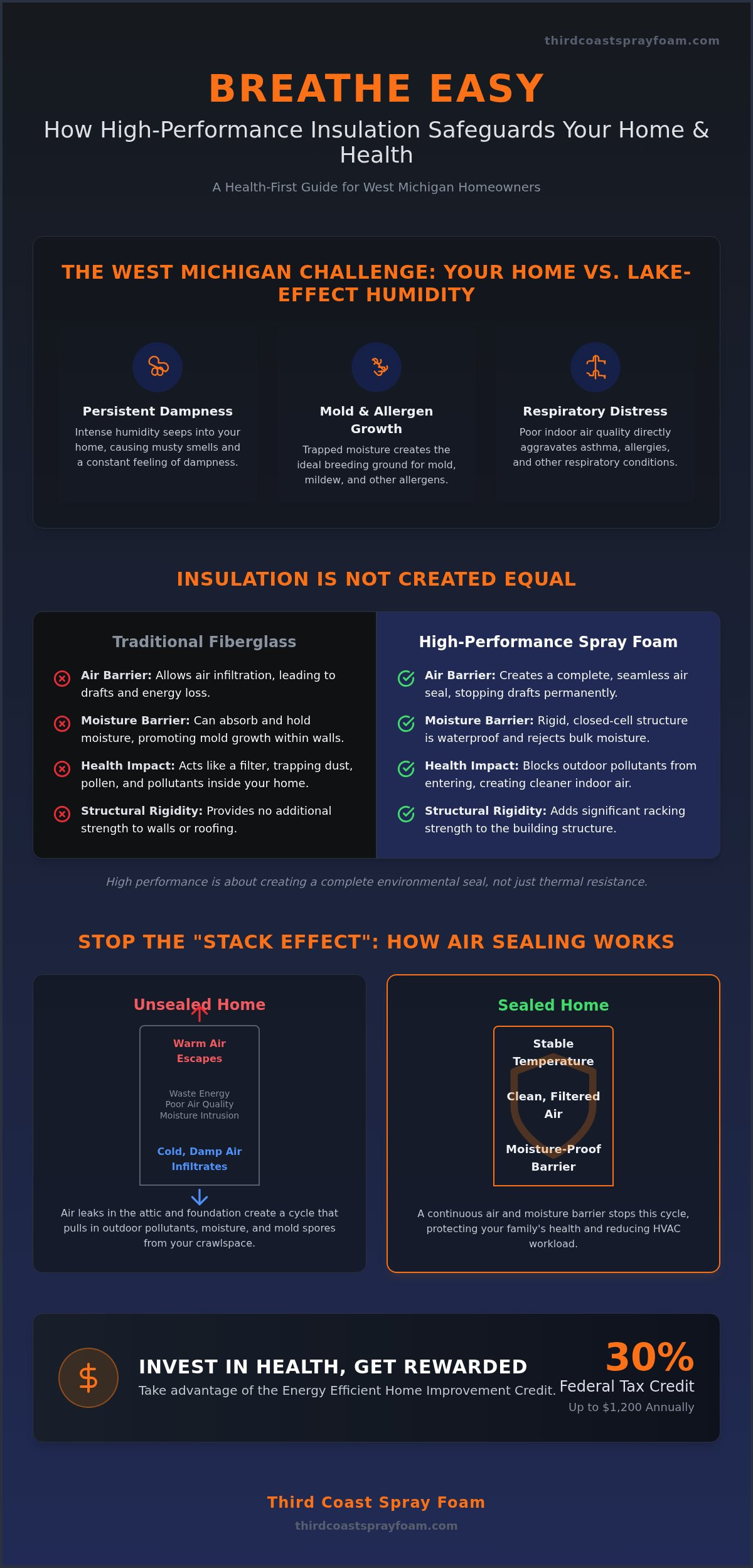
Air leaks in rim joists and attics act like open windows, even if they’re covered in thick layers of traditional insulation. This creates the “Stack Effect,” where warm air rises and escapes through the roof, pulling cold, damp air up from your crawl space. This cycle doesn’t just waste energy. It drags in musty smells and moisture that can lead to mold growth, directly impacting your family’s respiratory health and indoor air quality.
Material Science: Why Spray Foam Outperforms Fiberglass
At Third Coast Spray Foam, we don’t offer fiberglass batt insulation. We’ve seen how these batts act like a filter for dust rather than a barrier against air movement. We prioritize closed cell spray foam because it provides a rigid, waterproof seal that fiberglass simply can’t match. This is especially critical for high performance insulation West Michigan pole barns and agricultural structures, where structural integrity and moisture rejection are vital for long-term durability. By choosing a material that stops air and water, you’re making a permanent investment in your home’s health and efficiency.
The Health Connection: Improving Indoor Air Quality and Respiratory Wellness
Indoor Air Quality is the concentration of pollutants within a building that impacts occupant health. For families in our region, this metric is vital since we spend the majority of our time indoors during the long, damp winter months. When you install high performance insulation West Michigan homes become more than just thermally efficient; they become controlled environments. According to the EPA’s research on Energy, Weatherization and Indoor Air Quality, properly sealing your home’s envelope is a foundational step in reducing exposure to outdoor triggers. By creating a continuous barrier, you effectively block pollen, dust, and industrial pollutants from infiltrating your living space.
Air sealing goes beyond stopping drafts. It acts as a primary defense for family members living with asthma or chronic allergies. Traditional insulation often allows air to bypass the material, bringing in microscopic particulates that settle in your carpets and upholstery. High-performance systems stop this movement, ensuring the air you breathe is filtered by your HVAC system rather than leaked through your walls.
Eliminating Mold and Mildew at the Source
Moisture is the primary driver of poor health outcomes in Michigan homes. Our local humidity often settles in lower levels, making crawl space insulation and encapsulation essential for stopping the moisture cycle. Without a proper seal, damp air rises through the floorboards, carrying mold spores and musty odors into the main living areas. Similarly, rim joist condensation provides the perfect environment for mildew to thrive against your foundation. Sealing these critical points prevents the organic growth that frequently triggers respiratory distress.
Respiratory Health Benefits of a Sealed Building Envelope
A drafty home does more than feel cold; it creates air currents that keep dust and particulates in constant suspension. High-performance air sealing eliminates these micro-drafts, allowing your air filtration system to work more effectively. We focus on maintaining stable indoor humidity levels between 30% and 50%. This specific range is the “sweet spot” for respiratory wellness. It’s dry enough to prevent dust mites from flourishing but humid enough to prevent dry, irritated airways. If you’ve noticed persistent allergies while indoors, it’s worth seeing how a sealed building envelope can transform your daily comfort.
Maximizing Your Investment: ROI and Energy Credits in 2026
Investing in high performance insulation West Michigan is a strategic move for your home’s longevity and your family’s health. The EPA estimates that homeowners can save an average of 15% on heating and cooling costs simply by air sealing and adding insulation in key areas like attics and crawl spaces. These savings go beyond the monthly bill; they reduce the mechanical strain on your HVAC system, extending its lifespan and preventing costly mid-winter breakdowns. By creating a tighter building envelope, you’re investing in a permanent solution that protects your property value and indoor air quality simultaneously.
For projects completed in 2026, you can claim the Energy Efficient Home Improvement Credit. This federal incentive allows homeowners to receive a tax credit for 30% of the cost of insulation and air sealing, up to an annual maximum of $1,200. When combined with local utility rebates from Consumers Energy or DTE, which offer up to $600 for attic upgrades, the initial cost becomes much more manageable. We specialize in helping residents navigate the energy efficient home improvement credit to ensure every West Michigan project is as cost-effective as possible.
Long-Term Durability vs. Short-Term Savings
High-performance insulation is a “one-and-done” investment. Unlike blown-in alternatives that can sag, settle, or lose their thermal effectiveness over time, spray foam remains stable for the life of the structure. Closed-cell foam specifically adds measurable structural integrity to residential walls, acting as a glue that bonds the building components together. This durability ensures that your home remains protected against moisture and mold growth without the need for future top-offs or replacements.
Getting Started with a West Michigan Specialist
A professional insulation assessment is the first step toward a healthier home. Our local team understands the specific requirements of the 2015 Michigan Residential Code and how to achieve the necessary R-49 ceiling standards in Grand Rapids and Muskegon. We prioritize high-impact zones like rim joists and attics to stop the entry of allergens and damp lake-effect air immediately. Professional installation is vital to ensure the correct chemical balance and safety of the foam, providing a secure environment where your family can breathe easy for decades to come.
Take Control of Your Home’s Health and Efficiency
Securing your home against the specific environmental challenges of our region requires more than just standard materials. We’ve seen how high performance insulation West Michigan families trust can transform a drafty, damp house into a sanctuary of clean air and stable temperatures. By combining advanced air sealing with superior thermal resistance, you effectively eliminate the moisture that fuels mold growth and irritates respiratory systems. This isn’t just a home improvement project; it’s a long-term commitment to your family’s physical well-being and financial security.
Our team serves Grand Rapids, Muskegon, and the entire West Michigan area with a focus on health-first solutions like crawl space encapsulation. We have the technical expertise to help you maximize the 2026 federal tax credits while ensuring your home meets the highest standards of modern building science. Don’t let another season of lake-effect humidity compromise your indoor air quality or your comfort. Request Your Free High-Performance Insulation Estimate today to see the difference professional sealing makes. We look forward to helping you build a more durable, efficient, and healthy home for the years ahead.
Frequently Asked Questions
Is high-performance spray foam safe for people with asthma or allergies?
High-performance spray foam is safe for individuals with respiratory sensitivities because it creates a permanent barrier against outdoor allergens. Once the material is fully cured, it becomes inert and doesn’t off-gas or shed fibers like traditional materials. By sealing the gaps where pollen and dust enter, it reduces the environmental triggers that cause asthma attacks. This creates a more stable indoor air quality that supports long-term respiratory health.
How much can I save on my Michigan heating bills with spray foam insulation?
Homeowners see a noticeable decrease in their monthly energy costs by stopping the air infiltration that forces furnaces to work harder. Because heating and cooling account for over half of a typical home’s energy use, professional air sealing is one of the most effective ways to lower those expenses. This high performance insulation West Michigan residents install provides a permanent thermal break that keeps heat inside during the winter and blocks humid lake-effect air during the summer.
Does high-performance insulation really prevent mold better than fiberglass?
Spray foam prevents mold growth more effectively than fiberglass because it doesn’t provide a food source for fungi and it blocks the moisture-laden air that mold needs to thrive. Fiberglass batts often trap moisture against wooden studs, which can lead to hidden rot and mildew. Because high-performance foam is non-organic and creates a seamless seal, it eliminates the condensation points where mold typically begins to grow in damp basements or attics.
What is the difference between open-cell and closed-cell high-performance foam?
The primary difference lies in density and moisture resistance. Closed-cell foam is a rigid, dense material that acts as a powerful vapor barrier, making it ideal for the high-humidity environments found in West Michigan crawl spaces. Open-cell foam is lighter and more flexible, providing excellent sound-dampening qualities and thermal resistance in interior walls. Both options contribute to high performance insulation West Michigan standards by providing the continuous air seal necessary for a healthy home.
Disclaimer
Information provided is for general educational purposes. Individual needs and circumstances vary. Speak to an experienced professional to get the correct information for your situation.