
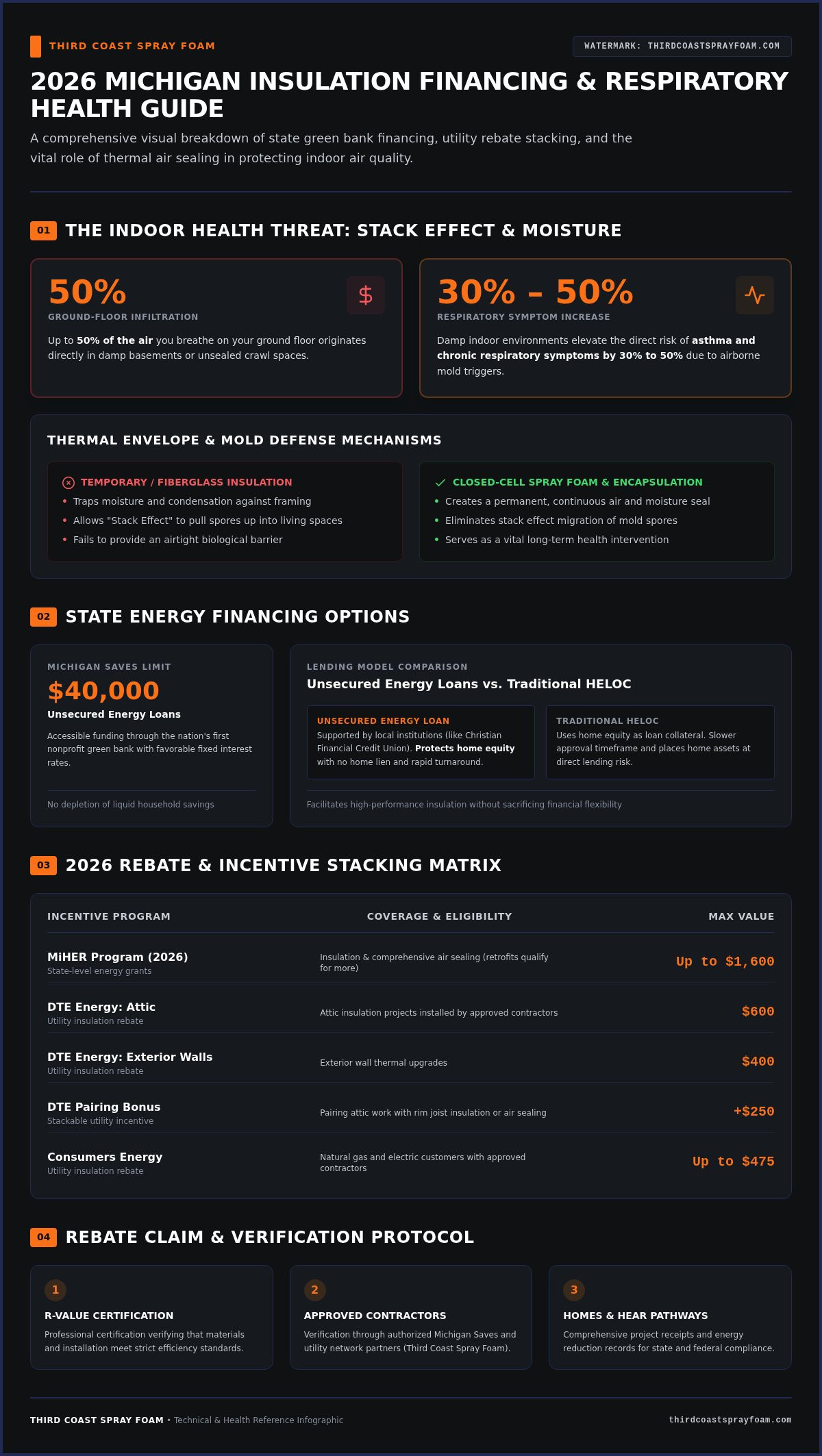
Did you know that up to 50% of the air you breathe on your home’s ground floor actually originates in your damp basement or unsealed crawl space? For many local families, a drafty house isn’t just about high winter energy bills; it’s a direct threat to your respiratory health. We understand that the upfront cost of high-performance spray foam often feels out of reach when you’re managing limited liquid cash. However, securing financing for insulation projects Michigan homeowners need has never been more accessible through specialized state programs.
You deserve a home that’s both thermally efficient and biologically safe. This resource will show you how to fund a permanent insulation solution using 2026 Michigan Saves loans, DTE or Consumers Energy rebates, and state-specific grants. We’ll outline a clear path to eliminate mold-related triggers and lower your monthly overhead, ensuring your family’s long-term well-being and financial security.
Key Takeaways
- Access unsecured loans up to $40,000 with favorable fixed rates through Michigan Saves to fund permanent energy upgrades without depleting your savings.
- Maximize your return on investment by stacking utility rebates from DTE or Consumers Energy with state-level MiHER grants for comprehensive air sealing.
- Understand how professional spray foam installation acts as a vital health intervention by stopping moisture infiltration and protecting your family from mold-related respiratory issues.
- Navigate the current 2026 landscape of financing for insulation projects Michigan to find a clear, affordable path toward improved indoor air quality and lower energy costs.
Understanding Your Michigan Insulation Financing Options
Michigan’s climate demands high-performance solutions to withstand freezing winters and humid Great Lakes summers. Many homeowners find that the initial cost of professional spray foam feels daunting, but financing for insulation projects Michigan provides a strategic way to manage this investment. Michigan Saves serves as the nation’s first nonprofit green bank, offering accessible energy loans that allow you to upgrade your home’s thermal envelope without depleting your cash reserves. By investing in quality materials that meet modern building insulation standards, you ensure the long-term structural integrity of your property while reducing monthly utility overhead.
Spreading the cost of your project over several years empowers you to prioritize your family’s respiratory health. Instead of settling for temporary fixes like fiberglass that can trap moisture, you can opt for closed cell spray foam or professional crawl space encapsulation. These materials create a permanent air seal that stops the “stack effect” from pulling mold spores and damp air into your living spaces. Financing ensures you don’t have to compromise on indoor air quality due to budget constraints. This makes financing for insulation projects Michigan a practical choice for those looking to improve their home’s value and safety simultaneously.
To better understand this concept, watch this helpful video:
The Role of Local Credit Unions and Green Banks
Local institutions, such as Christian Financial Credit Union, play a vital role in supporting energy projects across West Michigan. These lenders offer unsecured energy loans, which differ significantly from a traditional Home Equity Line of Credit (HELOC). While a HELOC uses your home as collateral, an unsecured loan protects your equity while providing the funds needed for immediate improvements. It’s a faster route to securing your home’s envelope. Michigan Saves acts as a bridge between homeowners and authorized contractors like Third Coast Spray Foam to ensure every project meets rigorous quality and safety standards.
Maximizing ROI: Rebates, Tax Credits, and Energy Savings
Securing Michigan Saves financing is the first step toward a high-performance home, but the real value comes from stacking local incentives. While federal tax credits for new projects shifted after 2025, Michigan homeowners in 2026 can leverage the MiHER program for significant savings. These rebates offer up to $1,600 for insulation and air sealing for many households, with performance-based retrofits potentially qualifying for much more. Combining these with Energy Efficient Home Improvement Credit knowledge ensures you don’t leave money on the table.
Utility providers in West Michigan offer direct support for your upgrades. Consumers Energy provides rebates up to $475 for natural gas and electric customers who work with approved contractors. DTE Energy customers can access even larger incentives, including $600 for attic insulation and $400 for exterior walls. When you pair attic work with rim joist insulation or air sealing, DTE adds a $250 bonus. These programs make financing for insulation projects Michigan a smart move by offsetting the initial principal of your loan.
Beyond the numbers, there’s a hidden ROI in your family’s health. Building science shows that damp indoor environments increase the risk of asthma and respiratory symptoms by 30% to 50%. By using spray foam to seal out moisture and prevent mold, you’re reducing potential medical expenses and improving daily wellness. If you’re ready to protect your home’s air quality, our expert team can help you navigate these programs.
How to Claim Your 2026 Insulation Rebates
To qualify for the maximum state and utility incentives, documentation is key. You’ll need professional R-value certification to prove your project meets strict efficiency standards. Whether you’re following our Blown-In Insulation Guide for attic upgrades or encapsulating a crawl space, keep all receipts and contractor certifications. These records are essential for verifying the energy reduction required for the HOMES and HEAR rebate pathways.
The Third Coast Approach: Healthy Homes Through Accessible Solutions
We serve the West Michigan community from Muskegon to Grand Haven, providing expert insulation removal and high-performance replacement. Our team prioritizes a health-first approach, particularly regarding Crawl Space Insulation. Since a significant portion of your home’s indoor air originates in the crawl space, sealing this area is vital for preventing respiratory health issues caused by mold and mildew. We help homeowners in Grand Rapids and Holland secure the precise documentation needed for financing for insulation projects Michigan residents use to protect their property’s structural integrity.
Navigating the paperwork for federal standards or the Energy Efficient Home Improvement Credit shouldn’t be a barrier to a safer home. We provide the technical certifications and R-value verification required by local lenders and utility companies. This collaborative expertise ensures your project meets the rigorous standards needed for approval while delivering a permanent solution to indoor air pollutants. We take pride in being a local partner that understands the unique environmental challenges of the Great Lakes region.
Choosing a Financing-Ready Contractor in West Michigan
It’s essential to hire a contractor who is an authorized partner in the Michigan Saves ecosystem. We understand the specific rebate standards for Consumers Energy and DTE, ensuring your project meets all technical requirements from the start. Whether you’re upgrading your primary residence or seeking Pole Barn Insulation, we focus on precision and tangible results. Your next step is to request a free estimate. We’ll include a detailed breakdown of potential energy savings and respiratory health benefits, providing a clear path toward a more secure and efficient indoor environment.
Invest in a Healthier, More Efficient Michigan Home
Upgrading your home’s thermal boundary is a permanent investment in your family’s comfort and respiratory health. By leveraging local utility rebates and low-interest loans, you can eliminate the mold and moisture issues that standard fiberglass batts often ignore. We’ve explored how stacking incentives and choosing specialized materials like closed cell spray foam creates a more secure indoor environment. Navigating the landscape of financing for insulation projects Michigan doesn’t have to be complex when you partner with an authorized Michigan Saves contractor. As specialists in West Michigan air quality and crawl space encapsulation, we ensure your project meets every technical requirement for maximum ROI. Don’t let high energy bills or poor air quality compromise your well-being. Request Your Free Healthy Home Insulation Estimate Today and take the first step toward a more stable, efficient future.
Frequently Asked Questions
Does spray foam insulation qualify for the Michigan Saves loan program?
Yes, professional spray foam installation is a qualifying measure under the Michigan Saves Home Energy Loan Program. This nonprofit green bank provides unsecured personal loans up to $40,000 for residential improvements. Homeowners in Grand Rapids and Muskegon must work with an authorized contractor to ensure the project meets required efficiency standards. It’s a reliable way to fund high-performance air sealing.
What is the maximum federal tax credit for insulation in 2026?
Effective January 1, 2026, the federal Section 25C tax credit for insulation materials has expired. Projects placed in service during the 2026 calendar year no longer qualify for this specific credit. Instead, Michigan homeowners should focus on stacking utility rebates from DTE or Consumers Energy with state-level MiHER grants to offset the costs of their energy upgrades and air sealing projects.
How does professional insulation improve my family’s respiratory health?
Professional insulation creates a permanent air seal that stops the migration of pollutants into your living area. Up to 50% of the air you breathe on the first floor comes from your crawl space or basement. By sealing rim joists and encapsulating crawl spaces, we eliminate the dampness and mold growth that often trigger asthma and other chronic respiratory conditions.
Can I finance crawl space encapsulation and mold prevention in Michigan?
Yes, Michigan Saves explicitly allows homeowners to bundle financing for insulation projects Michigan families need with environmental hazard remediation. This includes mold and mildew removal alongside crawl space encapsulation. This holistic approach ensures that you cure existing health hazards before installing permanent air seals. It’s a pragmatic way to secure your home’s structural integrity and your family’s long-term wellness.
Disclaimer
Information provided is for general educational purposes. Individual needs and circumstances vary. Speak to an experienced professional to get the correct information for your situation.