
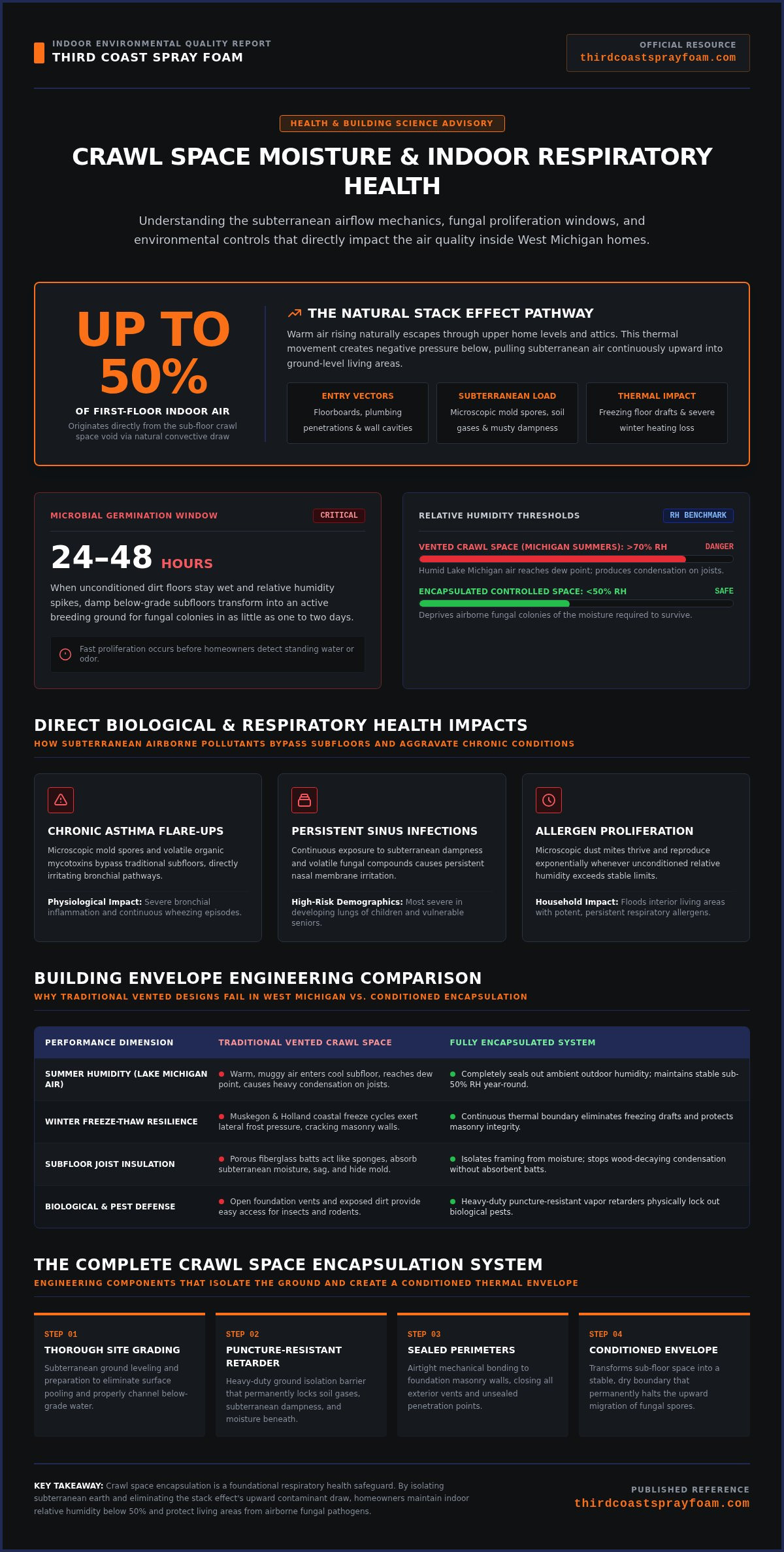
Up to 50% of the air you breathe on your home’s first floor originates directly from your crawl space due to the natural stack effect. If that sub-floor area is damp and unsealed, it continuously pulls airborne mold spores, soil gases, and musty odors straight up through your floorboards. For homeowners battling freezing winter floors and persistent allergy flare-ups, the crawl space encapsulation West Michigan properties require is far more than a simple moisture barrier; it’s a vital respiratory health safeguard for your entire household.
You shouldn’t have to tolerate lingering damp smells or worry that hidden fungal growth is compromising your family’s lungs. In this guide, you’ll discover how sealing your below-grade foundation stops moisture intrusion, lowers winter heating bills, and keeps toxic mold from taking hold. We will examine the local climate challenges affecting your indoor air quality and explain how a conditioned crawl space permanently protects your home.
Key Takeaways
- Understand how the stack effect pulls subterranean dampness and airborne fungal spores into your living spaces, directly aggravating chronic respiratory symptoms.
- Discover why traditional foundation vents fail against humid Lake Michigan summers and why professional crawl space encapsulation West Michigan properties rely on creates a permanently conditioned thermal envelope.
- Learn the critical steps of a complete system installation, including thorough site grading, heavy-duty puncture-resistant vapor retarders, and sealed foundation perimeters.
- See how isolating the ground stops wood-decaying condensation, eliminates freezing floorboard drafts, and permanently cuts winter heating loss.
Why Damp West Michigan Crawl Spaces Threaten Your Family Health
A traditional residential crawl space acts as an open gateway between the earth beneath your home and the air you breathe daily. True crawl space encapsulation transforms this sub-floor void into a sealed, conditioned building envelope system. Because of the natural stack effect, warm air rising out of your attic constantly draws subterranean air upward through subfloors, plumbing penetrations, and wall cavities. When unconditioned dirt floors stay wet, relative humidity spikes above critical thresholds, turning the foundation into a breeding zone for toxic mold and mildew within 24 to 48 hours.
To better understand how sealing your foundation envelope revolutionizes indoor living conditions, watch this helpful video:
The Direct Link Between Damp Crawl Spaces and Respiratory Illness
When subterranean relative humidity stays elevated, microscopic mold spores, volatile organic mycotoxins, and dust mite populations multiply unchecked. These airborne biological pollutants bypass standard subfloors, aggravating existing conditions and sparking adverse health outcomes:
- Chronic Asthma Flare-Ups: Microscopic spores irritate bronchial pathways, triggering severe wheezing and bronchial inflammation.
- Persistent Sinus Infections: Constant exposure to subterranean dampness inflames nasal tissues, particularly in vulnerable children and seniors.
- Allergen Proliferation: Dust mites thrive when damp conditions persist, filling interior living spaces with potent respiratory allergens.
Maintaining indoor relative humidity below fifty percent deprives fungal colonies of the moisture they need to survive. Investing in the comprehensive crawl space encapsulation West Michigan homes require permanently isolates damp earth, halting the continuous upward migration of biological contaminants and safeguarding household respiratory wellness.
Evaluating Encapsulation: Why Vented Crawl Spaces Fail in West Michigan
Decades ago, regional building codes mandated exterior vents under the mistaken assumption that outside airflow would dry out subfloors. In West Michigan, this outdated approach regularly backfires. Humid summer air drifting off Lake Michigan enters naturally cool crawl spaces, reaching its dew point and producing heavy condensation along subfloor framing. During bitter winters, repeated freeze-thaw cycles in coastal communities like Muskegon and Holland exert lateral frost pressure on uninsulated masonry, cracking foundation walls while pulling freezing drafts across your ground-level flooring.
Vented Versus Fully Encapsulated Crawl Spaces: Performance Comparison
Traditional configurations often relied on porous fiberglass batts between joists. Unfortunately, batts act like sponges; they absorb subterranean moisture, sag under excess weight, and conceal fungal blooms. Recognizing the verified health risks of mold and moisture reveals why modern building envelope designs drastically outperform open vents across several metrics:
- Humidity Control: Vented spaces easily exceed 70% relative humidity during muggy Michigan summers. Encapsulation seals out ambient humidity, keeping spaces stable year-round.
- Pest Intrusion: Vents and unsealed dirt floors offer open access for insects and rodents. Heavy-duty barrier systems physically block biological pests.
- Heating Efficiency: Vented foundations drain heat through exposed subfloors. Conditioned spaces seal warm air inside your thermal boundary.
Switching to modern crawl space insulation creates a continuous thermal break against severe winter weather. By choosing the complete crawl space encapsulation West Michigan conditions demand, you protect framing integrity and indoor air quality. If you want to eliminate moisture issues at the source, partnering with Third Coast Spray Foam ensures your foundation envelope performs reliably through every season.
The Complete Crawl Space Encapsulation Process and Modern Moisture Defense
A dependable foundation defense begins with meticulous site preparation. Specialists first clear damp organic debris, level uneven soil, and complete a detailed moisture assessment to identify hidden bulk water paths. Once the site is ready, a heavy-duty, puncture-resistant ground vapor barrier covers the dirt floor, with all overlapping seams taped and the membrane anchored securely up foundation walls. To lock out subterranean vapor transmission completely, technicians seal masonry stem walls and rim joists with impermeable closed cell spray foam. This monolithic insulation expands into irregular rim joist voids, providing an airtight thermal barrier that repels water intrusion.
Ensuring Long-Term Environmental Safety and Mechanical Moisture Control
Active mechanical control finishes the conditioned building envelope. Installing an energy-efficient crawl space dehumidifier regulates relative humidity levels below fifty percent, depriving mold spores and dust mites of the moisture they need to survive. Relying on professional installation guarantees long-term indoor safety; proper application protocols prevent chemical off-gassing, while intentional site grading eliminates hidden water pooling beneath the liner.
Investing in the full crawl space encapsulation West Michigan homes require permanently transforms an unconditioned sub-floor void into a sanitary, energy-conserving thermal asset. If musty basement odors or unexplained respiratory flare-ups affect your household, scheduling a professional crawl space evaluation provides the actionable path toward lasting home safety.
Protect Your Family and Secure Your Home Envelope
Living above a damp foundation compromises both structural timber and the air your family breathes. You don’t have to let the stack effect draw allergens, mold spores, and lake-effect humidity up through your floorboards. Investing in the complete crawl space encapsulation West Michigan homes need permanently blocks coastal freeze-thaw moisture, keeping your indoor humidity balanced and your winter floors comfortably warm.
As a Fruitport-based specialist with deep building science expertise, Third Coast Spray Foam installs impermeable closed-cell spray foam to stop sub-slab vapor drive at the perimeter. Clean indoor air always begins below grade. Take the decisive step to safeguard your household and protect your home air quality with a crawl space evaluation from Third Coast Spray Foam.
Frequently Asked Questions
How does crawl space encapsulation improve my home indoor air quality?
Crawl space encapsulation directly improves indoor air quality by sealing off the subterranean dampness and soil gases that naturally migrate upward into your living quarters. By pairing an impermeable ground retarder with conditioned air control, you stop damp earth from supplying the high humidity that fungal colonies require. This keeps airborne spores, mycotoxins, and biological allergens out of your family’s breathing zone.
Can crawl space encapsulation eliminate existing mold and musty odors?
Encapsulation eliminates musty odors by removing the subterranean moisture reservoir that fuels fungal activity. However, existing active mold colonies on wood framing must be properly cleaned before sealing the space. Once cleared, professional crawl space encapsulation West Michigan homes rely on permanently deprives dormant spores of moisture, stopping future colonization and eliminating sour odors permanently.
Why do open foundation vents make moisture problems worse in West Michigan?
Open foundation vents pull muggy outdoor air directly into shaded, cooler sub-floor cavities during humid Great Lakes summers. As warm air enters foundations across coastal areas like Grand Haven and Muskegon, its temperature drops rapidly to the dew point. This causes heavy condensation to form along structural floor joists, accelerating wood rot and creating fertile ground for toxic mold.
How does closed-cell spray foam enhance crawl space vapor barrier systems?
Closed-cell spray foam bonds directly to porous masonry walls and rim joists, creating an impenetrable thermal and moisture seal that tape and mechanical fasteners alone cannot achieve. It expands into rim joist cavities to block cold drafts, rejects bulk water penetration, and ties the ground liner into a monolithic building envelope built to withstand severe winter freeze-thaw cycles.
Disclaimer
Information provided is for general educational purposes. Individual needs and circumstances vary. Speak to an experienced professional to get the correct information for your situation.