Last November, a homeowner in East Grand Rapids noticed that every time their furnace kicked on, a distinct, musty odor filled the living room. It wasn’t just a nuisance; it was a clear sign that their home was pulling damp, unfiltered air directly from the dirt floor below. Understanding the crawl space encapsulation cost Grand Rapids homeowners face is about more than just comparing quotes. It’s about stopping the 50% of air you breathe on your first floor from originating in a damp, mold-prone environment that can trigger asthma and other chronic respiratory issues.
You likely already feel the bite of West Michigan winters through your cold floorboards and worry about the long-term impact of moisture on your home’s foundation. We’ll show you exactly how this investment protects your property’s structural integrity and your family’s health while significantly lowering your monthly Consumers Energy or DTE bills. This 2026 guide breaks down the local pricing landscape and explains why sealing your home’s thermal envelope is a permanent solution for superior indoor air quality and lasting peace of mind.
Key Takeaways
- Get a clear breakdown of 2026 market rates and square foot pricing to accurately budget for your West Michigan home’s protection.
- Understand how the “Stack Effect” pulls moisture and mold spores into your living area, and learn how to stop these environmental triggers from compromising your family’s respiratory health.
- Discover the technical standards for a dry home, including why 20-mil vapor barriers and closed-cell spray foam are essential for creating a permanent, airtight seal.
- Calculate your potential return on investment, as the crawl space encapsulation cost Grand Rapids families pay is often offset by 15-25% lower energy bills and higher property resale value.
- Identify the critical licensing and quality markers to look for when choosing a local partner dedicated to your home’s structural integrity and total indoor air quality.
Understanding Crawl Space Encapsulation Cost in Grand Rapids
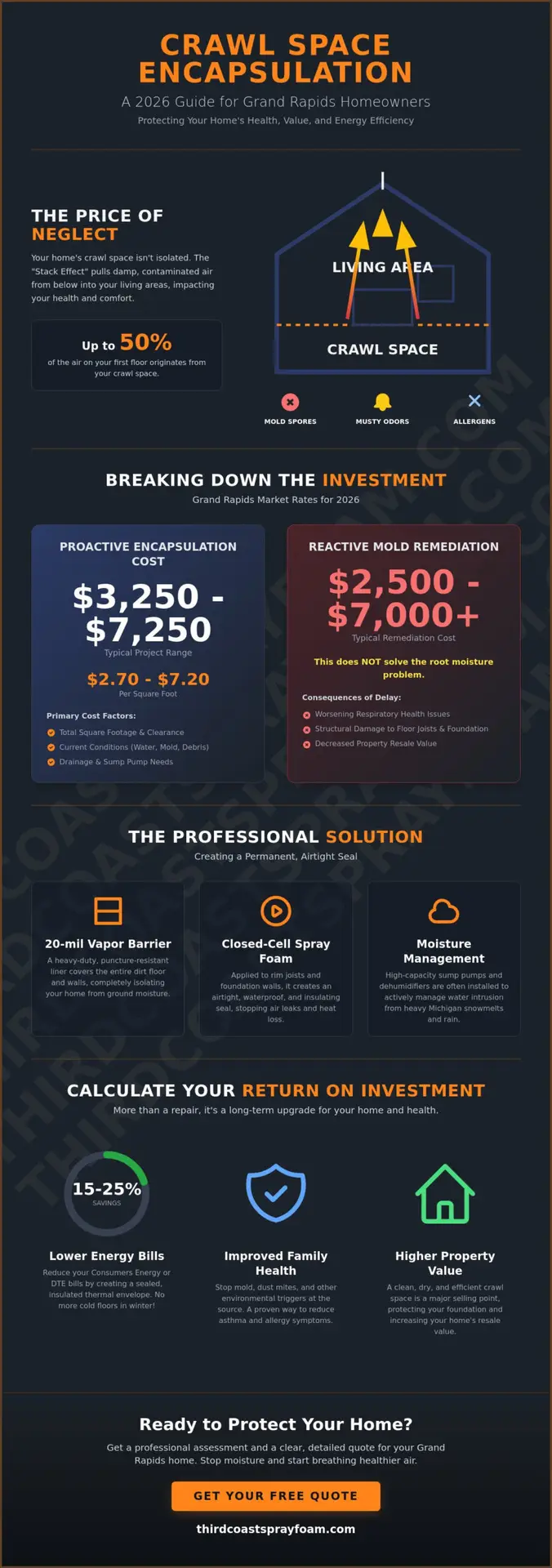
Investing in your home’s foundation is about more than just structural integrity; it’s about the air your family breathes every day. For the 2026 season, the average crawl space encapsulation cost Grand Rapids homeowners should budget for ranges between $3,250 and $7,250 for a full professional system. This investment creates a permanent barrier between your living space and the damp Michigan earth. Understanding What is a Crawl Space? helps clarify why this area is so susceptible to moisture and why sealing the envelope is a critical step for total home health.
On a per-square-foot basis, most West Michigan projects fall between $2.70 and $7.20. The variation in price usually reflects the complexity of the moisture management system required. West Michigan’s lake-effect humidity isn’t just a weather pattern; it’s a direct threat to your respiratory health. High humidity levels in unsealed spaces trigger mold growth and dust mite infestations that eventually migrate into your upper floors. Our team also considers the local geography. The sandy soils found in parts of Cascade drain differently than the heavy clay common in other Kent County neighborhoods, which can significantly impact the cost of necessary drainage upgrades.
Primary Variables Affecting Your Quote
Total square footage and the vertical clearance available for our technicians are the first factors we assess during an inspection. A tight, 18-inch crawl space requires more labor-intensive work than a taller space where movement is easier. We also evaluate the current state of the environment. If we find standing water, existing mold, or old construction debris, these must be remediated first to ensure a clean, healthy foundation. Local labor rates across the Kent and Ottawa County markets are factored into these quotes to ensure we provide the specialized expertise your property deserves.
The “Michigan Factor”: Frost Lines and Foundation Depth
Michigan building codes require a 42-inch frost line depth. This means your foundation is constantly interacting with significant ground moisture and temperature shifts. This below-grade protection is vital because lake-effect precipitation can quickly overwhelm a standard, unsealed crawl space. We often find that high-capacity sump pumps are a necessary addition to handle sudden snowmelts or heavy spring rains in the Grand Rapids area. Additionally, permit costs and specific local building codes in Grand Rapids and Lansing ensure that every encapsulation meets strict safety standards for indoor air quality and structural stability. By addressing these factors, we provide a pragmatic solution that protects both your respiratory health and your financial investment.
The Price of Neglect: Mold, Air Quality, and Respiratory Health
In Grand Rapids, many homeowners treat the crawl space as an isolated area that doesn’t affect the rest of the house. Physics proves otherwise. Your home functions like a vacuum through a process known as the “Stack Effect.” As warm air rises and escapes through your roof, it creates negative pressure that pulls air upward from the soil. Scientific data confirms that up to 50% of the air you breathe on the main floor of your home originates in your crawl space. If that space is damp and unsealed, you’re breathing in whatever is growing beneath your floorboards.
Damp foundations are the primary breeding grounds for mold spores and dust mites. These biological triggers are more than just a nuisance; they’re a direct threat to your family’s respiratory wellness. A 2023 report from the Asthma and Allergy Foundation of America highlights how poor indoor air quality acts as a primary catalyst for chronic allergies and asthma attacks. By prioritizing controlling moisture in your crawlspace, you’re making a proactive investment in preventative healthcare. This health-centric perspective is why the crawl space encapsulation cost Grand Rapids families pay is often viewed as a medical ROI rather than just a home repair expense.
Mold Remediation vs. Prevention
Delaying encapsulation often leads to the high cost of professional mold removal. In West Michigan, professional remediation for a standard crawl space can range from $2,500 to over $7,000 depending on the severity of the infestation. We frequently identify Michigan mold varieties like Cladosporium, Penicillium, and Aspergillus in untreated foundations. These species thrive in the 70% relative humidity common in local crawl spaces. Sealing the thermal envelope stops this moisture-driven growth at the source, saving you from the recurring costs of temporary cleaning solutions.
Improving Indoor Air Quality (IAQ)
High-performance vapor barriers serve as a critical defense against more than just water. They block harmful soil gases, including radon and methane, from entering your living areas. When our team installs these barriers, we focus on reducing humidity to below 55%, which is the threshold where dust mites and most fungal species can no longer survive. The physiological health of a home’s occupants is directly tied to the psychrometric management of the foundation’s air temperature and relative humidity. If you’re concerned about the air your family is breathing, our specialists at Third Coast Spray Foam can assess your home’s unique needs to create a permanent barrier against pollutants.
Breaking Down the Components of a Professional Encapsulation
A professional encapsulation is a high-performance system designed to isolate your home from the earth. While the initial crawl space encapsulation cost Grand Rapids homeowners face depends on the square footage, the quality of components dictates the long-term return on investment. We don’t just lay down plastic. We create a controlled environment that protects your foundation and your family’s respiratory health.
The foundation of this system is a heavy-duty vapor barrier. While big-box stores sell thin 6-mil plastic, the West Michigan standard for a durable seal is a 20-mil reinforced liner. This thickness prevents tears from traffic and effectively blocks soil gases and moisture from entering your air supply. We pair this with the Third Coast Advantage: using closed cell spray foam to seal the rim joists. This creates an airtight thermal break where the house meets the foundation, stopping humid summer air and freezing winter drafts in their tracks.
To maintain a healthy indoor environment, we install dedicated dehumidification systems. These units are programmed to keep relative humidity in the “sweet spot” of 45% to 55%. This range is critical because mold spores and dust mites thrive once humidity levels cross the 60% threshold. For homes in high-water-table areas near the Grand River, we integrate drainage solutions like sump pumps and French drains to ensure standing water never compromises the encapsulation system.
Why Material Choice Matters for Your ROI
Choosing the right materials determines whether your encapsulation lasts five years or fifty. When comparing spray foam to traditional crawl space insulation, the difference is clear. Fiberglass batts often fail in Michigan because they act like a sponge, absorbing moisture and eventually sagging under their own weight. This damp material becomes a breeding ground for mold, which can trigger asthma and other respiratory issues. Professional-grade 20-mil liners and closed cell foam don’t degrade or support mold growth, ensuring your crawl space encapsulation cost Grand Rapids investment provides permanent protection rather than a temporary fix.
The Sealing Process: Rim Joists and Box Sills
The rim joist and box sill area is often the leakiest part of a Grand Rapids home. Air infiltration here forces your HVAC system to work 20% harder and leads to the “cold floor” syndrome many homeowners experience in January. Our team focuses on creating an airtight seal in these cavities to complete the home’s thermal envelope. By identifying and sealing these air leaks, we stop the “stack effect” that pulls allergens and damp air from the crawl space up into your living areas. This process is essential for total home energy efficiency and consistent indoor air quality.
ROI Analysis: Energy Savings and Property Value
Investing in your home’s foundation is about more than just stopping a leak. While the initial crawl space encapsulation cost Grand Rapids residents encounter might seem like a large upfront expense, the long-term financial and health returns are substantial. On average, homeowners in West Michigan see a 15% to 25% reduction in their monthly heating and cooling expenses. This happens because your HVAC system no longer fights against the humid, unconditioned air seeping up through your floorboards. Beyond the bills, this process creates a critical barrier against mold and mildew. By managing moisture, you’re directly protecting the respiratory health of everyone in your household and ensuring that indoor air quality remains high.
Property value also sees a significant boost from this investment. Local home inspectors in Kent County prioritize dry, stable crawl spaces during pre-sale evaluations because they indicate a well-maintained structure. A vented, damp crawl space is a red flag for wood rot and sagging floor joists, which often lead to structural repairs costing $10,000 or more. Encapsulation preserves the structural integrity of your home’s skeleton and prevents the “bouncy floor” syndrome caused by moisture-weakened wood. You can also lower your net investment by leveraging the energy efficient home improvement credit, which provides a federal tax incentive for qualifying upgrades that seal the home’s thermal envelope.
Calculating Your Long-Term Savings
Most homeowners find that encapsulation pays for itself through energy savings alone within 5 to 7 years. Because the air under your home is now dry and temperature-controlled, your HVAC system doesn’t have to cycle as frequently to maintain comfort. This reduces mechanical wear and tear, potentially extending the lifespan of your furnace or air conditioner by several years. For the 2026 tax year, Michigan homeowners can claim 30% of the project cost, capped at an annual limit of $1,200 for weatherization and insulation improvements under the current federal guidelines.
Encapsulation vs. Traditional Venting
The old philosophy of using foundation vents to let the house breathe fails in our Great Lakes climate. During a humid Grand Rapids summer, open vents allow heavy, moisture-laden air into the cool space under your home. This causes condensation on wood and insulation, creating the perfect breeding ground for mold spores. These spores eventually travel upward into your living areas, compromising indoor air quality and triggering respiratory issues. Maintaining an encapsulated space is significantly cheaper than the recurring costs of mold remediation or replacing fiberglass batts that have become sodden and useless. It’s a permanent solution for a permanent climate challenge.
Protect your home and your family’s health with a permanent moisture solution. Schedule your professional crawl space inspection today.
Choosing the Right Grand Rapids Encapsulation Partner
Selecting a contractor for your home in West Michigan requires a focus on local accountability and technical precision. You aren’t just buying a vapor barrier; you’re investing in a dry, stable foundation. To ensure your investment is protected, verify that any professional you hire holds a valid Michigan Residential Builder’s License and carries comprehensive liability insurance. Data from BrightLocal in 2023 shows that 90% of consumers use online reviews to evaluate local contractors, so look for a partner with a consistent track record across Kent and Ottawa counties.
A transparent, no-nonsense quote is essential. This document should detail every component of the project, from debris removal to the final seal. Understanding your crawl space encapsulation cost Grand Rapids requires looking beyond the initial price tag to the long-term ROI of a healthy home. A cheap, poorly installed barrier will fail within 5 years, leading to recurring mold growth and wasted energy. Third Coast Spray Foam focuses on permanent solutions that address the “Total Home Health” of your property, ensuring your family breathes cleaner air for decades.
Questions to Ask Your Contractor
- Do you provide a written warranty for the vapor barrier? A reputable installer should offer a guarantee on both materials and labor to protect against tears or seam failures.
- What specific type of insulation do you use for rim joists? We recommend closed-cell spray foam because it provides a high R-value and acts as an airtight seal against Michigan’s lake-effect humidity.
- How do you handle existing mold or moisture issues before sealing? Encapsulating over active mold is dangerous. Ensure your contractor uses professional remediation or EPA-approved antimicrobial treatments to stabilize the space first.
The Third Coast Commitment
Our team understands the unique climate challenges of West Michigan. We know that the high humidity levels in Grand Rapids, Muskegon, and Holland can turn a vented crawl space into a breeding ground for allergens. We prioritize your respiratory health by sealing the thermal envelope with high-performance spray foam. This prevents the “stack effect,” where damp, mold-laden air from the ground is pulled up into your living rooms. While the crawl space encapsulation cost Grand Rapids varies based on square footage, the cost of ignoring indoor air quality is always higher.
We believe your home should be a sanctuary, not a source of health concerns. By focusing on air quality and moisture control, we provide a holistic system that lowers utility bills and protects your family’s physical well-being. If you’re ready to secure your property, the next step is a professional assessment. We’ll walk through your crawl space, identify specific vulnerabilities, and provide a clear plan for a healthier home environment.
Secure Your Foundation and Family Health
Your crawl space shouldn’t be a source of hidden stress or chronic sickness. Since 2013, Third Coast Spray Foam has helped West Michigan homeowners reclaim their indoor air quality by sealing out the dampness that triggers mold growth and respiratory issues. The EPA reports that indoor pollutants can be 2 to 5 times higher than outdoor levels; much of that contaminated air rises directly from your home’s foundation. By utilizing expert installation of closed-cell spray foam, we create a permanent barrier that protects your family’s lungs and stabilizes your property’s thermal envelope. While the crawl space encapsulation cost Grand Rapids residents plan for depends on specific site conditions, the long-term ROI is found in lower utility bills and the prevention of expensive structural repairs. Don’t let moisture compromise your well-being or your home’s integrity. We prioritize a health-first approach to ensure every breath you take is clean and safe. Our team is ready to help you build a more resilient home starting from the ground up.
Get Your Free Crawl Space Encapsulation Quote in Grand Rapids
Frequently Asked Questions
Is crawl space encapsulation worth the cost in Michigan?
Encapsulation is a high-value investment for Michigan homeowners because it permanently addresses the 50% of indoor air that rises from your crawl space. By sealing the thermal envelope, you prevent the stack effect from pulling damp, mold-laden air into your living areas. This protection reduces energy bills by an average of 15% to 20% according to Department of Energy benchmarks. It’s a pragmatic choice for long-term structural integrity and family wellness.
How much does full crawl space encapsulation cost per square foot in 2026?
National industry data for 2026 indicates that the crawl space encapsulation cost Grand Rapids residents might expect ranges from $5 to $10 per square foot. Total project expenses depend on the condition of your foundation and whether supplemental drainage or structural repairs are necessary. While the upfront investment is measurable, the return comes through lower utility costs and the prevention of expensive structural damage caused by persistent West Michigan moisture.
Can I encapsulate my crawl space myself to save money?
You can attempt a DIY installation, but most homeowners find that achieving a 100% airtight seal is difficult without professional-grade materials. Improperly sealed vapor barriers can trap moisture against wooden floor joists, leading to hidden rot and wood-destroying fungi. Our team uses specialized spray foam to ensure a continuous thermal envelope. Professional installation also guarantees that gas-fired appliances in the home continue to vent safely without backdrafting risks.
Does crawl space encapsulation help with allergies and asthma?
Encapsulation directly improves respiratory health by cutting off the source of 40% of indoor allergens. Damp crawl spaces are breeding grounds for mold and dust mites, which trigger asthma attacks and chronic sinus issues. By maintaining a dry environment, we eliminate these triggers and improve your home’s total health. This proactive approach ensures that the air your family breathes is clean, dry, and free from microscopic environmental pollutants.
How long does a professional crawl space encapsulation last?
A professionally installed encapsulation system typically lasts 20 to 25 years when high-quality 20-mil liners and closed-cell spray foam are used. These durable materials are designed to withstand the heavy moisture loads common in the Great Lakes region. Unlike simple plastic sheets that tear or shift, a complete seal creates a permanent barrier. Regular annual inspections of your dehumidifier ensure the system continues to protect your home’s foundation for decades.
Does homeowners insurance cover the cost of encapsulation?
Standard homeowners insurance policies generally don’t cover the crawl space encapsulation cost Grand Rapids homeowners pay for preventative maintenance. Insurance is designed for sudden and accidental events rather than gradual moisture intrusion or mold growth. However, investing in encapsulation can prevent the types of structural claims that insurance companies often deny. Think of it as a security measure that protects your property value and reduces future liability from environmental hazards.
What is the difference between a vapor barrier and encapsulation?
A vapor barrier is a thin plastic sheet that only covers the dirt floor to slow down moisture. Encapsulation is a comprehensive solution that seals the floor, foundation walls, and all exterior vents to create a conditioned space. This process involves air sealing the entire thermal envelope to prevent humid air from entering. While a barrier provides basic protection, encapsulation offers the total home health benefits required to stop mold and rot.
How do I know if my Grand Rapids home needs encapsulation?
Your home needs encapsulation if you notice persistent musty smells or if your indoor humidity levels stay above 55%. High moisture in the crawl space often manifests as cupping hardwood floors or visible condensation on basement pipes. In our local climate, cold floors during Michigan winters are another sign that your thermal envelope is failing. If you see standing water or wood rot, it’s time to secure your home’s structural integrity.
Disclaimer
Information provided is for general educational purposes. Individual needs and circumstances vary. Speak to an experienced professional to get the correct information for your situation.