
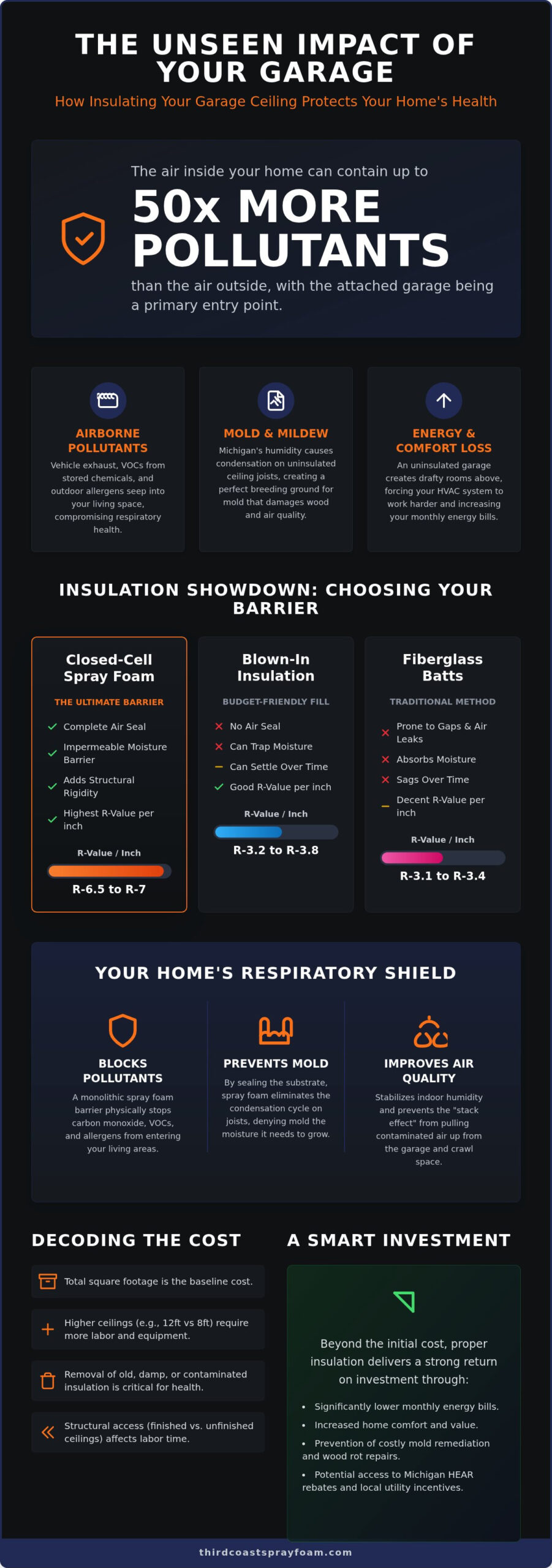
Did you know the air inside your home can contain up to 50 times more pollutants than the air outside, simply because of your attached garage? Most West Michigan homeowners view their garage as just storage, but it’s actually a vital barrier for your home’s respiratory health. When you evaluate the cost to insulate a garage ceiling Grand Rapids homeowners often find the investment is as much about air quality as comfort. If you’ve noticed drafty rooms upstairs or mold on your joists, you aren’t alone.
In this guide, we’ll break down the factors driving these 2026 project prices. We’ll also show you how the right insulation can stop moisture and keep your family breathing easier. With federal tax credits expired, we’ll explore state-level HEAR rebates and how closed-cell spray foam blocks vehicle exhaust. You’ll find everything needed to make a smart, health-conscious investment for your property’s long-term well-being.
Key Takeaways
- Understand how structural factors like ceiling height and the removal of old, moisture-damaged materials determine the total cost to insulate a garage ceiling Grand Rapids homeowners face in 2026.
- Identify the critical link between professional air sealing and your home’s indoor air quality to prevent vehicle exhaust and VOCs from entering your living areas.
- Learn how high-performance insulation manages Michigan’s humidity to stop the condensation cycles that lead to mold growth on your ceiling joists.
- Discover how to stack 2026 Michigan HEAR rebates and local utility incentives to maximize your return on investment and lower monthly energy bills.
Factors Driving the Cost to Insulate a Garage Ceiling in Grand Rapids
Every garage in Grand Rapids is unique, and several variables dictate the final cost to insulate a garage ceiling Grand Rapids residents should budget for. Total square footage is the baseline, but vertical reach adds complexity. Working 12 feet up requires specialized equipment and more labor hours than a standard 8-foot ceiling. It’s about safety and ensuring the material reaches every corner of the overhead space.
We also evaluate existing materials. If old insulation is damp, settled, or contaminated by pests, it often becomes a breeding ground for mold. Removing these materials is a critical first step to protect your indoor air quality and respiratory health. Structural accessibility also dictates the labor involved:
- Unfinished ceilings: Allow for direct application to joists and easier air sealing.
- Finished ceilings: Require strategic access points to ensure a complete thermal seal without total demolition.
- Joist spacing: Narrow or non-standard cavities require more technical precision during material distribution.
To better understand how these structural factors come together during an installation, watch this helpful video:
Material Choice: High-Performance Spray Foam vs. Blown Insulation
Choosing between materials is your most significant decision. Closed-cell spray foam offers the highest R-value per inch, which is vital for the shallow cavities often found in garage ceilings. While blown in insulation offers a lower upfront price, it lacks the dense air-sealing power of foam. We don’t recommend fiberglass batts because they often sag over time. This creates gaps where moisture collects, leading to mildew growth and compromising your home’s structural integrity and your family’s respiratory wellness.
Protecting Respiratory Health Through Proper Garage Air Sealing
Attached garages are a primary source of indoor air pollutants. Poorly sealed ceilings allow harmful substances to seep into the rooms above, directly impacting your respiratory health. To see how professional surface sealing can further improve your environment, you can check out Drip Epoxy Flooring for examples of high-performance coating options. These irritants often include:
- Carbon monoxide from vehicle exhaust
- Volatile organic compounds (VOCs) from stored fuel or paint
- Outdoor allergens and fine particulate matter
By using professional spray foam, we create a monolithic air barrier. This doesn’t just stop drafts; it physically blocks these irritants from migrating into your living space. When you evaluate the cost to insulate a garage ceiling Grand Rapids families should prioritize this barrier to ensure the air they breathe is clean and safe.
Moisture management is equally critical in West Michigan. During our humid summers, warm air often condenses on cool ceiling joists. This cycle creates the perfect environment for mold and mildew growth. When we calculate the total cost to insulate a garage ceiling Grand Rapids projects often include air sealing to prevent this. Unlike materials that trap moisture, spray foam seals the substrate. This prevents the condensation that leads to structural wood rot and airborne spores. While federal incentives have changed, staying informed on current Michigan tax credits and state rebates helps offset the investment in these high-performance materials.
Mold Prevention and Indoor Air Quality (IAQ) Standards
A healthy home operates as a single, integrated system. This is why we often recommend pairing garage sealing with professional crawl space insulation. When both areas are controlled, indoor humidity levels stabilize. This reduction in moisture prevents the “stack effect” from pulling contaminated air through your floors and ceilings. If you’re concerned about lingering odors or dampness, our team can provide a comprehensive insulation assessment to identify hidden air leaks.
Calculating ROI: Energy Savings and Michigan Tax Credits
When calculating the cost to insulate a garage ceiling Grand Rapids homeowners should look beyond the initial invoice to the long-term ROI. In many two-story homes across West Michigan, an uninsulated garage creates a “chimney effect.” This occurs when warm air escapes through the garage ceiling, pulling cold air into the living spaces above. By stopping this thermal transfer, you’ll see a direct reduction in monthly utility bills. High-performance materials like closed cell spray foam also increase property value. Buyers in our region prioritize efficiency and the structural integrity that comes from preventing moisture-related mold growth.
Professional-grade solutions offer a permanent fix. DIY kits or low-end materials often sag or degrade within just a few seasons. This failure doesn’t just waste money; it compromises your home’s air quality by allowing dampness to linger. Our focus on precision ensures your investment remains intact for decades, protecting your family’s respiratory health from airborne irritants and allergens.
Navigating the 2026 Energy Efficient Home Improvement Credit
While the federal 25C tax credit expired at the end of 2025, staying informed on the Energy Efficient Home Improvement Credit remains vital for tracking potential extensions or state-level replacements. In 2026, the focus has shifted to Michigan’s HEAR and HOMES rebates, which offer up to $1,600 or $8,000 respectively based on household income and energy savings. To qualify for any energy efficient home improvement credit or rebate, you must meet strict R-value standards and provide professional documentation. Combining your garage project with other upgrades can help you maximize these state funds while ensuring a healthier home environment.
Investing in a Healthier, More Efficient West Michigan Home
Investing in high-performance insulation is a commitment to your home’s longevity and your family’s respiratory wellness. By choosing professional air sealing, you effectively block vehicle exhaust and allergens from migrating into your living spaces. When you consider the total cost to insulate a garage ceiling Grand Rapids homeowners must weigh initial pricing against the long-term protection from moisture and mold. Our team of expert West Michigan contractors specializes in health-focused air sealing technology that stabilizes indoor humidity and utilizes 2026 tax credit eligible solutions. To complete your garage transformation, high-performance floor systems from Elite Concrete Coatings provide a durable finish that complements your new ceiling insulation. We take pride in delivering results that lower your utility bills and improve your air quality. Ready to secure your home’s thermal envelope? Request Your Free Garage Insulation Estimate in Grand Rapids today to start your journey toward a more comfortable, energy-efficient property.
Is spray foam worth the extra cost for a garage ceiling in Michigan?
Yes, spray foam is the most effective choice for Michigan’s extreme temperature swings and high humidity. It provides a complete air seal that prevents condensation from forming on your ceiling joists. While the cost to insulate a garage ceiling Grand Rapids homeowners pay for foam is higher than blown-in options, it’s the only material that permanently stops mold growth and protects your respiratory health.
Can I stay in my home while the garage ceiling is being spray foamed?
You can typically remain in your home during the installation, but you must stay out of the garage and any rooms directly above it. We require a 24-hour period for the foam to fully cure and off-gas. This safety protocol is vital for maintaining your indoor air quality and ensuring that your family isn’t exposed to any airborne particulates during the application process.
Will insulating my garage ceiling prevent the room above from being cold?
Insulating the garage ceiling is the most effective way to stop cold floors in the rooms above. Without a proper thermal barrier, your home’s heat escapes through the floor and into the unconditioned garage space. Our high-performance spray foam creates a monolithic seal that stops this heat loss. This improves your daily comfort and reduces the strain on your heating system during West Michigan winters.
How long does it take to professionally insulate a standard 2-car garage ceiling?
A standard two-car garage ceiling usually takes one full day to complete. This timeframe includes setting up protective barriers, applying the insulation, and performing a thorough site cleanup. If your project involves professional insulation removal of old, moisture-damaged materials, we may need a few additional hours. Our crews prioritize efficiency to restore your home’s structural integrity and air quality as quickly as possible.
Disclaimer
Information provided is for general educational purposes. Individual needs and circumstances vary. Speak to an experienced professional to get the correct information for your situation.