
What if the biggest threat to your Grand Rapids business isn’t the fluctuating West Michigan market, but the invisible air circulating inside your own building? You likely already know that managing a commercial property in Climate Zone 5 means battling high heating and cooling overhead every single season. It’s frustrating to watch profits leak through drafty walls while worrying about how hidden moisture and mold might impact your staff’s respiratory health. Choosing the right commercial spray foam insulation Grand Rapids solution is no longer just about comfort; it’s a strategic move for your facility’s long-term financial and physical viability.
This guide demonstrates how high-performance spray foam can transform your facility into a sealed, efficient environment that protects your bottom line and secures employee well-being. By investing in professional insulation, you’re securing long-term energy savings and vital structural reinforcement for your property. We’ll explore how meeting the 2021 Michigan Energy Code standards with closed cell or open cell spray foam secures your building’s integrity while leveraging 2026 tax incentives, such as the 179D deduction available for projects starting by June 30, 2026.
Key Takeaways
- Learn how advanced air sealing prevents mold growth and protects your team’s respiratory health in the humid West Michigan climate.
- Understand the critical differences between open cell and closed cell spray foam to choose the right R-value and structural reinforcement for your building.
- Discover how professional commercial spray foam insulation Grand Rapids secures your compliance with the latest Michigan Energy Code and federal tax incentives.
- Calculate the long-term ROI of a sealed building envelope through reduced utility overhead and increased commercial property resale value.
- Explore why partnering with a local specialist ensures your insulation system works holistically to maintain superior indoor air quality.
High-Performance Commercial Insulation for the Grand Rapids Climate
In West Michigan, the weather doesn’t just stay outside; it actively tries to penetrate your building’s perimeter. High humidity from Lake Michigan and intense temperature swings create a constant pressure on your facility’s structure. Traditional materials often fail to stop the air movement that carries moisture deep into your wall cavities. This is why we view Spray foam insulation as a total building envelope solution rather than just a thermal barrier. By creating a monolithic seal, commercial spray foam insulation Grand Rapids protects the entire perimeter from our aggressive Lake Effect climate.
To see how this application looks in a professional setting, watch this demonstration of a shop application:
Many older structures in the city suffer from what experts call “sick building syndrome.” This occurs when poor ventilation and porous insulation allow pollutants to linger and moisture to accumulate. High-performance commercial spray foam insulation Grand Rapids addresses this by acting as a physical shield. It stops the uncontrolled infiltration of dust and outdoor allergens that often bypass fiberglass batts. This transition to a sealed environment is the first step in reclaiming control over your facility’s health and operational efficiency.
Combating Moisture and Mold in West Michigan
Grand Rapids businesses often struggle with condensation in commercial roof decks during the winter months. When warm indoor air hits a cold roof, moisture forms, leading to rot and mold. Our installation process eliminates the gaps where air meets cold surfaces. For local warehouses and industrial spaces, closed cell spray foam acts as a built-in vapor barrier that prevents moisture from migrating through the building assembly. This proactive approach significantly reduces the risk of mold-related respiratory issues for your employees, ensuring the air they breathe remains clean and dry.
The Impact on Respiratory Health and Occupant Wellness
Indoor air quality is a primary pillar of workplace safety. By reducing the infiltration of Grand Rapids smog and seasonal allergens, you create a cleaner environment for everyone on the clock. This stability also reduces thermal stress. Employees perform better when they aren’t dealing with drastic temperature fluctuations or drafty workstations. We align our projects with EPA standards for healthy commercial environments to ensure your team stays healthy and focused throughout the work week. It’s about creating a space that supports the people who make your business run.
Closed Cell vs. Open Cell: Which is Right for Your Commercial Project?
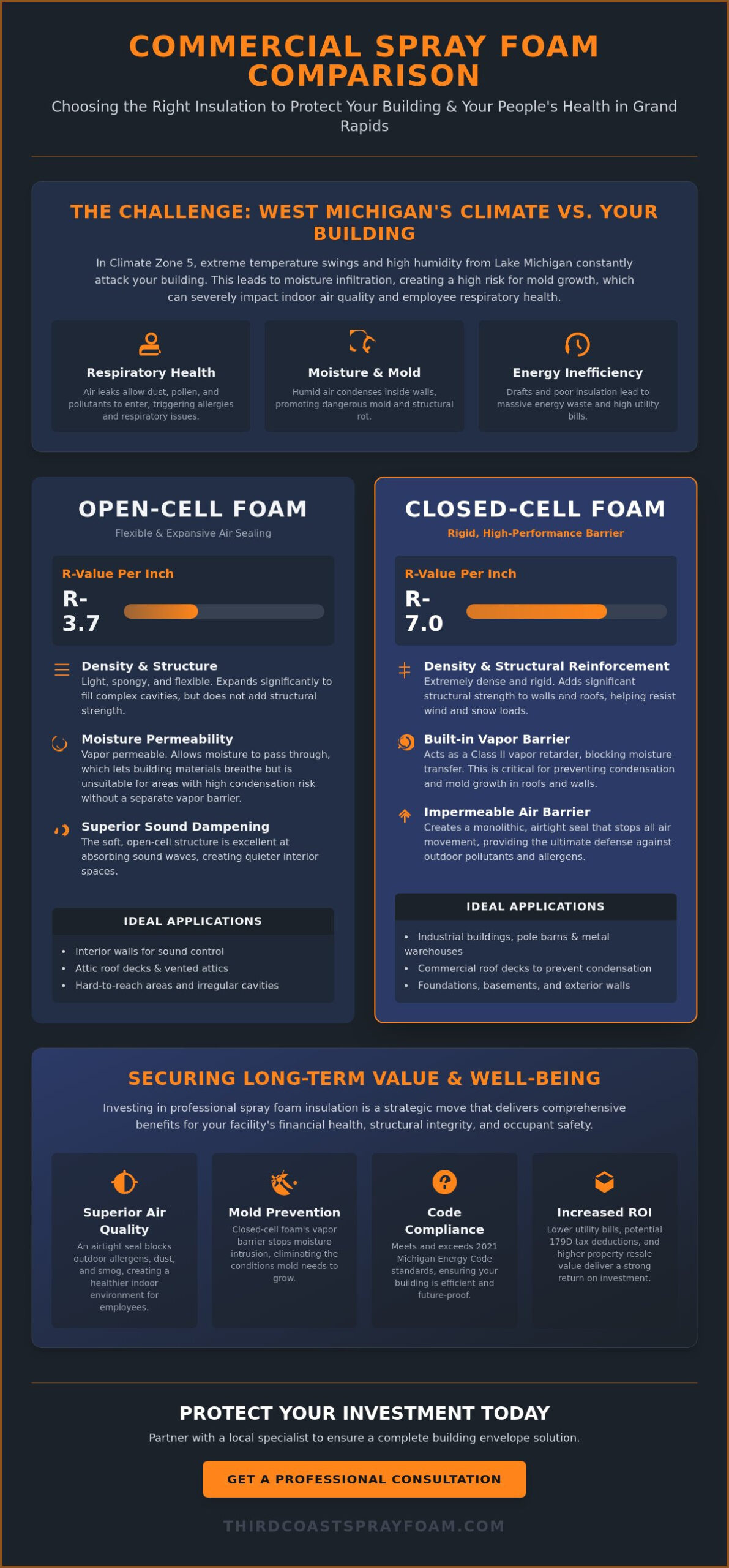
Selecting the right material for your commercial spray foam insulation Grand Rapids project depends on your building’s architecture and operational goals. While both options provide an airtight seal, they differ significantly in density and thermal resistance. We evaluate each project based on commercial insulation performance data to ensure the chosen system meets Michigan’s Zone 5 requirements. Closed cell foam offers approximately R-7.0 per inch, while open cell provides around R-3.7. This technical difference affects your wall thickness and the total thermal protection of your facility.
Closed Cell Foam: The Industrial Powerhouse
We often recommend closed cell spray foam for industrial environments where durability is paramount. This material is incredibly dense and rigid. It actually adds structural strength to the building assembly. For Grand Rapids pole barns and metal warehouses, this reinforcement is vital against heavy snow loads and high winds. It also functions as a Class II vapor retarder. This means it stops moisture from migrating through masonry or steel walls, which is the primary defense against mold growth and subsequent respiratory issues for your staff. It’s a permanent investment in the physical and financial health of your property.
Open Cell Foam: Precision Air Sealing and Acoustics
Open cell foam is a cost-effective solution for interior commercial applications and multi-unit office spaces. Its soft, flexible nature allows it to expand into complex architectural details that other materials can’t reach. It’s particularly effective at dampening noise. If your business operates in a high-traffic Grand Rapids office, open cell foam creates a quieter, more focused workspace by absorbing sound waves between rooms. While it doesn’t provide the same structural rigidity as closed cell, it excels at maintaining superior indoor air quality by sealing out dust and allergens. This helps prevent the accumulation of environmental triggers that can compromise employee wellness.
Choosing between these two systems requires a pragmatic look at your building’s needs. Whether you need the rugged protection of a vapor barrier or the acoustic benefits of a flexible seal, we help you navigate these technical choices with confidence. If you’re ready to secure your facility’s future, our team specializes in applying closed cell spray foam to protect your investment and ensure a healthier workplace.
The Business Case: ROI, Energy Credits, and Long-Term Value
When analyzing the ROI of commercial spray foam insulation Grand Rapids, business owners must look beyond simple monthly bill reductions. A building’s efficiency is a tangible asset that directly influences its market valuation. High-performance insulation transforms a drafty warehouse or office into a high-efficiency facility, which significantly increases the total resale value of commercial real estate. Prospective buyers in West Michigan prioritize properties with documented low overhead and superior building envelope integrity. By sealing the structure now, you’re building equity that pays dividends long before you ever decide to sell.
Strategic property managers also use insulation to lower immediate capital expenditures. Properly installed commercial spray foam insulation Grand Rapids allows for the specification of smaller, more affordable HVAC units during building retrofits. Because the building maintains its temperature more effectively, you don’t need oversized, expensive equipment to combat the Lake Effect winters. This reduction in HVAC load doesn’t just save money on the initial purchase; it also lowers ongoing maintenance costs and extends the lifespan of your mechanical systems. These savings contribute directly to your ESG goals and can be a cornerstone for achieving LEED certification.
Leveraging the 2026 Energy Efficient Home Improvement Credit
For owners of mixed-use properties, navigating the energy efficient home improvement credit is a critical step in 2026. While some credits target residential units, the Section 179D Energy Efficient Commercial Building Deduction offers a powerful incentive for pure commercial spaces. This federal deduction is available for projects starting by June 30, 2026. It provides a base deduction starting at $0.50 per square foot for a 25% improvement in efficiency, scaling up to $1.00 per square foot for a 50% improvement. We also recommend partnering with local Grand Rapids utilities like Consumers Energy or DTE to identify custom rebates that further offset your initial investment.
Protecting the Foundation and Building Health
A building’s health starts at the ground level. Professional crawl space insulation prevents commercial foundation rot by stopping the upward migration of moisture. This moisture is the primary catalyst for mold growth, which can quickly compromise the respiratory health of everyone in the building. By eliminating damp environments, you also remove nesting sites for pests that can damage structural components. Unlike traditional materials that sag or degrade over time, high-performance spray foam acts as a permanent investment that maintains its thermal and structural properties for the life of the building. This long-term stability ensures that your indoor air quality remains high and your maintenance budget remains low.
Commercial Installation: Logistics and Local Requirements
Executing a commercial spray foam insulation Grand Rapids project requires more than just technical skill; it demands a deep understanding of local logistics and regulatory standards. Michigan’s Part 10 Energy Code, which became effective on April 22, 2025, sets strict requirements for the building envelope in Climate Zone 5. Our team ensures every application meets or exceeds these standards, focusing on air leakage mandates and functional performance testing. This compliance isn’t just a legal hurdle. It’s a guarantee that your building will perform as intended for decades to come.
We understand that business continuity is a primary concern for property managers. Large-scale applications involve specific staging and safety protocols to protect your assets and equipment. We utilize high-capacity ventilation systems to manage indoor air quality during the application process. This ensures re-occupancy times are minimized and the environment remains safe for your staff. By adhering to rigorous safety standards, we prevent the lingering odors or respiratory irritants that can occur with improper installations. Our goal is to provide a seamless transition to a healthier, more efficient workspace.
West Michigan Specific Challenges
Older downtown Grand Rapids buildings often have significant air bypass issues through rim joists and box sills. These gaps allow cold air and moisture to enter, which can lead to mold growth and compromised respiratory health for occupants. In the agricultural and industrial sectors, pole barn insulation requires a specialized approach to handle large spans of metal and high internal humidity. We typically recommend scheduling these retrofits during the spring or fall. The moderate Michigan temperatures during these seasons are ideal for achieving the perfect chemical bond and cure rate for the foam.
The Commercial Installation Roadmap
A successful commercial spray foam insulation Grand Rapids project follows a logical, grounded process. We begin with a comprehensive site assessment. This often includes thermal imaging to pinpoint exactly where your building is losing heat and where moisture might be accumulating. Surface preparation is the next critical step. We protect your commercial equipment and ensure that masonry or steel surfaces are clean and ready for the foam to adhere. Finally, we move to the application phase. Our specialists apply the foam in precise layers, followed by trimming and a rigorous quality control inspection to verify the seal’s integrity. If you’re ready to secure your facility’s perimeter, schedule a professional site assessment with our West Michigan specialists today.
Partnering with Third Coast Spray Foam for Your Grand Rapids Business
Choosing a partner for your facility’s energy and health upgrades is a decision that impacts your business for decades. We’ve dedicated ourselves to the West Michigan commercial and industrial community by providing solutions that prioritize long-term security. Our team doesn’t just apply product; we engineer integrated systems designed to stabilize your indoor environment. By focusing on health-first insulation, we ensure that your property remains a safe place for your employees to work. This commitment to quality is why we utilize professional-grade equipment and maintain a staff of highly trained installers who understand the nuances of the local climate.
We view every commercial spray foam insulation Grand Rapids project through a lens of pragmatism and reliability. It’s not about flashy marketing; it’s about tangible results you can see on your utility bills and feel in the air quality of your office or warehouse. We take immense pride in our craft and the role we play in improving local building standards. Our approach is grounded in the belief that a well-insulated building is a fundamental requirement for a successful, healthy business operation. We’re here to ensure your facility remains a durable asset that supports your bottom line.
Expertise Beyond the Spray Gun
Our professional standards mean we never offer DIY kits or inferior materials like fiberglass for commercial needs. These options often fail to provide the airtight seal necessary to prevent mold growth and protect respiratory health. Since 2013, we’ve served the Grand Rapids, Muskegon, and Holland areas with a focus on permanent, high-performance solutions. While spray foam is our specialty, we also recognize that some structures require a hybrid approach. For example, blown in insulation is often the most effective choice for large commercial attic spaces where maintaining a consistent thermal boundary is essential for preventing moisture accumulation and protecting the building’s structural integrity.
Get Your Professional Commercial Estimate
Every facility has its own set of challenges, from the high ceilings of a distribution center to the specialized acoustic needs of a retail space. During your commercial consultation, we perform a detailed analysis of your building’s current performance. We identify thermal bridges and air leakage points that are currently driving up your overhead and compromising your indoor air quality. Our team then provides a customized roadmap tailored to your specific operational goals and budget. We’re here to act as your trusted advisor, ensuring your investment leads to a healthier, more profitable future. Schedule your Grand Rapids commercial insulation assessment today! and take the first step toward a more secure facility.
Securing Your Facility’s Future in West Michigan
Investing in your building’s envelope is a pragmatic strategy that yields immediate financial and physical returns. By leveraging the 2026 tax incentives and meeting the updated Michigan Energy Code, you’re positioning your property for long-term growth and higher resale value. Beyond the balance sheet, a sealed environment is the primary defense against moisture accumulation and poor air quality. This focus on respiratory health ensures your team remains productive and safe from environmental triggers that often plague older structures.
Choosing the right commercial spray foam insulation Grand Rapids solution means moving away from temporary fixes toward a permanent, structural investment. We’ve been serving West Michigan since 2013 as licensed and insured commercial specialists. Our health-first focus on indoor air quality ensures your facility isn’t just efficient, but truly optimized for human wellness. We’re ready to help you navigate these technical decisions with the confidence that comes from local expertise and a commitment to quality.
Request a Free Commercial Spray Foam Estimate
Let’s work together to build a more stable and secure future for your Grand Rapids business.
Frequently Asked Questions
Is spray foam insulation safe for employees with respiratory issues?
Spray foam is safe and beneficial for indoor air quality once it has fully cured. It creates an airtight seal that prevents the infiltration of outdoor pollutants, dust, and pollen. This barrier reduces the triggers that often cause respiratory distress in commercial environments. By preventing moisture accumulation, it also stops the growth of mold and mildew, which are primary contributors to poor building health.
How long does a commercial spray foam installation take in Grand Rapids?
Project timelines vary based on the square footage and complexity of your facility. A standard retrofit for a retail space or small office might take two to three days. Larger industrial warehouses or pole barns require more time for staging and application. We prioritize business continuity and work with you to establish a schedule that minimizes downtime for your operations.
Can spray foam be applied to existing commercial buildings or only new construction?
We apply commercial spray foam insulation Grand Rapids to both new construction and existing structures. Retrofitting older buildings is a common way for West Michigan business owners to lower their overhead and meet modern energy codes. We can apply foam to roof decks, walls, and rim joists to seal leaks that traditional materials can’t reach.
Does commercial spray foam meet Michigan fire code requirements?
Yes, the commercial grade spray foam products we use are formulated with flame retardants to comply with strict Michigan building codes. These materials undergo rigorous testing to ensure they meet the necessary fire safety standards for industrial and commercial applications. We ensure every installation follows the specific thermal barrier requirements mandated by local inspectors.
What is the R-value requirement for commercial roofs in West Michigan?
Grand Rapids is located in Climate Zone 5, which dictates specific insulation standards under the Michigan Energy Code. For commercial buildings with insulation installed entirely above the roof deck, the current code requires a minimum of R-30. Closed cell spray foam is particularly effective for meeting these requirements because of its high R-value per inch and moisture resistant properties.
Will spray foam help reduce noise between office units or warehouse sections?
Open cell spray foam is an excellent solution for acoustic dampening in commercial settings. Its flexible, porous structure absorbs sound waves, which reduces the transfer of noise between high traffic office units or noisy warehouse sections. This creates a quieter, more focused environment for your staff while simultaneously improving the building’s thermal performance.
Does spray foam prevent mold growth in commercial crawl spaces?
Spray foam is a powerful tool for preventing mold and mildew in commercial crawl spaces. By creating a seamless moisture barrier, it stops the damp conditions that allow fungal growth to thrive. We often combine foam application with crawl space encapsulation to ensure the foundation remains dry and the air circulating into the building is free from harmful spores.
What is the life expectancy of commercial spray foam insulation?
Spray foam is designed to last for the entire lifespan of your commercial building. Unlike traditional fiberglass that can sag, settle, or lose its R-value over time, spray foam maintains its structural integrity and thermal properties permanently. It’s a one time investment that continues to protect your building’s health and your bottom line for decades without requiring replacement.
Disclaimer
Information provided is for general educational purposes. Individual needs and circumstances vary. Speak to an experienced professional to get the correct information for your situation.