
What if your drafty West Michigan basement is doing more than just driving up your heating bill? Most homeowners in our region expect to pay a premium for heat during the lake-effect snow season, but you shouldn’t have to tolerate damp crawl spaces or the constant worry of mold spores affecting your family’s respiratory health. According to the Asthma and Allergy Foundation of America, moisture control is the single most important step in preventing indoor triggers. Understanding the closed cell spray foam cost per sq ft Michigan homeowners will face in 2026 is about more than just a line item on a renovation quote. It’s a permanent investment in your home’s thermal envelope and your family’s daily well-being.
You’ve likely noticed that traditional fiberglass often fails to stop the humid air that leads to musty smells and poor indoor air quality. We’re here to help you discover the real cost of high-performance insulation and how this solution protects your property from structural moisture damage. This guide breaks down the financial ROI of lower monthly utility bills and provides a clear look at how sealing your home creates a healthier, mold-free environment for years to come.
Key Takeaways
- Understand the current 2026 market range for closed cell spray foam cost per sq ft Michigan to accurately budget for your home’s high-performance thermal envelope.
- Learn how professional air sealing improves indoor air quality and respiratory health by blocking outdoor pollutants and preventing moisture-driven mold growth.
- Discover the long-term structural ROI of high-density foam, which protects your property against Michigan’s unique climate challenges and humid summers.
- Identify high-impact energy loss zones, such as rim joists and pole barns, where moisture management is critical for maintaining a healthy, conditioned environment.
- Find out why an on-site assessment is essential for a precise quote that prioritizes both your financial investment and your family’s long-term well-being.
Understanding Closed Cell Spray Foam Costs in West Michigan
Closed cell spray foam is the heavy-duty solution for Michigan homeowners who prioritize durability and total home health. This high-density material serves as a powerful insulation, a structural reinforcer, and a moisture-impermeable air barrier all in one. By creating an airtight seal, it prevents the infiltration of outdoor pollutants and allergens, directly supporting better respiratory health for your family. To get a foundational look at the technology, you can explore What is Spray Foam Insulation? for a technical overview of its chemical composition and history.
To better understand this concept and how it translates to real-world projects, watch this helpful video:
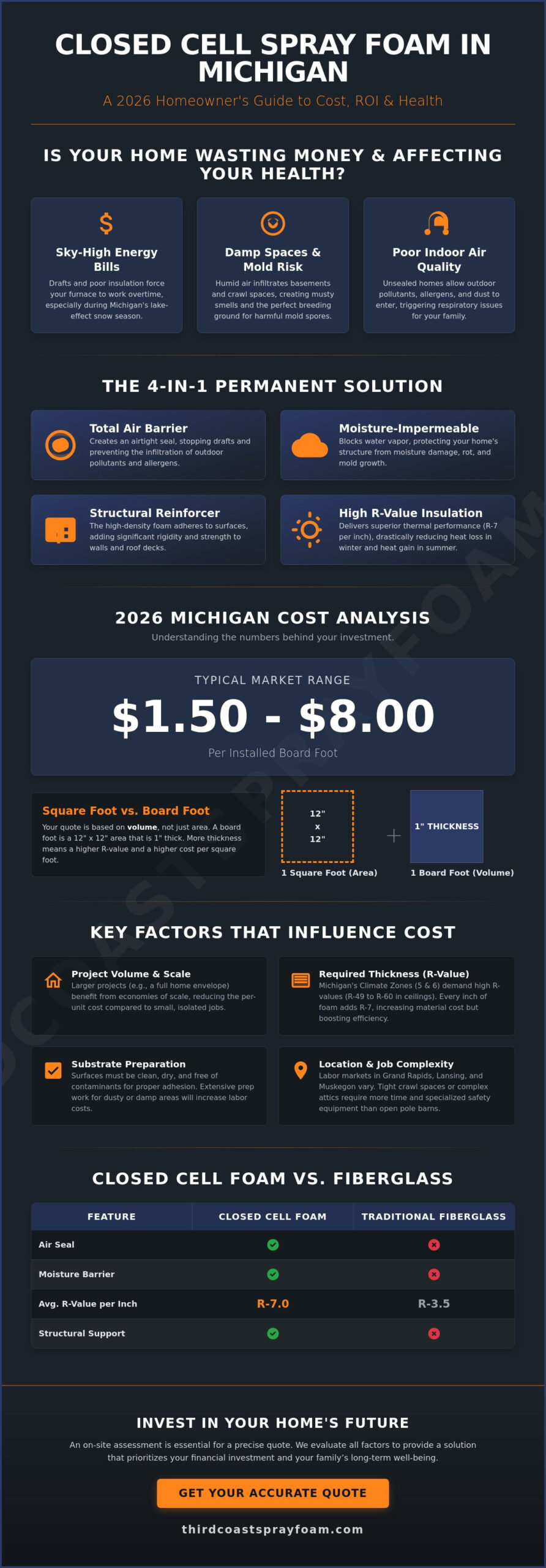
For 2026, the market range for closed cell spray foam cost per sq ft Michigan typically falls between $1.50 and $8.00. This price reflects the superior R-value and density of closed cell compared to open cell alternatives. While fiberglass batts are often viewed as the “cheap” option, they fail to provide an air seal. This allows moisture to move through walls, which often leads to mold and mildew growth. Our team views closed cell foam as a permanent investment in your property’s structural integrity and indoor air quality.
The Board Foot vs. Square Foot Confusion
Understanding your quote requires knowing the difference between a square foot and a board foot. A board foot is the volume measurement used by professionals to ensure accurate coverage. It measures an area 12″ x 12″ that is exactly 1″ thick. Because Michigan energy codes require specific R-values for different parts of the home, your total closed cell spray foam cost per sq ft Michigan will rise as the required thickness increases. For example, a basement rim joist requires more depth than a standard wall cavity to meet local efficiency standards.
Why West Michigan Prices May Vary
Local factors in Grand Rapids, Lansing, and Muskegon play a massive role in final pricing. Labor markets fluctuate by county, and the physical layout of your home dictates the difficulty of the job. A tight, cramped crawl space in Holland requires more intensive labor and safety equipment than an open-ceiling pole barn in Allegan. We also see seasonal shifts in demand. Planning your installation during the early spring or late fall is a strategic move that can help you avoid the mid-winter rush when every homeowner is fighting the Michigan cold.
Factors That Influence Your Investment: Beyond the Surface
Determining the closed cell spray foam cost per sq ft Michigan requires looking at more than just the square footage on a blueprint. Project volume plays a massive role in the final price. For larger residential or commercial properties in West Michigan, economies of scale often reduce the price per unit of material. This happens because setup times, equipment calibration, and travel costs are spread across a larger surface area, making a full-home envelope seal more cost-effective than a small, isolated patch job.
Michigan’s Climate Zones 5 and 6 demand high thermal performance to combat sub-zero winters. While standard fiberglass might sag or lose efficiency over time, closed cell foam maintains a consistent R-value of approximately 7.0 per inch. To meet the 2021 Michigan Energy Code requirements, which often call for R-49 or R-60 in ceilings, the thickness of the application will directly impact your investment. Every additional inch of foam increases the material cost but simultaneously strengthens the structural integrity of your walls and roof deck.
A successful installation depends entirely on the bond between the foam and the structure. Our team spends significant time preparing substrates, whether it’s concrete basement walls or wooden rim joists. If a surface is covered in dust, grease, or moisture, the foam won’t adhere properly. This creates gaps that compromise the air seal. Ensuring a clean, dry surface is a non-negotiable step that protects the longevity of your home’s thermal envelope.
The Cost of Professional Insulation Removal
Before we can seal your home, we often have to address what’s already there. Old, contaminated fiberglass is a leading cause of poor indoor air quality. Over a 10 year period, attic insulation can accumulate pounds of dust, rodent waste, and mold spores. Professional insulation removal is a critical first step for your respiratory health. By clearing out these pollutants, we ensure that your new air seal isn’t trapping old allergens inside your living space. This process protects your family from asthma triggers and long term lung irritation while creating a sterile environment for the new foam to bond. If you’re concerned about what’s currently hiding in your attic, you can request a professional assessment of your home’s air quality.
Accessibility and Complexity
Labor costs fluctuate based on how hard it’s to reach the target area. A wide-open pole barn with 20-foot ceilings requires lifts and specialized safety gear. Conversely, tight box sills and crawl spaces limit movement and slow down the application process. Our professional rigs are equipped with heated hoses and sensors to keep the chemicals at a precise 120 to 130 degrees Fahrenheit. This temperature control is something DIY kits can’t reliably provide. It’s essential for a proper cure that won’t off-gas or pull away from the studs. When you calculate the closed cell spray foam cost per sq ft Michigan, you’re paying for this technical precision and the security of a permanent, healthy home environment.
The Health and Structural ROI: Why Quality Foam Pays for Itself
Investing in insulation isn’t just about the numbers on a quote. While the initial closed cell spray foam cost per sq ft Michigan homeowners see might be higher than fiberglass, the return on investment (ROI) extends into the very air you breathe and the bones of your house. Our team views the home as a single, holistic system where every gap affects your family’s wellness and your property’s longevity.
Indoor Air Quality and Respiratory Wellness
Closed cell foam creates a high-performance sealed envelope that acts as a physical barrier against outdoor pollutants. In Michigan, seasonal pollen and dust often find their way through tiny cracks in traditional insulation. We use high-density foam to stop this infiltration entirely. It also eliminates the “stack effect,” a process where cold, damp air is sucked up from the ground level into your living spaces. By installing specialized crawl space insulation, you create a health-first shield against soil gases and allergens, keeping your indoor air clean and stable.
Mold Prevention and Moisture Management
Michigan’s humid summers create a breeding ground for moisture. Closed cell spray foam is the only insulation material that serves as a Class II vapor retarder. It doesn’t just slow down moisture; it stops it from reaching cold surfaces where it would otherwise condense. This is vital for rim joists and pole barns where wood rot and mold are common threats. A mold-free environment is a direct defense against asthma and allergy triggers. By keeping the structure dry, you ensure that 100% of your home remains a safe zone for sensitive respiratory systems.
Beyond health, you’re gaining structural peace of mind. Closed cell foam is incredibly dense and rigid. Data from the National Association of Home Builders (NAHB) shows that this material can increase wall racking strength by up to 300%. This reinforcement is crucial during Michigan’s high-wind storms and heavy snow loads. Additionally, the airtight seal significantly reduces the workload on your HVAC system.
Reducing the furnace load by 35% to 50% can add years to the life of your equipment. This prevents the need for a $10,000 furnace replacement sooner than necessary. When you factor in these long-term protections for both your family’s lungs and your home’s frame, the closed cell spray foam cost per sq ft Michigan residents pay becomes a savvy financial and health-conscious decision. We focus on these results because a home should be a permanent sanctuary, not a source of maintenance stress.
Planning Your Project: From Rim Joists to Pole Barns
Strategic insulation starts where the most air escapes. Our team treats the building as a holistic system, focusing on the thermal envelope to ensure your family breathes cleaner air. In West Michigan, we prioritize high-impact zones that offer the fastest return on investment for both your wallet and your respiratory health.
Insulating Rim Joists and Box Sills
Rim joists represent the primary entry point for unconditioned air and outdoor pollutants in Grand Rapids and Lansing homes. This specific area often accounts for up to 20% of a home’s total air leakage. When these gaps aren’t sealed, they allow moisture to seep into your floor joists, which creates a breeding ground for mold and mildew. By applying closed cell foam, we stop the “stack effect” that pulls allergens from the soil into your living spaces. For a standard residential footprint, the typical cost for a professionally sealed rim joist project ranges from $900 to $1,600. This small investment is the cornerstone of Total Home Health, as it prevents foundation-level drafts and protects your indoor air quality.
The Pole Barn Advantage
Michigan winters turn uninsulated metal buildings into “rain chambers” due to heavy condensation. This “sweating” occurs when warm interior air hits a cold metal roof; it eventually drips onto expensive machinery and promotes rust. Choosing pole barn insulation made of closed cell foam is the gold standard for creating a conditioned, usable workspace. For a standard 30×40 barn, you are managing 1,200 square feet of floor space, but the actual sprayable surface area of the walls and ceiling often totals 3,500 to 4,000 square feet. Understanding the closed cell spray foam cost per sq ft Michigan homeowners encounter for these structures helps in planning a workspace that stays dry and mold-free for decades.
Basements, Crawl Spaces, and Attic Strategies
Damp crawl spaces are a major trigger for asthma and other respiratory issues. We seal these areas to prevent the upward migration of moisture and soil gases. This process results in warmer floors and a more stable indoor climate. For attics, we often recommend a hybrid approach. Our crew uses closed cell foam to air-seal the attic floor or roof deck, then adds blown-in cellulose to meet the Michigan energy code requirement of R-49 or R-60. This combination keeps the closed cell spray foam cost per sq ft Michigan residents pay manageable while achieving maximum thermal efficiency. Sealing the envelope this way ensures that dust and insulation fibers don’t circulate through your HVAC system.
Every structure has unique vulnerabilities that impact your comfort and health. To see how these strategies apply to your specific property, you should request a detailed quote for your project today.
Getting an Accurate Quote from Third Coast Spray Foam
Online calculators often provide a false sense of certainty. They cannot account for the unique structural challenges of a 1920s Grand Rapids bungalow or a modern Muskegon lakefront home. To determine your actual closed cell spray foam cost per sq ft Michigan, our team performs a physical, on-site assessment. We evaluate joist spacing, existing moisture levels, and accessibility. This precision ensures you do not face surprise change orders halfway through the project. We provide a fixed price based on the specific geometry of your home, not a generic estimate that shifts once the work begins.
During a Third Coast consultation, we prioritize your “Total Home Health.” We examine how your current insulation affects your indoor air quality. Poorly sealed homes often allow outdoor pollutants, pollen, and humidity to enter through the building envelope. This can trigger respiratory issues or lead to mold growth in hidden wall cavities. Our closed-cell application creates a seamless vapor barrier. It stops the air movement that transports moisture, effectively protecting your family from the environmental triggers that cause asthma and allergies. We treat the building as a holistic system where air sealing and respiratory health are inextricably linked.
Maximizing Your 2026 Tax Credits and Rebates
The energy efficient home improvement credit is a powerful tool for Michigan homeowners to offset their initial investment. Under Section 25C of the Internal Revenue Code, you can claim 30% of your insulation material costs, up to an annual limit of $1,200. Residents in Lansing and Grand Rapids can also tap into utility-specific rebates from providers like Consumers Energy or DTE. These programs often require specific documentation, including manufacturer certification statements and detailed project invoices. We provide all the necessary technical paperwork to ensure your claim is processed without delays. This financial strategy makes the closed cell spray foam cost per sq ft Michigan significantly more manageable when viewed as a long-term asset.
The Third Coast Difference
We view your home as a complex ecosystem. Our team focuses on professional-grade air sealing that transforms your living space into a controlled, healthy environment. Whether you are in Allegan, Kalamazoo, or Holland, we bring specialized equipment designed to handle the volatile West Michigan climate. We take pride in our no-nonsense approach to quality. We ensure every gap is sealed and every R-value target is met to prevent the condensation that leads to mold and mildew. Our commitment to local reliability means we are here for the long haul, ensuring your home remains a sanctuary of comfort and safety.
Secure Your Home’s Future and Health
Investing in your property’s thermal envelope is about more than just tracking the closed cell spray foam cost per sq ft Michigan markets project for 2026. The real value lies in achieving “Total Home Health” through precision engineering. Since 2013, our team has specialized in creating airtight environments that stop the moisture migration responsible for mold growth and respiratory irritants. By utilizing a Class II vapor retarder, we provide a permanent solution that protects your structural integrity while significantly boosting indoor air quality.
A sealed building envelope is your first line of defense against West Michigan’s volatile climate. We don’t just spray foam; we solve the underlying issues of air leakage and thermal bridging that drive up energy costs and degrade your living standards. It’s a pragmatic investment that pays dividends in both financial savings and daily comfort. Take the first step toward a more efficient, healthier indoor environment today.
Get Your Free Health-First Insulation Estimate
We’re ready to help you lock in long-term protection and peace of mind for your family.
Frequently Asked Questions
How much does closed cell spray foam cost per square foot in Michigan?
National industry data from sources like HomeGuide indicates that closed cell spray foam typically ranges from $1.50 to $3.00 per board foot. Local factors like Michigan labor rates and material shipping costs influence the final closed cell spray foam cost per sq ft Michigan homeowners see on their quotes. Our team provides detailed estimates based on the specific R-value requirements found in the 2026 Michigan Residential Code.
Is closed cell spray foam worth the extra cost over open cell?
Yes, closed cell foam provides a higher R-value of 6.5 to 7.0 per inch compared to just 3.5 for open cell. This density creates a structural vapor barrier that prevents moisture from entering your wall cavities. It’s a superior choice for Michigan’s humid summers and freezing winters because it stops internal condensation. This protection keeps your framing dry and extends the life of your home.
Can closed cell spray foam help prevent mold and improve my health?
Closed cell foam acts as an impermeable moisture barrier that eliminates the damp conditions where mold spores thrive. By sealing the building envelope, we stop the infiltration of outdoor allergens and pollutants that trigger respiratory issues. This creates a controlled indoor environment where air quality remains stable. Maintaining a dry, mold-free space is essential for long-term respiratory health and peace of mind.
How long does it take for spray foam insulation to pay for itself in energy savings?
Most homeowners see a full return on investment within 3 to 5 years through reduced monthly utility bills. The Department of Energy states that air sealing and proper insulation can save an average of 15% on heating and cooling costs. Because spray foam doesn’t sag or degrade like fiberglass, these savings continue for the life of the structure. It’s a permanent solution for home efficiency.
Does Michigan offer any rebates or tax credits for spray foam insulation in 2026?
Michigan residents can currently access the Federal Energy Efficient Home Improvement Credit, which offers a tax credit of 30% for weatherization projects up to $1,200 annually. Additionally, local utility providers like Consumers Energy and DTE often provide localized rebates for air sealing and insulation upgrades. We recommend checking the Database of State Incentives for Renewables and Efficiency for the latest 2026 updates in our region.
Is spray foam safe for people with asthma or respiratory issues?
Once fully cured, spray foam is inert and provides a healthier environment by blocking common asthma triggers like dust, pollen, and outdoor mold. It eliminates the “stack effect” that pulls unfiltered crawlspace air into your living areas. Our team follows strict safety protocols to ensure the chemical reaction is complete. This results in a cleaner thermal envelope that supports better respiratory health for your entire family.
Can I stay in my home during the spray foam installation?
We require occupants and pets to vacate the property for 24 hours during and after the application process. This timeframe allows for proper off-gassing and ensures that the indoor air quality returns to safe levels as the foam cures. We use high-capacity ventilation fans to exchange the air in the workspace throughout the project. Your safety is our priority, and this waiting period is a standard industry requirement.
How does closed cell foam strengthen the structure of my pole barn?
Closed cell spray foam increases the racking strength of a wall by up to 300% according to testing by the National Association of Home Builders. The foam’s high density bonds the posts and metal siding together into a single, rigid unit. This is especially vital for Michigan pole barns facing heavy snow loads or high winds. It turns your building into a more durable, wind-resistant structure that lasts.
Disclaimer
Information provided is for general educational purposes. Individual needs and circumstances vary. Speak to an experienced professional to get the correct information for your situation.