

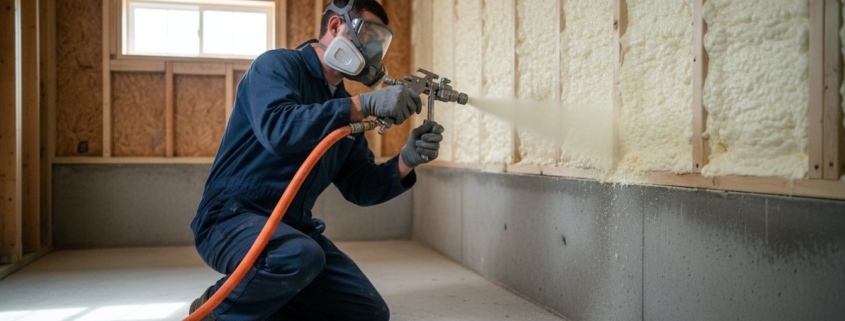
What if your home’s biggest enemy isn’t the 30 inches of lake-effect snow on your roof, but the invisible air leaks draining your bank account? For many Grand Rapids homeowners, seeing a monthly Consumers Energy or DTE bill exceed $350 is a frustrating winter reality. You already know that West Michigan weather is relentless, swinging from sub-zero winds to 90% summer humidity that turns pole barns into sweating, dripping messes. That’s why closed cell spray foam is becoming the standard for families who want to seal their home’s envelope and stop the cycle of wasted energy once and for all.
We believe your home should be a fortress against these extremes, not a sieve. In this guide, you’ll discover how this high-density insulation provides a 100% air seal while adding up to 300% more structural strength to your walls. We’ll show you how to permanently slash your utility costs, stop mold growth in its tracks, and finally achieve a bone-dry crawl space. Our team is going to break down the technical R-values and the real-world benefits of protecting your investment for the next 50 years.
Key Takeaways
- Understand why standard insulation struggles with West Michigan’s unique lake-effect climate and how to build a more resilient thermal envelope for your home.
- Explore the science behind closed cell spray foam, including its industry-leading R-value and its ability to provide a rigid, moisture-resistant barrier.
- Learn to distinguish between open and closed cell options to make an informed decision that prioritizes long-term energy efficiency and structural integrity.
- Pinpoint high-priority areas like rim joists and pole barns where specialized insulation is the only way to effectively stop condensation and “sweating” issues.
- Discover the hidden risks of DIY foam kits and why professional installation is necessary to ensure the safety and longevity of your Grand Rapids property.
The West Michigan Climate Challenge: Why Standard Insulation Fails
Living in West Michigan means facing a relentless weather cycle driven by Lake Michigan. Our team sees how this unique high-humidity and extreme-cold pattern destroys traditional insulation performance. In Grand Rapids, relative humidity often exceeds 75% during the summer months, only to be followed by sub-zero lake-effect winds in January. This creates a constant vapor drive where moisture tries to force its way into your home’s structure. Standard materials aren’t designed to handle this pressure.
Fiberglass batts are often sold as a solution, but they function more like a filter than a barrier. When those 25 mph lake-effect gusts hit your siding, they push air directly through the gaps in your framing. Because fiberglass is porous, it lets this cold air pass through while trapping dust and allergens. You aren’t just losing heat; you’re losing control of your indoor air quality. To understand the mechanics of these materials, looking into the history of Spray foam reveals why modern chemistry has moved toward more rigid, non-porous solutions for harsh climates.
The dew point is where the most significant damage occurs in local homes. This is the specific temperature where air can no longer hold its water vapor, causing it to turn into liquid. In a typical Michigan winter, that dew point often lands right on your roof deck or inside your crawl space walls. When warm air from your living room hits these cold surfaces, condensation forms. We’ve found that this process leads to mold growth or wood rot in approximately 40% of older homes in the region. Without a complete thermal envelope, your house is essentially “breathing” in a way that invites structural decay.
The Problem with “Standard” Insulation in Grand Rapids
Traditional insulation in Muskegon and Grand Rapids fails because it’s physically unstable. Cellulose and fiberglass settle under their own weight. Industry data shows that loose-fill cellulose can lose 20% of its volume over a decade, leaving the top of your wall cavities completely uninsulated. These gaps create air bypasses that act like chimneys, sucking heat out of your home. During humid Muskegon summers, these materials absorb moisture, which makes them heavy and further accelerates the settling process while creating a breeding ground for bacteria. For homeowners dealing with blown in insulation that has settled or thinned over time, this settling problem becomes even more pronounced in attic spaces where loose-fill materials gradually lose their effectiveness.
Sealing the Envelope: A 2026 Perspective
The thermal envelope is the continuous boundary that separates your conditioned living space from the outdoors. For 2026 energy codes in Grand Rapids, the focus has shifted from simple thickness to total airtightness. Air sealing is more important than R-value alone in 2026 because a high R-value means nothing if the wind blows right through the material. This shift in building science is why closed cell spray foam has become the local benchmark for climate resilience. It doesn’t just insulate; it creates a structural, air-tight, and moisture-resistant seal that stays in place for the life of the home. By using closed cell spray foam, we treat the house as a holistic system, ensuring that your energy dollars aren’t literally vanishing into the West Michigan wind.
What is Closed Cell Spray Foam? The Science of Superiority
Closed cell spray foam is a high-density, rigid insulation that functions as much as a structural component as it does a thermal barrier. Unlike its softer counterparts, this material consists of tiny, compact cells that are completely closed off from one another. During the application process, two liquid components meet at the tip of a spray gun, triggering a chemical reaction that expands the foam and creates a permanent, monolithic bond to your home’s substrate. This isn’t just a layer of material sitting in a wall; it’s a hard, plastic-like reinforcement that seals every crack and crevice.
Density and R-Value: Breaking Down the Numbers
The physical properties of this insulation are measured by density, which for closed cell products typically sits at 2.0 lbs per cubic foot. This density allows for an impressive R-value of 6.5 to 7.0 per inch of thickness. In the tight 2×4 or 2×6 wall cavities found in West Michigan homes, this high R-value is a game changer. You can achieve superior thermal performance in half the space required by fiberglass batts or cellulose. Beyond heat retention, the rigidity of the foam adds immense physical integrity to a building. Engineering tests have shown that filling a wall cavity with closed cell spray foam can increase the racking strength of a structure by up to 300%. For pole barns or homes exposed to high wind loads near the lake, this added durability provides a level of security that traditional materials can’t match.
The Built-in Vapor Barrier
Moisture management is a primary concern for any homeowner in our region. When applied at a thickness of 2 inches or more, closed cell foam acts as its own Class II vapor retarder. This means it effectively stops moisture from migrating through the walls, which is a critical feature for Michigan crawl spaces and rim joists. In these areas, warm, humid air often meets cold surfaces, leading to condensation and mold growth. Because the foam has a closed-pore structure, it possesses a moisture-wicking resistance that keeps water out of the building envelope. This technical advantage is a core reason why experts like Green Building Advisor on spray foam highlight the importance of understanding how these high-performance materials create airtight environments. By sealing the envelope so tightly, you prevent the rot and structural decay often associated with seasonal temperature swings.
Choosing the right material for your project depends on your specific goals for home health and energy efficiency. If you’re ready to see how this technology fits into your renovation or new build, you can request a detailed assessment from our local team to ensure your property is protected for decades. We focus on the long-term stability of your structure, ensuring every inch of the application meets the highest industry standards for density and adhesion.

Closed Cell vs. Open Cell: Which is Right for Your Michigan Property?
Choosing the right insulation requires looking beyond the price tag. In West Michigan, the choice between open and closed cell foam depends entirely on the specific environment of the installation site. A common misunderstanding among homeowners in Grand Rapids is the “breathability” myth. Some believe houses need to breathe through their walls to stay healthy. This is inaccurate. Uncontrolled air movement through walls leads to heat loss and hidden condensation. True efficiency comes from an airtight building envelope where ventilation is managed by your HVAC system, not by gaps in your siding. Closed cell spray foam provides this absolute air seal, effectively stopping the biting winds that roll off Lake Michigan.
The cost-to-benefit ratio shifts depending on where you apply the product. While closed cell has a higher upfront cost, its R-value of approximately 7.0 per inch is nearly double that of open cell. This means you achieve superior thermal resistance in half the space. Scientific data from long-term thermal performance research conducted by the Oak Ridge National Laboratory shows that closed cell structures maintain their insulating power over decades without settling or sagging. This longevity makes it a pragmatic investment for the permanent protection of your property.
When to Choose Closed Cell (The Heavy Hitter)
We recommend closed cell for any area exposed to high moisture or structural stress. For pole barns in Kent County, this foam adds significant racking strength to the building, helping it withstand heavy snow loads. It is also the only choice for rim joists and flood-prone crawl spaces. Because it is a FEMA Class 5 flood-resistant material, it won’t be ruined if it comes into contact with water. This is a critical consideration for properties near the Grand River or in low-lying areas of Ottawa County. The rigid nature of the foam also acts as a vapor barrier, preventing the humid Michigan summers from migrating into your cooled living spaces.
When Open Cell Might Suffice
Open cell foam has its place, particularly when the primary goal is sound attenuation or budget-conscious attic projects. It is a softer, more flexible material that excels at absorbing mid-to-high frequency noises. We often suggest it for interior walls between bedrooms and laundry rooms or for attic roof decks where a vapor barrier isn’t legally required by local building codes. It is less expensive than closed cell spray foam, but it doesn’t offer the same structural reinforcement or moisture resistance. Our team evaluates your home as a holistic system to ensure you aren’t overpaying for performance you don’t need, or under-insulating a critical area. Check out our guide on Open vs. Closed Cell Foam for a deeper dive into these technical differences.
The West Michigan Decision Matrix
To simplify the choice for homeowners in Kent and Ottawa counties, use this quick reference guide based on common local applications:
- Rim Joists: Always Closed Cell. Stops 95% of air infiltration at the home’s most vulnerable leak point.
- Metal Buildings/Pole Barns: Closed Cell. Prevents “sweating” on the metal and adds structural rigidity.
- Conditioned Crawl Spaces: Closed Cell. Essential for moisture management and pest deterrence.
- Interior Soundproofing: Open Cell. Superior at dampening echoes and room-to-room noise.
- Standard 2×6 Exterior Walls: Closed Cell. Maximizes R-value in a limited cavity space.
Third Coast Spray Foam focuses on “sealing the envelope” correctly the first time. We don’t just spray foam; we engineer a barrier that protects your financial well-being and your family’s comfort for the life of the home.
Critical Applications in Grand Rapids: Pole Barns, Rim Joists, and Crawl Spaces
West Michigan winters bring a specific set of challenges for homeowners from Fruitport to Grand Rapids. Our local climate demands more than standard insulation; it requires a complete air seal that stands up to heavy lake-effect snow and high humidity. We focus on three critical areas where closed cell spray foam provides the most significant impact on building longevity and comfort.
Stop the Sweat: Insulating West Michigan Pole Barns
If you own a metal pole barn in the Grand Rapids area, you’ve likely seen “Sweating Pole Barn” syndrome. This occurs when warm interior air meets a cold metal ceiling, causing water to condense and drip like rain onto your vehicles or equipment. It’s a physics problem that fiberglass can’t solve. Closed cell foam is the only permanent fix because it creates a 100% airtight thermal break directly against the metal. This application provides three major benefits for local owners:
- Condensation Elimination: It stops moisture from forming, protecting tools and inventory from rust.
- Structural Rigidity: The foam hardens into a dense plastic, adding up to 30% more racking strength to the building.
- Pest Control: It creates a hard barrier that rodents and insects can’t easily nest in.
This durability is vital for local workshops and agricultural buildings that need to withstand years of heavy use without losing thermal efficiency. It turns a seasonal storage shed into a usable, year-round workspace.
Rim Joists and Foundations: The Energy Leak You Can’t See
Rim joists are often the most neglected part of a Michigan home, yet they’re usually the biggest source of energy loss. Through a process called the “Stack Effect,” cold air pours into your basement through the gaps where your house meets its foundation. This forces your furnace to work 20% harder just to keep up with the infiltration. Our team at Third Coast targets these specific leaks with precision. We spray the rim joist area to create an impenetrable barrier that stops drafts at the source. Learn more about our Rim Joist services to understand how this single project can make your kitchen floors feel warmer immediately.
Crawl Space Encapsulation for Foundation Protection
Damp crawl spaces are a recipe for structural rot and poor indoor air quality. In the Grand Rapids region, high water tables and sandy soil often lead to moisture migrating through foundation walls. We use closed cell spray foam to encapsulate these spaces, sealing out the earth’s moisture and preventing wood rot in your floor joists. This process transforms a dark, damp area into a clean, dry part of your home’s thermal envelope. By treating your foundation as a holistic system, we ensure your home remains stable and healthy for decades. It’s about protecting your biggest investment from the ground up while lowering your monthly utility costs. Many homeowners also benefit from upgrading their blown in insulation in attic spaces to complement the comprehensive thermal envelope protection that closed cell foam provides in basements and crawl spaces.
The Professional Advantage: Why DIY Foam Kits Risk Your Investment
It is tempting to walk into a big-box retailer and grab a portable spray foam kit for $800. You might think you are saving $2,500 on labor costs. However, closed cell spray foam is not just “insulation in a can.” It is a complex chemical reaction that requires surgical precision. If the mix ratio between the “A” and “B” sides deviates by even a small margin, the foam may never fully cure. This leaves you with a sticky, ineffective mess that fails to provide the air seal you paid for.
Professional installation is a one-and-done permanent solution because of the industrial-grade equipment we bring to your driveway. Third Coast utilizes high-pressure pumps and 210-foot heated hoses to maintain a constant 130-degree temperature and 1,000 PSI of pressure. DIY tanks rely entirely on the ambient temperature of your garage floor. If those tanks drop below 70 degrees, the chemical reaction fails. This leads to lingering “fishy” odors or toxic off-gassing that can persist for years, compromising your indoor air quality.
When you hire a professional, you are paying for the chemical expertise required to manage the “exothermic” reaction. If foam is applied too thick in a single pass, it can actually generate enough heat to cause internal charring or, in extreme cases, a fire. Our technicians monitor every inch of the application to ensure the thermal envelope is sealed safely and effectively.
The Hidden Dangers of DIY Spray Foam
In a cold Michigan winter, applying foam in an unheated space is a recipe for disaster. When foam doesn’t cure properly due to freezing substrate temperatures, it loses its structural integrity and adhesive properties. Removing uncured, “wet” foam is a nightmare scenario that often costs three times the original installation price in labor alone. We dedicate 20% of our total project time to professional masking and prep to ensure your windows, floors, and mechanical systems remain protected from permanent overspray damage.
Why Third Coast is West Michigan’s Trusted Partner
We serve homeowners throughout Muskegon, Ottawa, and Kent counties with a focus on long-term home health. We treat your house as a holistic system rather than just a collection of walls. Our “Straight-Shooter” approach means we won’t upsell you on unnecessary thickness. We only recommend the specific R-value your home requires to stop drafts and lower your Consumers Energy or DTE bills. We live where we work, and our reputation is built on the durability of our seals.
Stop guessing with retail kits and start investing in a permanent thermal barrier. Get your free insulation estimate in Grand Rapids today!
Choosing professional closed cell spray foam ensures your home remains a sanctuary. Our team brings the technical rigor and local reliability needed to handle the unique climate challenges of the Lakeshore. We don’t just spray foam; we provide the peace of mind that comes with a job done right the first time.
Secure Your West Michigan Home for the Long Haul
West Michigan winters don’t wait for anyone, and your home shouldn’t have to fight them with outdated materials. By upgrading to closed cell spray foam, you’re investing in a high-performance 2.0 lb density barrier that seals the thermal envelope against Lake Michigan’s heavy humidity. Our Fruitport-based team specializes in reinforcing critical areas like rim joists and pole barns. We ensure your structure stands up to 60-plus mph wind gusts and the sub-zero temperatures that regularly hit the Grand Rapids area. Choosing a professional application over a DIY kit protects your property from the structural risks of improper curing. It’s about more than just lowering monthly energy bills by up to 15 percent; it’s about the permanent health of your building. We take pride in being local partners who understand exactly what your property needs to stay dry and warm. You deserve a home that works as hard as you do. Our experts are ready to provide the precision your project requires.
Schedule Your Free West Michigan Insulation Inspection
Frequently Asked Questions
Is closed cell spray foam waterproof?
Yes, closed cell spray foam is completely waterproof and acts as a high-performance vapor barrier. It’s engineered with a high-density, closed-cell structure that doesn’t absorb or hold moisture. FEMA classifies this material as a Class 5 flood-resistant material, which means it can survive contact with floodwaters for 72 hours without damage. This makes it the most reliable choice for protecting West Michigan homes against heavy rains and melting snow.
How much does closed cell spray foam cost per square foot in Michigan?
In the Michigan market, you can expect to pay between $1.50 and $2.50 per board foot for professional installation. A board foot is a measure of 1 square foot of coverage at 1 inch of thickness. For a typical 1,500-square-foot basement or attic project, homeowners usually see a total investment ranging from $3,500 to $8,000. While the upfront cost is higher than fiberglass, the 15% to 50% reduction in monthly heating bills provides a fast return on investment.
Does closed cell spray foam stop condensation in metal buildings?
Yes, it stops 100% of condensation by eliminating the temperature differential that causes “sweating” on metal surfaces. When our team applies a 1.5-inch layer of foam to a metal roof or wall, it creates a seamless air seal that prevents warm, humid air from touching the cold steel. By keeping the surface temperature above the dew point, you protect your building from the rust and dripping that typically occurs during Michigan’s volatile spring and fall seasons.
Can closed cell spray foam be used in a crawl space?
Yes, it’s the most effective solution for sealing and insulating West Michigan crawl spaces. We apply the foam directly to the rim joists and foundation walls to create a permanent thermal envelope. This process blocks 99% of outside air infiltration and prevents damp soil odors from rising into your living areas. Sealing a crawl space this way can increase your first-floor temperature by 5 to 10 degrees during a typical January freeze in Grand Rapids.
How long does closed cell spray foam last?
Closed cell spray foam is designed to last for the entire life of the building, often exceeding 80 years. Unlike traditional fiberglass batts that sag or settle after 10 to 15 years, this material maintains its rigid structure and R-value indefinitely. It’s a chemically stable product that won’t shrink or degrade over time. Once it cures, it becomes a permanent part of your home’s structure, providing consistent energy savings for as long as the house stands.
Is there a smell after installing closed cell spray foam?
There’s a temporary odor during the application process, but it dissipates completely within 24 hours. Our crew uses high-powered ventilation fans to cycle the air 10 times per hour during the installation to ensure proper airflow. We require homeowners and pets to stay out of the house for 24 hours to allow the foam to fully cure and off-gas. After this period, the foam is inert, odorless, and safe for your family to be around.
Does spray foam insulation qualify for the 2026 federal tax credit?
Yes, spray foam insulation qualifies for the Energy Efficient Home Improvement Credit, also known as Section 25C. Under current federal law, homeowners can claim 30% of the material costs, up to a maximum of $1,200 every year, through December 31, 2032. This includes the 2026 tax year. We recommend saving your itemized receipts and the manufacturer’s certification statement to ensure you receive the full credit when you file your annual tax return. For detailed guidance on maximizing your energy efficient home improvement credit in Grand Rapids, our team can help you understand the specific documentation requirements and qualifying improvements that provide the greatest tax benefits for Michigan homeowners.
Disclaimer
Information provided is for general educational purposes. Individual needs and circumstances vary. Speak to an experienced professional before relying on the information given here.