
Your attic is a complex biological ecosystem where a single imbalance can trigger respiratory issues for your entire family. You likely already feel the sting of high heating costs during our West Michigan winters, or perhaps you’ve spotted ice dams forming along your gutters after a heavy snow. When managing attic ventilation and insulation Grand Rapids homeowners must look beyond just staying warm. If your attic cannot breathe, it traps moisture that fuels mold growth and degrades your indoor air quality.
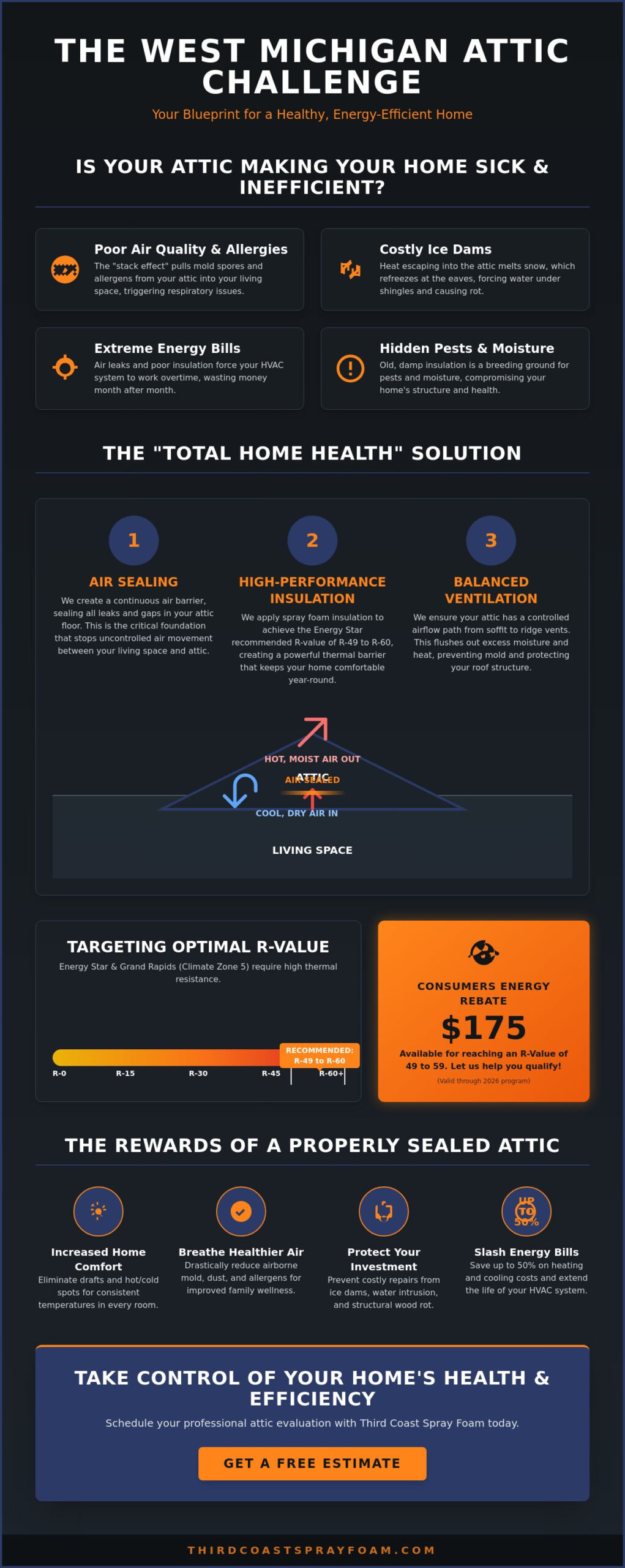
At Third Coast Spray Foam, we believe a healthy home starts with a sealed thermal envelope that prioritizes your family’s well-being. You’ll discover how the right balance of air sealing and insulation can slash your energy bills by up to 50% while eliminating the moisture triggers that cause household allergies. We will also walk you through the 2026 Consumers Energy rebates, which offer $175 for reaching an R-value of 49 to 59, and explain why the Energy Star recommendation of R-49 to R-60 is vital for a mold-free environment. This guide provides a clear roadmap to a healthier, more efficient home for the years ahead.
Key Takeaways
- Understand how the “stack effect” pulls mold spores and allergens from your attic into your living space, impacting your family’s respiratory health.
- Learn to balance attic ventilation and insulation Grand Rapids homes require to prevent ice dams caused by West Michigan’s intense Lake Effect snow.
- Discover why air sealing the thermal envelope is more critical for energy efficiency than simply adding more insulation over existing air leaks.
- See how professional insulation removal eliminates hidden moisture and pests to create a clean foundation for high-performance spray foam.
- Explore the long-term financial benefits of proper attic management, including HVAC longevity and utility bill savings of up to 50%.
The West Michigan Attic Challenge: Why Grand Rapids Homes Struggle
Grand Rapids homeowners face a unique set of meteorological hurdles that most generic home improvement guides simply ignore. Our proximity to Lake Michigan means we deal with intense Lake Effect snow and high seasonal humidity that can turn an improperly managed attic into a breeding ground for mold. To protect your property, you must view attic ventilation and insulation Grand Rapids as a single, integrated system. While insulation keeps heat where it belongs, ventilation ensures that moisture doesn’t settle on your rafters and floor joists. At Third Coast Spray Foam, we call this the “Total Home Health” envelope. It’s a holistic approach that treats your house as a living system, ensuring that every breath your family takes is free from the airborne irritants associated with attic decay.
To better understand the mechanics of a healthy attic, watch this helpful video:
The West Michigan climate doesn’t just test your patience; it tests your home’s structural integrity. During our humid summers, moisture levels in unventilated attics can soar, leading to wood rot and the proliferation of mildew. This moisture often migrates into the living spaces below, triggering respiratory irritation and allergies. The principles of building insulation dictate that stopping heat flow is only half the battle; managing the movement of air and moisture is equally vital for long-term safety.
The Role of R-Value in Michigan Winters
Grand Rapids sits firmly in Climate Zone 5, which requires high thermal resistance to combat sub-zero temperatures. R-value is the specific measurement of a material’s ability to resist the conductive flow of heat through an attic space. Traditional fiberglass batts often fail here because they don’t stop air movement. When air leaks through the ceiling, it carries heat and moisture into the attic, rendering the R-value of the fiberglass nearly useless and creating a damp environment where mold thrives.
Ice Dams and Attic Overheating
Ice dams are more than just a nuisance; they are a “canary in the coal mine” for your home’s health. When poor insulation allows warm air to escape into the attic, it melts the snow on your roof from underneath. This water then refreezes at the cold eaves, creating a dam that forces water back under your shingles. Properly balanced attic ventilation and insulation Grand Rapids residents invest in will keep the roof deck cool, extending the lifespan of your shingles and preventing the moisture intrusion that compromises your respiratory wellness. Damp insulation is a primary source of indoor air quality issues, as it provides the perfect substrate for mold growth that eventually reaches your family’s lungs.
The Science of Balance: How Ventilation and Insulation Work Together
A common myth among West Michigan homeowners is that a house needs to “breathe” through random cracks and gaps in the attic floor. In reality, these uncontrolled leaks allow conditioned air to escape, forcing your furnace to work harder and driving up those monthly utility bills. The U.S. Department of Energy estimates that homeowners can save between 15% and 50% on heating and cooling costs by properly air sealing and adding insulation. True attic ventilation and insulation Grand Rapids residents can rely on requires a precise balance between air sealing and controlled airflow. Air sealing involves closing off the bypasses where air travels freely between your living space and the attic. Ventilation, on the other hand, is the strategic movement of air from intake vents at the soffits to exhaust vents at the ridge or gables. This controlled movement is essential for improving indoor air quality by flushing out stagnant, moisture-laden air before it can lead to mold growth.
Air Sealing: The Foundation of Attic Health
The foundation of a healthy attic starts with sealing the envelope. We pay close attention to rim joists and plumbing bypasses, as these are often the primary culprits for heat loss. While blown-in insulation can provide thermal resistance, it lacks the air-sealing properties of spray foam. For many projects, choosing Closed Cell Spray Foam in Grand Rapids is the most effective way to create a permanent air barrier. This material doesn’t just insulate; it seals every microscopic gap, preventing humid indoor air from meeting cold attic surfaces where condensation and respiratory-irritating mold typically form.
Managing Airflow with Baffles and Vents
Once the attic floor is sealed, we must ensure proper airflow through the remaining space. Rafter baffles play a critical role here. They prevent insulation from clogging your soffit vents, which are the “intake” for your attic’s breathing system. Without these baffles, air cannot flow freely to the ridge vents, causing the attic to overheat. In the winter, a properly ventilated attic stays cold. This prevents the snow-melting cycles that lead to ice dams. A professional ventilation strategy ensures your insulation performs at its peak while protecting your home from structural rot. If you’re concerned about your current airflow, our team can perform a comprehensive assessment to identify hidden blockages and ensure your attic remains a dry, healthy environment.
Health Implications: Respiratory Wellness and Indoor Air Quality
Many homeowners don’t realize that the air they breathe in their bedrooms often originates in the attic. This happens because of a physical phenomenon called the “stack effect,” where warm air rises and escapes through the roof, creating a vacuum that pulls air upward from the lower levels. If your attic is damp or contains deteriorating materials, this upward airflow carries mold spores, dust, and pest dander directly into your living spaces. When you invest in high-quality attic ventilation and insulation Grand Rapids professionals provide, you aren’t just saving money; you’re filtering the very air your family breathes. Following the Department of Energy guidelines on attic insulation ensures your home is protected from these thermal and environmental hazards.
Deteriorating insulation in older West Michigan homes can become a significant health liability over time. These materials often trap decades of environmental pollutants and may release volatile organic compounds (VOCs) as they break down. For residents dealing with chronic asthma or seasonal allergies, these invisible triggers can lead to constant respiratory irritation. By replacing old, contaminated materials with modern spray foam, we eliminate the source of these pollutants and create a cleaner, safer environment for everyone in the household.
Mold Prevention through Moisture Control
Condensation is a primary enemy of respiratory health in Michigan. During our freezing winters, warm, moist air from your kitchen or bathroom can leak into a cold attic and condense on the underside of the roof deck. This standing moisture leads to the growth of opportunistic molds like Cladosporium or the more dangerous Stachybotrys, commonly known as toxic black mold. Our team uses closed cell spray foam because it acts as a high-performance vapor barrier. This material prevents moisture from ever reaching the cold surfaces of your roof, effectively starving mold of the water it needs to grow and keeping your home’s air supply pure.
Improving Respiratory Health for Your Family
A sealed thermal envelope does more than regulate temperature; it acts as a shield against outdoor allergens like ragweed and tree pollen. By closing off the microscopic gaps in your ceiling, air sealing prevents the continuous cycle of dust and airborne pollutants from moving between your attic and your bedrooms. This holistic approach to home health is just as important in other areas of the building, which is why we often recommend looking at Crawl Space Insulation in Grand Rapids to complete the protection of your indoor environment. When your attic ventilation and insulation Grand Rapids system is working correctly, you’ll notice a tangible difference in the freshness of your home and the wellness of your family.
The Professional Process: Upgrading Your Grand Rapids Attic
Achieving a healthy home requires more than just tossing new material over old problems. Our team follows a rigorous five-step protocol to ensure your attic ventilation and insulation Grand Rapids project delivers permanent results. We begin with a comprehensive inspection to identify active moisture intrusion or existing mold growth. This assessment allows us to map out the thermal envelope and locate critical bypasses where your conditioned air is escaping. Following the inspection, we perform a professional extraction of old, contaminated materials. Once the space is clear, we air seal top plates and light fixtures before installing high-performance insulation. The final step is a meticulous ventilation check to verify that your R-value meets the 2026 standards of R-49 to R-60 while maintaining optimal airflow.
The Advantages of Professional Removal
Many homeowners consider DIY removal, but this often leads to cross-contaminating the living space with decades of accumulated dust and animal waste. Old insulation acts like a giant filter, trapping mold spores, rodent droppings, and environmental pollutants. Attempting to move this material without industrial-grade vacuum systems can release these particles into your home’s air supply, triggering severe respiratory reactions. Our team safely extracts these hazards, creating a “clean slate” that ensures your new insulation performs at its maximum efficiency without trapping old allergens underneath. If you’re ready to clear out the hidden health hazards in your ceiling, schedule a professional attic assessment with our team today.
When to Choose Blown-In Insulation
While spray foam offers the ultimate air barrier, there are specific scenarios where Blown-In Insulation in Grand Rapids is a highly effective health upgrade. If your budget is a primary concern but you still need to reach an R-value of 60 to qualify for the highest 2026 Consumers Energy rebates, blown-in cellulose or fiberglass is a reliable choice. We only use high-quality, treated materials that resist pests and mold. This method is particularly useful for topping off existing insulation in attics that already have a strong air seal but lack the necessary thermal resistance to prevent ice dams. We ensure every blown-in project includes the installation of baffles to keep your soffit vents clear, maintaining the delicate balance of your home’s ventilation system.
Investing in Your Home: ROI and Energy Savings
Investing in your attic’s infrastructure is a pragmatic move for your financial well-being and your family’s health. The U.S. Department of Energy estimates that homeowners can save between 15% and 50% on their heating and cooling bills by air sealing their homes and adding insulation. In a climate like West Michigan, where furnaces often run for six months of the year, these savings add up quickly. Beyond the monthly utility bill, a properly sealed thermal envelope reduces the workload on your HVAC system. When your furnace doesn’t have to fight constant drafts or heat loss from the attic, it lasts longer and requires fewer expensive repairs. This is a crucial part of our total home health philosophy. We ensure your home remains a sanctuary where respiratory health is protected and energy waste is eliminated.
The long-term durability of professional spray foam makes it a permanent investment in your property’s value. Unlike traditional materials that can sag or settle over time, our high-performance insulation maintains its R-value for decades. This stability prevents the moisture cycles that lead to wood rot and the development of respiratory-irritating mildew. By choosing a comprehensive approach to attic ventilation and insulation Grand Rapids residents can secure both their comfort and their building’s structural integrity. We take pride in being a local partner that understands these regional challenges and delivers results that stand up to our harshest winters.
Maximizing Your ROI with 2026 Incentives
While the federal Energy Efficient Home Improvement Credit (Section 25C) expired at the end of 2025, Grand Rapids homeowners still have excellent opportunities for immediate ROI in 2026. Consumers Energy currently offers specific rebates for residential customers who upgrade their attic insulation. You can receive $125 for increasing your insulation to an R-value of 48 or less, or $175 if you reach an R-value between 49 and 59. These incentives require a minimum of 500 square feet of coverage. Our team helps you document every step of your project to ensure you capture every available dollar from these local utility programs.
Choosing a Local Grand Rapids Expert
Choosing a local partner who understands the specific building codes of Kent County is essential for long-term reliability. We are a “straight-shooter” business that prioritizes tangible results and the safety of your indoor environment. Unlike DIY spray foam kits that often lead to improper application and lingering chemical odors, our professional-grade materials create a clean, healthy seal. We treat your building as a holistic system, ensuring that the attic ventilation and insulation Grand Rapids families rely on provides lasting peace of mind. Your home is your most significant investment. Contact Third Coast Spray Foam for your free attic health assessment and let us help you seal the envelope for a healthier, more efficient 2026.
Securing a Healthier Future for Your West Michigan Home
Your home functions as a holistic system where the attic serves as the primary regulator of air quality and temperature. By establishing the correct balance of attic ventilation and insulation Grand Rapids families can permanently eliminate the moisture cycles that fuel mold growth and respiratory irritation. This guide explored how professional air sealing and high-performance spray foam protect your indoor air quality while potentially reducing heating and cooling costs by 15% to 50% based on U.S. Department of Energy data.
Third Coast Spray Foam is a locally owned and operated specialist deeply invested in the wellness of our West Michigan neighbors. Our expertise in mold prevention and specialized spray foam solutions ensures your thermal envelope remains secure against the harshest Lake Effect snow. We take pride in being a trusted advisor, helping you navigate the 2026 rebate landscape while providing a permanent investment in your property’s durability.
Protect your home and health, request a free insulation estimate from Third Coast Spray Foam today. We look forward to helping you breathe easier and save more in the years ahead.
Frequently Asked Questions
Is spray foam insulation better than blown-in for Grand Rapids attics?
Spray foam is generally superior because it provides a complete air seal that blown-in materials cannot achieve on their own. While blown-in insulation offers excellent thermal resistance, it allows air to pass through, which can carry moisture into your attic. Spray foam creates a permanent barrier that prevents the stack effect from pulling allergens and mold spores into your bedrooms. This makes it the preferred choice for homeowners prioritizing long-term respiratory health and maximum energy efficiency.
Can poor attic ventilation cause mold even if I have good insulation?
Yes, mold can still develop in a well-insulated attic if there is no way for moisture to escape. Even the best insulation won’t stop humidity from entering the space through daily activities like showering or cooking. Without proper airflow from soffit to ridge vents, this moisture settles on cold wood surfaces and triggers fungal growth. Maintaining a balance between attic ventilation and insulation Grand Rapids homes require is the only way to ensure a dry, mold-free environment.
How much does it cost to insulate an attic in Grand Rapids?
Current 2026 data shows that attic insulation in Michigan typically ranges from $1.50 to $6.00 per square foot. For spray foam specifically, general application costs approximately $1.78 per square foot, with total project costs for an average attic ranging between $5,900 and $12,000. These figures vary based on the complexity of your roofline and whether you require the removal of old, contaminated materials before the new installation begins.
What are the signs that my attic insulation needs to be removed?
You should consider professional removal if you notice persistent musty odors, visible mold on rafters, or evidence of pest infestations. Old insulation often traps animal waste and environmental pollutants that degrade your indoor air quality over time. If your current material has been compressed or water-damaged by roof leaks, it no longer provides the necessary R-value to protect your home. Removing these health hazards creates a clean foundation for a new, high-performance thermal envelope.
Will new attic insulation help with my seasonal allergies?
New insulation significantly reduces allergy symptoms by sealing the gaps where outdoor pollen and dust enter your home. When we use spray foam to close off attic bypasses, we stop the infiltration of ragweed and other West Michigan allergens. This process also prevents the circulation of old dust and fragmented fibers from deteriorating legacy materials. By stabilizing your indoor environment, you create a safer space for family members with asthma or chronic respiratory sensitivities.
How long does the attic insulation and ventilation installation process take?
Most attic upgrades are completed within one to three business days. A standard installation involves a day for the safe removal of old materials and a subsequent day for air sealing and applying new spray foam or blown-in insulation. Larger Grand Rapids homes or those requiring complex ventilation baffles may take slightly longer. Our team works efficiently to minimize disruption while ensuring every seal is airtight and every vent is clear.
Does spray foam insulation qualify for the Michigan energy tax credit?
Federal tax credits for insulation upgrades, such as the 25C credit, expired at the end of 2025. However, as of May 2026, Consumers Energy still offers significant rebates for Grand Rapids residents. You can receive $125 for reaching an R-value of 48 or $175 for achieving an R-value between 49 and 59. Our team provides the necessary documentation to help you claim these local incentives and maximize the return on your investment in attic ventilation and insulation Grand Rapids.
What happens if I insulate my attic but don’t fix the ventilation?
Insulating without addressing ventilation often leads to trapped heat and moisture, which can cause structural rot and ice dams. During the winter, a lack of airflow allows the roof deck to stay warm, melting snow that eventually refreezes at your eaves. This moisture can also condense on the underside of your roof, creating a damp environment where toxic black mold thrives. Professional installers always ensure that your insulation does not block your intake vents to maintain a healthy, breathing attic system.
Disclaimer
Information provided is for general educational purposes. Individual needs and circumstances vary. Speak to an experienced professional to get the correct information for your situation.