Imagine trying to run a table saw in your Holland pole barn, only to have the sound bounce off the metal walls like a drum, followed by a frustrated text from your neighbor. It’s a common struggle for West Michigan craftsmen who want a professional space but can’t stand the ear-piercing echoes or the worry about noise complaints. You’ve likely realized that soundproofing a pole barn workshop is about more than just volume control. In our humid climate, it’s equally about protecting your respiratory health. Many insulation choices fail to stop the condensation that leads to mold growth behind your walls.
This guide shows you how to transform your noisy metal building into a professional-grade, quiet workshop while improving indoor air quality. We’ll explain how the right insulation prevents Michigan-specific moisture issues and provides the structural integrity your investment deserves. Discover how to create a workspace that is as healthy as it is silent.
Key Takeaways
- Learn how thin metal panels amplify tool noise and the vital difference between absorbing internal echoes and blocking sound from reaching your neighbors.
- Discover why open cell spray foam is the most effective material for soundproofing a pole barn workshop due to its unique cellular structure and superior air-sealing properties.
- Understand the critical link between professional insulation and preventing the condensation that leads to mold growth, protecting your long-term respiratory health.
- Identify the “flanking paths” like ridge vents and electrical penetrations where noise and air escape, and learn how to seal them for a truly professional workspace.
Why Metal Workshops Are Noise Magnets: Understanding Sound Transmission
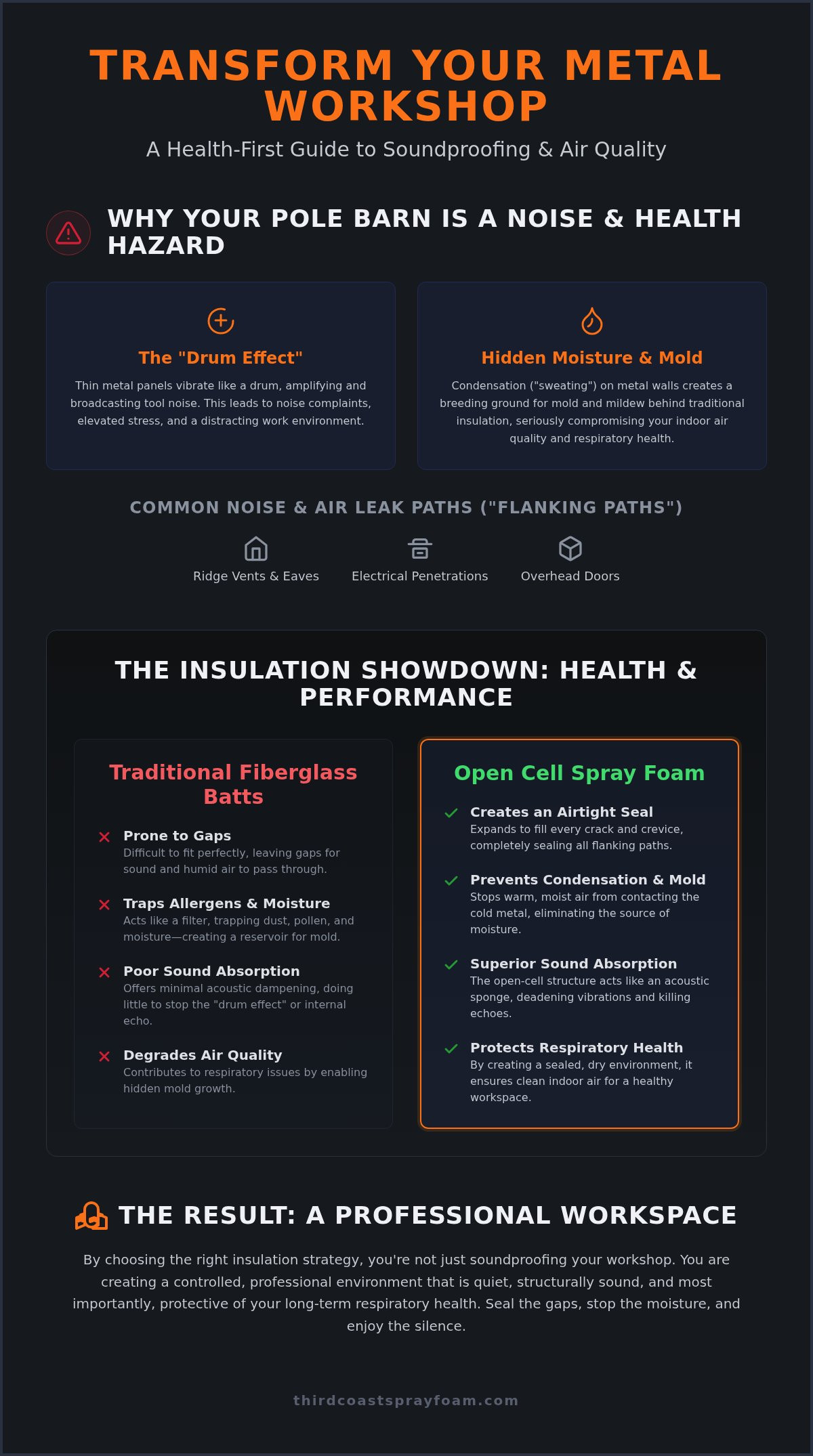
Metal buildings are efficient, but they act like acoustic amplifiers. When you run a planer or a grinder, the thin steel panels vibrate violently. This is the “Drum Effect.” Instead of containing sound, the metal skin actually broadcasts it across your property in Holland or Grand Haven. Understanding Sound Transmission is the first step in soundproofing a pole barn workshop. You have to tackle two distinct problems: sound absorption to stop internal echoes and sound blocking to keep the noise inside.
High decibel levels don’t just annoy neighbors; they impact your well-being. Constant noise exposure raises stress levels and heart rates. In many West Michigan shops, the lack of proper sealing also contributes to poor air quality. Without an airtight barrier, moisture seeps in, creating a breeding ground for mold that can compromise your respiratory health. A noisy shop is often a damp shop, and both issues require a systemic fix.
The Science of Reverberation in Large Metal Buildings
Standard metal workshops are full of hard, non-porous surfaces. Sound waves bounce indefinitely, creating a chaotic environment. Effective pole barn insulation must do more than regulate temperature. It needs to dampen vibrations and seal common leak points. Noise often escapes through:
- Ridge vents and eaves: These are primary exit points for high-frequency noise.
- Electrical penetrations: Small gaps that act as acoustic bridges.
- Overhead doors: Large surfaces that lack mass and a proper seal.
By sealing these gaps, you protect your hearing and your lungs simultaneously.
Open Cell Spray Foam: The Health-First Solution for Workshop Soundproofing
When soundproofing a pole barn workshop, you need a material that does more than just sit in a wall cavity. Open cell spray foam is the premier choice for acoustic dampening because of its unique cellular structure. The foam consists of millions of tiny, interconnected bubbles that act as a sponge for sound waves. This effectively kills the internal echo that makes power tools sound deafening. Unlike fiberglass batts, which often leave gaps for noise to escape, spray foam expands to fill every crevice. This creates a seamless airtight seal that stops sound “leaks” at the source. It is helpful to understand Why Metal Workshops Are Noise Magnets when you are planning your shop layout.
Choosing spray foam is also a critical health-conscious decision. Fiberglass batts are a liability for West Michigan indoor air quality. They are notorious for trapping dust, pollen, and moisture, which leads to a degraded environment. In our humid climate, this often results in hidden mold growth that can trigger serious respiratory issues. By air sealing your shop with professional foam, you’re investing in the most reliable method for soundproofing a pole barn workshop while protecting your health. If you’re ready to improve your workspace, you can reach out to a specialist for a tailored solution.
Preventing Mold and Protecting Indoor Air Quality
Metal walls are prone to “sweating” when warm indoor air hits the cold exterior steel. This condensation often hides behind traditional insulation, leading to structural rot and mold colonies. Spray foam eliminates this risk by preventing warm, moist air from ever touching the metal surface. While open cell is the leader for sound dampening, closed cell spray foam is often used on exterior walls to provide structural rigidity and a complete vapor barrier. This integrated approach ensures your workshop stays quiet, sturdy, and safe for your lungs over the long term.
Strategic Soundproofing: Sealing the Gaps in Your West Michigan Workshop
Sealing the main wall cavities is only the first phase of a successful project. To achieve true silence, you must address flanking paths where noise bypasses your insulation. In standard West Michigan builds, ridge vents, eaves, and electrical penetrations are the primary culprits. These gaps act like chimneys for sound waves. They also serve as entry points for humid air. When you seal these openings, you aren’t just soundproofing a pole barn workshop; you’re creating a controlled environment that prevents the condensation responsible for mold growth and respiratory irritation. A healthy shop requires this level of detail to ensure air pollutants stay out and quiet stays in.
Windows and overhead doors are often the weakest links in your acoustic defense. Standard metal doors lack the mass to block low-frequency vibrations from heavy machinery. We recommend utilizing high-quality weatherstripping and heavy-duty seals to close these gaps. You should also consider decoupling large tools, like air compressors or planers, from the concrete slab using vibration-damping mounts. This prevents the entire building structure from acting as a resonator for mechanical noise. Small adjustments to how your equipment sits on the floor can significantly lower the decibel levels inside the structure. For craftsmen shipping their finished projects, using custom foam inserts for shipping provides the same level of precision protection for your work as high-quality insulation does for your workshop environment.
Once the acoustics and air quality are addressed, the final step in creating a professional workspace is optimizing the layout. To see how a residential garage or shop can be fully transformed through expert organization, you can discover The Garage RX.
Build a Quieter, Healthier Workshop Today
Achieving a professional-grade workspace in West Michigan requires more than just hanging acoustic quilts on the wall. You’ve seen how the “drum effect” amplifies tool noise and why standard insulation often leads to hidden mold growth behind metal panels. By choosing professional open cell spray foam, you solve the noise problem while protecting your respiratory health. This approach creates an airtight seal that eliminates the condensation common in our humid climate. It ensures that your shop remains a safe environment for both your ears and your lungs.
As local Fruitport-based experts, we specialize in high-performance solutions that prioritize your indoor air quality and long-term structural integrity. Don’t let a noisy, damp shop limit your productivity or well-being. Our team is ready to help you finalize your plans for soundproofing a pole barn workshop with precision and care. Get Your Free Pole Barn Soundproofing Estimate in West Michigan. It’s time to enjoy a workspace that is as quiet as it is healthy.
Frequently Asked Questions
Is open cell or closed cell spray foam better for soundproofing a workshop?
Open cell spray foam is the superior choice for dampening internal echoes because its flexible, porous structure absorbs sound waves. While closed cell foam provides incredible structural strength and a vapor barrier, its density reflects more sound. For soundproofing a pole barn workshop, we typically recommend open cell on interior walls to maximize acoustic comfort while maintaining a healthy, airtight seal.
Can I soundproof my pole barn without replacing the existing insulation?
It’s rarely effective to add soundproofing over old fiberglass batts. Traditional materials often hide existing moisture issues and lack the airtight seal needed to block noise. To protect your respiratory health and prevent mold, we recommend professional insulation removal followed by spray foam. This ensures a clean foundation that stops noise leaks and prevents environmental triggers like dust or allergens.
Will soundproofing my workshop also help with the “sweating” on my metal ceiling?
Yes, the same airtight seal that blocks noise also eliminates condensation. In West Michigan, “sweating” occurs when warm interior air touches cold metal panels. By applying professional spray foam directly to the steel, you create a thermal break. This prevents the moisture buildup that leads to mold colonies. It’s a pragmatic way to improve indoor air quality while silencing your workshop.
How much noise reduction can I realistically expect in a metal building?
You can expect a dramatic decrease in the sharp, echoing noise common in metal buildings. While complete silence isn’t possible, an airtight seal reduces sound transmission by filling the gaps where noise escapes. Real-world results depend on sealing flanking paths like doors and vents. This comprehensive approach turns a vibrating metal shell into a quiet, stable environment suitable for professional-grade craftsmanship.
Disclaimer
Information provided is for general educational purposes. Individual needs and circumstances vary. Speak to an experienced professional to get the correct information for your situation.