
Last December, a homeowner near Grand Rapids walked into his workshop to find his $40,000 collection of woodworking tools covered in a thick layer of condensation “sweat” after a typical West Michigan temperature swing. This moisture isn’t just a threat to your equipment; it’s the primary catalyst for mold growth that can compromise your family’s respiratory health. If you’re researching the pole barn insulation cost Michigan contractors are quoting for 2026, you likely know that metal buildings are notoriously difficult to keep dry during our 100-inch snowfall winters. You want a space that stays warm without sending your utility bills through the roof, but you also need to ensure the air you breathe is clean and safe.
This guide breaks down the real-world factors that influence your investment, focusing on how owners in Grand Rapids and Lansing can effectively seal their building’s thermal envelope. We’ll explore the long-term ROI of professional air sealing and the technical steps our team takes to prevent mold and mildew. By the end, you’ll have a clear roadmap for turning a damp metal shell into a healthy, climate-controlled environment that protects both your property and your well-being.
Key Takeaways
- Get transparent 2026 pricing for common barn sizes to help you accurately estimate your pole barn insulation cost Michigan project.
- Learn why closed-cell spray foam outperforms traditional materials by creating a rigid moisture barrier that withstands Michigan’s unique “Lake Effect” humidity.
- Protect your family’s respiratory health by discovering how high-performance insulation prevents mold and seals out airborne irritants for better indoor air quality.
- Explore how proper ventilation and air sealing work together to create a stable, healthy environment while significantly reducing your monthly energy bills.
- Identify specific 2026 federal tax credits and rebates that can offset your initial investment and maximize the long-term ROI of your Michigan pole barn.
Understanding Pole Barn Insulation Costs in Michigan (2026)
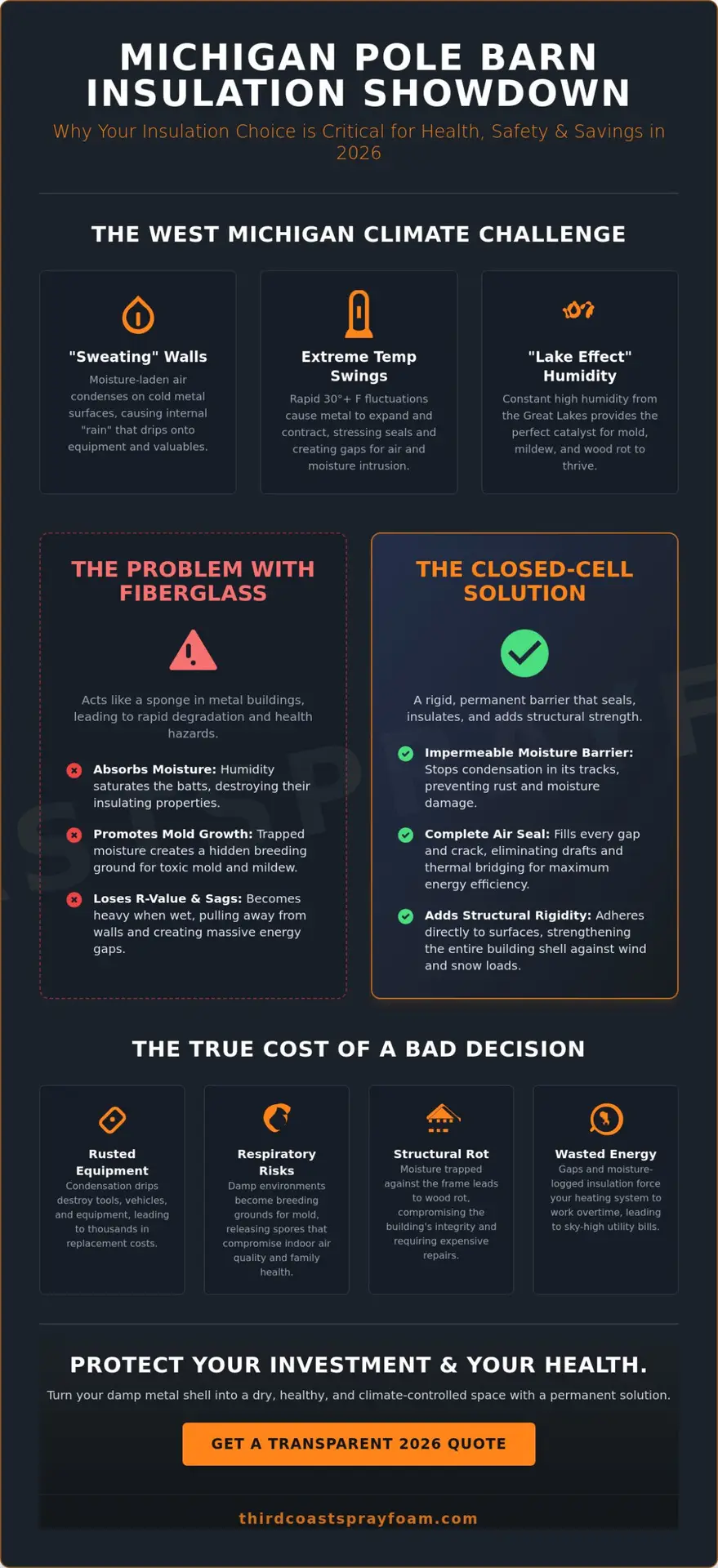
Building a pole barn in Michigan is a significant investment. Without a proper thermal and moisture barrier system, that investment is at risk. We define pole barn insulation as more than just a way to stay warm; it’s the primary defense against the Lake Effect humidity that defines our region. In Grand Rapids and Muskegon, owners frequently report a “sweating” phenomenon. This happens when moisture-laden air condenses on the interior metal skin, essentially raining inside your building. When evaluating the pole barn insulation cost Michigan residents face in 2026, it’s vital to look at the price-to-value ratio. While some materials have a lower initial price, they often fail to provide the air sealing required to stop condensation.
Our team views the building as a holistic system. Choosing the right material isn’t just about R-value; it’s about sealing the envelope to prevent the unique environmental challenges found in the Great Lakes state. For 2026, the market has shifted toward solutions that offer long-term durability over cheap, temporary fixes that degrade within five years.
The “Hidden” Costs of Poor Insulation
Skipping quality insulation creates long-term financial drains that go beyond monthly utility bills. Inadequate barriers allow moisture to build up, leading to rapid oxidation and rust on expensive equipment, tractors, and hand tools. Beyond property damage, there’s a direct link between damp environments and respiratory health. Mold and mildew thrive in unsealed barns, releasing spores that compromise indoor air quality and pose a risk to anyone working inside. If left unchecked, moisture trapped against the frame leads to wood rot, which can compromise the structural integrity of the barn and require thousands of dollars in repairs.
Why West Michigan Climate Demands Better Solutions
Temperature shifts in Lansing and Kalamazoo can be extreme, with 30-degree swings occurring in less than 24 hours. These rapid fluctuations cause metal buildings to expand and contract, stressing the building’s seals. In coastal towns like Holland and Grand Haven, high humidity levels act as a catalyst for mold growth within the wall cavities. Thermal bridging occurs when heat transfers through the conductive metal framing of a building, creating a direct path for energy loss that bypasses standard insulation layers. To combat this, our approach focuses on a complete air seal that stops the pole barn insulation cost Michigan owners pay from being wasted through invisible gaps.
- Rust Prevention: Stops condensation from dripping onto vehicles and tools.
- Respiratory Safety: Prevents mold colonies from forming in damp corners.
- Structural Integrity: Keeps support posts dry to prevent rot and shifting.
- Energy Efficiency: Maintains a stable internal temperature regardless of the 2026 winter forecast.
Closed Cell vs. Other Materials: Why Material Choice Dictates Price
When you evaluate your pole barn insulation cost Michigan, the sticker price of the material is only one part of the equation. The real cost includes how that material performs during a Grand Rapids winter and how it impacts your health over time. Material choice dictates price because it determines whether your insulation is a temporary filler or a permanent structural upgrade. In West Michigan, where humidity levels can fluctuate wildly, choosing a material that cannot handle moisture is a recipe for expensive future repairs.
The Problem with Fiberglass Batts in Metal Buildings
Fiberglass batts are often the cheapest initial option, but they perform poorly in metal structures. Fiberglass acts like a sponge for Michigan humidity. When warm indoor air hits the cold metal skin of your barn, condensation forms. Fiberglass absorbs this moisture, which causes the material to sag and lose its R-value. This creates a hidden breeding ground for mildew and toxic mold. For anyone using their barn as a workshop or hobby space, this is a significant concern for respiratory health. Breathing in mold spores can trigger asthma and other chronic lung issues. Our team at Third Coast Spray Foam avoids these methods because we prioritize total home health and long-term durability over cheap, short-term fixes.
Closed Cell Foam: The Health and Structural Gold Standard
Closed-cell spray foam is the premium choice for owners who want a “one and done” solution. It provides an impressive R-value of roughly 7.0 per inch, which is nearly double the efficiency of traditional batts. This density allows you to maintain a comfortable climate even when temperatures drop below zero. Beyond thermal performance, closed-cell foam adds significant structural rigidity to your barn. It bonds directly to the metal panels, which can increase the racking strength of your walls by up to 300 percent.
This material also addresses the vapor barrier requirement found in Michigan building codes. At a thickness of 1.5 inches, closed-cell foam becomes an impermeable barrier that prevents moisture from ever reaching your steel. This permanent air seal keeps out common allergens, dust, and outdoor pollutants. By sealing the envelope, you create a pristine indoor environment that supports better air quality and physical well-being. You can review the specific technical specs in our guide to Closed Cell Spray Foam in Grand Rapids. While the initial pole barn insulation cost Michigan might be higher for foam, the protection it offers your lungs and your building is unmatched. If you want to ensure your structure remains a healthy space for years to come, chat with our team about a custom insulation plan.
Estimating Your Michigan Pole Barn Insulation Project
Understanding your pole barn insulation cost Michigan requires a look at the “board foot” pricing model. This is the industry standard for spray foam transparency. A board foot is a volume measurement representing a 12-inch by 12-inch square at one inch of thickness. By using this metric, our team ensures you pay for the exact amount of material required to seal your building envelope. For most West Michigan structures, we calculate costs based on the total surface area of the walls and the roof deck. Insulating the roof deck is often a higher priority for owners because it stops the “stack effect” where heat escapes through the top, but a full envelope treatment provides the best protection against the moisture that triggers mold growth.
Cost Breakdown by Barn Size
For a standard 1,200 square foot shop in Muskegon (30×40), project totals vary based on the depth of the thermal barrier. A ceiling-only application focuses on preventing heat loss through the roof, which is often the most cost-effective entry point for hobbyists. However, a full envelope treatment, covering both the walls and the roof, creates a superior air seal. This complete seal is vital for respiratory health because it prevents the humid air from Michigan’s lake-effect weather from condensing on cold metal surfaces. When moisture is controlled, the risk of mildew and structural rot vanishes. Owners should [verify] current 2026 material surcharges with their quote, as supply chain shifts can impact the final price of chemical components.
- 30×40 Barn: Ceiling-only projects focus on the 1,200 sq. ft. overhead area; full envelope includes roughly 1,400 to 1,800 sq. ft. of wall space depending on height.
- 40×60 Barn: This 2,400 sq. ft. footprint requires significantly more material and often involves specialized lift equipment for the larger roof spans.
- Surface Area Variables: Roof decks typically require a higher R-value than walls to combat Michigan’s intense winter temperature gradients.
Factors That Influence Your Final Quote
The physical dimensions of your barn play a massive role in labor costs. A building with a 12-foot eave height is much simpler to spray than a 16-foot or 20-foot commercial-scale barn. Higher walls require heavy-duty scissor lifts and more time for our technicians to move safely. If your barn currently has old, sagging fiberglass batts, you must factor in the cost of professional insulation removal. Removing old material is a health-conscious choice. Traditional batts often trap dust, rodent waste, and allergens that degrade indoor air quality. By clearing the old material, we can apply foam directly to the substrate, ensuring a permanent air seal that supports better respiratory health for anyone working inside.
Location also impacts the bottom line. While we frequently serve the Muskegon area, projects in rural Allegan or Kalamazoo require additional mobilization and travel planning. Our team coordinates these logistics to keep the process efficient. We prioritize a “straight-shooter” approach, so your quote will clearly detail how height, accessibility, and material volume contribute to the final investment in your property’s longevity.
Planning for Health: Air Quality and Mold Prevention
West Michigan’s fluctuating humidity levels create a breeding ground for biological growth if a building isn’t properly sealed. While calculating your pole barn insulation cost Michigan, it’s essential to factor in the long-term health benefits of a sealed building envelope. We view your barn as a holistic system where air quality is just as important as temperature control. High-performance spray foam creates an airtight barrier that stops the infiltration of outdoor allergens, including the heavy ragweed pollen common in Kent and Ottawa counties. When you eliminate random air leaks, you gain total control over the environment where you work, store equipment, or house livestock.
Proper ventilation must work in tandem with high-performance insulation to ensure a healthy space. A tight seal prevents “ghosting” and moisture spots, but managed airflow via HRV or ERV systems ensures fresh air cycles through the building without losing your heated or cooled air. This balance is what prevents the stagnant, musty conditions often found in older, traditionally insulated barns.
Respiratory Health and Mold Management
Spray foam is an inorganic material, which means it doesn’t provide a food source for mold or mildew. Traditional fiberglass batts often trap moisture against wooden studs, leading to rot and the release of harmful spores into your breathing zone. Because closed-cell foam stays dry and rejects bulk water, it effectively starves mold before it can start. Air sealing reduces the spread of mold spores by eliminating the drafts that carry these irritants from wall cavities into your workspace. You’ll notice a cleaner, dust-free environment that’s safer for those with asthma or chronic respiratory conditions.
To maintain a healthy “barn environment” after our team finishes the job, follow this maintenance checklist:
- Monitor indoor humidity levels and keep them below 50 percent to discourage dust mites.
- Inspect door seals and window gaskets annually to maintain the integrity of the thermal envelope.
- Ensure all fuel-burning equipment is vented directly to the outdoors to prevent carbon monoxide buildup.
- Change filters on heating and cooling units every 90 days to keep air circulation crisp and clean.
Preparing Your Barn for a Professional Install
Preparing your site is a critical step that impacts both safety and the quality of the finished product. We ask all owners to move equipment, tools, and storage bins at least 3 to 5 feet away from the walls. This clearance allows our installers to maintain the correct spray angle for a uniform thickness. Our team follows strict safety protocols, including the use of high-powered exhaust fans to manage off-gassing and specialized PPE for every crew member. We typically require a 24-hour period before you resume normal activities in the barn to ensure the foam is fully cured and the air is clear.
A clean, dry substrate is the only way to guarantee 100 percent foam adhesion. If your barn has existing moisture or debris on the girts or metal panels, the foam won’t bond correctly, which can lead to air gaps later. You can find a full preparation checklist in our Ultimate Guide to Pole Barn Insulation to make sure your project starts on the right foot.
Investing in a professional seal helps offset the hidden pole barn insulation cost Michigan owners face when remediating mold or respiratory issues later. If you’re ready to create a healthier, more durable workspace, contact Third Coast Spray Foam for a professional health-focused consultation.
Maximizing ROI: Rebates, Tax Credits, and Long-Term Savings
Calculating the pole barn insulation cost Michigan owners must budget for requires looking beyond the initial quote. Smart property owners view this as a strategic investment that pays dividends through immediate tax relief and permanent utility reductions. For the 2026 tax year, the federal government continues to incentivize high-performance building envelopes. You can significantly offset your project expenses by maximizing your Energy Efficient Home Improvement Credit. This 25C credit typically covers 30% of your insulation material costs, with an annual cap of $1,200 for residential-use structures.
Federal and Local Michigan Incentives
If your pole barn serves as a primary workshop or agricultural storage, you might also qualify for specific commercial deductions under Section 179D. To claim these credits, keep your itemized invoices and the manufacturer’s certification statement that confirms the spray foam meets current energy standards. Locally, West Michigan residents should check with Consumers Energy or DTE. These utility providers often offer rebates ranging from $0.75 to $1.25 per square foot for professional air sealing and insulation upgrades. These financial perks combine to shorten your payback period, often making the net pole barn insulation cost Michigan residents pay much lower than the sticker price.
The financial return is only one part of the equation. We prioritize your physical well-being by focusing on total indoor air quality. Traditional insulation materials like fiberglass often act as a sponge for Michigan’s high humidity, creating a breeding ground for mold and mildew. This can lead to serious respiratory health issues for those spending long hours in their workshops. Our spray foam solutions eliminate the air infiltration that carries outdoor pollutants and allergens. By sealing the envelope, we prevent the condensation that triggers fungal growth, ensuring your workspace supports your long-term health and comfort.
The Third Coast Advantage in West Michigan
Our team understands the unique climate challenges facing neighbors from Grand Rapids to Grand Haven. We don’t believe in one-size-fits-all solutions. Instead, we treat your building as a holistic system where air quality and energy efficiency work together. This local expertise ensures your pole barn remains a dry, healthy environment regardless of the lake-effect snow or summer humidity. We take pride in our no-nonsense approach to quality, providing you with a thermal barrier that lasts for the life of your structure. Ready to protect your investment and your health? Get your free pole barn insulation estimate today and see how we can help you save.
Secure Your Investment and Your Health
Choosing the right insulation is about more than just numbers on a quote; it’s about protecting your building’s structural integrity and your family’s respiratory health. In 2026, navigating the pole barn insulation cost Michigan residents expect requires weighing the upfront investment against long-term gains like the 30% federal tax credit provided by the Energy Efficient Home Improvement Credit. Our team specializes in closed cell moisture barriers that “seal the envelope” to stop the condensation cycles that trigger mold growth. By maintaining these health-first installation standards, we effectively eliminate environmental pollutants that can lead to chronic lung irritation. We bring local Grand Rapids expertise to every job, ensuring your workspace remains a dry, safe environment for decades. It’s time to stop worrying about fluctuating energy bills and start enjoying a building that works as hard as you do.
Request a Free Pole Barn Insulation Quote from Third Coast Spray Foam and build a legacy of comfort and safety.
Frequently Asked Questions
How much does it cost to spray foam a 30×40 pole barn in Michigan?
The pole barn insulation cost Michigan homeowners encounter for a 30×40 structure depends on the total surface area of the walls and roof. For a barn with 12 foot eaves, you are typically looking at insulating approximately 2,800 square feet of surface. While prices fluctuate based on the thickness of the foam, our team focuses on providing a precise thermal envelope that maximizes your long term energy savings.
Is spray foam insulation safe for my respiratory health?
Spray foam is safe for your respiratory health once the curing process is finished. We follow a strict 24 hour re-occupancy period to ensure the workspace is completely clear of any application vapors. By creating a total air seal, the foam actually protects your lungs by blocking outdoor allergens, pollen, and dust from entering the building. This results in much cleaner indoor air quality for your workshop or storage area.
Can I insulate my pole barn myself with a DIY kit to save money?
You can purchase DIY kits, but they often lack the professional pressure and temperature controls required for a stable chemical reaction. If the two components don’t mix at a perfect 1:1 ratio, the foam may not cure properly, which leads to lingering odors and potential respiratory irritation. Professional application ensures the product is chemically stable and provides the permanent peace of mind you expect from a high quality install.
Does pole barn insulation qualify for the Energy Efficient Home Improvement Credit in 2026?
Pole barn insulation qualifies for the Section 25C tax credit if the building is used as part of your primary residence. In 2026, this federal credit allows you to claim 30% of the material costs, with a maximum annual limit of $1,200. You should save your manufacturer’s certification statement and your itemized receipt to verify that the materials meet the required energy efficiency standards during tax season.
What is the best type of insulation to stop pole barn ceiling condensation?
Closed cell spray foam is the superior choice for stopping the “raining” effect caused by ceiling condensation in West Michigan. It creates a seamless vapor barrier that prevents warm, humid air from reaching the cold metal roof panels. This proactive approach stops moisture from dripping onto your tools and prevents the damp conditions that lead to structural rot and poor air quality.
How long does it take to professionally insulate a Michigan pole barn?
Our crew typically completes a professional insulation job in 1 to 2 business days. The first day is dedicated to site prep and masking off your windows, doors, and equipment to prevent any overspray. Once the foam is applied, it reaches a stable state quickly, though we require a 24 hour period before you return to the building to ensure the indoor environment is healthy and fresh.
Will insulating my pole barn prevent mold and mildew growth?
Insulating with spray foam is a highly effective way to prevent mold and mildew because it eliminates the moisture source. Traditional materials like fiberglass can trap dampness and organic dust, creating a breeding ground for spores that harm your respiratory health. Since spray foam is inorganic and seals out humid air, it keeps your barn dry and prevents the growth of 99% of common household molds.
Do I need to remove old fiberglass before spraying new foam?
We strongly recommend removing old fiberglass batts before our team applies new spray foam. Old insulation often contains years of accumulated dust, rodent droppings, and trapped moisture that can compromise your indoor air quality. Removing the old material allows the foam to bond directly to the substrate, which creates a permanent seal and a much healthier environment for your family.
Disclaimer
Information provided is for general educational purposes. Individual needs and circumstances vary. Speak to an experienced professional to get the correct information for your situation.