
Your pole barn shouldn’t feel like a rain forest every time the West Michigan temperature drops. That steady drip from your ceiling, often called “barn rain,” is more than just a nuisance; it’s a direct threat to your property and your family’s well-being. If you’re searching for how to stop condensation in a pole barn, you’ve likely noticed musty smells or rusted tools that signal a deeper moisture problem. These conditions don’t just damage tractors and timber; they create a breeding ground for mold and mildew that can severely impact indoor air quality and respiratory health.
We understand the frustration of watching a significant investment “sweat” away its value. You deserve a workspace that stays dry and safe regardless of the season. In this guide, we’ll show you how to eliminate condensation permanently by focusing on high-performance air sealing and moisture control. We’ll explain why professional closed-cell spray foam is the most effective tool for preventing wood rot and protecting the air you breathe, ensuring your barn remains a healthy, functional asset for decades to come.
Key Takeaways
- Understand the specific environmental triggers in West Michigan that cause the “dew point” to shift, turning your ceiling into a source of damaging moisture.
- Learn the professional standards for how to stop condensation in a pole barn to prevent the mold and mildew that compromise your family’s respiratory health.
- Evaluate the limitations of passive ventilation and see why airflow alone isn’t a reliable fix for the extreme humidity fluctuations in our region.
- Discover how closed-cell spray foam creates a permanent vapor barrier that reinforces your building’s structure while keeping the interior bone-dry year-round.
- Gain a clear roadmap for transforming a damp, musty barn into a healthy, climate-controlled space that protects your tools and your air quality.
The Science of Sweating: Why Your West Michigan Pole Barn Has a Condensation Problem
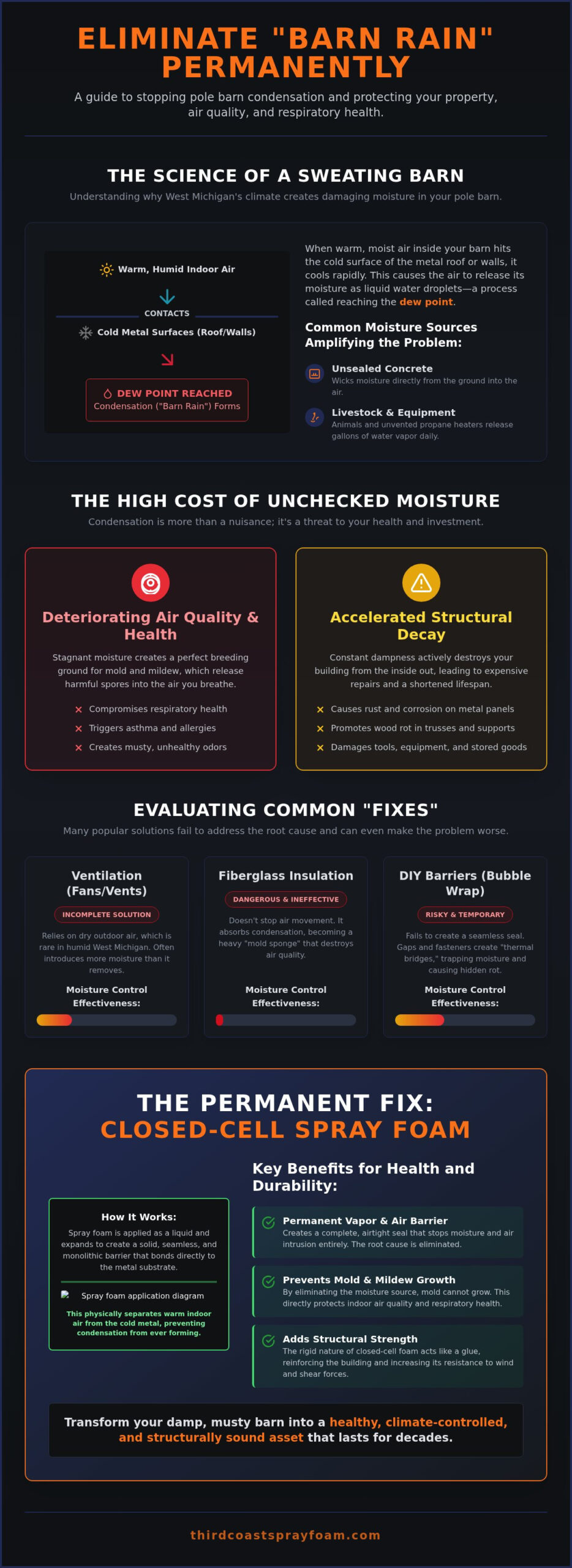
West Michigan weather is notoriously unpredictable. One day it’s freezing, and the next, a warm front brings humid air off the lake. This volatility is the primary driver for “barn rain.” To understand The Science of Sweating, you have to look at the dew point. This is the specific temperature where air becomes fully saturated and begins releasing water vapor as liquid. In a pole barn, this occurs the moment warm, moist indoor air makes contact with the cold surface of your metal roof or wall panels.
The problem is often amplified by internal moisture sources you might not even consider. Unsealed concrete slabs naturally “wick” moisture from the ground, while livestock and unvented propane heaters add gallons of water vapor to the air every day. When these factors combine with our high regional humidity, your barn’s thermal envelope fails. Learning how to stop condensation in a pole barn isn’t just about comfort; it’s about stopping a cycle that actively degrades your building’s environment.
To better understand this concept, watch this helpful video:
The Hidden Health Risks: Mold, Mildew, and Respiratory Safety
Stagnant moisture trapped against wooden girts and trusses creates an ideal environment for rapid mold colonization. These colonies release microscopic spores into the air, which can quickly compromise the indoor air quality of your workspace. Breathing in these contaminants poses a serious risk to your respiratory health, as mold spores are frequent triggers for asthma attacks and severe allergic reactions in enclosed barn environments. Protecting your air quality is just as vital as protecting your equipment.
Structural Integrity: How Moisture Shortens Your Building’s Lifespan
Chronic dripping is more than a nuisance; it’s a slow-motion wrecking ball for your property. Metal panels subjected to constant moisture undergo oxidation, which leads to deep-seated rust that weakens the exterior shell. When water stays trapped against wooden supports, it facilitates dry rot and eventual structural failure. While “minor” sweating might seem like a small issue, the long-term financial cost of replacing rotted timber or rusted metal far outweighs the investment in a permanent moisture solution. We focus on how to stop condensation in a pole barn to ensure your building stands strong for the next generation.
Maintaining the structural integrity of your property often involves a combination of moisture management and protective coatings. You can learn more about Midwest Paint to see how professional finishing and high-quality painting services further safeguard your building investment.
Evaluating Solutions: Ventilation vs. Insulation for Moisture Control
Many owners believe that more airflow is the only way to solve “barn rain.” While passive ridge vents or active mechanical fans are common suggestions, they often fail to address the root cause in our climate. Ventilation relies on the assumption that outdoor air is drier than indoor air. During a humid West Michigan summer or a damp autumn, bringing in more outside air simply introduces more moisture. Proper moisture control in farm buildings requires a strategy that goes beyond just moving air; it requires managing the thermal boundary of the structure.
Traditional fiberglass batts are a disastrous choice for metal buildings. They don’t stop air movement, meaning warm, moist air still reaches the cold metal panels. Once the dew point is hit, water saturates the fiberglass, turning it into a heavy “mold sponge.” This trapped moisture triggers rapid mold growth that ruins indoor air quality and puts your respiratory health at risk. To truly understand how to stop condensation in a pole barn, you must prioritize a continuous air seal that prevents air from ever making contact with the metal skin.
Why DIY Vapor Barriers and Bubble Wrap Often Fall Short
Thin radiant barriers and bubble wrap kits are popular DIY fixes, but they rarely provide a permanent solution. These materials often suffer from the “thermal bridge” effect, where moisture still forms on the fasteners or behind the barrier itself. Without the high-pressure chemistry used in professional Pole Barn Insulation, these kits fail to create a seamless bond. This creates hidden moisture pockets that accelerate wood rot and structural decay without you ever seeing the damage.
The Role of Dehumidification and Heat Management
Adding a heater to a damp, uninsulated barn actually makes the problem worse. Warm air holds more water vapor, which then condenses more aggressively when it touches cold surfaces. A properly insulated building reduces the load on your dehumidification systems and stabilizes the interior environment. Use this checklist to see if your setup is failing:
- Do you see water pooling on the floor despite having vents?
- Is your fiberglass insulation sagging or discolored?
- Do you notice a sharp, musty odor when you first walk in?
If you answered yes, your current system isn’t protecting your health or your property.
The Permanent Fix: Closed-Cell Spray Foam for Michigan Pole Barns
When you’re looking for a definitive answer on how to stop condensation in a pole barn, closed-cell spray foam stands alone as the only permanent solution. Unlike other materials that merely slow down heat transfer, high-density closed-cell foam acts as insulation, an air seal, and a vapor barrier in a single application. By adhering directly to the metal panels, it eliminates the air gap where moisture typically forms. This creates a seamless thermal envelope that prevents warm, moist air from ever reaching a cold surface, effectively ending the cycle of “barn rain” for good.
In high-moisture agricultural environments, the choice between open-cell and closed-cell foam is critical. Open-cell foam has an interconnected pore structure that can actually trap moisture in damp conditions, potentially leading to the same mold and respiratory health issues you’re trying to avoid. We exclusively recommend closed-cell spray foam for Michigan pole barns because its cells are completely encapsulated. This makes the material impermeable to water and adds significant structural rigidity to your building, often increasing the wind uplift resistance of your metal panels.
The Professional Installation Process: What to Expect
Achieving a permanent bond requires more than just spraying a chemical; it requires precision and expertise. Our process begins with thorough site preparation, which includes masking off your expensive equipment and cleaning the metal surfaces to ensure maximum adhesion. We carefully monitor ambient temperature and humidity levels throughout the application, as these factors are vital for the chemical reaction that creates a durable seal. Once the foam is applied, we follow strict safety protocols and provide clear guidance on curing times, ensuring the air quality is safe before you return to your workspace.
Long-Term ROI: Energy Savings and Property Value
Investing in a professional seal pays dividends by protecting your most valuable assets. By stopping the steady drip of condensation, you eliminate the primary cause of rust on tractors and tools, while also preventing the wood rot that compromises your building’s frame. For owners with heated workshops in Grand Rapids or Lansing, the energy efficiency gains are immediate and substantial. A properly insulated barn stays warmer in the winter and cooler in the summer, drastically reducing your utility costs. To learn more about optimizing your structure, check out The Ultimate Guide to Pole Barn Insulation in Grand Rapids & West Michigan. This holistic approach ensures your barn remains a dry, healthy, and high-value asset for years to come.
A dry, climate-controlled barn also serves as the ideal environment for automotive enthusiasts to work on vehicle upgrades. Whether you are installing a new sound system or custom electronics from Music In Motion, having a moisture-free workspace ensures that sensitive components remain safe from the corrosive effects of condensation.
Securing Your Structure and Health for the Long Term
Managing a pole barn in West Michigan requires a strategy that respects our unique environmental challenges. You’ve learned that “barn rain” isn’t just an inconvenience; it’s a structural threat that feeds mold and compromises your family’s respiratory health. While ventilation and temporary DIY fixes often fail during humid lake-effect cycles, professional closed-cell insulation offers a definitive path forward. Mastering how to stop condensation in a pole barn is ultimately about creating a stable, dry environment that preserves your equipment and protects the air you breathe.
As a locally owned and operated specialist in Fruitport, MI, we take pride in helping our neighbors build structures that last. Our team understands the technical demands of West Michigan’s climate and prioritizes a health-first approach to every project. We’re ready to help you transform your damp workspace into a secure, climate-controlled asset. Protect Your Barn and Your Health; Get a Free Inspection from Third Coast Spray Foam today. You deserve a building that works as hard as you do, and we’re here to ensure it stays bone-dry for decades to come.
Frequently Asked Questions
Will adding more vents stop my pole barn from sweating?
Vents alone are often insufficient to stop sweating because they rely on the assumption that outdoor air is drier than indoor air. In West Michigan, high humidity levels mean that ridge or soffit vents can actually draw moist air into the building, where it then hits the cold metal and condenses. To truly understand how to stop condensation in a pole barn, you must focus on creating a thermal barrier that prevents air from reaching the metal panels.
Is mold in my pole barn dangerous to my health?
Yes, mold colonization in an enclosed barn poses significant risks to your respiratory health. Mold spores are microscopic triggers for asthma, chronic coughing, and severe allergic reactions. When moisture is left unmanaged, these spores circulate through the indoor air, compromising the safety of anyone working inside. Preventing mold growth is a critical step in maintaining a healthy environment for your family and livestock.
Can I use fiberglass batts to stop condensation in a metal building?
Fiberglass batts are generally ineffective and even counterproductive in metal buildings. Because they don’t provide an air seal, warm air passes through the fibers and condenses against the metal. The fiberglass then absorbs this water, turning it into a “mold sponge” that damages your wooden supports and ruins indoor air quality. This trapped moisture accelerates wood rot and creates long-term structural instability.
How thick does spray foam need to be to stop condensation?
A depth of one to two inches of closed-cell spray foam is typically sufficient to create a permanent vapor barrier and stop condensation. This thickness ensures that the dew point is moved outside the insulation layer, preventing water from forming on the interior metal surface. While thicker layers offer higher R-values for temperature control, even a thin, continuous seal will effectively eliminate the “barn rain” that threatens your property.
Does closed-cell spray foam prevent rust on metal barn panels?
Yes, closed-cell spray foam is an excellent tool for preventing rust and oxidation. By adhering directly to the metal, it blocks oxygen and moisture from reaching the surface of the panels. This airtight seal stops the chemical reaction that causes rust, significantly extending the lifespan of your building’s exterior skin. It’s a proactive investment in the structural integrity of your pole barn.
Is it safe to breathe the air in a barn after spray foam installation?
It is completely safe to breathe the air once the foam has fully cured and the space has been properly ventilated. During the professional installation process, we use specialized safety protocols to manage off-gassing. We provide specific timelines for when you can safely re-enter the building, typically within 24 hours. Once cured, the foam is inert and actually improves indoor air quality by preventing the growth of mold and mildew.
Disclaimer
Information provided is for general educational purposes. Individual needs and circumstances vary. Speak to an experienced professional to get the correct information for your situation.