
Imagine walking into your West Michigan pole barn on a humid morning in 2026 only to find “barn rain” dripping from the steel ceiling onto your expensive equipment. Finding expert pole barn insulation installers near me is about more than just temperature control; it’s a vital step in protecting your respiratory health and your building’s structural integrity. You’ve likely felt the frustration of extreme temperature swings or worried about the hidden mold growth that thrives in damp, unsealed spaces.
We agree that your barn should be a safe, bone-dry environment where you don’t have to worry about air quality or rust. This guide will provide the clarity you need to choose a local contractor who understands the unique lake-effect moisture loads of our region. You’ll learn how the Michigan Commercial Energy Code updates filed on April 21, 2026, impact your project and why investing $8,600 to $21,700 in professional spray foam creates a permanent thermal envelope. We’ll explore the best installation practices to ensure your space hits the recommended R-38 ceiling standards while effectively sealing out the allergens and moisture that compromise your health.
Key Takeaways
- Learn how to eliminate “barn rain” and prevent the mold growth that threatens your respiratory health during West Michigan’s humid seasonal transitions.
- Discover why closed-cell spray foam is the superior choice for creating a bone-dry thermal envelope while adding essential rack strength to your metal structure.
- Identify the hidden dangers of traditional materials like fiberglass batts, which often trap moisture and provide a breeding ground for rodents and allergens.
- Understand how to properly vet pole barn insulation installers near me by asking critical questions about equipment calibration and climate-specific application.
- Navigate the 2026 Michigan Commercial Energy Code updates to ensure your insulation project meets new performance standards for air barrier verification.
The West Michigan Pole Barn Challenge: Condensation, Mold, and Air Quality
West Michigan weather is notoriously hard on steel structures. Our proximity to the lake creates a high-humidity environment that turns uninsulated pole barns into giant refrigerators during the winter and humid boxes in the summer. When property owners search for pole barn insulation installers near me, they usually want to escape the cold. However, the most urgent threat isn’t just a low temperature. It’s the invisible moisture that accumulates on metal panels, leading to “barn rain” and a host of respiratory health issues. Our team at Third Coast Spray Foam sees the results of this daily: rusted tools, rotting structural poles, and moldy storage bins that were once dry.
Understanding the ‘Sweating Ceiling’ Phenomenon
Condensation occurs when warm, moisture-laden interior air makes contact with cold metal surfaces. This is especially common during Michigan’s seasonal transitions in late spring and autumn. When the surface temperature of your steel panels drops below the dew point, water droplets form and eventually drip onto your floor. Many owners try to fix this with fiberglass batts, but this often makes the problem worse. Fiberglass doesn’t stop air movement; it simply hides the moisture against the metal skin, leading to hidden corrosion and sagging. Condensation acts as the primary catalyst for structural rot in uninsulated barns.
Respiratory Health and Mold Prevention
A damp barn is more than just a nuisance; it’s a health hazard. Trapped moisture provides the perfect breeding ground for mold spores like Cladosporium and Penicillium, which can quickly colonize porous materials stored inside. These spores become airborne and significantly degrade indoor air quality (IAQ). For hobbyists or business owners who spend hours in their shops, breathing these allergens can lead to chronic coughs, sinus congestion, and long-term respiratory distress.
Applying professional Spray foam insulation is the only way to create a true air seal that prevents this moisture cycle. By sealing the envelope, we eliminate the pockets where mold thrives. This creates a hypoallergenic workspace that is safe for both you and your family. With the Michigan Commercial Energy Code updates filed on April 21, 2026, there is now a much heavier emphasis on air barrier performance. This regulatory shift confirms what we’ve always known: a healthy building requires a tight seal.
Protecting your investment is a matter of financial pragmatism. With pole barn construction costs reaching up to $45 per square foot in 2026, allowing moisture to degrade your structure is an expensive mistake. Choosing pole barn insulation installers near me who prioritize air sealing ensures your vehicles, equipment, and lungs remain protected for the long haul. We focus on total building health, ensuring your barn remains a bone-dry asset rather than a liability.
Why Closed-Cell Spray Foam is the Standard for Barn Health
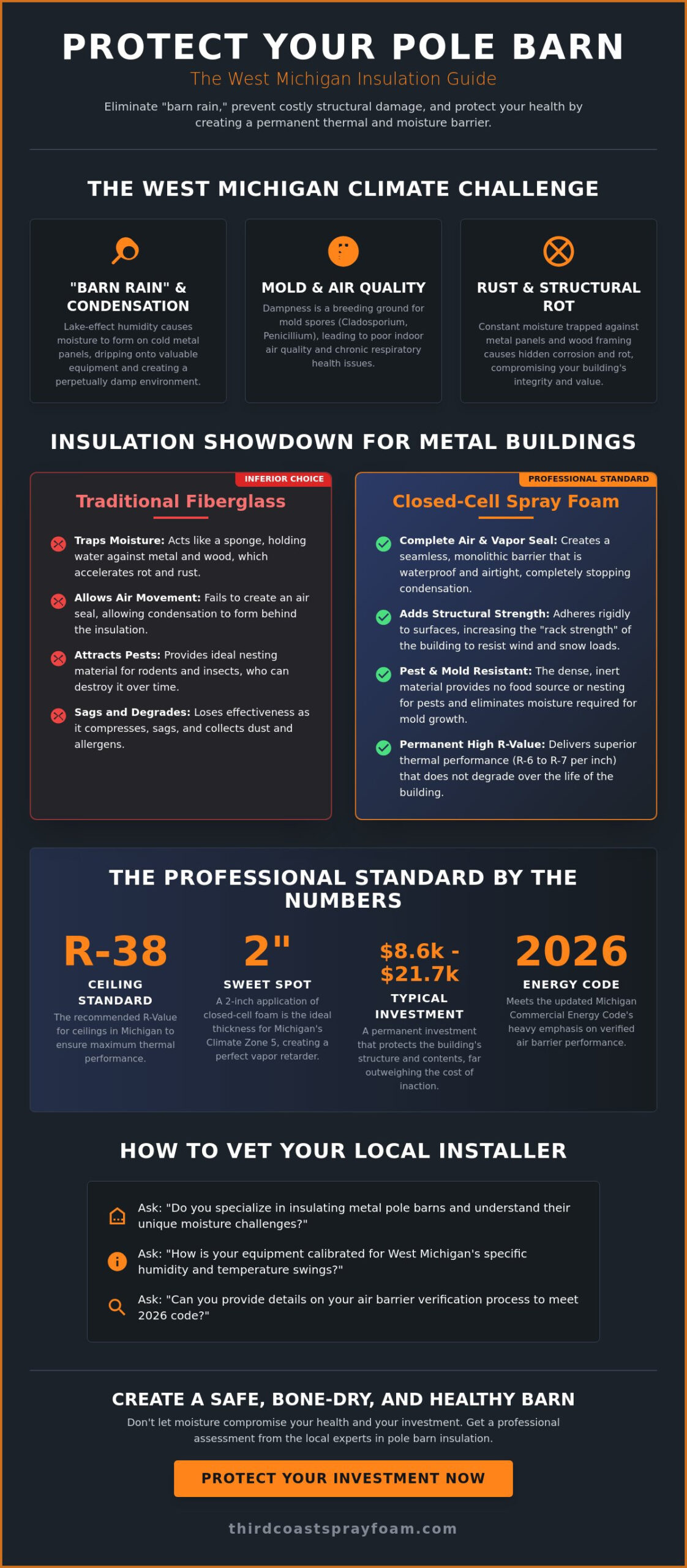
When you start looking for pole barn insulation installers near me, you’ll quickly realize that metal buildings require a specific type of protection. While fiberglass or cellulose might work in a standard home, they often fail in the harsh, high-moisture environment of a West Michigan barn. Closed-cell spray foam is the industry standard because it’s a high-density material that acts as a thermal barrier, air seal, and vapor retarder all in one. It doesn’t just sit in the wall cavity; it adheres to the metal panels, adding “rack strength” to the structure. This rigidity helps your barn resist the heavy snow loads and high winds common in our region, making the building itself more durable over time.
Closed-Cell vs. Open-Cell in Metal Buildings
We don’t install open-cell foam in pole barns, and for a good reason. Open-cell foam has a sponge-like structure that can actually trap moisture against your steel siding. In contrast, closed-cell polyurethane is waterproof. It provides a superior R-value of R-6 to R-7 per inch, which is nearly double that of other materials. A 2-inch application is typically the “sweet spot” for Michigan’s Climate Zone 5. This thickness creates a seamless vapor retarder, which is essential for preventing condensation in pole barns. You won’t need to worry about extra plastic liners or the “barn rain” that ruins your tools and equipment.
Sealing the Thermal Envelope
Our team views every barn through the lens of “total home health.” Even if you don’t live in your barn, the air you breathe while working inside matters. By sealing the thermal envelope, we stop the “chimney effect.” This occurs when warm air leaks out of the roof, creating a vacuum that pulls in cold, damp air and outdoor pollutants through the base of the walls. This cycle introduces dust, allergens, and pests that can trigger respiratory issues.
A professional spray foam application eliminates these air leaks permanently. It won’t sag or settle like traditional batts, ensuring your indoor air quality remains high for the life of the building. This “straight-shooter” approach to insulation means you aren’t just buying a temperature fix; you’re investing in a clean, climate-controlled environment. If you’re ready to protect your structure and your health, you can see how our team seals the envelope for local property owners.
Comparing Insulation Methods: Protecting Your Workshop and Your Lungs
When you search for pole barn insulation installers near me, you’ll likely encounter a range of quotes and material types. It’s tempting to look at the lowest price tag, but a true cost-benefit analysis must include your health and the building’s longevity. In West Michigan, where humidity levels often exceed 70% during the summer, your choice of insulation determines whether your workshop stays dry or becomes a haven for respiratory irritants. Choosing the wrong material can lead to “sick building syndrome,” where poor indoor air quality (IAQ) causes headaches and lung irritation for anyone working inside.
Why We Don’t Install Fiberglass Batts
We don’t install fiberglass batts in pole barns because they are fundamentally incompatible with corrugated metal structures. Batts fail to provide an air seal. This creates a “filter” effect where air pushes through the fiberglass, leaving behind dust, pollen, and moisture. Over time, these batts sag and become heavy with water, which often leads to rodent nesting and hidden mold growth. For those working inside, breathing in fiberglass particles and mold spores is a serious risk to respiratory health. For more technical details on the high-performance alternative we recommend, see our Closed Cell Spray Foam Guide.
Blown-In Insulation for Pole Barn Ceilings
Blown-in insulation can be a viable, budget-friendly choice for pole barn ceilings, provided there is a solid ceiling deck. It’s an effective way to hit the R-38 to R-49 targets recommended for Michigan’s Climate Zone 5 in 2026. However, it requires a professional-grade vapor barrier to prevent moisture from rising into the attic space. Without this barrier, the cellulose or fiberglass will absorb rising humidity and lose its R-value, eventually leading to ceiling rot. You can learn more about this specific application in our Attic Blown-In Insulation Guide.
Investing in high-performance insulation is a 20-year health and energy strategy. While a complete spray foam package for a Michigan barn in 2026 typically ranges from $8,600 to $21,700, the long-term protection against structural rot and poor IAQ pays for itself. You aren’t just buying foam; you’re buying peace of mind for your lungs and your equipment. Our team focuses on sealing the envelope correctly the first time, ensuring your barn remains a healthy, functional space for decades. We take pride in being the pole barn insulation installers near me who prioritize your well-being over a quick, cheap fix.
Hiring Local: Vetting Pole Barn Insulation Installers in West Michigan
Selecting a contractor from a list of pole barn insulation installers near me involves more than just picking the lowest bid. In West Michigan, our climate is a major factor in how spray foam cures and performs. Our proximity to Lake Michigan means we deal with unique humidity spikes that can interfere with the chemical reaction of the foam. A national chain or a big-box store installer might follow a generic manual, but they often lack the local expertise required to adjust equipment settings for a humid morning in Muskegon or a freezing afternoon in Grand Rapids.
The ‘Near Me’ Advantage: Why West Michigan Roots Matter
Local roots provide more than just a shorter drive time. Our team understands the specific building codes in Ottawa, Kent, and Muskegon counties, especially with the new Michigan Commercial Energy Code rules filed on April 21, 2026. These updates require stricter verification of the air barrier, a task that demands precision during the installation process. An installer who lives and works here knows how to “seal the envelope” to account for lake-effect moisture loads. This ensures your barn remains a healthy environment that won’t trigger respiratory issues due to hidden mold growth. For a full list of what to look for in a contractor, check out our guide on Choosing a Local Insulator.
Red Flags to Watch For
Your health and safety depend on the installer’s commitment to professional standards. If a contractor suggests using DIY kits for a large-scale pole barn, walk away. These kits lack the temperature controls and pressure stabilization needed to ensure the foam cures properly. When foam is “off-ratio,” it can lead to lingering chemical odors and off-gassing that compromise your indoor air quality. Always watch for these red flags:
- Lack of proper PPE: If the crew isn’t using supplied-air respirators and full-body suits, they aren’t following safety protocols.
- Vague quotes: A professional estimate should always specify the foam density and the exact R-value targets for your walls and ceiling.
- No local office: A physical presence in West Michigan is your guarantee of long-term warranty support.
We take pride in our “straight-shooter” approach. We use high-end, calibrated equipment to ensure every application is precise, safe, and permanent. This level of detail protects your respiratory health and your property’s value. If you’re looking for a partner who knows West Michigan barns inside and out, contact our team today for a reliable site assessment.
The Third Coast Approach: Professional Installation for a Healthier Barn
At Third Coast Spray Foam, we don’t just apply insulation; we engineer a healthier environment for your property and your family. As leading pole barn insulation installers near me, our team prioritizes a health-first philosophy that goes beyond simple temperature control. We understand that a West Michigan barn is a significant investment. Our “Straight-Shooter” guarantee ensures you receive an honest, technical assessment and a precision application that leaves no room for error. We take immense pride in our craft, focusing on the long-term structural integrity and indoor air quality of every building we touch.
Our specialized process pays close attention to the often-overlooked areas that compromise a building’s health. We focus on sealing rim joists and gables, which are the primary entry points for the moisture and outdoor allergens that trigger respiratory distress. By creating a seamless thermal envelope in these critical zones, we eliminate the pockets where mold spores and mildew thrive. This meticulous approach ensures that your workshop or storage space remains bone-dry and safe for years to come. We treat your barn as a holistic system, ensuring every gap is closed to protect your lungs and your equipment.
Serving Grand Rapids, Muskegon, and the Lakeshore
Our service area is deeply rooted in the West Michigan community, stretching from the state capital in Lansing all the way to the shores of Grand Haven. We’ve built our reputation on being a local partner who understands the unique moisture loads of the lakeshore. Our team coordinates closely with you to ensure minimal disruption to your barn’s daily operations. Whether you’re managing a commercial fleet or a private collection, we provide the security and pragmatism you expect from a local expert. For a closer look at our recent work across the region, you can explore our Ultimate Pole Barn Guide.
Your Free Estimate and Health Audit
When you schedule a site walk-through with us, you’re getting more than a price quote. We conduct a comprehensive “health audit” of your structure to identify existing moisture triggers and air leaks. Our experts explain the mechanical process of how closed-cell foam will transform your space, providing a clear picture of the results you can expect. We also help you calculate the return on investment by looking at projected energy savings and the value of long-term structural protection. As trusted pole barn insulation installers near me, we believe in providing you with the facts so you can make an informed decision for your property. Don’t wait for “barn rain” to damage your health or your assets. Get your free estimate from Third Coast Spray Foam and take the first step toward a cleaner, more efficient barn today.
Take Control of Your Barn’s Climate and Health
Investing in high-performance insulation is a permanent commitment to your building’s health and your own well-being. You’ve seen how closed-cell spray foam creates a bone-dry thermal envelope that effectively blocks the mold spores and allergens that threaten your respiratory health. You also know that local expertise is the only way to navigate West Michigan’s unique humidity loads and the latest energy code updates filed on April 21, 2026. Choosing the right pole barn insulation installers near me is the first step toward a healthier, more durable structure that protects your equipment and your lungs.
As a locally owned business in Fruitport, MI, our team at Third Coast Spray Foam specializes in these exact climate challenges. We take pride in our “straight-shooter” approach, focusing on precision applications that ensure your indoor air quality remains high for decades. We’re ready to help you eliminate condensation and maximize your energy efficiency with solutions tailored to your specific needs. Secure your free, no-obligation pole barn insulation estimate today. We look forward to helping you transform your barn into a space that’s as comfortable as it is secure.
Frequently Asked Questions
Is it worth insulating a pole barn if I don’t heat it?
Yes, insulating an unheated barn is essential for moisture control and structural preservation. Without insulation, the “sweating ceiling” phenomenon causes water to drip on your tools and equipment. This moisture leads to rust and promotes mold growth, which compromises your respiratory health. By hiring pole barn insulation installers near me, you create a dry environment that protects your investment from rot, even without a dedicated heat source.
Can I use spray foam on a metal pole barn ceiling?
You can and should use closed-cell spray foam on metal ceilings. It adheres directly to the steel panels, creating a seamless air and vapor barrier. Unlike other materials, it won’t sag or fall over time. This application is the most effective way to stop “barn rain.” Our team ensures the foam is applied at the correct temperature to guarantee a permanent bond and a healthy, leak-free thermal envelope.
How much R-value do I really need for a Michigan pole barn?
For a Michigan pole barn in Climate Zone 5, we recommend R-38 to R-49 for ceilings and R-13 to R-21 for walls. These standards align with the Michigan Commercial Energy Code updates filed on April 21, 2026. Achieving these values with closed-cell spray foam requires approximately 2 to 3 inches of material. This thickness provides the necessary thermal resistance while simultaneously sealing the building against outdoor pollutants and moisture.
Does pole barn insulation qualify for the Energy Efficient Home Improvement Credit?
Generally, the Energy Efficient Home Improvement Credit (Section 25C) applies only to primary residences, not detached agricultural buildings or shops. However, if your pole barn is structurally attached to your home or used as a primary living space, it might qualify for a tax credit of up to 30% of the material costs. We recommend consulting a tax professional to see how these 2026 federal guidelines apply to your specific structure.
What is the best way to stop condensation in a pole barn?
The most effective way to stop condensation is by applying closed-cell spray foam directly to the metal skin. This creates a permanent vapor barrier that prevents warm, moist air from reaching the cold steel panels. By eliminating this dew point contact, you stop “barn rain” entirely. This process is vital for preventing the mold and mildew that can severely impact your indoor air quality and long-term respiratory health.
Can I stay in the barn while the spray foam is being installed?
No, you must vacate the barn during the installation and for typically 24 hours afterward. Our team uses specialized PPE and supplied-air respirators to stay safe during the chemical reaction. While the foam is curing, it can release vapors that irritate the lungs. We prioritize your safety and ensure the space is properly ventilated before you return to a clean, hypoallergenic, and fully sealed environment.
How long does professional pole barn insulation last?
Professional closed-cell spray foam is designed to last for the entire lifespan of your building. Unlike fiberglass batts, it doesn’t settle, sag, or lose its R-value over time. It remains a permanent part of the structure, providing continuous air sealing and moisture protection. This durability makes it a one-time investment that pays for itself through energy savings and by preventing the costly structural rot caused by untreated condensation.
Will insulating my barn help with respiratory allergies or asthma?
Yes, professional insulation significantly improves indoor air quality for those with allergies or asthma. By sealing the envelope, we prevent outdoor allergens, dust, and pests from entering your workspace. More importantly, it stops the moisture cycles that allow mold and mildew to grow. This results in a cleaner, safer environment where you can work comfortably without the triggers that cause respiratory distress or lung irritation.
Disclaimer
Information provided is for general educational purposes. Individual needs and circumstances vary. Speak to an experienced professional to get the correct information for your situation.