
What if the most dangerous threat to your commercial building’s bottom line isn’t a leaking roof, but the invisible moisture trapped right beneath it? As a property owner in West Michigan, you’re likely tired of watching heating costs climb every winter while tenants complain about damp air or lingering odors. These aren’t just minor annoyances; they’re signs that your commercial roof insulation West Michigan strategy isn’t meeting the demands of our unique climate.
We understand the frustration of dealing with ice damming on flat roofs and the constant worry about how indoor air quality affects your team’s respiratory health. You deserve a workspace that’s both efficient and safe. This guide will show you how high-performance insulation protects your structural integrity and prevents the mold growth that compromises occupant well-being. We’ll explore the latest 2021 Michigan Energy Code requirements, including the mandatory R-30ci standards for our region, and explain how choosing the right system leads to lower operational costs and a healthier indoor environment for everyone.
Key Takeaways
- Learn why West Michigan’s intense freeze-thaw cycles require specialized thermal barriers to maintain your building’s structural integrity over time.
- Discover how advanced moisture management prevents the mold and mildew growth that directly compromises indoor air quality and tenant respiratory health.
- Understand the performance advantages of closed cell spray foam in eliminating the air leaks and seam failures often found in traditional board insulation.
- Identify the long-term financial benefits of high-performance commercial roof insulation West Michigan, including significantly lower operational costs and enhanced building longevity.
- Explore our comprehensive installation process, focusing on detailed site audits and surface preparation to ensure a permanent, airtight seal for your facility.
The Critical Role of Commercial Roof Insulation in West Michigan
High-performance barrier systems are more than just padding for your building; they are sophisticated assemblies designed for large-scale thermal and moisture control. In our region, commercial roof insulation West Michigan serves as the primary defense against a volatile climate that can swing forty degrees in a single day. To understand the foundational science behind these systems, you can refer to this Building insulation overview, which highlights how modern materials prevent energy transfer. For a local business, this system acts as the first line of defense for structural health, ensuring that the bones of your facility remain dry and stable regardless of the weather outside.
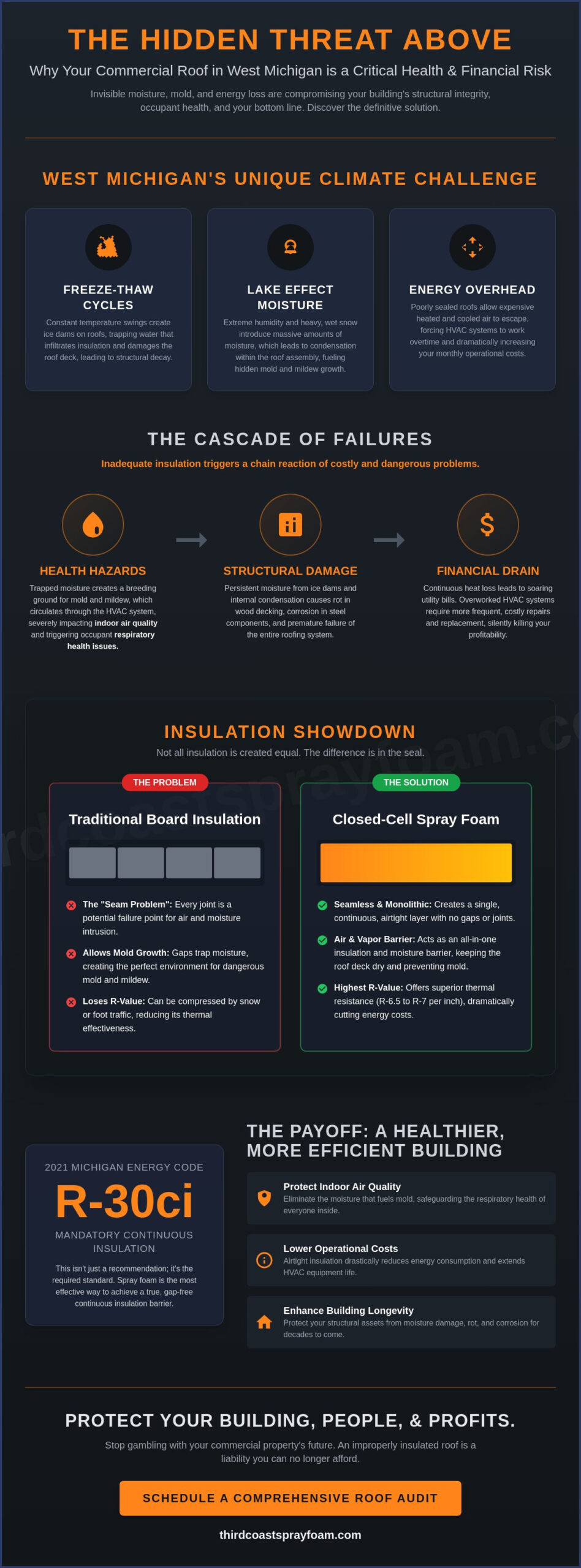
West Michigan buildings face intense stress from relentless freeze-thaw cycles. When heat escapes through an under-insulated roof, it melts the bottom layer of snow. This water runs to the cold edges or drains and refreezes, creating massive ice dams. On a flat commercial roof, these dams trap standing water that eventually finds its way into your deck and insulation. Once moisture enters the system, it doesn’t just damage the steel or wood; it creates a breeding ground for mold. This compromise leads to poor indoor air quality and can trigger serious respiratory health issues for your employees or tenants.
To better understand the risks of moisture in your roofing system, watch this helpful video:
Combatting the Lake Effect: Moisture and Thermal Loss
Proximity to Lake Michigan means cities like Muskegon and Holland deal with extreme humidity and heavy, wet snow loads. This moisture requires superior vapor management that traditional materials often fail to provide. Heavy snow can compress fiberglass or low-quality boards, stripping them of their thermal effectiveness. When warm indoor air meets a cold, compressed roof deck, condensation forms within the roof assembly. This hidden “rain” inside your ceiling causes rot and fuels the growth of mildew, which eventually circulates through your ventilation system. Protecting respiratory health starts with a roof that stays dry from the inside out.
Energy Overhead: The Financial Cost of Under-Insulation
The financial impact of poor commercial roof insulation West Michigan is felt every month on your utility bill. Heat loss through unsealed commercial roof decks is a silent profit killer. While many contractors focus solely on R-value, this number doesn’t tell the whole story. If your insulation doesn’t provide a continuous air seal, your expensive conditioned air is simply leaking into the atmosphere. This forces your commercial HVAC systems to work overtime during the humid Michigan summers and frigid winters. Investing in a seamless, high-performance barrier reduces this mechanical load, extending the life of your equipment and lowering your long-term operational costs.
Spray Foam vs. Traditional Board Insulation: A Performance Breakdown
Choosing the right material for your facility requires looking beyond the initial price tag. While Polyiso boards are a common sight on many job sites, they carry an inherent weakness known as the “seam problem.” Every joint between these rigid boards represents a potential break in your thermal envelope. Over time, as a building settles or temperatures fluctuate, these seams can widen. This allows conditioned air to escape and moisture to seep in, creating a perfect environment for mold to thrive. Closed cell spray foam eliminates this risk by creating a seamless, fully adhered layer that contours to every inch of your roof deck.
The technical performance of your system is often measured by R-value, which is the material’s resistance to heat flow. According to the Department of Energy on insulation, the effectiveness of these materials depends heavily on proper installation and air sealing. Closed cell foam typically offers an R-value of 6.5 to 7.0 per inch. This significantly outperforms Expanded Polystyrene (EPS) at roughly 3.6 per inch and Extruded Polystyrene (XPS) at 5.0 per inch. For commercial roof insulation West Michigan, this higher density is vital for resisting the weight of lake-effect snow and preventing the compression that ruins traditional materials.
We strictly avoid using fiberglass batts for high-performance commercial projects. Fiberglass is highly porous and acts like a filter, trapping dust, moisture, and pollutants. In the high-humidity environment of West Michigan, wet fiberglass becomes a heavy, soggy mess that fuels fungal growth. This compromise leads to poor indoor air quality and can cause chronic respiratory health issues for your employees. To ensure a safe and efficient environment, we recommend closed cell spray foam insulation as a superior, health-conscious alternative.
The Air Sealing Advantage of Spray Foam
Traditional board insulation often fails to address thermal bridging in steel and concrete roof decks. Heat easily transfers through the fasteners and gaps inherent in board systems. Spray foam expands sixty times its liquid volume in seconds. This expansion fills irregular gaps, cracks, and penetrations that boards simply miss. The result is a monolithic barrier. It acts as a permanent seal that prevents your expensive heated or cooled air from leaking into the atmosphere, keeping your indoor climate stable and comfortable.
Durability and Longevity in Commercial Environments
Commercial roofs must withstand mechanical vibrations and occasional foot traffic from maintenance crews. Unlike blown-in materials that settle over time, closed cell foam remains rigid and maintains its R-value for the life of the building. It is the only insulation material that adds significant structural strength to the roof assembly. This rigidity helps prevent the sagging that leads to ponding water. By maintaining a dry, stable deck, you protect the building’s structural integrity and prevent the moisture-driven decay that threatens occupant health.
Protecting Indoor Air Quality: The Health and Safety Advantage
Managing a commercial property involves more than just keeping the lights on. It requires a commitment to the health of everyone under your roof. Indoor air quality (IAQ) has become a primary liability concern for building owners, as poor environmental conditions can lead to costly legal challenges and decreased productivity. If your commercial roof insulation West Michigan strategy doesn’t prioritize a tight seal, you’re leaving the door open for pollutants, allergens, and moisture to bypass your defenses. A compromised roof system is often the silent source of lingering health issues that affect an entire workforce.
The direct link between roof performance and respiratory health is well-documented. When a roofing system fails to manage moisture properly, the insulation becomes a hidden reservoir for biological contaminants. These contaminants don’t stay in the ceiling; they circulate through the building’s air supply every time the HVAC system kicks on. High-performance commercial roof insulation West Michigan acts as a critical barrier. It blocks the infiltration of outdoor smog and seasonal pollens while ensuring that the internal environment remains dry and stable. This proactive approach to property maintenance is essential for preventing the sick building syndrome that plagues many older facilities.
Respiratory Health and Mold Prevention
Mold spores are microscopic triggers that can cause severe asthma attacks and chronic allergic reactions in sensitive individuals. In West Michigan’s damp climate, preventing fungal growth is a constant battle for facility managers. Closed cell foam provides a built-in vapor barrier that stops moisture from reaching the dew point within your roof assembly. By eliminating the damp conditions required for toxic black mold and other fungal growth to survive, you’re making a direct investment in the long-term physical well-being of your tenants and staff. It’s a pragmatic choice that prioritizes human health alongside structural safety.
Safe Installation and Environmental Standards
Modern building codes now demand stricter adherence to environmental safety, including low-VOC (volatile organic compound) requirements. We ensure that every installation meets these 2026 standards through rigorous surface preparation and professional application techniques. This careful process guarantees proper off-gassing and a clean transition to a more efficient, safer workspace. Choosing a high-quality closed cell spray foam system doesn’t just lower your monthly overhead; it creates a sanctuary of clean air that supports a healthy, productive workforce for decades to come.
Implementation: The Installation Process and ROI for Local Businesses
Precision is the hallmark of a successful installation. Our process begins with an exhaustive site audit where we use thermal imaging to identify hidden moisture and thermal leaks. Finding these compromised areas is a non-negotiable step for protecting respiratory health. If moisture is trapped beneath new layers, it will eventually fuel the growth of mold and mildew that can infiltrate your ventilation system. Once we’ve mapped the roof’s condition, surface preparation begins. We ensure the roof deck is clean and dry to allow for maximum adhesion of the commercial roof insulation West Michigan system. This bond is what creates the permanent, monolithic barrier that prevents the structural decay we’ve discussed in previous sections.
Precision application follows as our specialists manage the spray thickness to reach the exact R-value your building requires. We don’t guess at the results; we finish every project with a final inspection and thermal imaging verification. This proof of performance ensures your facility has an airtight seal that will last for decades. This meticulous approach to commercial roof insulation West Michigan ensures that your investment provides the maximum possible protection for both your building’s bones and the people working inside them.
Minimizing Business Disruption During Install
We understand that Muskegon and Grand Rapids businesses can’t afford to stop operations for a construction project. Our team uses specific scheduling strategies to work around your peak hours. We implement strict safety protocols for occupied buildings to manage the spray process without compromising the safety of your staff or customers. Professional installers work significantly faster than general contractors because we use specialized equipment designed for large-scale commercial applications. This efficiency means less downtime and a faster return to a stable, healthy indoor environment.
Calculating Your ROI and Energy Savings
The financial benefits of high-performance insulation are immediate and long-lasting. Most commercial property owners in West Michigan see a return on their investment through reduced utility bills within a few years. You can further offset these initial costs by leveraging the energy efficient home improvement credit for eligible commercial upgrades. Beyond monthly savings, a seamless insulation system increases the overall appraisal value of your property. It proves to future buyers or tenants that the building is efficient, structurally sound, and free from the moisture issues that lead to mold. If you are ready to secure your facility’s future, contact us today to discuss a professional commercial roof insulation assessment.
Why Third Coast Spray Foam is Your Commercial Partner
We believe that a building is only as strong as its protective layers. For years, Third Coast Spray Foam has served the local business community from Lansing to Muskegon. We don’t just provide commercial roof insulation West Michigan; we provide peace of mind. While some contractors offer cheap alternatives that compromise on density or seal quality, we prioritize health-first solutions. This means using materials that actively prevent the moisture buildup that leads to respiratory health issues for your tenants. We treat every commercial roof as an integrated system designed to protect your physical and financial assets.
Our expertise extends across various large-scale structures. Whether you’re managing a retail center or need specialized pole barn insulation, we bring the same level of professional-grade equipment to every job. We don’t use sub-standard materials like fiberglass batts that can trap allergens and pollutants. Instead, we focus on high-performance spray foam that ensures your indoor air quality remains pristine. Our team is dedicated to transparent quoting, ensuring you understand the value of a permanent investment in your property’s structural integrity. We’re here to be a trusted advisor, not just a service provider.
Expertise in West Michigan’s Climate
Ottawa and Kent counties present specific environmental challenges that national companies often overlook. Our local team understands how the high humidity near the lake affects adhesion and curing times. We know the 2021 Michigan Energy Code inside and out. This local knowledge ensures your project is permit-ready and meets the R-30ci standards required for our climate zones. We’re your neighbors. We take pride in building long-term relationships based on precision, honesty, and a deep understanding of the commercial roof insulation West Michigan landscape. We focus on results that stay stable for decades.
Get Started on Your Commercial Project
Your journey toward a more efficient facility begins with a comprehensive on-site thermal evaluation. We use advanced diagnostic tools to pinpoint exactly where your current system is failing. This data allows us to provide a detailed estimate without hidden fees or surprise costs. We’re ready to help you lower your operational costs and create a healthier workspace. It’s time to secure your building against the elements and protect the people inside. Contact Third Coast Spray Foam for your commercial estimate today.
Secure the Future of Your Commercial Facility
Your building’s roof is more than a weather shield; it’s a complex system that dictates your operational costs and the well-being of your occupants. We’ve explored how a seamless barrier outperforms traditional boards by eliminating thermal bridging and preventing the moisture traps that fuel mold. Protecting respiratory health starts with these high-performance choices. By choosing commercial roof insulation West Michigan, you’re making a permanent investment in structural integrity and indoor air quality.
Our team brings deep local expertise to every project, ensuring your facility meets the latest 2026 energy standards. We use precision thermal imaging audits to verify that every square inch is airtight and secure. This data-driven approach guarantees that your investment provides tangible results for decades. Whether you’re looking to lower utility bills or eliminate tenant complaints about dampness, we have the specialized equipment and experience to get the job done right. Don’t leave your property’s health to chance. Request Your Free Commercial Insulation Quote and let’s build a more resilient future together.
Frequently Asked Questions
What is the best insulation for a flat commercial roof in Michigan?
Closed cell spray foam is widely considered the superior choice for West Michigan’s volatile climate. It provides a seamless air seal and high R-value while adding structural strength to the roof deck. Unlike board insulation, it eliminates the seams where moisture often enters; this protects the building from internal rot and prevents the mold growth that compromises indoor air quality and occupant health.
How much can commercial roof insulation save on energy bills?
Property owners often see a reduction in heating and cooling costs by up to 30% after installing high-performance commercial roof insulation West Michigan systems. By creating a monolithic barrier, spray foam prevents conditioned air from leaking out and stops outdoor humidity from entering. This reduction in thermal transfer lowers the mechanical load on your HVAC equipment, extending its operational lifespan and reducing monthly overhead.
Can spray foam insulation be applied over existing commercial roofing?
Spray foam can often be applied over existing roofing materials if the substrate is dry and structurally sound. However, the 2021 Michigan Building Code requires that if a roof has two or more existing layers, they must be stripped to the deck before replacement. We use thermal imaging to detect trapped moisture before any application to ensure we don’t seal in dampness that leads to mold.
Is spray foam insulation safe for employees with respiratory issues?
High-quality spray foam is safe and beneficial for indoor air quality once it has properly cured. It creates an airtight seal that blocks outdoor pollutants, pollen, and allergens from entering the workspace. By managing moisture and preventing mold and mildew growth, it directly supports the respiratory health of employees who might otherwise suffer from symptoms associated with poor environmental conditions in older buildings.
Does commercial roof insulation help prevent ice dams?
High-performance commercial roof insulation West Michigan is the most effective way to prevent ice damming on flat or low-slope roofs. Ice dams occur when heat escapes through the roof and melts snow, which then refreezes at the cold edges. A seamless foam barrier keeps the roof deck at a consistent temperature. This stops the melt-refreeze cycle and protects the structural integrity of your facility.
How long does commercial spray foam insulation last?
Spray foam insulation is designed to last for the entire life of the building when properly maintained. It doesn’t sag, settle, or lose its R-value over time like traditional blown-in materials or fiberglass batts. As long as the protective roof membrane remains intact, the underlying closed cell foam will continue to provide a permanent thermal and moisture barrier that protects both the building and its occupants.
What R-value is required for commercial roofs in West Michigan?
Under the 2021 Michigan Energy Code, low-slope commercial roofs in Climate Zones 5 and 6 require a minimum insulation value of R-30ci. This requirement applies to both new construction and major roof replacements as of April 2025. Using closed cell spray foam allows you to meet these strict standards with a thinner profile than traditional board systems, saving space while exceeding local performance mandates.
Can I get a tax credit for insulating my commercial building?
Commercial building owners can leverage federal incentives like the Section 179D tax deduction for energy-efficient building envelopes. These incentives encourage the installation of high-performance systems that reduce total energy consumption and improve environmental standards. We recommend consulting with a tax professional to confirm how these 2026 credits apply to your specific commercial insulation project and property type in Michigan.
Disclaimer
Information provided is for general educational purposes. Individual needs and circumstances vary. Speak to an experienced professional to get the correct information for your situation.