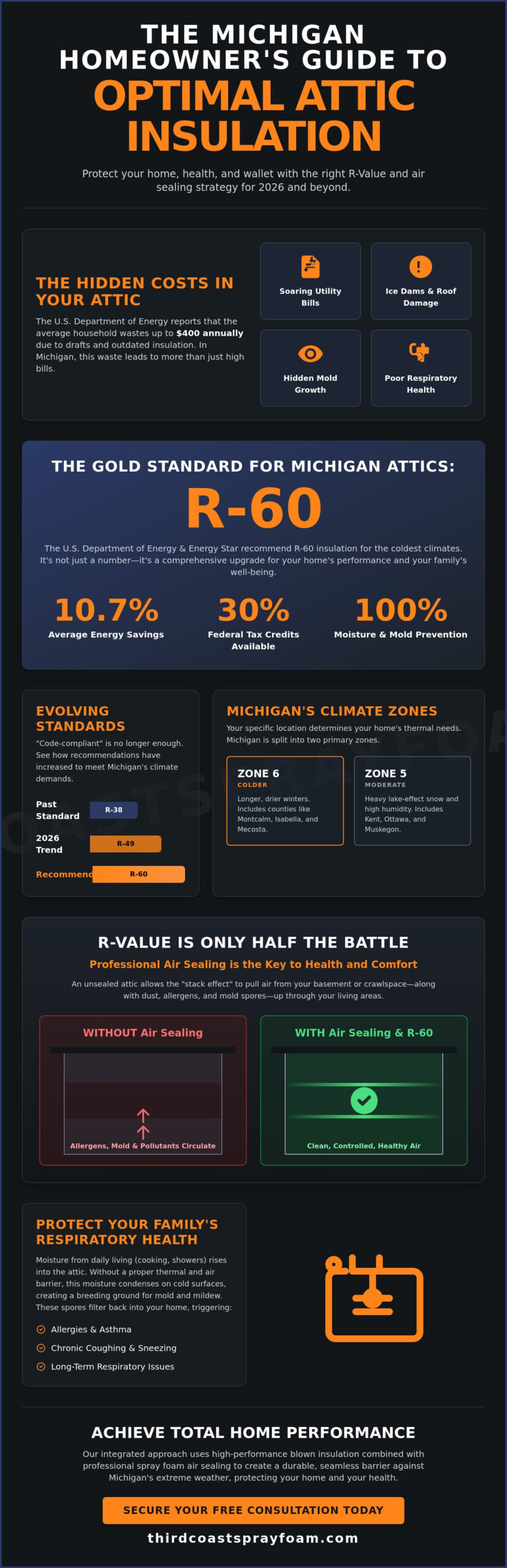
Did you know the U.S. Department of Energy reports that the average household wastes up to $400 annually due to drafts and outdated insulation? In our state, where winter temperatures frequently plummet, that lost energy translates directly into soaring utility bills and uncomfortable living spaces. Finding the best R value for attic in Michigan is no longer just a suggestion for comfort; it’s a financial and health necessity for every local homeowner.
We understand that you want a home that feels secure and efficient, but you’re likely tired of battling ice dams or worrying about the hidden mold growth that triggers family allergies. The good news is that aiming for an R-60 rating can save homeowners an average of 10.7% on energy costs while creating a permanent barrier against moisture. This guide will show you how to maximize your energy savings, secure 30% federal tax credits, and improve your indoor air quality by choosing a system that prioritizes respiratory health. We’ll break down the latest 2026 standards and explain why a holistic approach to air sealing is the only way to keep your attic dry and your family safe.
Key Takeaways
- Identify your specific Michigan climate zone to understand the minimum thermal resistance requirements for your 2026 home upgrade.
- Discover why R-60 is currently the best R value for attic in Michigan to maximize your energy savings and protect your HVAC system.
- You’ll learn why R-value must be paired with professional air sealing to stop the “stack effect” from pulling allergens into your living spaces.
- Understand the critical link between attic moisture management and the prevention of mold growth that threatens your family’s respiratory health.
- See how an integrated approach using blown insulation and spray foam provides a durable, high-performance barrier against the state’s extreme weather.
Understanding R-Value Requirements for Michigan Homes in 2026
Living in Michigan means preparing for some of the most drastic temperature swings in the country. From humid summer afternoons to sub-zero winter nights, your home’s structure is under constant thermal stress. To manage this, we look at R-value, which is a specific rating used to measure a material’s resistance to heat flow. The higher the number, the better the material is at keeping your expensive heated air inside during January and the sweltering humidity out during July. It’s your primary defense against the elements.
To better understand how these measurements impact your home’s performance, watch this helpful video:
What is R-Value and Why Does it Matter?
R-value isn’t just a random number; it’s a technical calculation of thermal resistance. While different materials like blown insulation or open cell spray foam achieve these ratings through different thicknesses, the goal remains the same. A high R-value stops heat from migrating through your ceiling. This is vital because heat naturally moves toward cold. Without a proper barrier, your furnace works overtime as heat escapes into the attic. Beyond comfort, this heat transfer creates a dangerous cycle of melting and freezing snow, leading to ice dams and structural damage. Achieving the best R value for attic in Michigan ensures your home remains a stable, controlled environment regardless of the forecast.
Michigan Climate Zones: Zone 5 vs. Zone 6
Michigan is unique because it’s split into distinct climate zones that dictate how much insulation you actually need. Most of West Michigan, including Grand Rapids and Holland, sits in Zone 5. As you move further inland or toward the northern parts of the Lower Peninsula, like Lansing or Mt. Pleasant, you enter Zone 6. These zones are determined by “heating degree days,” or how often and how severely the temperature stays below a comfortable threshold.
- Zone 5: Covers counties like Kent, Ottawa, and Muskegon. These areas face heavy lake-effect snow and high seasonal humidity.
- Zone 6: Includes counties like Montcalm, Isabella, and Mecosta, where winters are often longer and drier.
In 2026, energy code trends are shifting toward much higher efficiency standards. While many builders once aimed for R-38, the updated benchmarks are moving toward R-49 and even R-60. Meeting the bare minimum code is rarely enough for Michigan residents. We see that “code-compliant” homes often still suffer from cold spots and poor indoor air quality. When insulation is insufficient, moisture from the living space can condense in the attic. This creates a breeding ground for mold and mildew. These spores don’t stay in the attic; they circulate back into your home, potentially causing respiratory issues for your family. A holistic approach to the best R value for attic in Michigan prioritizes health as much as it does energy savings.
Why R-60 is the Recommended Standard for Michigan Attics
For Michigan homeowners, the debate over how much insulation is enough has a clear winner in 2026. While older building codes often settled for lower numbers, the U.S. Department of Energy and Energy Star now point toward a specific benchmark for our region. They suggest Recommended insulation levels of R-60 for the coldest climates. This isn’t just about following a guideline; it’s about reaching the best R value for attic in Michigan to ensure your home operates as a high-performance system. Achieving this level of thermal resistance provides a buffer that prevents your furnace from running constantly during those brutal February cold snaps.
Some people worry that R-60 might be “too much” for a standard home. This is a common myth. As long as your attic is ventilated correctly, there is no such thing as over-insulating. In fact, increasing your insulation to this level significantly reduces the wear and tear on your HVAC equipment. When your home holds its temperature longer, your mechanical systems don’t have to cycle as frequently, which extends their lifespan and delays expensive replacements.
The Financial Benefits of R-60 Insulation
Investing in R-60 pays dividends that go beyond lower monthly utility bills. Most Michigan families see a noticeable drop in heating and cooling costs, but the immediate financial relief also comes from federal incentives. You can currently take advantage of the Energy Efficient Home Improvement Credit to offset the cost of your attic upgrade. Beyond the tax season, a well-insulated attic is a major selling point. Prospective buyers in West Michigan prioritize energy efficiency, and documented R-60 levels can increase your home’s resale value by proving the structure is durable and cost-effective to maintain.
Preventing Ice Dams and Roof Damage
One of the most persistent threats to Michigan homes is the ice dam. When heat escapes through a poorly insulated ceiling, it warms the roof deck and melts the snow sitting on top. That water then runs down to the cold eaves and refreezes, creating a block of ice that forces water back under your shingles. By installing the best R value for attic in Michigan, you keep the roof deck cool and prevent this destructive cycle. This protection is vital for your family’s health. When ice dams cause roof leaks, moisture enters the attic and wall cavities, leading to mold growth. These fungal spores can easily migrate into your living space, compromising indoor air quality and causing respiratory issues for children or seniors. If you’re concerned about your current levels, a professional assessment of your blown insulation can identify where your home is losing heat and risking damage.
R-Value vs. Air Sealing: The Secret to Year-Round Comfort
Many homeowners believe that simply piling more material into the attic will solve their comfort issues. However, even the best R value for attic in Michigan becomes irrelevant if your ceiling is riddled with tiny air leaks. Think of your attic like a thermal envelope. If that envelope has holes, heat will bypass your insulation entirely. This process, known as air infiltration, is why some homes remain drafty despite having thick layers of traditional insulation. We see this frequently in West Michigan homes where the furnace runs constantly but the rooms stay chilled.
The Leaky Bucket Analogy
Imagine trying to fill a bucket with water while the bottom is full of holes. The size of the bucket represents your R-value, but the holes represent air leaks around recessed lights, plumbing stacks, and wall top plates. No matter how large the bucket is, it will never stay full until you plug the leaks. Air sealing is the essential foundation of any effective insulation strategy. Without it, warm indoor air escapes into the attic, carrying moisture that can condense on cold surfaces. This moisture is the primary catalyst for mold and mildew growth. When we address the best R value for attic in Michigan, we start by ensuring the “bucket” is watertight and airtight first.
Why Spray Foam Outperforms Traditional Materials
Traditional materials like fiberglass batts are technically breathable. They allow air to pass through them like a filter. Over time, these filters trap dust and allergens while doing nothing to stop the flow of air. In contrast, closed cell spray foam acts as both a high-density thermal barrier and a permanent air seal. It expands into every crack and crevice, creating a monolithic layer that blocks drafts and structural heat loss simultaneously.
This dual-action performance is critical for protecting your family’s respiratory health. When air leaks are left unsealed, a phenomenon called the stack effect pulls air from your attic down into your living spaces. This air often contains dust, insulation fibers, and mold spores. By choosing a high-performance solution that seals as it insulates, we ensure that the air you breathe remains clean. These advanced systems do not settle or degrade over time. They provide a permanent investment in your home’s structural integrity and your family’s long-term well-being.
How Proper Attic Insulation Protects Your Family’s Respiratory Health
Most homeowners view the best R value for attic in Michigan through the lens of lower utility bills. While financial savings are significant, the impact on your family’s respiratory health is even more critical. Your home operates as an integrated system where air constantly moves between floors. This movement is driven by the “stack effect,” a physical process where warm air rises and escapes through the top of the house. As this air exits, it creates a vacuum that pulls air from the attic down into your bedrooms and living areas. If your attic is harboring mold, dust, or allergens, those pollutants are being pulled directly into your lungs.
Achieving the best R value for attic in Michigan isn’t just about thickness; it’s about moisture management. When warm, humid air from your kitchen or bathroom leaks into a cold attic, it condenses on the rafters and roof deck. This persistent dampness creates the ideal breeding ground for mold and mildew. Once these colonies establish themselves, they release microscopic spores that circulate throughout your home. For children, seniors, or anyone with asthma, this poor air quality can lead to chronic coughing, wheezing, and recurring sinus infections.
The Link Between Attic Mold and Air Quality
Mold doesn’t stay confined to the attic. It travels. Even small gaps around plumbing stacks or electrical wires act as highways for contaminated air. A poorly insulated attic often suffers from localized “cold spots” where condensation is most likely to occur. By maintaining a consistent thermal barrier and high R-value, we keep the attic temperature stable and dry. A dry attic is a healthy attic. We prioritize solutions that prevent the moisture accumulation responsible for fungal growth, ensuring that the air pulled into your living space remains clean and safe to breathe.
Preventing Pests and Allergens
Traditional insulation materials can sometimes work against your health goals. Old, degraded fiberglass often settles and traps decades of dust, pet dander, and pollen. It can also become a nesting site for pests, whose waste products further degrade indoor air quality. If your current insulation is damp, dusty, or contaminated, we recommend professional insulation removal before installing new materials. High-performance spray foam provides a distinct advantage here because it doesn’t serve as a food source or nesting material for pests. It creates a durable, airtight seal that keeps outdoor pollutants and rodents where they belong: outside.
Protecting your home’s structural integrity is a long-term investment in your family’s well-being. If you are concerned about hidden mold or old insulation affecting your air quality, we can help you transition to a cleaner, safer environment. Contact us today to discuss a health-first approach to your attic insulation.
Achieving Optimal Attic R-Values with Third Coast Spray Foam
Achieving the best R value for attic in Michigan isn’t a simple weekend DIY task. While some homeowners consider renting a machine to blow in extra material, this often bypasses the most critical step: professional air sealing. We’ve seen many attics where new insulation was piled over existing leaks, which simply traps moisture and accelerates mold growth. Our team treats your home as an integrated system. We focus on creating a permanent barrier that stops heat loss while protecting your family’s respiratory health.
Our Professional Attic Insulation Process
We start every project with a thorough diagnostic phase to identify hidden thermal bridges and air bypasses. This includes checking recessed lights, top plates, and plumbing stacks where warm air often escapes. If your current attic environment is compromised by old, dusty, or moldy material, we prioritize safety through professional insulation removal. We use high-powered vacuums to extract contaminants directly out of the house, ensuring no mold spores or allergens enter your living areas during the process.
Once the attic is clean and sealed, we install blown-in insulation to achieve the R-60 benchmark, which is the best R value for attic in Michigan for 2026. We also place baffles at every rafter tail. These baffles are vital because they keep the soffit vents clear, allowing the roof deck to stay cool and dry. This prevents the condensation that leads to mildew and structural rot. By balancing high R-values with proper ventilation, we ensure your home remains a dry, healthy environment for your family.
Why West Michigan Trusts Third Coast
Our commitment to West Michigan is rooted in transparency and technical expertise. We understand how the humidity in Grand Haven and the deep snow in Muskegon affect a building’s envelope. We don’t believe in one-size-fits-all solutions. Instead, we provide tailored upgrades that focus on the long-term well-being of the client. Whether you’re in Grand Rapids or the surrounding lakeshore communities, we are here to act as your trusted advisor. We take pride in our craft and the tangible results we deliver for our neighbors. Your home’s safety and efficiency are our top priorities. Schedule your free attic health and insulation assessment today.
Secure Your Home’s Future and Your Family’s Health
Securing your home’s thermal envelope is a permanent investment in your family’s comfort and physical well-being. We’ve established that reaching R-60 is the best R value for attic in Michigan to meet modern efficiency standards while preventing the destructive cycle of ice dams. Remember that insulation only works as intended when it’s paired with a meticulous air sealing strategy. This dual approach doesn’t just lower your bills; it actively protects your respiratory health by blocking the migration of mold spores and allergens into your living spaces.
Since 2013, our team has acted as a trusted partner for West Michigan homeowners. We specialize in comprehensive attic removal and the installation of high-performance systems that prioritize indoor air quality. We take pride in our honest, results-oriented craft and our deep understanding of the local climate. Don’t let an outdated attic compromise your home’s integrity or your family’s safety. It’s time to experience the peace of mind that comes with a professionally sealed and insulated home.
Ready to transform your attic into a high-performance barrier? Get a Free Attic Insulation Estimate from Third Coast Spray Foam and start breathing easier today.
Frequently Asked Questions
What is the current Michigan building code for attic R-value?
Michigan is currently transitioning to the 2021 International Energy Conservation Code standards. While implementation for residential buildings has faced some procedural delays, the new code targets a minimum of R-49 for Climate Zone 5 and R-60 for Climate Zone 6. We suggest checking with your local building department for the specific requirements in your municipality. Aiming for R-60 ensures your home remains compliant with future energy efficiency trends and maximizes your long-term savings.
Can I just add more insulation on top of my old attic insulation?
You can add new material over existing insulation, but only if the current layer is completely dry and free of contaminants. If your old material is damp, compressed, or shows signs of pest activity, it’s safer to perform a full insulation removal first. Adding weight to wet or degraded insulation can trap moisture against your ceiling. This moisture creates a breeding ground for mold and threatens your family’s respiratory health.
How many inches of insulation is R-60?
The depth required to reach R-60 depends entirely on the material’s density. For standard blown insulation like cellulose, you generally need about 16 to 18 inches of depth to reach this thermal resistance level. If you’re using blown fiberglass, that depth often increases to 22 inches or more. It’s important to ensure your attic has the structural clearance and proper baffles to accommodate this height without blocking essential ventilation pathways.
Is spray foam better than blown-in insulation for Michigan attics?
Both materials serve specific roles in a high-performance home. Closed cell spray foam is superior for air sealing and moisture control because it creates a permanent, airtight barrier. However, many homeowners find that a hybrid approach is the most effective way to reach the best R value for attic in Michigan. We often use spray foam to seal critical leaks around plumbing and lights before adding blown insulation to achieve the full R-60 depth.
Does a higher R-value prevent mold in the attic?
A higher R-value prevents mold primarily by keeping the attic temperature stable and reducing condensation on the roof deck. When your attic stays at a consistent temperature, moisture is less likely to settle on wooden rafters and trigger fungal growth. However, insulation must be paired with professional air sealing to be effective. If humid air from your home still leaks into the attic, mold can grow regardless of how much insulation you have installed.
What happens if I over-insulate my Michigan home?
It’s nearly impossible to over-insulate a Michigan home as long as you maintain proper ventilation. The real risk is blocking your soffit vents with too much material, which stops air circulation and leads to moisture buildup. We use specialized baffles to keep these air pathways clear. This ensures your home stays energy-efficient without sacrificing the dry environment necessary for protecting your family’s lung health and preventing structural rot.
How much does it cost to upgrade an attic to R-60 in West Michigan?
The investment required for an upgrade depends on your attic’s size, current insulation levels, and whether you need professional removal services. While we don’t provide fixed pricing here, homeowners can often offset their costs through the Michigan Home Energy Rebates (MiHER) program or federal tax credits. These incentives provide significant financial relief for upgrades that improve energy efficiency and help you reach the best R value for attic in Michigan.
Will new attic insulation improve my indoor air quality?
New insulation and air sealing significantly improve indoor air quality by stopping the “stack effect.” This physical process prevents dusty, mold-laden air from your attic from being pulled down into your bedrooms and living spaces. By creating a clean, airtight barrier, you reduce the circulation of allergens and pollutants. This is a vital step for any homeowner who wants to support better respiratory health and a safer indoor environment for their children and seniors.
Disclaimer
Information provided is for general educational purposes. Individual needs and circumstances vary. Speak to an experienced professional to get the correct information for your situation.