
What if the drafty corners of your West Michigan home are actually a warning sign for your family’s respiratory health? We all know our winters are relentless, often leading to skyrocketing utility bills and damp crawl spaces that invite hidden mold growth. Understanding the spray foam insulation cost Michigan homeowners face in 2026 is about more than just a line item in a renovation budget. It’s a strategic move to secure your indoor air quality and structural integrity.
You’ll discover how this precision-engineered barrier eliminates moisture triggers and lowers monthly expenses while qualifying for new state rebates like the HEAR program. We’ll break down the structural factors that influence pricing, the latest 2026 rebate updates, and why professional air sealing is a permanent investment in your family’s long-term well-being and physical comfort.
Key Takeaways
- Learn how the board foot metric and project accessibility, such as high pole barn ceilings, directly impact the spray foam insulation cost Michigan homeowners can expect.
- Understand how a professional air barrier protects your family from outdoor pollutants and prevents the mold growth that triggers respiratory issues.
- Discover the long-term ROI of closed cell foam in protecting your home’s structural integrity and reducing seasonal utility expenses.
- Identify the specific 2026 rebates and local utility incentives from Consumers Energy and DTE that help offset the initial investment in high-performance insulation.
Understanding the Factors That Drive Spray Foam Costs in Michigan
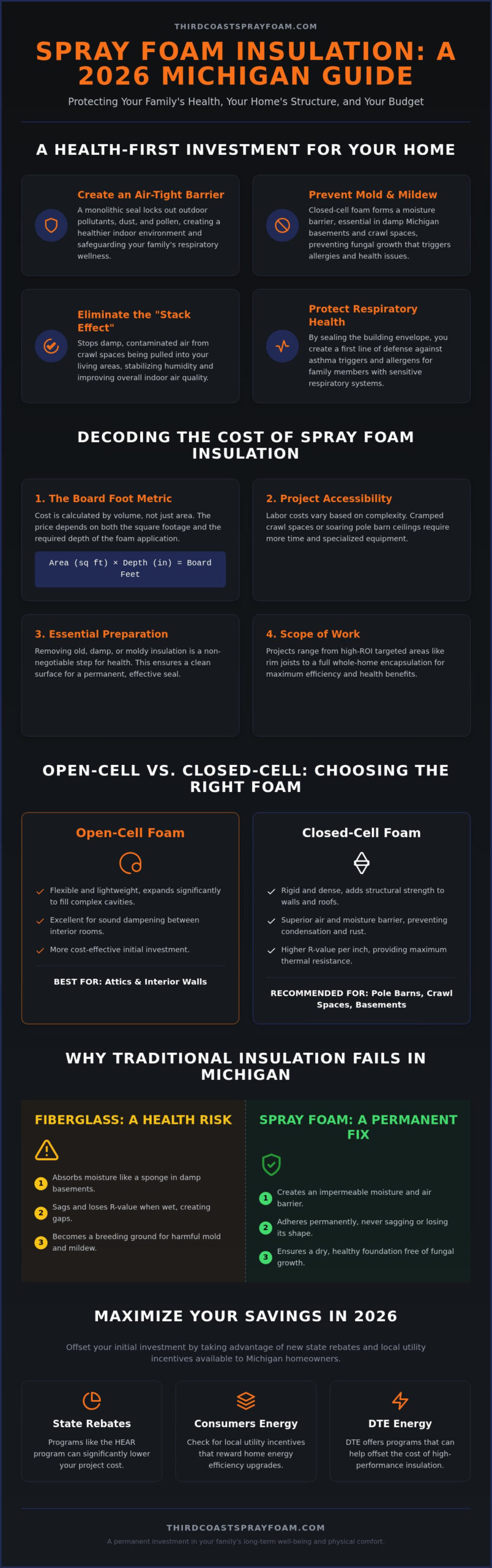
Calculating the spray foam insulation cost Michigan homeowners encounter starts with the board foot metric. This measurement accounts for both the surface area and the depth of the foam application. Unlike traditional materials, Spray foam insulation expands to fill every crack, creating a permanent seal. Labor costs fluctuate based on accessibility; a cramped crawl space or a soaring pole barn ceiling requires specialized equipment and more time to ensure a precision application.
To better understand how these variables affect your project, watch this helpful video:
Preparation often dictates the final price. If your existing fiberglass is damp or harbors mold, professional insulation removal is a non-negotiable step for your respiratory health. Installing new foam over contaminated material traps allergens and compromises air quality. Michigan’s seasonal cycles also play a role, as material availability and demand often peak during the transition into our harsh winters.
Open Cell vs. Closed Cell: Choosing the Right Value for Your Space
Choosing between foam types depends on your specific goals. Open cell is a flexible, cost-effective choice for attics. However, we recommend closed cell for Michigan pole barns because its rigid structure prevents condensation and rust. Closed cell offers a higher R-value per inch, making it the superior choice for moisture resistance and structural strength in our humid climate.
Project Scope: From Rim Joists to Whole-Home Encapsulation
Scope significantly influences the bottom line. Insulating rim joists is a high-ROI starting point that stops drafts at the foundation. For newer Grand Rapids homes with complex architectural designs, square footage calculations become more intricate. Whether you’re targeting a single problem area or a whole-home encapsulation, a professional assessment ensures every gap is sealed to protect your home’s efficiency.
The Health ROI: Why Air Quality and Mold Prevention Are Worth the Investment
Investing in high-performance insulation is about more than just numbers on a utility bill. It’s a commitment to your family’s physical well-being. By creating a monolithic air barrier, spray foam effectively locks out outdoor pollutants, pollen, and dust mites. This seal eliminates the “Stack Effect,” a process where cold, damp air from your crawl space is pulled up into your living areas as heat rises. When you stabilize indoor humidity, you’re not just improving comfort; you’re protecting your home’s structural integrity from wood rot during West Michigan’s humid summers. While the upfront spray foam insulation cost Michigan homeowners see might be higher than fiberglass, the health ROI is immediate. You can also leverage Federal tax credits for insulation to make this health-first upgrade more accessible.
Combating Mold and Mildew in Michigan Crawl Spaces
Traditional fiberglass batts often fail in damp Michigan basements. They absorb moisture, sag, and eventually become a breeding ground for fungal growth. Utilizing professional crawl space insulation creates a dry foundation that stops soil gases and moisture from migrating into your home. This encapsulation process is essential for preventing the mold-related respiratory issues that often plague older homes in Grand Rapids and Muskegon.
Respiratory Health and the Benefits of a Sealed Building Envelope
A sealed building envelope is your first line of defense against asthma triggers. By stopping the infiltration of outdoor allergens, you create a sanctuary for those with sensitive respiratory systems. It’s vital to rely on professional installation to ensure the foam cures correctly, providing optimal indoor air quality without lingering odors. If you’re ready to prioritize your home’s air quality, our team at Third Coast Spray Foam can help you design a holistic solution that protects your family’s long-term health.
Maximizing Your Savings with Rebates and Tax Credits in 2026
Managing the spray foam insulation cost Michigan families invest in requires understanding the latest financial incentives. While federal tax credits under Section 25C terminated at the end of 2025, 2026 marks a significant shift toward point-of-sale rebates. Programs like the Home Electrification and Appliance Rebates (HEAR) now offer up to $1,600 specifically for insulation and weatherization. Additionally, the HOMES program provides rebates up to $8,000 for low-income households and $4,000 for moderate-income families. These incentives, alongside local utility rebates from Consumers Energy and DTE, drastically reduce the “payback period.” In the Grand Rapids and Muskegon markets, energy-efficient homes command a premium because they offer a permanent solution to high utility costs and seasonal moisture issues.
Federal Incentives and Professional Documentation
Navigating these new programs and maximizing your energy efficient home improvement credit or rebate potential requires precise professional documentation. Our team ensures your installation meets the efficiency benchmarks set by the Michigan Public Service Commission. By creating a monolithic air barrier, we don’t just lower your bills; we eliminate the environmental triggers that lead to mold growth and respiratory health issues. This integrated approach ensures your investment pays dividends in both financial savings and family wellness.
Choosing a Local Michigan Expert for Your Installation
DIY spray foam kits often fall short of the lifetime air seal required for Michigan’s climate. These kits carry safety risks and often fail to provide the structural integrity needed to prevent condensation. Hiring a local contractor in Fruitport or Grand Rapids ensures your project complies with the 2015 IECC building codes currently in use. We recommend a comprehensive site assessment to identify existing air quality hazards before installation. Taking this step ensures your new insulation provides a healthy, mold-free environment for years to come.
Securing Your Home’s Future and Family’s Health
Investing in your home’s envelope is a pragmatic step toward long-term security. While the initial spray foam insulation cost Michigan homeowners encounter reflects the precision of the installation, the returns in efficiency and respiratory health are permanent. By sealing out allergens and preventing the moisture buildup that leads to mold, you create a sanctuary for your loved ones. New 2026 rebates like the HEAR and HOMES programs provide the perfect opportunity to offset your investment while upgrading to superior moisture-resistant Closed Cell Foam.
Our team provides expert local service across Grand Rapids, Muskegon, and Holland, focusing on a health-first approach to every project. We understand the unique environmental challenges of West Michigan and are dedicated to improving your indoor air quality. Don’t let drafty rooms and high utility bills compromise your comfort any longer. Get Your Free Health-Focused Insulation Estimate in West Michigan today. It’s time to breathe easier in a home that’s built to last.
Frequently Asked Questions
Is spray foam insulation more expensive than fiberglass in Michigan?
Yes, the upfront spray foam insulation cost Michigan residents encounter is higher than traditional fiberglass. However, fiberglass often sags and absorbs moisture, which can lead to hidden mold growth. Spray foam acts as both insulation and a permanent air seal. It protects your home’s structural integrity and your family’s respiratory health by preventing the infiltration of outdoor allergens.
Does spray foam insulation qualify for the 2026 federal tax credit?
Federal tax credits for energy efficiency under Section 25C terminated for installations completed after December 31, 2025. In 2026, Michigan homeowners should focus on the HEAR program, which offers rebates up to $1,600 for insulation. The HOMES program also provides up to $8,000 for low-income households. These state-administered rebates help West Michigan families offset the cost of high-performance upgrades.
How much can I save on my Michigan energy bills with spray foam?
Homeowners often see substantial savings because spray foam eliminates the air leaks that traditional materials miss. Transitioning to modern energy standards can save Michigan residents an estimated 10.7% in annual energy costs, or roughly $396 in utility savings. By sealing the building envelope, you reduce the workload on your HVAC system during our humid summers and freezing winters.
Can spray foam help with my family’s allergies and respiratory health?
Absolutely. Spray foam creates a monolithic air barrier that blocks outdoor pollutants, pollen, and dust mites from entering your living space. It’s especially vital in crawl spaces where it prevents the damp conditions that lead to mold and mildew. Managing these environmental triggers is a proactive way to improve indoor air quality and protect your family from chronic respiratory issues.
How long does spray foam insulation last in a Michigan climate?
Spray foam is a permanent solution designed to last as long as the structure itself. Unlike blown insulation, it doesn’t settle or lose its R-value over time. It maintains its structural integrity through Michigan’s extreme temperature shifts. This durability ensures your Grand Rapids home remains efficient and mold-free without the need for the periodic top-offs required by traditional materials.
Is it worth insulating a pole barn with spray foam if it isn’t heated?
Yes, closed cell foam is ideal for pole barns to prevent condensation and rust. Michigan’s humidity often causes uninsulated metal structures to “sweat,” which leads to wood rot and equipment damage. Even in unheated buildings, spray foam protects the building’s structural integrity and creates a cleaner, healthier environment. It also makes future climate control much more cost-effective.
Disclaimer
Information provided is for general educational purposes. Individual needs and circumstances vary. Speak to an experienced professional to get the correct information for your situation.