
Could your warehouse or office be 25 times more vulnerable to Michigan’s lake-effect humidity than it needs to be? For many local business owners, the battle against rising utility bills and hidden mold growth feels like a constant struggle during our extreme seasons. We understand the frustration of seeing employee productivity dip because of poor indoor air quality and the stress of managing high overhead. Investing in commercial spray foam insulation Michigan is no longer just a structural choice; it’s a critical step to protect your staff’s respiratory health and your building’s integrity.
You’ll discover how professional spray foam acts as a permanent air and vapor barrier to seal out moisture and common allergens. We’ll also explain how aligning with the updated 2021 IECC energy codes can help you secure the Section 179D federal tax deduction before the June 30, 2026, deadline. This guide provides a clear roadmap to achieving a significant energy ROI while creating a safer, healthier environment for everyone inside your facility.
Key Takeaways
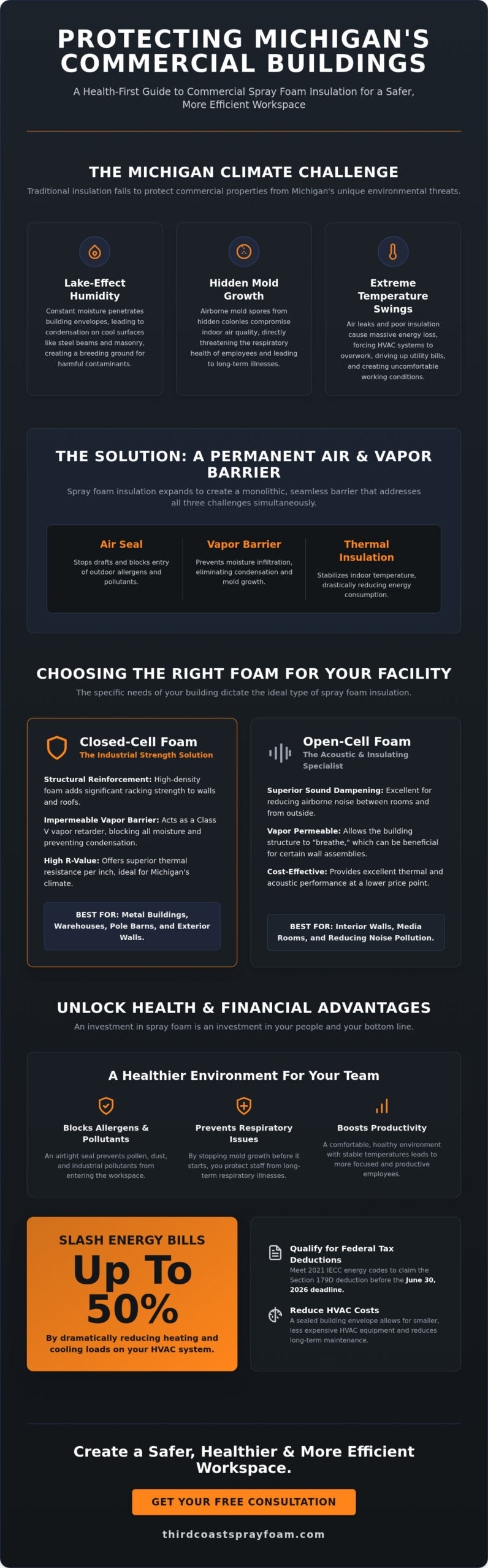
- Learn how to combat Michigan’s lake-effect humidity by creating a permanent vapor barrier that prevents mold growth and protects occupant respiratory health.
- Understand the specific applications for closed-cell and open-cell foam to optimize structural integrity and acoustic performance in your facility.
- Discover how commercial spray foam insulation Michigan helps you qualify for significant federal tax deductions under the 2021 IECC standards before the 2026 deadlines.
- Improve employee productivity by sealing out seasonal allergens and industrial pollutants through a comprehensive air-sealing strategy.
- Realize long-term financial security by reducing HVAC equipment costs and slashing monthly energy bills by up to 50%.
The Michigan Climate Challenge: Why Commercial Buildings Need Superior Air Sealing
Michigan’s commercial landscape faces a relentless humidity cycle that most standard buildings aren’t equipped to handle. In cities like Muskegon and Grand Rapids, the lake-effect moisture doesn’t just sit on the surface; it penetrates the building envelope. When warm, moist air meets cold steel or masonry, condensation forms. This hidden moisture often leads to mold colonies that threaten the respiratory health of your employees and compromise the structural integrity of your property. Relying on commercial spray foam insulation Michigan is a strategic move to stop this cycle before it starts.
Traditional insulation materials like fiberglass often fail because they allow air to pass through. This air carries moisture, which eventually settles behind walls and above ceilings. Spray foam insulation acts as both a thermal barrier and a high-performance air seal. It fills every crack and crevice, ensuring that humid air cannot find a place to condense. This is particularly vital for Michigan warehouses where thermal bridging through metal studs can create localized cold spots that attract moisture and foster mold growth.
To better understand how this technology creates a superior seal for your property, watch this helpful video:
Lake Effect Humidity and Structural Integrity
High humidity levels in coastal Michigan cities lead to “sweating” in uninsulated commercial ceilings. This isn’t just a cosmetic issue; it’s a safety hazard. Dripping condensation can damage inventory and create slippery floors. Closed-cell spray foam provides a seamless vapor barrier that prevents this moisture from reaching cold surfaces. Unlike other methods, it bonds directly to the substrate, leaving no room for water to collect or mold to thrive. This protection is essential for maintaining a healthy indoor environment and preventing long-term respiratory issues caused by airborne spores.
Combating Michigan Winters and Summer Humidity
The extreme temperature swings in Lansing and Grand Haven put immense pressure on commercial HVAC systems. In high-wind areas, air sealing is actually more important than R-value alone because it prevents the wind from “washing” the heat out of your insulation. Spray foam insulation effectively neutralizes the chimney effect by sealing the gaps at the top and bottom of a structure, preventing conditioned air from escaping and pulling outdoor pollutants inside. By stabilizing internal temperatures, you protect sensitive inventory and ensure your staff remains comfortable and productive year-round.
Closed-Cell vs. Open-Cell Spray Foam for Michigan Commercial Use
Selecting the right material for commercial spray foam insulation Michigan projects requires a clear understanding of your building’s structural demands and environmental exposure. Michigan’s unique climate, characterized by rapid freeze-thaw cycles and high humidity, makes the choice between closed-cell and open-cell foam a critical decision for long-term durability. Each type offers distinct advantages that impact both the building’s physical integrity and the respiratory health of its occupants. We believe in choosing the right tool for the job to ensure your investment stands the test of time.
Closed-Cell Foam: The Industrial Strength Solution
Closed-cell spray foam is a dense, rigid material that acts as a structural reinforcement. It’s particularly effective in metal buildings and industrial shops where the foam’s high density adds significant racking strength to the walls. This is why it remains the gold standard for pole barn insulation. Beyond strength, its water-resistant nature makes it a Class V vapor retarder. This density prevents moisture from migrating through the walls, which is the primary defense against hidden mold growth. By stopping condensation before it starts, you protect your staff from the respiratory illnesses often triggered by damp industrial environments. According to NYSERDA on Building Insulation Benefits, properly sealing these industrial envelopes significantly reduces operating costs while increasing the asset’s overall value.
Open-Cell Foam: Sound Control and Flexibility
Open-cell foam is a softer, more flexible alternative that excels in interior applications. It’s an ideal choice for office partitions and retail spaces where sound dampening is a priority. Because it expands up to 100 times its liquid volume, it fills complex commercial framing and hard-to-reach cavities more effectively than rigid boards. While it’s more cost-effective for large-scale roof decks, it requires careful planning regarding vapor barriers in Michigan’s climate. From a wellness perspective, open-cell foam provides an airtight seal that blocks outdoor pollutants and seasonal pollen. This creates a stable indoor air quality (IAQ) that supports employee productivity and focus. It’s a pragmatic choice for businesses that prioritize a quiet, clean workspace.
Michigan’s current energy codes require high thermal performance, especially in Climate Zones 5 and 6. Closed-cell foam offers a higher R-value per inch, typically around R-7, which allows you to meet strict code requirements even in thinner wall assemblies. This saves valuable floor space in commercial designs where every square foot counts. If you’re ready to upgrade your facility’s performance, we can help you select the most effective insulation strategy for your specific site.
A Health-First Approach: Indoor Air Quality and Respiratory Safety
A building’s air quality is just as vital as its structural integrity. Many older Michigan facilities suffer from “Sick Building Syndrome,” where employees experience chronic headaches, fatigue, or respiratory irritation due to poor ventilation and trapped pollutants. Choosing commercial spray foam insulation Michigan addresses these health concerns by creating a monolithic air barrier. This barrier prevents the uncontrolled exchange of air, which otherwise pulls in outdoor allergens and industrial particulates. We view a building as an integrated system where the envelope must protect the people inside from external environmental triggers.
Indoor air is often more polluted than outdoor air because of trapped gases and particulates. Sealing critical areas like rim joists and foundations is essential for maintaining a clean environment. This prevents soil gases and pests from migrating into the workspace. We apply the same health-first principles here as we do with crawl space insulation projects. By stabilizing the internal environment, you create a workspace that supports employee well-being and long-term productivity.
Mold Prevention and Respiratory Health
Mold is a silent threat to respiratory safety in West Michigan. When condensation builds up inside a wall cavity, it creates a breeding ground for spores. These spores eventually enter the building’s ventilation system, leading to asthma flare-ups or allergic reactions for your staff. Unlike cellulose or fiberglass, spray foam is an inorganic material. It does not provide a food source for mold colonies. By maintaining a dry, airtight envelope, we eliminate the moisture mold needs to survive. This proactive approach ensures the long-term lung health of everyone in the facility.
Improving IAQ (Indoor Air Quality)
Stable humidity levels play a significant role in workplace safety. Airborne pathogens and viruses often travel more easily in environments with extreme humidity fluctuations. Maintaining a consistent internal climate helps reduce the spread of these illnesses. Additionally, professional installation includes strict VOC management. We utilize high-capacity ventilation and specific off-gassing protocols to ensure that all Volatile Organic Compounds are cleared before the building is re-occupied. This commitment to safety ensures that your new insulation provides a healthy foundation for years to come. Our team prioritizes these technical details because we understand that your staff’s health is your business’s most valuable asset.
Maximizing ROI: Energy Credits and Long-Term Savings
Investing in commercial spray foam insulation Michigan is a strategic financial decision that pays dividends through immediate tax incentives and a permanent reduction in operational overhead. As our state transitions to the 2021 International Energy Conservation Code (IECC), building owners have a unique window to maximize their return on investment. Beyond the monthly utility savings, which can reach 50% or more compared to traditional insulation types, the structural and health benefits contribute to the long-term valuation of your property in competitive markets like Grand Rapids and Lansing. We focus on providing a solution that protects both your physical asset and your bottom line.
Tax Credits and Michigan Rebates in 2026
The federal government provides significant incentives for commercial energy efficiency upgrades, but timing is critical. The Section 179D tax deduction is available for projects that begin construction on or before June 30, 2026, offering a deduction for owners who achieve verified energy savings through high-performance building envelopes. The Section 179D tax deduction allows commercial building owners to claim a deduction for energy-efficient improvements to the building envelope that meet specific ASHRAE standards. Additionally, local utility providers like DTE Energy and Consumers Energy offer rebates for insulation upgrades that meet strict R-value benchmarks. We help our clients document these improvements to ensure they capture every available dollar. Many owners also explore the energy efficient home improvement credit for mixed-use properties to further offset initial costs.
Operational Savings and HVAC Longevity
One of the most overlooked financial benefits of spray foam is the “downsizing” effect. Superior air sealing allows for smaller, less expensive heating and cooling units because the HVAC system no longer has to fight constant air infiltration or the heavy moisture loads of West Michigan’s humidity. This reduces your initial capital expenditure on mechanical equipment. It also prevents the system from overworking during summer heatwaves, which lowers annual maintenance costs and extends the lifespan of your hardware. A stable climate doesn’t just save money; it prevents the damp conditions that lead to mold growth and respiratory issues. This creates a safer environment that improves employee retention and productivity. If you are ready to secure these financial and health benefits for your facility, reach out to us for a commercial insulation assessment.
Calculating the payback period for spray foam in high-usage Michigan industrial facilities often reveals that the system pays for itself through energy savings and tax credits within a few years. When you factor in the avoided costs of mold remediation and the health-related expenses of “Sick Building Syndrome,” the value proposition becomes even clearer. We view every commercial project as a long-term partnership in property health and efficiency.
Choosing a Commercial Spray Foam Contractor in West Michigan
Selecting the right partner for your commercial spray foam insulation Michigan project is a decision that impacts your building’s health and financial performance for decades. Large-scale commercial applications require a level of precision and specialized equipment that standard residential rigs simply can’t provide. We believe that a successful project starts with a contractor who views your facility as a complex, integrated system. This means evaluating not just the thermal performance but also the long-term respiratory safety of your employees and the structural durability of the building envelope.
A professional contractor’s safety record and insurance coverage are non-negotiable for on-site commercial work. You should always verify that a team is compliant with MIOSHA standards and has experience working with large masonry or steel structures. We take immense pride in our craftsmanship and our reputation for reliability across the region. Our goal is to provide a permanent solution that gives you peace of mind regarding both your property’s physical integrity and the health of everyone who steps inside.
Local Knowledge: From Grand Rapids to Muskegon
A contractor must understand the specific environmental stressors found along the Holland and Grand Haven coastlines. High moisture levels and unique wind patterns create condensation risks that differ significantly from inland properties. Our Fruitport-based team understands these regional nuances and the challenges they pose to West Michigan’s commercial zoning. We ensure every project complies with the latest Michigan Energy Code, which is currently based on the 2021 IECC and ASHRAE 90.1-2019 standards. Staying current with these regulations is essential for passing inspections and securing the energy credits that drive your ROI.
The Third Coast Advantage for Commercial Clients
Our commitment to your property goes beyond the spray gun. We prioritize a health-focused installation process that addresses indoor air quality (IAQ) from day one. This includes rigorous job-site safety protocols and advanced ventilation techniques to manage off-gassing effectively, ensuring a safe return to work for your staff. We specialize in closed cell spray foam for high-durability commercial needs; this material provides the rigid vapor barrier necessary to prevent mold growth during Michigan’s intense freeze-thaw cycles.
We invite you to request a professional assessment for your Michigan commercial property today. Our experts will walk through your facility to identify thermal bridges and moisture risks that could lead to respiratory issues or structural damage. By choosing a local specialist who understands the West Michigan climate, you’re making a pragmatic investment in the long-term health and efficiency of your business. We look forward to helping you create a safer, more sustainable workspace.
Secure Your Building’s Health and Financial Future
Protecting a commercial property in Michigan requires more than just meeting basic building codes. It’s about creating a permanent barrier against lake-effect humidity and ensuring the respiratory health of every occupant. By choosing commercial spray foam insulation Michigan, you’re investing in a system that prevents mold growth while slashing monthly operational costs. We’ve seen how these high-performance upgrades qualify for significant tax deductions before the June 2026 deadlines, making right now the most pragmatic time to schedule your installation.
Since 2013, our team has served as the locally owned Fruitport experts for businesses from Grand Rapids to Muskegon. We specialize in health-conscious insulation practices that prioritize indoor air quality and structural integrity above all else. Don’t leave your building’s performance or your staff’s well-being to chance. Get a Professional Commercial Insulation Estimate from Third Coast Spray Foam to ensure your facility remains a safe, efficient, and profitable asset. We’re ready to help you build a more resilient future for your business.
Frequently Asked Questions
Is spray foam insulation safe for commercial buildings with employees present?
Spray foam is completely safe once it has fully cured and the building has been properly ventilated. During the installation of commercial spray foam insulation Michigan, we follow strict safety protocols, including high-capacity air exchange, to ensure all Volatile Organic Compounds (VOCs) are removed. Once the material is inert, it doesn’t off-gas. This creates a stable environment that protects the respiratory health of your employees by preventing the growth of mold and mildew.
How much does commercial spray foam insulation cost per square foot in Michigan?
The investment for commercial insulation depends on the density of the foam selected and the total square footage of the structure. While we don’t provide flat rates without a site inspection, it’s important to consider the long-term ROI. Spray foam can lead to energy savings of 50% or more compared to other materials. These operational savings, combined with federal tax deductions, often offset the initial installation costs within a few years.
Can spray foam insulation help my Michigan business qualify for LEED certification?
Yes, spray foam is a major asset for businesses pursuing LEED certification or other green building standards. It contributes points in categories like Energy and Atmosphere because of its superior thermal performance. By improving indoor air quality and preventing the infiltration of outdoor pollutants, it also helps meet standards for Indoor Environmental Quality. This makes it a pragmatic choice for sustainable commercial development in West Michigan.
How long does it take to install spray foam in a large warehouse or office?
Most large-scale commercial projects are completed within a few days, though the exact timeline depends on the building’s complexity. We utilize specialized high-output equipment to ensure the application is efficient and thorough. Our team works to minimize downtime for your business. We coordinate closely with your facility manager to ensure the building is ready for re-occupancy as soon as the mandatory off-gassing period is finished.
Does spray foam provide a fire rating required for Michigan commercial codes?
Commercial spray foam is engineered to meet stringent fire safety standards required by the Michigan Mechanical Code. Most products are Class A fire-rated and include flame retardants to slow the spread of fire. Depending on the specific building occupancy and structure, we often apply a thermal or ignition barrier over the foam. These coatings provide the necessary fire protection while maintaining the air-sealing benefits of the insulation.
Can spray foam be applied to existing commercial buildings or only new construction?
Spray foam is an excellent solution for both new construction and existing commercial retrofits. It adheres directly to most building materials, including steel, masonry, and wood. This makes it ideal for sealing drafty warehouses or older office buildings where traditional insulation has failed. By retrofitting with commercial spray foam insulation Michigan, you can permanently fix air leaks and moisture issues without requiring major structural changes to the building envelope.
How does spray foam improve the indoor air quality of a commercial space?
Spray foam improves indoor air quality by acting as a comprehensive air and vapor barrier. It prevents the chimney effect that pulls soil gases, seasonal pollen, and outdoor industrial pollutants into your workspace. By maintaining a dry environment, it also eliminates the moisture that allows mold and mildew to thrive. This proactive approach significantly reduces the risk of respiratory irritation and allergic reactions among your staff members.
What is the difference between open-cell and closed-cell foam for Michigan commercial roofs?
For Michigan commercial roofs, closed-cell foam is generally preferred because it provides a built-in vapor barrier and adds structural rigidity. This is crucial for handling heavy snow loads and the high humidity of our lake-effect climate. Open-cell foam is occasionally used in roof assemblies for its superior sound dampening qualities. However, it requires an additional vapor retarder to prevent condensation from forming against the roof deck during our cold winters.
Disclaimer
Information provided is for general educational purposes. Individual needs and circumstances vary. Speak to an experienced professional to get the correct information for your situation.