
What if the most vulnerable part of your West Michigan home is a thin strip of wood you rarely even think about? For homeowners in Grand Rapids and Muskegon, the rim joist is often the primary entry point for the biting winter air that leaves your floors ice-cold and your furnace working overtime. When you start investigating the cost to insulate rim joist with spray foam, you’re looking at more than just a home improvement project. You’re addressing a structural gap that can account for up to 40% of your home’s total energy loss while simultaneously blocking out the dampness that leads to basement mold and musty smells.
We understand that managing a household budget in 2026 requires making smart investments that offer long-term security. You want a home that feels stable, stays dry, and doesn’t trigger respiratory issues or allergy flare-ups due to circulating spores. This guide will help you discover the real-world factors driving insulation expenses and how professional spray foam protects both your wallet and your family’s health. We will examine the differences between open-cell and closed-cell options, explain the mechanics of air sealing, and show you how to leverage local utility rebates to improve your home’s performance.
Key Takeaways
- Understand why the rim joist is the second largest source of heat loss in your home and how sealing it stabilizes indoor temperatures.
- Learn how linear footage and crawl space accessibility influence the total cost to insulate rim joist with spray foam in West Michigan homes.
- Discover the critical link between rim joist insulation and your family’s respiratory health by preventing mold growth and improving indoor air quality.
- Compare the long-term value of professional application against DIY kits, focusing on safety, specialized equipment, and material efficiency.
- Identify the immediate financial benefits of reduced furnace strain and the elimination of uncomfortable, drafty floors throughout your first story.
Understanding Rim Joist Insulation Costs in West Michigan (2026)
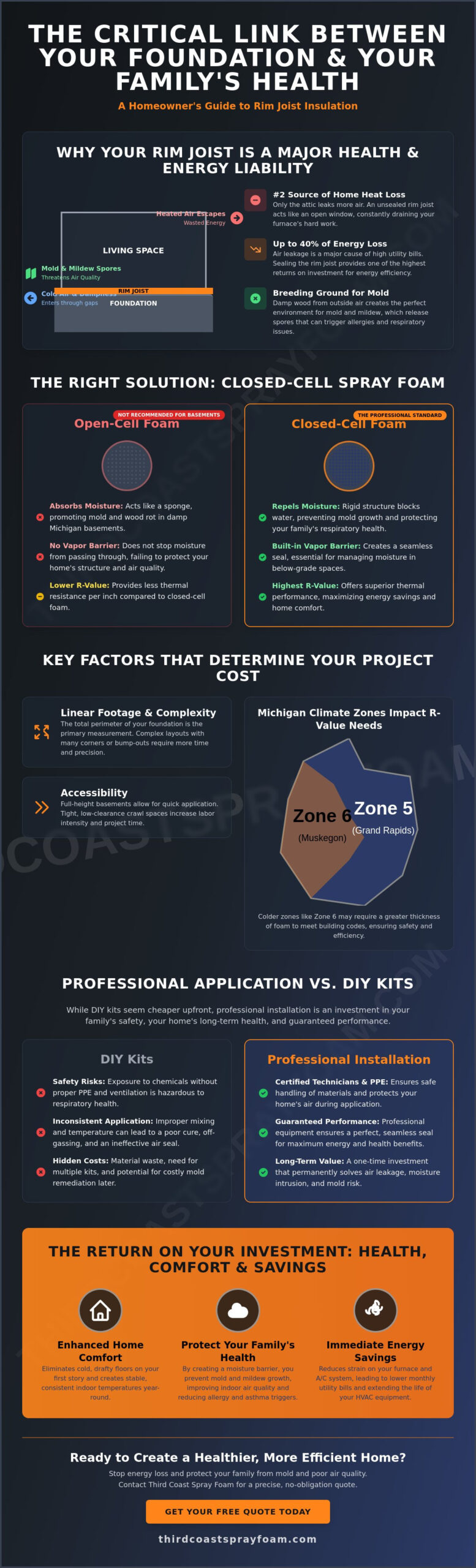
The rim joist, often called the band board, is the wooden structure that rests directly on top of your home’s foundation. It serves as the critical transition point between your basement or crawl space and the rest of your living area. Because this area sits so close to the exterior grade, it is prone to significant air leakage. In fact, air leaks can account for up to 40% of a home’s energy loss. The rim joist is frequently the second largest source of this loss, surpassed only by the attic. This happens through the “Stack Effect,” where warm air rising through your home creates a vacuum that pulls cold, damp air into your basement through unsealed rim joists.
To see exactly how professional application looks in a real-world setting, watch this helpful video:
This constant influx of outdoor air doesn’t just raise your heating bills; it introduces moisture and pollutants into your breathing zone. Damp rim joists are notorious breeding grounds for mold and mildew. These spores can enter your home’s air supply, potentially leading to allergy flare-ups and other respiratory health issues. When homeowners evaluate the cost to insulate rim joist with spray foam, they aren’t just buying material. They’re investing in a healthier, more stable indoor environment. Spray foam insulation provides a seamless air seal that traditional materials simply cannot match, creating a permanent barrier against environmental triggers.
Why Michigan Climate Zones Drive Insulation Costs
Michigan spans two distinct climate zones that directly influence project requirements. Grand Rapids and Lansing fall into Zone 5, while Muskegon and areas further north are categorized as Zone 6. These zones dictate specific R-value requirements under the Michigan Residential Code. Because Zone 6 requires higher thermal resistance, more material volume is often necessary to meet local safety and efficiency standards. Our local humidity levels also play a major role. Standard national quotes often ignore the unique moisture challenges of the Great Lakes region. We ensure your project accounts for these factors to prevent long-term structural decay and protect your respiratory health.
The Difference Between Open Cell and Closed Cell Costs
When you analyze the cost to insulate rim joist with spray foam, the type of foam selected is the most significant variable. Closed cell spray foam is the gold standard for rim joists. It acts as a built-in vapor barrier, which is essential for managing the moisture that naturally permeates foundation walls. While open cell foam is effective for sound dampening in interior walls, it is rarely recommended for Michigan basements. It lacks the moisture resistance needed to prevent mold in damp, below-grade environments. Investing in closed cell foam offers a superior cost-to-benefit ratio because it provides both high R-value insulation and permanent moisture protection for your foundation.
Key Factors That Determine Your Spray Foam Project Total
When we calculate the cost to insulate rim joist with spray foam, the first measurement we examine is the total linear footage. This is simply the perimeter of your basement or crawl space foundation. A larger footprint naturally requires more material and time. However, the complexity of the layout often matters as much as the distance. A standard rectangular basement is straightforward, while a foundation with multiple bump-outs or additions requires more precision and labor.
Accessibility is another major price driver in West Michigan homes. If our team can stand comfortably in a full basement, the application moves quickly. If we’re working in a “low-clearance” crawl space common in older Muskegon cottages or historic Grand Rapids neighborhoods, the labor intensity increases. Tight spaces require specialized maneuverability and a slower pace to ensure we reach every corner of the band board without compromising the seal.
The thickness of the application also shifts the final project total. While two inches of closed cell foam provides a reliable air seal, many homeowners opt for three inches to achieve a more robust thermal break. This approach aligns with guidance from the Department of Energy on insulation, which details how spray foam functions as both a high-performance insulator and an effective air barrier. Before any foam is applied, we must also ensure the substrate is clean. We inspect the wood for dust, cobwebs, or moisture to guarantee the foam bonds permanently to the structure.
Existing Insulation Removal and Prep Work
Many homeowners find old, sagging fiberglass batts stuffed into their rim joists. These batts are notorious for hiding mold growth and trapping moisture against the wood. We never recommend spraying over these materials because it creates a “mold sandwich” that can rot your sill plate. Our process often includes professional insulation removal to clear out contaminated debris. Removing these damp materials is a vital step for protecting your family’s respiratory health and ensuring the new foam adheres to a sterile, dry surface.
Obstacles and Mechanical Penetrations
Your rim joist is rarely a flat, unobstructed board. It’s usually pierced by HVAC ducts, dryer vents, gas lines, and electrical conduits. Sealing around these mechanical penetrations is meticulous work. In older Michigan homes, complex plumbing layouts can add significant labor time to the project. Our goal is to create a seamless “envelope” around every foundation penetration to prevent the “Stack Effect” from pulling pollutants into your breathing zone. If you’re curious about how these specific factors apply to your foundation, you can request a professional rim joist assessment from our local team.
Professional Spray Foam vs. DIY Kits: A Cost and Safety Analysis
When you begin researching the cost to insulate rim joist with spray foam, you will inevitably encounter DIY spray foam kits priced between $400 and $800. While these kits appear to save money upfront, they often lead to higher long-term expenses and compromised results. Professional installation involves high-pressure rigs that maintain precise temperatures and mixing ratios. This technology ensures that the chemicals react fully, creating a durable bond with your foundation. DIY canisters, by contrast, rely on low-pressure delivery systems that are prone to clogging, improper mixing, and significant material waste.
At Third Coast Spray Foam, we do not recommend or sell DIY kits for rim joist projects. The band board is a complex area with many tight angles and mechanical penetrations. Achieving a truly airtight seal requires the consistency that only professional equipment can provide. According to the Building Science Corporation guide, spray foam must act as a seamless thermal and air control layer to be effective. If the application is uneven or fails to bond, you lose the energy-saving benefits and leave your home vulnerable to the very drafts and moisture you were trying to eliminate.
The Health Risks of DIY Off-Gassing
The safety of your family’s respiratory health is our primary concern. Professional spray foam is applied using “on-ratio” mixing, which ensures the chemicals neutralize each other during the reaction. When DIY kits are used improperly, the foam may fail to cure correctly. This can lead to persistent off-gassing, where lingering chemical odors permeate your basement and living spaces. These fumes can trigger severe respiratory issues or lead to chemical sensitization, a condition where even minor future exposures cause allergic reactions. Our team uses specialized personal protective equipment (PPE) and high-volume ventilation to ensure your indoor air quality remains safe throughout the process.
Why Rigid Foam Board Often Fails in Michigan
Some homeowners try to lower the cost to insulate rim joist with spray foam by using rigid foam board and hand-sealing the edges with “can foam.” This method is rarely successful in the erratic West Michigan climate. Rigid boards are difficult to cut perfectly to size, leaving microscopic air gaps. Over time, the expansion and contraction of your home’s wood frame cause these seals to fail. Moisture then condenses behind the board, trapped against the wood. This hidden dampness is a primary cause of wood rot and mold growth that stays out of sight until the damage is extensive. Professional spray foam is the only “one-and-done” solution that provides a permanent, flexible moisture barrier.
The Health and Energy ROI: Why the Investment Pays Off
While homeowners often focus on the initial cost to insulate rim joist with spray foam, the long-term return on investment (ROI) is where the true value lies. This project provides an immediate reduction in the load on your furnace. By air sealing your home’s foundation, you can save an average of 15% on monthly heating and cooling costs. These savings accumulate year after year; some homeowners in the Grand Rapids area even report recouping their entire investment within three to five years through lower utility bills.
Beyond the financial numbers, there is a tangible increase in daily comfort. If you have ever experienced “Drafty Floor” syndrome, where your first-floor rooms feel cold despite the thermostat setting, you are feeling the direct impact of an unsealed band board. Spray foam eliminates these localized cold spots by stopping the infiltration of Lake Michigan’s winter winds. It also acts as a physical barrier against pests and outdoor allergens that typically enter through the small cracks and gaps in your foundation wood.
Mold Prevention and Respiratory Wellness
Health and environmental safety are at the heart of every project we complete. Uninsulated rim joists create a “dew point” surface where warm indoor air meets cold exterior temperatures. This collision results in condensation, which is the primary fuel source for mold and mildew. Because of the airflow patterns in a house, basement mold spores are frequently pulled into upstairs living areas. This can lead to persistent asthma triggers and allergy flare-ups for your family. Our professional spray foam application provides permanent moisture management, ensuring your foundation remains dry and your indoor air quality remains high.
Tax Credits and Local Rebates in Michigan
We believe in making high-quality insulation accessible to our West Michigan neighbors. You can lower your net investment by maximizing your Energy Efficient Home Improvement Credit. This federal tax incentive is designed to reward homeowners who invest in permanent energy-saving solutions like rim joist sealing. We provide the professional documentation necessary to help you claim these credits with confidence. Additionally, a sealed and insulated foundation is a major selling point for real estate in the Muskegon and Lansing markets, adding long-term value to your property. If you are ready to stabilize your home’s climate and protect your family’s health, request a professional quote from Third Coast Spray Foam today.
Getting a Precise Quote from Third Coast Spray Foam
Our process begins with a detailed on-site evaluation that covers every inch of your foundation’s perimeter. We serve homeowners from Fruitport to Grand Rapids and throughout the Lakeshore, bringing a deep understanding of local building challenges to every project. We don’t believe in “ballpark” figures that change later. Instead, we perform a professional rim joist assessment to identify the specific needs of your home. This includes checking for existing moisture, identifying air leak points, and determining the best approach to protect your family’s respiratory health.
During our visit, we look at your foundation as a complete system. In many West Michigan homes, the rim joist is the starting point for a broader moisture management strategy. Depending on your home’s layout, we may recommend a standalone treatment or a full crawl space encapsulation. We prioritize closed cell foam for these areas because it provides superior structural integrity and a built-in vapor barrier. This ensures that the final cost to insulate rim joist with spray foam is an investment in a permanent, mold-free solution rather than a temporary fix.
The Third Coast Difference: Expert Installers
What sets our team apart is our commitment to “On-Ratio” spraying. We use advanced, calibrated equipment to ensure the foam chemicals mix perfectly. This precision is vital for your safety; it ensures the material cures quickly and completely without leaving behind lingering odors or off-gassing. We take immense pride in our craft and treat every Grand Haven or Holland home like it’s our own. Our job isn’t finished until we’ve completed a post-install inspection and ensured your basement is clean and ready for use.
Ready to Stop the Drafts?
We’ve made it simple to book a free on-site estimate for residents in Ottawa or Kent County. When you’re ready to move forward, we suggest clearing a small path of access around the perimeter of your basement or crawl space. This allows our crew to work efficiently and ensures we can apply a seamless, airtight seal around every joist and mechanical penetration. Don’t let another Lake Michigan winter drive up your energy bills or compromise your indoor air quality. Get your free rim joist insulation quote today and secure the long-term well-being of your home and family.
Protect Your West Michigan Home for the Long Term
Investing in your foundation’s integrity is a pragmatic choice that pays dividends in both physical comfort and financial security. By evaluating the cost to insulate rim joist with spray foam, you’re taking a vital step toward reducing your energy bills by up to 15% through precision air sealing. This project does more than just stop drafts; it creates a permanent barrier against the moisture and mold that can trigger respiratory issues for your family. Our specialized team focuses on health-first moisture prevention to ensure your indoor air quality remains safe and stable regardless of the weather in Grand Rapids, Muskegon, or Holland.
We take pride in delivering professional, reliable results that protect your property’s value and your family’s well-being. Our expert local installation ensures that every chemical reaction is “on-ratio” and every gap is sealed for a lifetime of performance. It’s time to stop the cycle of cold floors and musty smells with a solution that works. Request Your Free Rim Joist Insulation Estimate Now and start breathing easier in a home that’s built to last.
Frequently Asked Questions
How much does it typically cost to spray foam rim joists professionally?
The cost to insulate rim joist with spray foam is determined by the linear footage of your foundation and the complexity of your home’s mechanical systems. While prices vary based on whether you have a full basement or a crawl space, professional installation ensures you meet Michigan’s strict building codes. We provide detailed, on-site evaluations to give you a precise total that includes all prep work and material costs.
Will rim joist insulation stop my floors from being cold?
Yes, sealing the rim joist is one of the most effective ways to eliminate cold floors on your home’s first level. By stopping the infiltration of frigid outdoor air at the foundation, you prevent the floorboards from losing their thermal energy. This creates a more stable temperature throughout your living space and reduces the constant strain on your furnace during harsh West Michigan winters.
Is spray foam safe for my family and pets?
Professionally applied spray foam is safe for both families and pets once the material has fully cured. Our team uses specialized equipment to ensure “on-ratio” mixing, which neutralizes the chemical components during application. This precision eliminates the risk of persistent off-gassing. By sealing out moisture and preventing mold growth, this service actually improves your home’s long-term respiratory health environment.
How long does the installation take for a standard basement?
A standard rim joist project typically takes between two and four hours to complete. The exact duration depends on the size of your basement and how many mechanical penetrations, such as vents or pipes, our crew needs to seal. We work efficiently to minimize disruption to your daily routine while ensuring every gap is meticulously filled for a permanent air seal.
Can I spray foam over my existing fiberglass insulation?
No, you should never apply spray foam directly over old fiberglass batts. Doing so traps moisture against the wood, which often leads to hidden rot and mold growth. We perform professional insulation removal to clear away contaminated materials before spraying. This ensures the foam bonds directly to the clean wood substrate for a durable, health-conscious seal.
What is the best R-value for rim joists in Michigan?
In Michigan’s climate zones, achieving an R-value between R-13 and R-21 is standard for optimal efficiency. Using closed cell spray foam allows you to meet these requirements with just two to three inches of material. This thickness provides a powerful thermal break and a vapor barrier, which is essential for protecting your foundation from the high humidity levels common in our region.
Does rim joist insulation help with basement mold smells?
Yes, insulating the band board is a primary defense against musty basement odors. These smells are usually caused by mold spores growing on damp wood surfaces. When you consider the cost to insulate rim joist with spray foam, you are investing in a solution that prevents warm air from condensing on cold foundation wood. This moisture management stops mold at the source and improves your home’s overall indoor air quality.
Can I stay in the house while the rim joists are being sprayed?
We generally recommend that residents and pets vacate the home for a brief period during and immediately after the application. While the “on-ratio” mixing we utilize is highly stable, a standard 24-hour window allows the foam to fully cure and any application odors to dissipate through our high-volume ventilation. This safety-first approach ensures that your respiratory health is protected throughout the entire installation process.
Disclaimer
Information provided is for general educational purposes. Individual needs and circumstances vary. Speak to an experienced professional to get the correct information for your situation.