
What if the very material designed to keep your home warm is actually acting as a silent magnet for allergens and moisture? Many homeowners overlook the structural health of their upper levels until a Lake Effect snowstorm sends heating costs soaring and drafts begin to chill the second floor. If you are questioning when to replace attic insulation Grand Rapids, you are likely already feeling the effects of material degradation or outdated R-values that no longer meet the 2021 International Building Code standards adopted in Michigan this past April.
We understand the frustration of unpredictable monthly bills and the genuine concern that comes with potential mold growth in your living spaces. This guide will show you how to identify the critical signs of failing insulation and explain how a structural upgrade can protect your family’s respiratory health. You will learn how to maximize 2026 financial incentives, including the $1,200 federal tax credit and local utility rebates from DTE or Consumers Energy. We provide a clear roadmap to achieving a permanent solution for indoor air quality and thermal efficiency, ensuring your home remains a secure sanctuary for the long term.
Key Takeaways
- Identify the visual and performance-based red flags, such as moisture spots or sudden utility spikes, that signal exactly when to replace attic insulation Grand Rapids homes for peak efficiency.
- Understand the direct link between degraded attic materials and your indoor air quality, including how old insulation traps dust mites and allergens that compromise respiratory health.
- Learn about the “Stack Effect” in West Michigan and how a failing attic seal forces your heating system to work harder by pulling cold air in through your home’s lower levels.
- Discover why professional insulation removal is a critical safety step to eliminate contaminants and mold spores before installing new, high-performance thermal barriers.
- Gain a strategic advantage by learning how to stack the 2026 federal tax credit with local utility rebates to offset the cost of a permanent, structural energy solution.
Critical Signs You Need to Replace Attic Insulation in Grand Rapids
Determining exactly when to replace attic insulation Grand Rapids homes require is a matter of both financial and physical health. As we move through 2026, many residents have noticed “unexplained” spikes in their utility bills despite maintaining their usual thermostat settings. These financial red flags often point to a structural failure in your attic’s thermal envelope. While older materials naturally degrade over decades, the high humidity levels characteristic of West Michigan can accelerate this process. If your energy costs are climbing while your comfort levels are dropping, your insulation is likely no longer meeting the R-49 minimum standard mandated by the Michigan building code update from April 2026.
To better understand the physical process of identifying and addressing these issues, watch this helpful video:
Physical deterioration is the most immediate indicator of a failing system. When you enter your attic, look for visible mold growth or dark staining on the underside of the roof deck. These are clear signs of moisture entrapment. Wet spots on the attic floor don’t just reduce your R-value; they create a breeding ground for spores that eventually migrate into your living spaces. In Kent County, older homes frequently face issues with rodent or bat intrusion. Pest droppings contaminate insulation and introduce harmful pathogens into your home’s air supply, making professional removal a health necessity rather than a luxury.
The Visual Inspection Checklist
Check for “settled” or compressed cellulose. Over time, gravity and moisture cause loose-fill materials to pack down, which eliminates the air pockets required to trap heat. If you can see the tops of your ceiling joists, your insulation level is dangerously low. You should also distinguish between common dust and black mold. Mold often appears as fuzzy patches or dark, soot-like streaks on fiberglass batts. This contamination directly impacts your family’s respiratory health by turning your attic into a reservoir for allergens and environmental triggers that aggravate asthma and other conditions.
Comfort and Performance Indicators
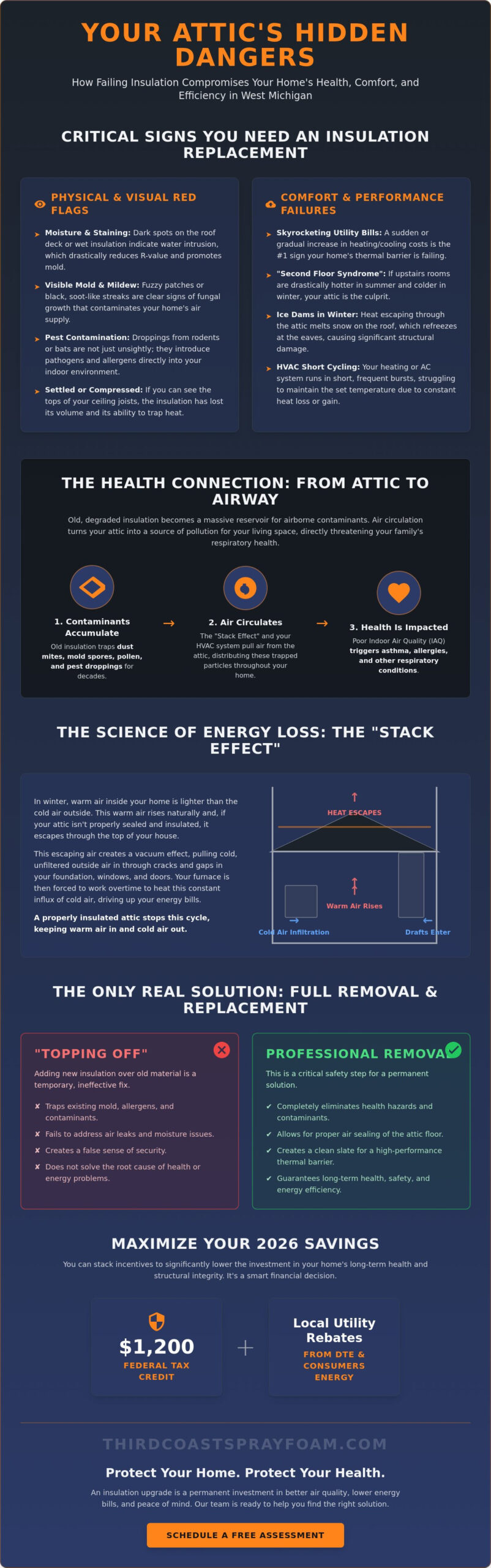
“Second Floor Syndrome” is a classic sign of insulation failure. If your upstairs bedrooms are significantly warmer in the summer or drafty during Lake Effect snowstorms, your attic is failing to regulate temperature. This often leads to your HVAC system “short cycling,” where it turns on and off frequently to keep up with heat loss. Recognizing when to replace attic insulation Grand Rapids residents should look for these performance failures before the next winter season arrives. You might also notice ice dams forming along your gutters. These occur when heat escapes through the attic floor, melting snow on the roof which then refreezes at the eaves. This process is driven by The Science of the Stack Effect, where warm air rises and escapes through the top of your house, pulling cold, unfiltered air into your lower levels. Addressing these indicators prevents long-term structural damage and ensures a stable, healthy indoor environment.
The Health Connection: How Attic Insulation Impacts Respiratory Safety
Indoor Air Quality (IAQ) is a measure of how clean the air inside your home is, and your attic plays a disproportionately large role in this metric. While many think of the attic as a separate storage space, it’s actually an integrated part of your home’s breathing system. Old, degraded insulation often acts as a massive, stagnant filter that has spent decades collecting pollen, dust mites, and outdoor pollutants. When air moves through these contaminated materials, it carries those particles directly into your living areas. Understanding when to replace attic insulation Grand Rapids residents require often starts with a simple sniff test. A persistent “dirty socks” odor usually indicates microbial growth or chemical breakdown within the fibers. Beyond just a nuisance, these smells can signal health risks from insulation off-gassing or active mold colonies that compromise your lungs every time the furnace kicks on.
Mold Prevention and Moisture Control
Michigan’s high seasonal humidity creates a specific challenge for local attics. When warm, moist air from your kitchen or bathroom escapes into a cold attic, it condenses on the underside of your roof. This moisture quickly saturates traditional materials, leading to wood rot and mold. We’ve found that a holistic approach is necessary for true moisture control. For example, the role of crawl space insulation is often overlooked, yet it prevents ground moisture from rising through the home and becoming trapped in the attic. If your current insulation is already damp or showing black spots, it must be completely removed. Simply adding new material on top traps the moisture and allows mold to continue its lifecycle underneath the fresh layer.
Protecting Your Family’s Respiratory Health
For those struggling with seasonal allergies or asthma in West Michigan, air sealing is the most critical step in a 2026 home upgrade. A “tight” home envelope acts as a shield against the heavy pollen counts and outdoor allergens typical of the Grand Rapids area. By sealing the gaps where wires and pipes enter the attic, you stop the vacuum effect that pulls unfiltered air from the outside into your bedrooms. Professional-grade air sealing isn’t just about saving money on heating; it’s a health-first investment that ensures the air your family breathes is filtered and safe. If you’re concerned about your home’s air quality, our team can provide a comprehensive insulation removal assessment to identify hidden health triggers.
The Science of Energy Loss: The Stack Effect in West Michigan
Your home functions like a vertical wind tunnel during a West Michigan winter. This physical phenomenon, known as the Stack Effect, occurs because warm air is less dense than cold air. As your furnace heats your living spaces, that air naturally rises toward the highest point of the structure. If your attic floor isn’t properly sealed and insulated, this warm air escapes through every recessed light, wire penetration, and plumbing stack. This escape creates a low-pressure zone in the lower levels of your home, which actively pulls freezing, damp air in through your basement and rim joists. This “makeup air” often carries dust, soil gases, and mold spores from your crawl space directly into your breathing zone, compromising your indoor air quality. This cycle is why determining when to replace attic insulation Grand Rapids residents find most effective often involves looking at the house as a complete system rather than isolated rooms.
The financial stakes for this energy loss have never been higher. With the 2026 Consumers Energy rate hikes impacting Kent and Ottawa County, a “leaky” home is a significant financial liability. Lake Effect snow adds a layer of complexity; the heavy snowpack on your roof can trap heat in the attic, worsening the pressure differential and accelerating heat loss. This constant stress on your home’s thermal envelope doesn’t just raise your bills; it forces your HVAC system to run longer, increasing the wear on mechanical components and reducing the overall lifespan of your equipment. When you combine high humidity with these pressure changes, you create an environment where condensation and mold thrive, making a structural upgrade a necessity for both your wallet and your health.
Why R-Value Isn’t the Only Number That Matters
While many homeowners focus solely on R-value, this number only measures a material’s resistance to conductive heat flow. It doesn’t account for air infiltration, which is the primary driver of discomfort in our windy climate. Traditional materials like fiberglass batts act like a filter rather than a barrier. They might have a high R-value on paper, but they allow air to pass through easily. According to the Department of Energy’s guide to insulation, different materials offer varying levels of protection against air movement. In contrast, closed cell spray foam provides a high R-value while simultaneously creating a permanent air seal. This dual-action protection stops the Stack Effect at its source, preventing contaminated air from circulating through your home and protecting your respiratory health.
2026 Utility Trends in Kent and Ottawa County
The cost of “doing nothing” is rising alongside energy prices. Relying on behavioral changes, like wearing extra layers or lowering the thermostat, provides diminishing returns when the structure itself is failing. Investing in a high-performance thermal envelope offers a much higher ROI because it addresses the root cause of energy waste. Transitioning from traditional, air-permeable materials to high-performance foam ensures that your home stays warm during the most brutal February storms. This structural fix provides long-term security, protecting both your bank account and your family’s comfort against future energy market volatility. When considering when to replace attic insulation Grand Rapids homeowners should view the project as a permanent hedge against rising local utility costs.
The Replacement Process: Removal vs. Topping Off
Many competitors suggest “topping off” your attic by simply blowing new fiberglass over the old material. This is often a fundamental mistake that compromises both your home’s structure and your family’s health. Adding weight to old, contaminated insulation traps moisture against your ceiling joists and provides a dark, warm hiding spot for pests to thrive. When determining when to replace attic insulation Grand Rapids homeowners should prioritize a clean slate. If your existing material is wet, moldy, or compressed, adding more only hides the underlying problem. Our process is designed to be a permanent, structural intervention that restores the integrity of your thermal envelope.
- Step 1: Assessment. We begin with a professional evaluation of the existing material and the structural integrity of the attic floor to identify hidden air leaks.
- Step 2: Safe Removal. We utilize high-powered, HEPA-filtered vacuums to extract contaminated or degraded insulation, ensuring that no dust or allergens enter your living spaces.
- Step 3: Air Sealing. We meticulously seal bypasses, top plates, and light fixtures to stop the movement of air that drives high energy costs.
- Step 4: Installation. We install new high-performance material, such as spray foam or blown-in options, to meet or exceed the latest R-49 Michigan building code requirements.
- Step 5: Final Testing. We perform a final inspection to ensure a continuous thermal and air barrier, leaving no gaps for cold Lake Effect winds to penetrate.
Why Professional Insulation Removal is Non-Negotiable
Why is insulation removal a non-negotiable step for a healthy home? Leaving pest-infested or moldy material in place is a significant health risk. It creates a reservoir of allergens that the “Stack Effect” will eventually pull down into your bedrooms. During our vacuuming process, we maintain a negative pressure environment. This ensures that fine particulate matter, including old fiberglass shards and dried pest waste, is pulled out of your home rather than drifting through your ceiling. By starting with a clean attic floor, we ensure your new insulation is in direct contact with the air-sealed surface for maximum efficiency.
Choosing the Right Material for Your Grand Rapids Attic
Choosing the right material is the final piece of the puzzle. If you need budget-friendly performance that still offers a significant upgrade, blown-in insulation is an excellent choice for many Kent County residences. However, for those seeking a permanent solution, spray foam provides the most robust air seal and thermal resistance. When considering when to replace attic insulation Grand Rapids residents often choose spray foam because it won’t settle or degrade over time, even with Michigan’s high humidity. Our team is dedicated to helping you select the solution that fits your budget while providing long-term security for your property. To ensure your home is ready for the next seasonal shift, you can request a comprehensive attic inspection to see which material is right for your structure.
Maximizing Your 2026 Savings and Home Health
The decision of when to replace attic insulation Grand Rapids homeowners face often aligns with financial opportunity. For the 2026 tax year, the fiscal incentives for structural energy upgrades are unprecedented. By timing your project correctly, you can transform your home’s thermal performance while significantly offsetting the initial investment. This isn’t just about lower monthly bills; it’s about utilizing available resources to create a permanent shield against the environmental triggers and rising energy costs that define life in West Michigan. We view every insulation project as a structural health intervention that pays dividends in both comfort and long-term property value.
Local Rebates and Tax Incentives
Navigating the financial landscape of 2026 requires a clear understanding of how to stack different incentives. Homeowners can currently leverage the Energy Efficient Home Improvement Credit, which allows you to claim 30% of the cost of your attic insulation project, up to an annual cap of $1,200. This federal credit applies to materials and labor for projects completed between January 1 and December 31, 2026. To maximize your savings, you should also look toward local utility providers. DTE Energy is offering a $600 rebate for qualifying attic upgrades this year. Consumers Energy customers may be eligible for home performance rebates ranging from $400 to $1,100, depending on the scope of the energy improvements. We ensure all project documentation is precise, as professional installation is almost always a prerequisite for these utility-sponsored programs.
The Third Coast Difference
Our team is deeply rooted in the local community, operating out of Fruitport to serve the specific architectural needs of Kent and Ottawa County. We understand how Grand Rapids homes are built and how they react to the unique stresses of Lake Effect moisture. This local expertise allows us to provide a more accurate calculation of your projected energy savings and return on investment. Whether we are discussing residential attics or specialized structures like pole barn insulation, our focus remains on the “Health-First” philosophy. We don’t just add material; we optimize your home’s breathing system to protect your family’s respiratory health from mold and pollutants.
Determining when to replace attic insulation Grand Rapids residents find most beneficial involves looking at the current state of your indoor air quality alongside these 2026 financial windows. If you’ve noticed the signs of degradation discussed in this guide, the time to act is now while these incentives are at their peak. We invite you to take the next step toward a more secure and efficient home by scheduling a free home energy assessment. We will evaluate your current R-values, identify hidden air leaks, and provide a clear plan to restore your home’s structural integrity and thermal comfort for years to come.
Take Action for a Healthier, More Efficient Grand Rapids Home
Deciding when to replace attic insulation Grand Rapids homeowners find most effective is a choice that impacts both your physical health and your financial stability. We’ve explored how failing materials compromise respiratory health by trapping allergens and how the Stack Effect drives up energy costs during our brutal West Michigan winters. By prioritizing a clean removal of contaminated materials and implementing professional air sealing, you can eliminate mold triggers and create a permanent thermal barrier. This structural approach ensures your home remains a safe, warm sanctuary regardless of the weather outside.
Our team at Third Coast Spray Foam consists of local Fruitport-based experts who have served West Michigan since 2013. We specialize in health-conscious air sealing and mold prevention; ensuring that your indoor air quality is never sacrificed for energy savings. We also provide expert guidance on 2026 energy tax credits and utility rebates to help you maximize your return on investment. Don’t let another season of high bills and drafts pass you by. Take control of your home’s integrity today.
Get Your Free Attic Insulation Estimate in Grand Rapids, MI
We look forward to helping you build a more durable and healthy future for your family.
Frequently Asked Questions
Why is my Grand Rapids electric bill so much higher than last year?
Rising utility costs are driven by a combination of 2026 rate adjustments from Consumers Energy and the natural degradation of your home’s thermal envelope. When insulation settles or absorbs moisture, its R-value drops; forcing your HVAC system to run longer to maintain comfort. This inefficiency is amplified during Lake Effect snowstorms when heat loss through the attic is at its peak. Structural air leaks also contribute to these spikes by allowing expensive conditioned air to escape.
Can I just add new insulation on top of my old attic insulation?
You should only add new material if the existing insulation is completely dry, free of pests, and mold-free. However, “topping off” often hides underlying structural issues like air leaks or moisture entrapment. For homeowners questioning when to replace attic insulation Grand Rapids experts recommend a full removal if the old material is contaminated. This ensures a clean surface for a proper air seal; which is the only way to truly stop the Stack Effect.
How long does attic insulation typically last in West Michigan?
Traditional loose-fill materials often last between 15 and 20 years, but their performance begins to decline much sooner due to our high regional humidity. Moisture causes materials like cellulose to compress, which eliminates the air pockets needed to trap heat. High-performance solutions like closed cell spray foam are considered permanent investments. They don’t settle or lose R-value over time; providing a stable thermal barrier for the entire lifespan of your home.
Is spray foam insulation safe for my family’s respiratory health?
Yes, professionally installed spray foam is an inert material that significantly improves indoor air quality. By creating a seamless air seal, it prevents outdoor allergens, pollen, and dust mites from entering your living spaces. It also eliminates the condensation that leads to mold growth in attic corners. This reduction in environmental triggers is a primary reason why many West Michigan families choose this material to protect those with asthma or seasonal allergies.
Does Michigan offer rebates for attic insulation replacement in 2026?
Michigan homeowners can currently stack several financial incentives to lower their project costs. For 2026, the federal Energy Efficient Home Improvement Credit provides up to $1,200 back on your tax return. Locally, DTE Energy offers a $600 rebate for qualifying attic upgrades, while Consumers Energy provides home performance rebates that can reach $1,100. Professional installation is typically required to qualify for these utility programs; so keep all your contractor documentation for your 2026 filings.
What are the signs of mold in my attic insulation?
Common indicators of mold include dark spotting, fuzzy patches on the surface of the material, or a persistent musty “dirty socks” odor. Mold often thrives where warm house air meets the cold roof deck, leading to condensation. If you see black streaks on your insulation or wood rot on your rafters, it is a sign of a serious moisture problem. Contaminated material must be professionally removed to prevent spores from migrating into your home’s breathing zone.
How much can I save on my energy bill by replacing attic insulation?
Properly sealing and insulating your attic can lead to savings of 15% to 20% on your annual heating and cooling costs. Since the attic is the primary site of heat loss in the winter and heat gain in the summer, it offers the highest return on investment of any home improvement. When you consider when to replace attic insulation Grand Rapids residents often find that the monthly utility savings quickly offset the cost of the structural upgrade.
Should I remove old fiberglass insulation before installing spray foam?
We always recommend a total removal of old fiberglass before applying spray foam. Spray foam requires a clean, direct bond to the attic floor and top plates to create a permanent air seal. Leaving old fiberglass in place traps decades of dust, dander, and potentially pest waste underneath the new seal. Removing the old material allows us to identify and seal every hidden bypass; ensuring your home’s thermal envelope is completely restored for maximum health and efficiency.
Disclaimer
Information provided is for general educational purposes. Individual needs and circumstances vary. Speak to an experienced professional to get the correct information for your situation.