
What if the condensation dripping from your workshop ceiling isn’t just a nuisance but a direct threat to your respiratory health and your equipment’s lifespan? When you’re considering the best approach for insulating a workshop in Grand Rapids, it’s easy to focus on the cold, but the real enemy is often the moisture trapped inside. You’ve likely felt the frustration of watching high heating bills climb. You’ve also likely worried about the hidden mold growth that thrives in our humid Lake Michigan climate. It’s a common struggle for local builders who want a workspace as reliable as their tools.
This guide will show you how to transform a damp, drafty building into a climate-controlled sanctuary that protects both your lungs and your machinery. We’ll examine how high-performance solutions like closed cell spray foam create a seamless vapor barrier to stop mold and maintain healthy indoor air quality. You’ll learn the technical steps to achieve a dry, efficient environment that keeps your energy costs low and your workspace safe throughout every season. We believe your workshop should be a permanent investment in your productivity and your health.
Key Takeaways
- Learn how to combat the unique “Lake Effect” humidity that causes condensation and rust in West Michigan workshops.
- Compare high-performance materials for insulating a workshop in Grand Rapids to ensure your space remains dry and energy-efficient year-round.
- Identify the specific ways proper insulation prevents mold growth and protects your long-term respiratory health.
- Understand the professional installation steps required to safeguard your tools and machinery during a structural upgrade.
- Discover how to reduce your project costs by utilizing the energy-efficient home improvement credit available for permanent insulation solutions.
Why Workshop Insulation in Grand Rapids Requires a Specific Strategy
Insulating a workshop in Grand Rapids is a specialized task that goes far beyond simply adding a layer of warmth. In West Michigan, we deal with a unique atmospheric cocktail that often turns unprotected workshops into humid, rust-prone environments. A professional insulation strategy must function as both a thermal envelope and a high-performance moisture barrier system. Without this integrated approach, you aren’t just losing heat; you’re inviting structural decay and compromising your indoor air quality. We view the building as a whole system where every component must work together to maintain a stable environment.
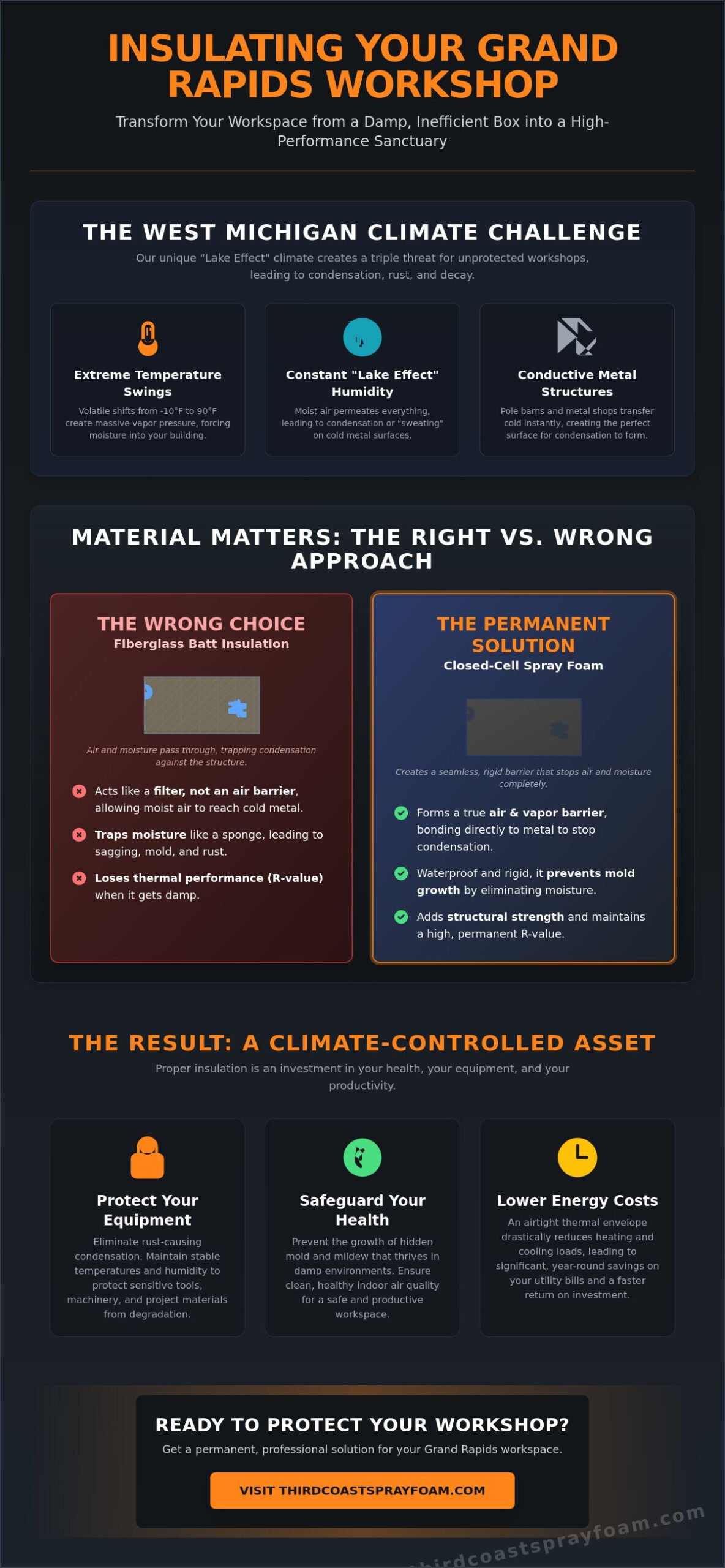
Most local workshops are metal structures or pole barns. These buildings are particularly susceptible to the “sweating” phenomenon during our volatile spring and fall months. When warm, humid air hits a cold metal ceiling or wall, it liquefies instantly. This condensation then drips onto expensive machinery, causing rapid oxidation and surface rust. Understanding building insulation principles is essential to stop this destructive cycle. It requires a material that creates a permanent, airtight bond with the substrate to eliminate the gap where moisture typically collects.
To better understand how different materials perform in a steel building, watch this helpful comparison:
The West Michigan Climate Challenge
In Kent County, temperature swings are incredibly taxing on a building. We frequently experience shifts from -10°F in the winter to 90°F with heavy humidity in the summer. This volatility creates massive vapor pressure that pushes moisture into every available crack. Standard residential methods often fail in these detached structures because they allow air to move through the insulation material. This air movement leads to “ghosting” and hidden mold growth behind the walls. A simple plastic vapor barrier isn’t enough for a Grand Rapids workshop because it cannot handle the sheer volume of Lake Effect moisture that permeates our local air.
Protecting Your Assets from Moisture Damage
For serious woodworkers, restoration enthusiasts, and mechanics, the workshop is a massive financial investment. Unregulated temperatures and fluctuating humidity levels lead to significant tool degradation over time. Rust doesn’t just look bad; it ruins the precision of a table saw or the finish on a classic car restoration project. Beyond the machinery, persistent dampness creates a breeding ground for mold and mildew. This is a critical health concern. Breathing in mold spores while you work can lead to chronic respiratory issues and poor long-term well-being. By choosing a professional solution like closed cell spray foam, you ensure a dry, healthy workspace that protects both your equipment and your lungs for decades.
Choosing the Best Materials for Insulating a Workshop in Grand Rapids
Selecting the right material is the foundation of a healthy, high-performing workspace. In our region, this choice dictates whether your shop remains a dry sanctuary or becomes a breeding ground for mold. We intentionally do not offer fiberglass batt insulation for workshop projects. While common in residential construction, fiberglass acts as a filter rather than an air barrier. In a metal workshop or pole barn, it frequently traps Lake Effect moisture against cold structural members. This leads to sagging, lost thermal performance, and hidden mold growth that directly compromises your respiratory health. For a permanent solution, you need materials that address both heat transfer and vapor movement.
The U.S. Department of Energy provides a comprehensive guide to insulation materials that highlights how different products handle moisture. When we’re insulating a workshop in Grand Rapids, we prioritize materials that create an airtight seal. This sealing capability is what prevents the internal wall condensation that ruins equipment and degrades air quality. By stopping air leakage, you eliminate the transport of moisture into wall cavities where it would otherwise settle and rot.
Closed-Cell Spray Foam: The Gold Standard
For most West Michigan workshops, closed-cell foam is the superior choice. It offers a higher R-value per inch than almost any other material, allowing for maximum thermal protection in tight wall cavities. More importantly, it acts as a Class II vapor retarder. This means it stops moisture migration entirely, providing a seamless shield against the “sweating” common in metal buildings. Because it’s a rigid plastic, it also adds significant structural reinforcement to pole barns by increasing rack strength. You can explore the technical details in our closed cell spray foam guide to see how it fits your specific building design.
When to Consider Blown-In Insulation
If your workshop features a large, flat ceiling with an attic space above, blown in insulation is a highly cost-effective option. We often use cellulose in these scenarios because it fills every nook and cranny of a ceiling joist system. It’s a pragmatic choice for maintaining consistent overhead temperatures. However, it’s vital to ensure proper venting is in place to prevent heat buildup and moisture entrapment. Using the right material in the right location ensures your workshop remains a safe, productive environment for years to come. If you’re ready to upgrade your workspace, reaching out for a professional assessment is the best way to ensure your investment is protected.
The Health Connection: Air Quality and Mold Prevention
Your workshop is more than a place for projects; it’s an environment where you spend hours breathing the air. When insulating a workshop in Grand Rapids, the primary goal isn’t just thermal comfort. It’s the creation of a healthy indoor ecosystem. Many hobbyists suffer from “sick building syndrome” without realizing the cause. This condition often stems from stagnant air and microbial growth trapped within the building’s shell. We treat the building envelope as a health-conscious barrier. Its job is to protect your respiratory system from the external elements while maintaining a stable interior climate.
A dry, mold-free environment is a prerequisite for long-term well-being. In our West Michigan climate, high humidity levels can easily penetrate a poorly sealed building. Once moisture enters, it becomes a catalyst for hidden issues. By choosing a high-performance insulation system, you’re making a proactive choice for your health. You’re ensuring that the air you breathe while working on your craft is free from the triggers that cause chronic respiratory irritation. A healthy workspace is a productive workspace.
Preventing Mold and Mildew Growth
Mold thrives in the dark, damp cavities behind your workshop walls. This growth occurs when warm indoor air reaches its “dew point” against a cold exterior surface. Professional air quality and mold prevention strategies rely on eliminating this thermal bridge entirely. By air-sealing the structure with spray foam, we prevent moisture-laden air from ever reaching those cold surfaces. This stops the condensation cycle before it begins. Prevention is always more effective and significantly more affordable than mold remediation. A dry building remains a safe building for decades.
Respiratory Health and Indoor Air Quality (IAQ)
Modern, professionally installed spray foam provides a superior seal against outdoor allergens, fine dust, and pests. This is a critical factor for maintaining high indoor air quality in a workspace. We utilize low-VOC materials designed for safety and durability. Unlike traditional materials that can shed fibers or harbor dust, our solutions create a clean, stable surface. This reduction in airborne pollutants is essential for anyone spending significant time in their shop. It helps keep your lungs clear and your energy levels high.
You should remember that a tightly sealed shop requires a strategic plan for air exchange. We emphasize the “seal tight, ventilate right” philosophy. This approach ensures that while you’re protected from drafts and moisture, you still have a consistent supply of fresh air. A holistic view of your workshop’s environment leads to better health outcomes and a more enjoyable working experience. Your physical well-being is the most valuable asset in your shop.
The Professional Installation Process in West Michigan
When insulating a workshop in Grand Rapids, the process begins long before the first trigger pull. We understand that your space houses valuable machinery and years of hard work. Our team coordinates with local building officials to ensure every project meets or exceeds Michigan Energy Code requirements. This commitment to compliance provides you with the peace of mind that your structure is legally sound and physically protected. We don’t just apply a product; we execute a technical plan tailored to the specific architecture of your building.
Preparation and Site Safety
Preparation is the most critical phase for any professional workshop project. We start by masking off your workbenches, stationary tools, and flooring with heavy-duty plastic and tape. High-pressure spray applications create a fine mist, so total containment is mandatory to protect your equipment. We also set up industrial-grade ventilation systems. These fans maintain negative pressure, pulling air out of the building to safeguard your indoor air quality during the installation. This prevents overspray from settling on your drill press or lathe while ensuring the workspace remains safe for our technicians and your future projects. Most standard workshop projects are completed within one to two business days.
Precision Application and Curing
Our approach to pole barn insulation involves precision-calibrated equipment. We monitor the temperature and pressure of the liquid components constantly. This ensures the chemical reaction is perfect, creating a stable, low-VOC product that won’t off-gas over the long term. Once applied, the foam expands rapidly into every crevice, sealing the building envelope against the Lake Michigan humidity. This creates a permanent barrier that prevents the respiratory health risks associated with damp, moldy wall cavities.
The foam typically cures within 24 hours. After this period, it’s completely inert and safe for you to return to your woodworking or mechanical repairs. Before we leave, our lead technician performs a rigorous visual inspection. We look for “holidays,” which are small gaps or missed spots that could allow a thermal bridge to form. We don’t consider the job done until the seal is 100% continuous. We then remove all masking materials and sweep the site clean, leaving you with nothing but a high-performance, climate-controlled environment. If you want to see how this process fits your specific building, schedule a site visit with our team today.
Maximizing Your Investment with Third Coast Spray Foam
Choosing high-performance solutions for insulating a workshop in Grand Rapids is a strategic move for your financial future and your physical well-being. Beyond the immediate comfort of a climate-controlled space, homeowners can often leverage the energy efficient home improvement credit. This federal incentive is designed to reward permanent upgrades to your building’s thermal envelope. We specialize in navigating these technical requirements to ensure your project qualifies for maximum benefits. Our commitment to West Michigan health and safety standards means we never cut corners on material quality or application precision.
Calculating Your Insulation ROI
The return on investment for professional workshop insulation manifests in several ways. While the reduction in monthly utility bills is the most visible benefit, it’s only the beginning. A fully conditioned outbuilding significantly increases the overall resale value of your property. Buyers in Kent County prioritize structures that are already protected against our harsh winters and humid summers. There is also a substantial “intangible ROI” regarding your health. By preventing the growth of mold and maintaining high indoor air quality, you avoid the long-term medical costs and discomfort associated with chronic respiratory irritation. A dry, comfortable shop allows you to work longer and more productively throughout the year.
The Third Coast Difference
We’re deeply rooted in the local community, with our headquarters in Fruitport and a dedicated service history throughout the Grand Rapids area. Our “no-fiberglass” policy isn’t just a preference; it’s a professional standard based on years of observing how traditional materials fail in our unique climate. We understand that West Michigan workshops require superior moisture management to prevent structural rot and tool rust. We treat every project as a partnership, aiming to improve the standards of our neighbors’ workspaces through honest advice and expert craftsmanship.
For workshops built with a sub-floor or raised foundation, we recommend a holistic approach that includes crawl space insulation. Protecting the structure from the ground up ensures that rising dampness doesn’t bypass your wall insulation to compromise your air quality. We take pride in building environments that last for generations. If you’re ready to secure your workspace and protect your respiratory health, contact us today for a professional local estimate. Let’s work together to make your workshop the most efficient and healthy building on your property.
Build a Healthier, More Efficient Workshop Today
Transforming your building into a climate-controlled environment is a permanent investment in your property’s value and your personal well-being. We’ve explored how a strategic approach to insulating a workshop in Grand Rapids prevents the “sweating” that leads to tool rust and structural decay. By prioritizing health-first air sealing technology, you don’t just lower your energy bills; you create a sanctuary free from the mold and allergens that compromise respiratory health. This holistic system ensures your space remains dry and productive regardless of the West Michigan weather. It’s about more than just heat; it’s about structural integrity and quality of life.
As West Michigan’s pole barn specialists, our team is dedicated to providing 5-star rated local service that puts your safety first. We handle every detail, from technical site preparation to final inspection, ensuring your project meets the highest professional standards. We believe every Grand Rapids builder deserves a workspace that is as reliable as the tools they use. Don’t let another season of Lake Effect humidity threaten your equipment or your health. It’s time to build a workspace that works as hard as you do. We look forward to helping you achieve a more efficient, health-conscious shop.
Get Your Free Workshop Insulation Estimate in Grand Rapids
Frequently Asked Questions
What is the best type of insulation for a workshop in Grand Rapids?
Closed-cell spray foam is the superior choice for insulating a workshop in Grand Rapids due to its high R-value and moisture resistance. Unlike traditional materials, it creates a rigid vapor barrier that is essential for the humid West Michigan climate. This permanent seal prevents moisture-laden air from penetrating your building’s shell. It’s a pragmatic investment that protects your structural integrity while maintaining a stable, comfortable workspace throughout the winter.
How do I stop condensation from forming on my workshop’s metal ceiling?
You stop condensation by eliminating the temperature difference between the warm indoor air and the cold metal surface. Professional spray foam bonds directly to the metal ceiling, leaving no gap for moisture to collect. This prevents the “sweating” that leads to mold growth and respiratory health concerns. By creating a seamless thermal break, you ensure the interior surface stays dry even during extreme Michigan temperature swings.
Is spray foam insulation safe for my respiratory health?
Professionally installed spray foam is safe and actually improves your long-term respiratory health. Once the 24-hour curing process is complete, the foam is inert and doesn’t off-gas. It creates an airtight seal that blocks outdoor allergens, dust, and pollutants from entering your shop. By preventing mold and mildew growth within your walls, it ensures the air you breathe remains clean and safe for years.
Can I insulate my workshop myself with a DIY kit?
We don’t recommend DIY spray foam kits for workshop projects due to the high risk of application failure. These kits often lack the precision temperature controls required to ensure a proper chemical reaction. Improperly mixed foam can lead to lingering odors and poor adhesion, which compromises your indoor air quality. Professional installation ensures a complete seal and a safe environment that meets all local building codes.
Does workshop insulation qualify for the 2026 federal tax credits?
Many workshop insulation projects do qualify for the 2026 Energy Efficient Home Improvement Credit. This federal tax credit encourages homeowners to make permanent upgrades that reduce energy consumption and improve building efficiency. Because our spray foam solutions provide a high-performance thermal barrier, they meet the rigorous standards required for these financial incentives. We recommend consulting with a tax professional to confirm the specific savings for your project.
How long does it take for spray foam to cure in a Michigan winter?
Spray foam typically cures within 24 hours, even during a cold Michigan winter. Our technicians use specialized, heated equipment to maintain the correct chemical temperature during the application process. This ensures the foam expands and hardens perfectly regardless of the external conditions. Once the initial curing window has passed, you can return to your projects with the confidence that your workspace is fully protected and safe.
Will insulating my workshop prevent my tools from rusting?
Yes, insulating a workshop in Grand Rapids is the most effective way to protect your expensive tools and machinery from rust. Rust occurs when moisture in the air condenses on cold metal surfaces. By stabilizing the internal temperature and sealing out the humid Lake Michigan air, you eliminate the conditions that cause oxidation. This keeps your table saws, lathes, and hand tools in pristine, working condition for decades.
Disclaimer
Information provided is for general educational purposes. Individual needs and circumstances vary. Speak to an experienced professional to get the correct information for your situation.