What if the musty smell in your crawl space and those soaring DTE bills are actually symptoms of the same underlying problem? Many homeowners accept drafty rooms and seasonal allergies as a normal part of life in West Michigan. You’ve likely felt the frustration of a furnace that never seems to stop running while your family still deals with respiratory irritation from hidden mold or mildew. At Third Coast Spray Foam, we know that prioritizing home energy efficiency improvements Grand Rapids Michigan is the most effective way to protect both your wallet and your lungs.
We believe your home should be a sanctuary of comfort and health. This 2026 guide will show you how to leverage new MiHER rebates and federal tax credits to slash your monthly expenses while creating a cleaner, safer indoor environment. We will explore the most effective ways to seal your home’s envelope, from professional rim joist insulation to full crawl space encapsulation, ensuring consistent temperatures and total peace of mind for your family.
Key Takeaways
- Learn why sealing the thermal envelope is the essential first step toward eliminating mold triggers and protecting your family’s respiratory health.
- Discover how targeted home energy efficiency improvements Grand Rapids Michigan, such as rim joist insulation, stop the drafts and air leaks that drive up utility bills.
- Identify the critical zones in your home where heat loss occurs and how professional spray foam provides a permanent, high-performance barrier against the West Michigan climate.
- Navigate the 2026 financial landscape with a clear breakdown of Federal tax credits and local utility rebates that make high-efficiency upgrades more affordable.
- Understand our holistic approach to indoor air quality, which treats your home as a complete system to ensure year-round comfort and long-term structural safety.
The State of Home Energy Efficiency in West Michigan (2026)
The thermal envelope is your home’s most important defense against the volatile West Michigan climate. Think of it as a protective shell that separates your conditioned living space from the harsh outdoor elements. In Grand Rapids, this boundary is constantly under attack. Our 2026 climate presents unique challenges, from bitter, sub-zero winters to humid “Lake Effect” summers that can turn a poorly sealed house into a breeding ground for moisture. When your thermal envelope fails, you don’t just lose money on utility bills; you lose control over your home’s health.
Traditional materials like fiberglass batts often fail in our specific environment because they lack air-sealing capabilities. They act like a filter rather than a barrier, allowing humid air to pass through and condense against cold surfaces. This moisture leads to mold growth and wood rot, which eventually compromises your indoor air quality. By investing in high-performance closed cell spray foam in Grand Rapids, you create a seamless seal that stops air movement and moisture in its tracks.
To better understand how modern trends are shaping home performance and efficiency, watch this helpful video:
The Connection Between Air Leaks and Respiratory Health
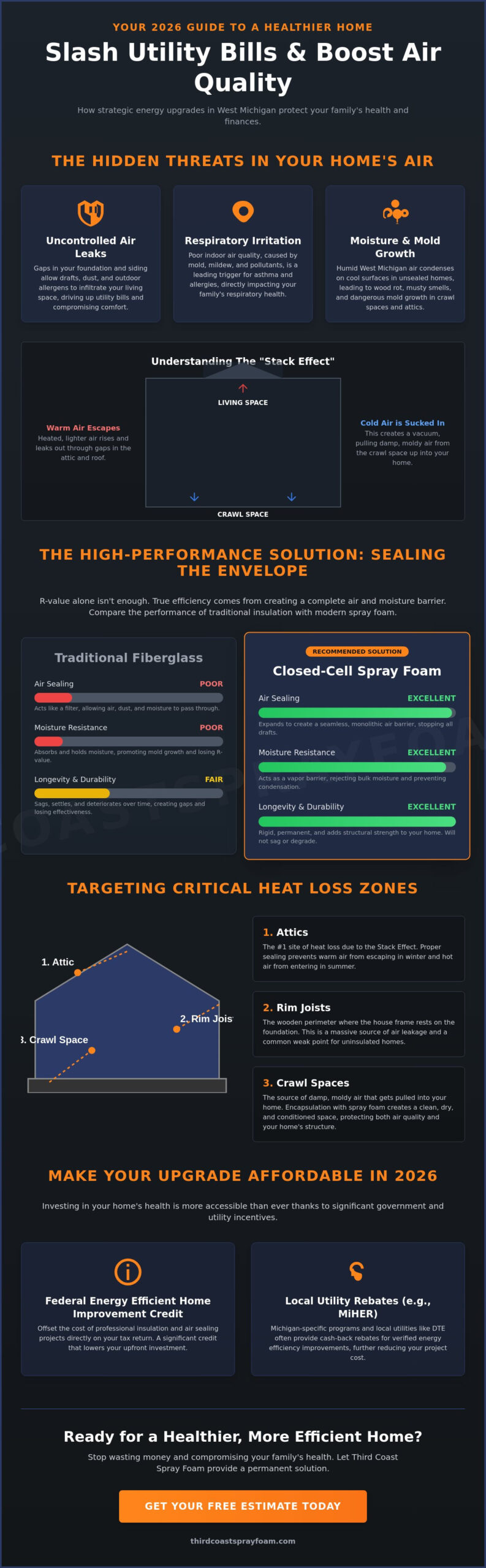
Uncontrolled air infiltration is a leading cause of respiratory irritation for many Kent County residents. When air leaks through gaps in your siding or foundation, it carries outdoor allergens, dust, and pollutants directly into your lungs. Maintaining consistent indoor humidity is vital for preventing asthma and allergy triggers. The Stack Effect is a physical phenomenon where warm air rises and escapes through your attic, creating a vacuum that pulls damp, potentially contaminated air from your crawl space up into your main living areas. Sealing these leaks is a critical step in managing long-term respiratory health.
Why 2026 is the Year for Energy Upgrades
With energy costs continuing to fluctuate, local homeowners are looking for permanent solutions to stabilize their monthly expenses. Fortunately, 2026 offers significant financial support for those ready to act. You can currently take advantage of the energy efficient home improvement credit, which helps offset the cost of professional upgrades. Beyond the immediate savings, there is a growing shift in the local real estate market toward “Total Home Health.” Buyers now prioritize a low-energy house design that guarantees comfort and safety. Making home energy efficiency improvements Grand Rapids Michigan is no longer just a maintenance task; it’s a strategic investment in your property’s value and your family’s well-being.
High-Performance Insulation: Sealing the Home Envelope
Many homeowners fixate on R-value numbers, but a high R-value means very little if air is whistling through the gaps in your walls. Resistance to heat flow is only one part of the equation. When planning home energy efficiency improvements Grand Rapids Michigan, we prioritize air sealing as the foundation of every project. A properly insulated home must address the movement of air, not just the transfer of heat. Traditional materials like fiberglass batts fail here because they don’t stop air infiltration. Instead, they act like a filter, trapping dust and allergens while allowing conditioned air to escape.
Our team relies on high-performance materials like closed cell spray foam in Grand Rapids to create a true air barrier. This material does more than just insulate; it expands to fill every crack and crevice, providing a seamless seal that fiberglass simply can’t match. This also adds significant structural integrity to your home. By bonding to the wall studs and roof sheathing, closed-cell foam increases the racking strength of the building, which is a major advantage during the high winds and heavy snow loads common in West Michigan.
Spray Foam vs. Blown-In Insulation
Choosing the right material depends on the specific area of your home. We often recommend blown-in insulation in Grand Rapids, MI for flat attic floors where cost-effectiveness is a priority. It’s an excellent way to add thermal mass over existing materials. However, in wall cavities, rim joists, and cathedral ceilings, spray foam is the clear winner. Unlike blown-in materials that can settle or shift over time, spray foam is a permanent solution. It stays exactly where it’s applied, ensuring your home’s energy performance doesn’t degrade as the years pass. If you’re unsure where your home is losing the most energy, our team can help you identify the best insulation solutions for your specific needs.
Environmental Safety and Indoor Air Quality (IAQ)
We take the health of your indoor environment seriously. A common concern with spray foam is “off-gassing,” but this is a non-issue when the product is installed by trained professionals. We use specialized equipment to ensure the foam cures properly and provide aggressive ventilation during the application process. Once cured, the foam is inert and safe. Because closed-cell foam acts as a powerful vapor barrier, it stops the moisture-driven mold growth that often triggers respiratory health issues. A “tight” home is a healthy home, provided it’s paired with proper mechanical ventilation to ensure a steady supply of fresh, filtered air for your family.
Targeting Critical Zones: Attics, Crawl Spaces, and Rim Joists
To achieve a truly high-performance home, you must address the specific zones where energy loss is most aggressive. In our West Michigan climate, the attic is typically the primary source of heat loss during the winter. Because heat naturally rises, a poorly insulated attic allows your expensive furnace-heated air to escape directly through the roof. This forces your HVAC system to work overtime, leading to the high utility bills many Grand Rapids residents face. However, while the attic is the most obvious culprit, the “gut” of your home often holds the key to total home health and comfort.
We often find that the most significant home energy efficiency improvements Grand Rapids Michigan homeowners can make involve the areas they rarely visit. The crawl space and rim joists are frequently neglected, yet they have a massive impact on your indoor air quality. When these areas are left unsealed, they allow cold drafts, moisture, and pests to enter the structure. This leads to a compromised thermal envelope and creates a cycle of energy waste that persists year-round.
Crawl Space Encapsulation for Health and Efficiency
A damp crawl space is a major threat to your family’s respiratory health. Our process for crawl space insulation in Grand Rapids involves more than just adding material; it focuses on total encapsulation. By sealing the floor and walls with a heavy-duty vapor barrier and professional spray foam, we isolate your home from ground moisture. This is vital for stopping the rise of soil gases like Radon and preventing the growth of mold and mildew. When you eliminate the primary source of indoor moisture, you effectively remove the musty basement smell that often drifts into upstairs bedrooms. This creates a cleaner, drier environment that significantly reduces triggers for asthma and seasonal allergies.
Rim Joist Sealing: Stopping the Drafts at the Source
The rim joist is the “Missing Link” in many energy efficiency projects. These are the areas where your home’s floor joists meet the foundation wall. Because of their irregular shape and location, they are notorious for leaking massive amounts of air. In the humid West Michigan environment, these gaps also allow warm air to hit cold foundation surfaces, causing condensation. This moisture leads to wood rot and foundation degradation over time. Spray foam is the only effective way to seal these irregular gaps. It provides a permanent, airtight seal that stops drafts at the source, ensuring your home energy efficiency improvements Grand Rapids Michigan provide lasting protection for your home’s structural integrity.
Financial Incentives: Tax Credits and ROI for 2026
Investing in high-performance insulation is a pragmatic decision that pays for itself through lower utility bills and improved property value. In 2026, the financial landscape for home energy efficiency improvements Grand Rapids Michigan is more favorable than ever before. Between federal tax credits and local utility rebates, the upfront cost of sealing your home’s envelope is significantly reduced. This makes it easier to prioritize the respiratory health of your family while securing your financial well-being. We believe that professional insulation shouldn’t be a financial burden; it should be a permanent investment in your home’s future.
The Energy Efficient Home Improvement Credit (Section 25C) is a cornerstone of these savings. For projects completed in 2026, you can claim a tax credit of 30% of the cost of qualifying insulation materials and air sealing. While there’s an annual maximum credit of $1,200 for weatherization, it’s important to remember that there’s no lifetime limit. This allows you to phase your upgrades over several years to maximize your tax benefits. For example, you might insulate your attic this year and encapsulate your crawl space the next, claiming the credit for each stage of the process.
Local utility programs provide even more relief for West Michigan residents. DTE natural gas customers are currently eligible for rebates up to $600 for roof and attic insulation, and another $50 for rim joist sealing. Consumers Energy also offers incentives for energy-saving upgrades, including rebates for Wi-Fi enabled thermostats that help manage your home’s thermal load. When you combine these local incentives with the 30% federal credit, the return on investment becomes clear almost immediately.
Navigating Federal Tax Credits
To claim these benefits on your 2026 tax return, you’ll need to keep your itemized receipts and the manufacturer’s certification statement for the products used. Both our spray foam and blown-in insulation materials qualify for the 30% credit for weatherization projects. We ensure our clients receive all necessary documentation to make the filing process straightforward. This credit effectively lowers the barrier for homeowners to address critical issues like mold prevention and air quality management.
Long-Term Property Value Increases
Beyond immediate tax relief, energy-efficient upgrades drive significant resale value in the Kent County area. Buyers are increasingly looking for a “Health-Home” premium, meaning they’re willing to pay more for properties with documented mold-prevention measures. An encapsulated crawl space is a major selling point because it guarantees a dry, healthy foundation free from respiratory triggers. Additionally, a sealed envelope reduces the strain on your HVAC system. By preventing your furnace and AC from running constantly, you’re extending the life of your equipment and avoiding premature replacement costs. Ready to see how these credits apply to your project? Schedule a professional consultation with our team to start your home’s transformation.
The Third Coast Approach: Total Home Health for West Michigan
Our team understands that every home in the Grand Rapids area is unique, yet they all share the same goal: providing a safe, comfortable environment for the people inside. We approach every project through our “Sealing the Envelope” philosophy. This means we don’t just look at a single wall or a drafty window; we treat your home as a holistic system where every component affects your indoor air quality and monthly expenses. When we address your home’s needs, we aren’t just installing material. We’re creating a permanent barrier against the elements.
This commitment to total home health is especially critical for our neighbors along the lakeshore. Whether we’re working in Fruitport, Grand Haven, or Muskegon, we account for the higher humidity levels and intense lake-effect weather that can lead to moisture buildup. Our deep local roots mean we know exactly how these conditions impact residential structures and large-scale projects like pole barn insulation in West Michigan. We ensure that your investment is durable enough to withstand the toughest Michigan seasons while maintaining a healthy, mold-free interior. Choosing the right partner for home energy efficiency improvements Grand Rapids Michigan means choosing a team that lives and works in the same climate you do.
Why Professional Installation Trumps DIY Kits
It’s tempting to look at DIY spray foam kits as a quick fix, but these products carry significant risks that can compromise your home’s safety. Professional application requires a precise chemical balance that DIY kits often fail to maintain. If the mixture isn’t perfect, the foam may not cure correctly, leading to lingering odors and a lower R-value than expected. Our team uses specialized, high-pressure equipment to ensure a perfect mix and complete coverage in tight areas like rim joists and attic peaks. This precision is what guarantees the long-term respiratory safety and structural integrity of your property.
Start Your Journey to a Healthier, Efficient Home
Starting your journey toward a more efficient home begins with a straightforward conversation. During our consultation, we’ll walk through your property to identify the specific gaps in your thermal envelope and explain how they impact your indoor air quality. We provide clear, honest advice on which home energy efficiency improvements Grand Rapids Michigan will offer the best return for your specific situation. Our service area spans from the Grand Rapids metro area down to Kalamazoo and across the entire West Michigan lakeshore. We take immense pride in being a local partner you can trust for expert results and peace of mind. Schedule your free home energy efficiency consultation today and take the first step toward a healthier, more comfortable home for your family.
Secure Your Home’s Health and Financial Future
Prioritizing home energy efficiency improvements Grand Rapids Michigan is a strategic investment that yields dividends in both comfort and wellness. By sealing your home’s thermal envelope and addressing critical areas like rim joists and crawl spaces, you effectively eliminate the moisture and mold triggers that compromise respiratory health. High-performance materials and professional encapsulation transform a drafty house into a stable, healthy sanctuary. With the significant tax credits and utility rebates available in 2026, there’s never been a more pragmatic time to upgrade your property’s performance.
Our team has served as West Michigan’s specialists in high-performance air sealing and crawl space health since 2013. We understand the unique climate challenges of our region and possess the expert knowledge needed to help you navigate the latest 2026 Michigan energy rebates. Don’t let another season of high bills and indoor allergens pass you by. Take the first step toward a more durable and efficient home today. Get Your Free Energy Efficiency Estimate from Third Coast Spray Foam and enjoy the peace of mind that comes with a professionally protected living space.
Frequently Asked Questions
Does spray foam insulation qualify for the 2026 federal tax credit?
Yes, professional spray foam and air sealing qualify for the Energy Efficient Home Improvement Credit under Section 25C. You can claim a tax credit of 30% of the material costs, up to an annual limit of $1,200 for weatherization projects. This incentive makes it much easier for families to prioritize high-performance upgrades that protect their home’s structure and their own respiratory health.
How does attic insulation improve my indoor air quality?
Air sealing your attic stops the movement of air that carries dust, outdoor pollutants, and allergens into your living spaces. When we use spray foam to create a seamless barrier, we prevent the humid air that leads to mold growth in your roof deck. This proactive approach ensures the air you breathe is filtered by your HVAC system rather than pulled through dirty wall cavities.
What is the most cost-effective way to improve energy efficiency in Grand Rapids?
Targeting air leaks at the rim joists and attic floor provides the fastest return on investment for home energy efficiency improvements Grand Rapids Michigan. These areas are notorious for leaking conditioned air and allowing dampness to enter the house. Sealing these gaps stops the drafts that force your furnace to work harder, resulting in immediate savings on your monthly DTE or Consumers Energy bills.
Can crawl space encapsulation help with my family’s allergies?
Yes, encapsulation is a powerful tool for reducing indoor allergy triggers like mold spores and dust mites. By sealing the floor and walls from ground moisture, we eliminate the damp environment where mildew thrives. This prevents the “musty” air in your crawl space from rising into your bedrooms, which is a common cause of nighttime respiratory irritation and chronic allergy symptoms.
Is spray foam insulation safe for people with respiratory issues like asthma?
Professional spray foam is safe for individuals with asthma because it becomes an inert, stable material once it has fully cured. Our team uses specialized equipment and aggressive ventilation during the install to ensure the product cures perfectly. By creating an airtight seal, the foam actually helps asthmatics by blocking the entry of outdoor triggers like pollen, smoke, and humid air that often cause flare-ups.
How much can I realistically save on my Michigan energy bills with new insulation?
While every house is different, the U.S. Department of Energy suggests that air sealing and insulating can save homeowners an average of 15% on heating and cooling costs. In our volatile Michigan climate, these savings are often higher during extreme sub-zero winters. When you combine these monthly savings with local utility rebates from DTE or Consumers Energy, the system often pays for itself within a few years.
How long does the installation of spray foam or blown-in insulation take?
Most residential insulation projects in West Michigan are completed within one to two days. A simple attic top-off with blown-in material might only take a few hours, while a full crawl space encapsulation and rim joist sealing project requires more detailed prep work. Our team works efficiently to minimize disruption to your daily routine, ensuring your home is sealed and protected as quickly as possible.
What is the difference between open cell and closed cell spray foam for Michigan homes?
Closed cell spray foam is a dense material that acts as a powerful vapor barrier, making it ideal for Michigan foundations and rim joists where moisture control is vital. Open cell foam is more flexible and provides excellent sound dampening, which is often preferred for interior walls or cathedral ceilings. Both materials provide superior air sealing compared to traditional fiberglass, but we typically recommend closed cell for the most demanding climate-facing areas.
Disclaimer
Information provided is for general educational purposes. Individual needs and circumstances vary. Speak to an experienced professional to get the correct information for your situation.