
What if the “indoor rain” dripping off your steel rafters isn’t just damaging your expensive equipment, but actually quietly compromising your family’s respiratory health? In Michigan, we know that metal buildings are notorious for heavy condensation. When warm air hits cold steel, it creates a perfect breeding ground for mold and mildew that can trigger chronic asthma or allergies. You shouldn’t have to choose between a functional workspace and your physical well-being.
Finding the best insulation for metal buildings in Michigan is about more than just stopping a draft. It’s about sealing the building’s envelope to stop moisture before it starts. This guide explains why professional closed-cell spray foam is the gold standard for creating a bone-dry, healthy interior that protects your lungs and your wallet. We’ll explore the updated 2026 energy code requirements, the mechanics of total building health, and how to secure up to $1,600 in HEAR program rebates to make your pole barn a safe, stable environment year-round.
Key Takeaways
- Understand how Lake Effect moisture and metal’s high thermal conductivity create “sweating” that threatens your building’s structural integrity.
- Compare the performance of different materials to see why closed-cell spray foam is the best insulation for metal buildings in Michigan due to its superior air-sealing capabilities.
- Learn how a properly sealed thermal envelope prevents mold growth and blocks outdoor allergens to protect your long-term respiratory health.
- Identify the 2026 Michigan Energy Code requirements for pole barns and commercial shops to ensure your project stays compliant and energy-efficient.
- Discover our team’s specific process for insulating metal structures to provide a permanent solution for temperature stability and peace of mind.
The Michigan Metal Building Dilemma: Why Standard Insulation Fails
Michigan winters are notoriously harsh on steel structures. In coastal communities like Grand Haven and Muskegon, Lake Effect moisture creates a unique set of challenges that standard building practices often ignore. Metal has high thermal conductivity, meaning it transfers heat much faster than wood. When the temperature drops outside, your metal siding becomes ice-cold. When that cold surface meets the relatively warm, humid air inside your building, you get “indoor rain.” This sweating phenomenon isn’t just a minor annoyance; it’s a sign that your building’s environment is out of balance.
As more Michigan residents transform their pole barns into workshops, gyms, or home offices, the need for the best insulation for metal buildings in Michigan becomes a matter of safety and structural longevity. You’re no longer just storing a tractor; you’re creating a space where people breathe and equipment stays dry. To see the “sweating” phenomenon in action and why professional application matters, watch this video:
The Science of Condensation in Steel Structures
Condensation occurs when air reaches its dew point. In a metal building, the steel panels act as a perfect condensing surface. Because metal doesn’t breathe, moisture sits on the surface and eventually drips onto your floor and tools. In West Michigan, where seasonal humidity levels can fluctuate wildly, this moisture buildup is constant. If left unchecked, this “sweating” leads to structural threats. It weakens fasteners, encourages rust, and creates the damp conditions that mold thrives in. This isn’t just a building problem; it’s a health risk for anyone spending time inside.
Why Fiberglass Batts are a Mistake for Metal
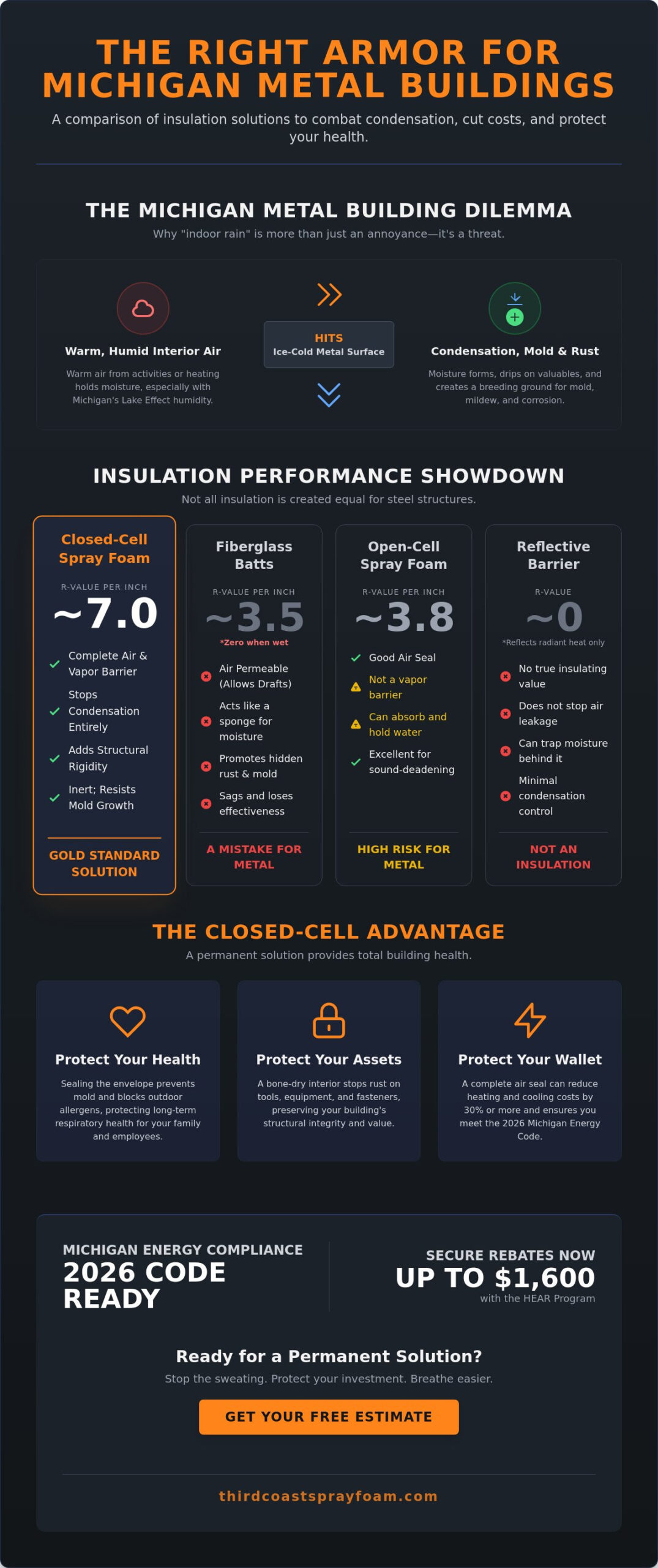
Traditional building insulation materials like fiberglass batts are air-permeable. This is a fatal flaw for a metal building. Fiberglass allows humid air to pass through it and reach the cold metal. Once the moisture condenses, the fiberglass soaks it up like a sponge. This creates a “wet blanket” effect. Wet insulation has zero thermal resistance, meaning your heating bills will skyrocket while your building remains freezing.
Even worse, trapped moisture against the metal accelerates hidden corrosion and structural decay. From a health perspective, wet fiberglass is a disaster. It becomes a sanctuary for mold and mildew, which can severely impact your indoor air quality and lead to long-term respiratory issues for those working inside. At Third Coast Spray Foam, we’ve seen the damage firsthand. We refuse to install fiberglass in metal buildings because it’s a temporary fix that leads to permanent structural and health problems. We believe in doing the job once and doing it right.
Comparing the Best Insulation Options for Metal Buildings
Choosing the right material for your steel structure isn’t just about the price tag. It’s about the physics of air movement and moisture control. While many big-box retailers suggest various best insulation for metal buildings in Michigan, most options fail to address the core problem: air leakage. Air leakage can account for nearly 30% of a building’s heating and cooling costs. In a drafty pole barn, a high R-value means very little if the wind blows right through the material. To get the best results, you need a solution that provides both thermal resistance and a complete air seal.
When we look at the performance of different materials, the differences are stark. Closed-cell spray foam offers an R-value of approximately 7 per inch, while open-cell foam typically sits around 3.8 per inch. Reflective barriers, often called “double bubble,” provide almost no R-value at all. Beyond heat retention, closed-cell foam is the only “all-in-one” solution that creates a seamless thermal envelope. It also adds significant rigidity to large metal panels, reducing the vibration and “oil-canning” noise common during Michigan windstorms.
Closed-Cell Spray Foam: The Gold Standard
In Lansing and throughout West Michigan, closed-cell spray foam is the only material our team recommends for metal structures. Because it’s dense and moisture-resistant, it acts as a 100% airtight vapor barrier that stops condensation in its tracks. This is critical for preventing indoor air quality problems caused by mold and mildew. Closed-cell spray foam is the only insulation that creates a seamless thermal envelope directly on metal surfaces without leaving gaps for moisture to hide. By sealing every crack and crevice, it also blocks outdoor allergens and pollutants from entering your workspace, protecting your long-term respiratory health.
Reflective Barriers and ‘Double Bubble’
Reflective barriers are often marketed as a budget-friendly fix, but they frequently fail in heated workshops. These products rely on an air gap to work, which is rarely maintained in real-world applications. They lack the thermal mass needed to keep a building warm during a January freeze. While the initial cost is lower, the long-term energy costs are significantly higher. When you consider that professional insulation upgrades can yield a return on investment of up to 117%, cutting corners with reflective foil often costs more in the long run. If you want to ensure your building remains a healthy, stable environment, it’s worth exploring how pole barn insulation can transform your space into a year-round asset.
- Closed-Cell Foam: R-7 per inch, full air seal, structural reinforcement.
- Open-Cell Foam: R-3.8 per inch, air seal, requires separate vapor barrier.
- Reflective Barriers: Minimal R-value, no air seal, prone to condensation.
Protecting Your Respiratory Health and Indoor Air Quality
Moisture control is a direct prerequisite for human health. While we often focus on the structural damage caused by “indoor rain,” the biological impact of condensation is far more concerning. When water clings to cold steel panels, it creates an environment where mold and mildew thrive. These fungi release microscopic spores into the air you breathe while working in your shop or pole barn. For anyone choosing the best insulation for metal buildings in Michigan, the goal must be to eliminate these moisture-driven health triggers entirely.
Traditional insulation methods often hide these problems until they become severe. Moisture trapped behind air-permeable materials leads to hidden rot and fungal growth. This creates a cycle of poor indoor air quality that can exacerbate chronic respiratory conditions like asthma or seasonal allergies. A healthy indoor environment starts with a dry, airtight thermal envelope that prevents the “sweating” that fuels these irritants.
Preventing Mold Spores and Respiratory Irritants
When moisture accumulates in the wall cavities of a metal building, it creates a dark, damp sanctuary for toxic mold. These spores don’t stay behind the walls; they circulate throughout the building every time the air moves. High humidity levels in West Michigan make this a year-round threat. Poor indoor air quality (IAQ) is linked to immediate symptoms like headaches and throat irritation, but the long-term effects on lung function are the real danger. Our holistic approach to building health often includes crawl space insulation to ensure that moisture isn’t rising from the ground to contaminate the air in your main workspace.
The Importance of a Seamless Air Barrier
A seamless air barrier does more than just keep you warm; it acts as a filter for your entire building. Unsealed metal buildings often suffer from the “stack effect,” where warm air escaping through the roof pulls in dusty, pollen-heavy air from the outside through gaps in the siding and base. This brings outdoor pollutants directly into your lungs. By sealing these gaps with closed-cell foam, you create a controlled environment. This is especially vital for commercial spaces or workshops where dust management is a priority for both the projects and the people. Using the best insulation for metal buildings in Michigan ensures that you aren’t just insulating against the cold, but also against the invisible contaminants that compromise your well-being.
Beyond moisture and dust, professional installation is critical for managing volatile organic compounds (VOCs). Our team follows strict safety protocols to ensure proper off-gassing and ventilation during the application process. This precision ensures that once the foam cures, your building is a safe, inert environment. We take pride in providing a solution that protects your structure and your respiratory health for the long haul.
Planning Your Project: R-Values, Costs, and Rebates
A successful insulation project requires balancing state regulations with your specific goals for comfort and health. When selecting the best insulation for metal buildings in Michigan, you must first consider the updated Michigan Commercial Energy Code. Effective April 22, 2025, this code mandates a minimum R-value of R-30 for insulation installed in Climate Zones 5 and 6. While agricultural buildings often have more flexibility, meeting or exceeding these standards is a proactive step toward preventing the moisture issues that compromise respiratory health.
Preparation is the first step toward a bone-dry interior. Before our team arrives, ensure that all metal surfaces are free of heavy oils or dust, and move sensitive equipment toward the center of the room. This allows for a seamless application of closed-cell foam, ensuring every gap is sealed. By prioritizing a high-performance seal now, you avoid the future costs of mold remediation and structural repairs. You can learn more about these financial benefits by maximizing your energy efficient home improvement credit through available state and federal programs.
Calculating ROI and Energy Savings
Properly insulating a pole barn in Kalamazoo or Holland can reduce your heating and cooling costs by nearly 30%. Because closed-cell foam prevents the “wet blanket” effect of traditional materials, your energy efficiency remains stable for decades. This upgrade provides a return on investment of up to 117% by increasing property value and extending the lifespan of your steel panels. More importantly, it safeguards your health. A dry building doesn’t grow the mold that triggers asthma, making the long-term medical savings a significant part of your ROI.
Local Regulations and Rebates
Navigating the financial landscape of 2026 is easier than you might think. With some federal tax credits having expired in late 2025, the focus has shifted to state-administered programs like HEAR (Home Electrification and Appliance Rebates). This program offers up to $1,600 for insulation and weatherization for eligible Michigan households. Utility companies like DTE Energy and Consumers Energy also provide rebates ranging from $25 to $600 for natural gas customers who improve their building’s thermal envelope. For a deeper look at project logistics, consult our pole barn insulation guide to see how these savings apply to your specific structure.
Investing in your building’s health today ensures a safer environment for years to come. If you’re ready to stop the condensation and start saving, get a professional insulation quote from our local West Michigan team.
- Commercial Code (Zones 5/6): R-30 minimum requirement.
- HEAR Program: Up to $1,600 in potential rebates.
- ROI: Up to 117% return on professional upgrades.
The Third Coast Difference: Expert Metal Building Insulation
Our team at Third Coast Spray Foam understands that a metal building in West Michigan isn’t just a shell of steel. It’s an investment in your lifestyle or your livelihood. Whether you’re in Grand Rapids, Muskegon, or Holland, our specialized process for insulating pole barns and metal shops is designed to survive our unique climate. We prioritize closed-cell foam because it remains the best insulation for metal buildings in Michigan, specifically because metal panels require a material that bonds permanently to the substrate. This bond prevents the microscopic gaps where condensation and mold typically take root. We value precision. Our work ensures your structure remains a healthy, functional space for decades.
We approach every project through the lens of total building health. This means we don’t just look at the walls; we look at how the entire system affects your respiratory safety. By sealing the envelope with the best insulation for metal buildings in Michigan, we create a barrier that keeps your air clean. It’s about your livelihood. We protect your lungs from the dampness that triggers chronic health issues. Our local reputation is built on this “no-nonsense” commitment to quality and tangible results.
Our Professional Installation Standards
We never use DIY kits. One of the most dangerous trends we see is the use of consumer-grade spray foam kits. These kits often fail to maintain the precise temperature and pressure required for a proper chemical reaction. This leads to off-ratio foam that may never fully cure, resulting in lingering chemical odors and poor adhesion to metal surfaces. At Third Coast, we use industrial-grade equipment that ensures a perfect 1:1 mixing ratio every time. Our rigorous safety protocols include active ventilation during the application and a strict curing schedule to manage indoor air quality. We take immense pride in our craft, especially when handling large-scale agricultural and commercial steel structures where professional precision is the only way to guarantee a bone-dry interior.
Get Started on Your West Michigan Project
Protecting your property and your physical well-being shouldn’t be a guessing game. We offer a free on-site health and efficiency assessment to help you understand the specific needs of your building. Our team serves residents throughout 4 major counties, including Kent, Ottawa, Muskegon, and Allegan. We are here to help you navigate the technical details of air sealing and vapor barriers so you can enjoy peace of mind. Contact Third Coast Spray Foam today to protect your metal building and your health with a permanent, professional solution.
Secure Your Building’s Future and Your Family’s Health
Stop the cycle of “indoor rain” and structural decay by choosing a solution that addresses the unique climate of West Michigan. We’ve established that closed-cell spray foam is the best insulation for metal buildings in Michigan because it creates a permanent, airtight seal that traditional materials simply can’t match. By eliminating condensation, you aren’t just protecting your steel panels; you’re removing the moisture required for mold to grow. This proactive approach ensures that your workshop or pole barn remains a safe environment for your lungs and your equipment.
Our team brings deep expertise in navigating the 2025 Michigan Energy Code and the specific challenges of Lake Effect humidity. We prioritize your respiratory safety by using professional equipment that guarantees a safe, inert thermal envelope. Don’t let drafty walls or hidden mold compromise your property’s value or your long-term well-being. It’s time to invest in a permanent solution that provides peace of mind for decades.
Protect your Michigan metal building with a free insulation estimate from Third Coast Spray Foam and take the first step toward a healthier, more efficient space. We look forward to helping you seal the envelope on your next project.
Frequently Asked Questions
Is spray foam safe for metal building indoor air quality?
Yes, professional spray foam is safe for indoor air quality once it has fully cured, which typically takes 24 hours. By creating a seamless air barrier, it prevents outdoor pollutants, dust, and pollen from infiltrating your workspace. This level of protection is why many consider it the best insulation for metal buildings in Michigan. It also stops the moisture that leads to mold growth, directly benefiting your long-term respiratory health.
Can I use open-cell foam on a metal building ceiling in Michigan?
Open-cell foam is rarely the right choice for metal ceilings in Michigan’s climate. Because open-cell is vapor-permeable, it allows humid air to reach the cold steel roof deck, leading to hidden condensation and potential rot. In West Michigan, where Lake Effect humidity is high, closed-cell foam is the standard because it acts as its own vapor barrier, keeping the structure dry and healthy without extra layers.
How thick should spray foam be on a metal building wall?
For most Michigan metal buildings, a thickness of 2 inches of closed-cell spray foam is the professional standard. This depth provides an R-value of approximately R-14 and creates a complete vapor barrier to stop condensation. While the 2025 Michigan Energy Code mandates R-30 for some applications, 2 inches on the walls is often the baseline needed to prevent “indoor rain” and protect the steel from corrosion.
Will spray foam cause my metal building to rust?
No, professional spray foam actually prevents rust by sealing the metal substrate away from oxygen and moisture. Rust requires water to form; since closed-cell foam bonds directly to the steel, it eliminates the “sweating” that causes corrosion in uninsulated buildings. This permanent bond ensures that your structural fasteners and panels remain dry and secure, extending the lifespan of your investment by decades.
Can I insulate my metal building myself with a DIY kit?
You should avoid DIY spray foam kits for metal buildings due to the high risk of improper chemical mixing. If the components aren’t heated and pressurized correctly, the foam may fail to bond to the cold metal or result in lingering chemical odors. Professional installation ensures a 1:1 mixing ratio and follows strict safety protocols for off-gassing, protecting both your building’s integrity and your respiratory health.
How does insulation prevent ‘sweating’ in a pole barn?
Insulation prevents sweating by stopping warm, humid indoor air from contacting the cold metal surface of the building. When you use the best insulation for metal buildings in Michigan, you create a thermal break. Closed-cell foam is particularly effective because it stops air movement entirely. Without this barrier, the temperature difference causes water to condense into droplets, which eventually leads to mold and respiratory irritants.
What is the best R-value for a heated shop in Michigan?
A heated shop in Michigan should aim for a minimum of R-30 to meet the Commercial Michigan Energy Code effective April 22, 2025. For maximum comfort and lower utility bills, many West Michigan owners target R-49 or higher in the ceiling. Achieving these levels with closed-cell foam ensures your heating system doesn’t have to work overtime, significantly reducing the 30% of energy costs typically lost to air leakage.
Does metal building insulation qualify for the 25C tax credit in 2026?
The federal 25C Energy Efficient Home Improvement Credit is not available for equipment installed after December 31, 2025. Instead, 2026 projects should look toward the state-administered HEAR and HOMES programs. These programs offer up to $1,600 specifically for insulation and weatherization. Low-income families may qualify for even higher rebates, helping to offset the cost of creating a healthier, more energy-efficient indoor environment.
Disclaimer
Information provided is for general educational purposes. Individual needs and circumstances vary. Speak to an experienced professional to get the correct information for your situation.