
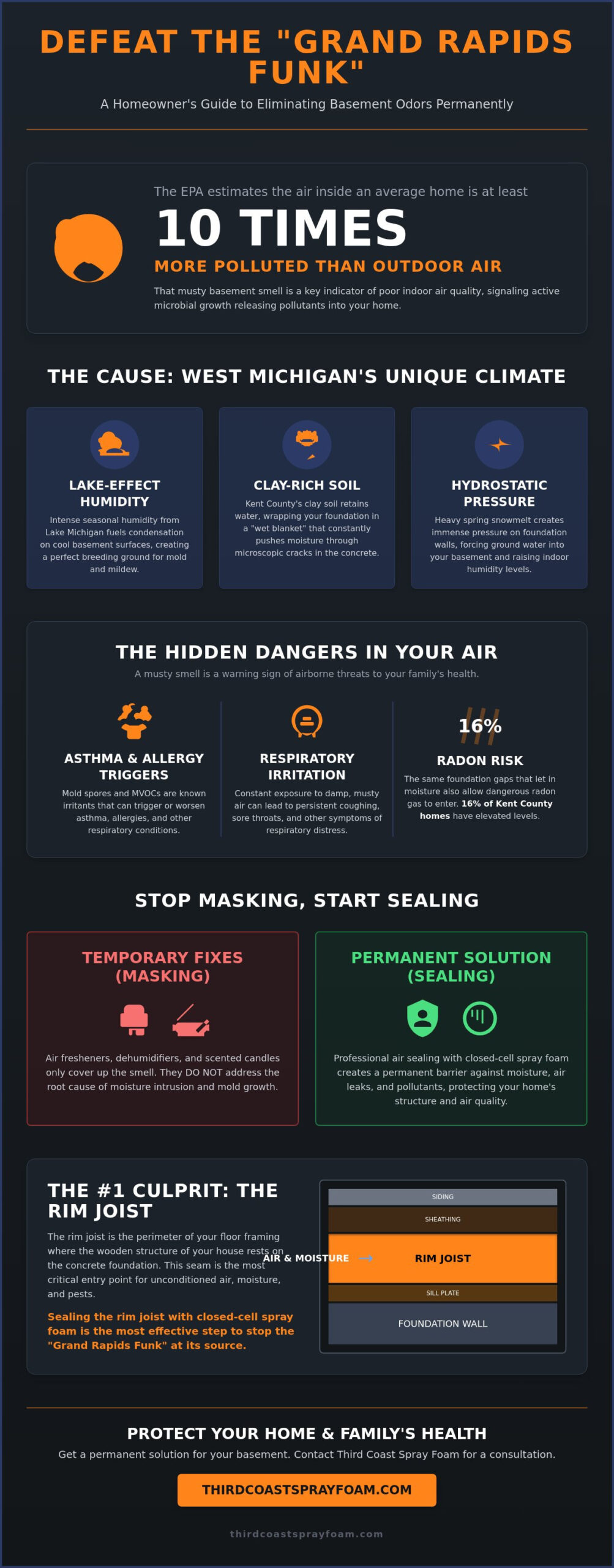
The EPA estimates that the air inside the average home is at least 10 times more polluted than the air outside, and in West Michigan, that pollution often begins right beneath your feet. If you have been searching for how to get rid of damp smell in basement Grand Rapids houses, you already know that a musty odor is more than a nuisance; it’s a persistent reminder of high humidity and potential mold growth. You deserve to feel safe in every room, yet the fear of hidden spores or respiratory irritation often keeps families from fully utilizing their lower levels.
At Third Coast Spray Foam, we believe your home should be a sanctuary for your health. This guide provides the permanent, professional steps needed to eliminate those odors by addressing the root cause rather than just masking the scent. You will discover how sealing the thermal envelope and utilizing advanced solutions like rim joist insulation or crawl space encapsulation can protect your family from the 16% of Kent County homes with elevated radon levels while ensuring your indoor air remains fresh and clean.
Key Takeaways
- Understand the science behind the “Grand Rapids Funk” by identifying how lake-effect humidity triggers the release of microbial volatile organic compounds (MVOCs) in your foundation.
- Learn the permanent steps for how to get rid of damp smell in basement Grand Rapids homes by focusing on air sealing rather than temporary scent masking.
- Identify the rim joist as a critical entry point for odors and discover why professional closed-cell spray foam is the superior choice for sealing your home’s thermal envelope.
- Connect the dots between basement moisture and respiratory health, including how addressing dampness can reduce asthma triggers and improve overall indoor air quality.
- Discover why crawl space encapsulation and professional insulation removal are essential components of a “Total Home Health” strategy for West Michigan homeowners.
Understanding the “Grand Rapids Funk”: Why Your Basement Smells Damp
Living in West Michigan means dealing with specific environmental pressures that most national blogs simply don’t understand. If you’ve ever walked down your stairs and noticed a sharp, earthy scent, you’re dealing with what locals often call the “Grand Rapids Funk.” This isn’t just a sign of an old house; it’s a warning from your home’s ecosystem. Many homeowners search for how to get rid of damp smell in basement Grand Rapids properties because they realize that standard air fresheners are useless against a biological problem.
That smell is actually the result of chemical compounds being released into your air as microorganisms feed on your building materials. MVOCs are the byproduct of active microbial growth in damp West Michigan basements. These compounds are produced as mold and bacteria consume organic matter like your floor joists or drywall. Our local climate, characterized by intense lake-effect humidity and significant seasonal shifts, provides the perfect fuel for these organisms to thrive.
To better understand this concept, watch this helpful video:
The Science of Musty Odors: Mold, Mildew, and Bacteria
At Third Coast Spray Foam, we look at your basement as a holistic system where mold and bacteria don’t just sit on surfaces; they actively digest your home. In dark, unventilated spaces, Indoor mold spores settle on moist organic materials and begin a rapid lifecycle of growth and reproduction. While a “dirty” smell might come from dust or stagnant air, a “damp” biological smell is the scent of active digestion. Bacteria often join the party, thriving in wet drywall or wood and contributing to the complex odor profile that can irritate your lungs and trigger allergy symptoms.
This process is particularly aggressive in basements where air remains stagnant. When mold colonies grow, they release spores and metabolic gases into the air you breathe. For anyone in the home with asthma or respiratory sensitivities, these pollutants represent a serious health risk. Our team knows that understanding that the smell is a byproduct of a living, growing organism is the first step toward a permanent solution for your family’s safety.
Why West Michigan Basements are Prone to Moisture
Our geography plays a major role in your basement’s air quality. The Grand River valley area features high soil saturation, especially during the spring thaw. Heavy Michigan snowmelt puts immense hydrostatic pressure on your foundation walls, forcing moisture through microscopic cracks in the concrete. Local Kent County soils are often rich in clay. This material is notorious for holding onto water, effectively keeping your foundation in a “wet blanket” for months at a time.
When this moisture meets the seasonal humidity spikes common in our region, the result is heavy condensation on cool masonry surfaces. This creates a cycle where the air inside becomes a health hazard. Since the EPA estimates indoor air is 10 times more polluted than outdoor air, these local factors make sealing your basement’s envelope a critical priority for your family’s respiratory health. Addressing how to get rid of damp smell in basement Grand Rapids homes requires more than a dehumidifier; it requires a strategy that accounts for our unique West Michigan soil and climate.
Identifying the Hidden Culprits: Where the Smell Actually Starts
Learning how to get rid of damp smell in basement Grand Rapids properties requires a shift in perspective. Most homeowners spend their time scrubbing floors or buying scented candles, but the true source of that musty odor is often structural rather than surface-level. Smells frequently enter your home through unsealed gaps and cracks that are invisible to the naked eye. These openings don’t just let in air; they act as gateways for moisture and outdoor pollutants that settle into your foundation and begin to decay.
This issue is driven by a physical phenomenon known as the “Stack Effect.” As warm air rises and escapes through the upper levels of your home, it creates a vacuum that pulls air from the lowest point, your basement or crawl space, upward into your living areas. If your basement is damp, this process constantly draws MVOCs and mold spores into your kitchen and bedrooms. This is why a basement problem quickly becomes a whole-house health concern. Since 1 in 7 homes in Kent County tested for elevated radon levels, these same gaps can also be entry points for colorless, odorless gases that impact your long-term safety.
The Rim Joist and Box Sill Connection
The rim joist is perhaps the most overlooked area in West Michigan homes. This is the perimeter of your floor system where the wooden frame of your house meets the concrete foundation. Because this joint is subject to constant expansion and contraction, it often develops small gaps that allow humid air and pests to enter. Many older homes in our area still use fiberglass batt insulation in these spaces. Unfortunately, fiberglass acts like a filter for dirt and a sponge for moisture. It traps humidity against the wood, leading to rot and providing a perfect breeding ground for mold. Over time, this deteriorating insulation holds onto odors and contributes significantly to the health effects of mold, including respiratory irritation and asthma triggers.
Foundation Seepage and Porous Concrete
Concrete may feel solid, but it actually behaves like a very dense sponge. Through a process called capillary action, porous concrete walls pull water from the saturated Michigan soil into your basement. You might notice efflorescence, a white, powdery substance on your walls, which is a clear sign of mineral deposits left behind by migrating moisture. During high-humidity Grand Rapids summers, these walls often “sweat” as warm air hits the cool masonry. This constant dampness keeps the relative humidity high enough to support microbial growth. Addressing these issues through professional sealing the envelope is the only way to break the cycle and ensure your home’s air remains clean and safe for your family.
Step-by-Step Guide to Eliminating Basement Odors for Good
Stopping a musty smell requires more than a bottle of cleaner and a weekend of scrubbing. While surface cleaning feels productive, it rarely addresses the structural issues that allow odors to persist. To truly understand how to get rid of damp smell in basement Grand Rapids homes, you have to transition from temporary fixes to permanent structural solutions. Our team focuses on “sealing the envelope,” a process that creates a total barrier between your living space and the damp Michigan soil. This approach doesn’t just hide the smell; it stops the migration of moisture and gases that compromise your home’s air quality.
Phase 1: Immediate Remediation and Cleaning
The first step in any health-first guide is removing the existing biological triggers. You should prioritize safe mold removal practices using non-toxic, health-conscious cleaners that won’t further irritate your respiratory system. Many people reach for bleach, but we strongly advise against it. Bleach is mostly water; when applied to porous surfaces like wood or concrete, the water can soak in and actually feed the mold roots while the chlorine evaporates. This often leads to the mold returning more aggressively than before. Additionally, the fumes from bleach can be a significant trigger for those with asthma or sensitive lungs.
Instead, follow the guidelines provided by the CDC for mold prevention and cleanup to ensure you’re handling the situation safely. Once surfaces are clean, you must stabilize the environment. Setting up a professional-grade dehumidifier is essential to keep the relative humidity below 50%. This specific threshold is critical because most mold and bacteria struggle to grow in environments with less than 50% moisture. This step buys you time to implement the permanent air sealing measures your foundation requires.
Phase 2: Permanent Air Sealing and Insulation
Once the environment is stable, it’s time to address the structural gaps we identified earlier. This phase begins with insulation removal. We often find that old fiberglass batts in the rim joists have become heavy with moisture and trapped odors. Removing this contaminated material is the only way to ensure the smell doesn’t return. After the area is clear, our team applies closed cell spray foam to the rim joists and box sills. Unlike fiberglass, closed-cell foam acts as both high-performance insulation and a seamless vapor barrier. It expands to fill every crack, effectively sealing out the humid West Michigan air and preventing pests from entering.
Total home health also requires looking beyond the basement walls. If your home has an attached crawl space, subterranean odors will continue to rise through your floorboards unless that area is also addressed. Investing in professional crawl space insulation and encapsulation creates a clean, dry environment that works in tandem with your basement. By sealing these lower levels, you stop the “Stack Effect” from pulling pollutants into your kitchen and bedrooms, ensuring the air your family breathes is fresh, dry, and safe.
The Health Implications of a Musty Basement: Protecting Your Family’s Lungs
A musty odor in your home is more than an aesthetic issue; it’s a biological warning sign. When homeowners ask how to get rid of damp smell in basement Grand Rapids, they are often reacting to the physical discomfort that accompanies the scent. Respiratory health is inextricably linked to the environment of your foundation. Mold spores and mycotoxins can irritate the respiratory tract even in healthy individuals, leading to persistent coughing, throat irritation, or congestion that never seems to clear up. Understanding how to get rid of damp smell in basement Grand Rapids houses is the first step toward reclaiming your family’s physical well-being.
For those living with chronic conditions, the stakes are even higher. Basement dampness is one of the most common asthma triggers found in West Michigan homes. Beyond the lungs, poor indoor air quality (IAQ) has been shown to degrade sleep quality and impair cognitive function. If you find yourself feeling “foggy” or waking up tired despite a full night of rest, the culprit might be the air rising from your unsealed basement. We view your home as a holistic system where the air in your lowest level eventually becomes the air in your bedroom.
Indoor Air Quality and Respiratory Health
Because of the stack effect, your basement effectively acts as the “lungs” of your home. As air is pulled upward through the structure, it carries everything from the lower level into your main living spaces. This is particularly dangerous for children and the elderly, whose respiratory systems are more sensitive to airborne mold spores. High humidity levels, often exceeding 60% in untreated Grand Rapids basements, also lead to dust mite proliferation. These microscopic pests thrive in damp environments and are a leading cause of year-round indoor allergies and sinus inflammation.
Preventing Mycotoxin Exposure
Mycotoxins are toxic secondary metabolites produced by certain types of mold, and they are a major concern in enclosed, poorly ventilated basements. Unlike the spores themselves, these toxins can linger in the air and settle into furniture or carpeting upstairs. The long-term effects of living in a home with “hidden” mold behind walls can include chronic fatigue and immune system suppression. Professional air sealing provides a critical defense by creating a permanent barrier against these pollutants. By sealing the thermal envelope with closed-cell spray foam, you stop the movement of these toxins into your breathing zone. If you’re ready to secure your home’s air, contact our team for a total home health assessment today.
Professional Solutions in Grand Rapids: Total Home Health with Third Coast
At Third Coast Spray Foam, we don’t just spray insulation; we engineer a healthier environment for your family. Addressing how to get rid of damp smell in basement Grand Rapids homes requires a contractor who understands the building as a holistic system rather than a collection of separate walls. Our “Total Home Health” approach focuses on sealing the thermal envelope to stop the migration of moisture, allergens, and soil gases. By using high-performance materials, we provide a permanent solution that protects your respiratory health and stabilizes your home’s indoor climate for decades.
The primary tool in our arsenal is closed-cell spray foam. Unlike traditional materials that merely slow down heat transfer, closed-cell foam acts as a robust vapor barrier and air seal. It’s particularly effective for Michigan foundations because it doesn’t absorb water or provide a food source for mold. Investing in these professional upgrades is now more accessible than ever. We encourage our clients to look into the energy efficient home improvement credit to help offset the costs of making their homes safer and more efficient.
Crawl Space Encapsulation and Rim Joist Sealing
Our specialized encapsulation process stops moisture at the source by covering exposed earth with a heavy-duty vapor barrier and sealing the perimeter walls. This is a critical step for Grand Rapids homes with attached crawl spaces, as it prevents subterranean odors from ever entering your breathing zone. For the rim joists, we utilize the “set it and forget it” nature of closed-cell spray foam. Once applied, it expands to fill every hairline crack, creating an airtight seal that lasts the lifetime of the structure. This doesn’t just eliminate musty smells; it significantly improves your home’s overall energy efficiency by stopping the drafts that drive up heating bills in our harsh West Michigan winters.
Why Choose a Local West Michigan Specialist?
Our team lives and works in Kent and Muskegon counties. We have a deep understanding of Grand Rapids architecture and the specific challenges posed by our clay-heavy soil conditions. A “quick fix” contractor might suggest a simple dehumidifier or a surface coating, but a “total health” partner looks for the root cause of the moisture. We know how the Grand River valley’s water table affects foundation pressure and how to get rid of damp smell in basement Grand Rapids properties using methods tailored to our region’s unique climate.
Choosing Third Coast means choosing a local partner invested in the long-term comfort and safety of our community. We take pride in our craft and the tangible results we deliver for our neighbors. If you’re ready to stop masking odors and start breathing cleaner air, we’re here to help. Contact our team today for a professional assessment of your basement’s health and a free local inspection in Grand Rapids, Muskegon, or the surrounding West Michigan areas.
Secure Your Foundation and Breathe Easier Today
Your home’s foundation should provide security, not a source of respiratory stress. We have explored how musty odors are actually biological signals of active microbial growth and how the stack effect carries these pollutants directly into your living areas. Truly understanding how to get rid of damp smell in basement Grand Rapids properties requires moving beyond temporary dehumidifiers to a permanent, structural seal. By prioritizing air sealing at the rim joists and addressing crawl space moisture, you effectively shut the door on mold, pests, and soil gases.
Third Coast Spray Foam has served as local Grand Rapids experts since 2013. As authorized West Michigan closed-cell foam installers, we specialize in health-first crawl space encapsulation that transforms your home’s environmental safety. We don’t just fix smells; we protect the total home health of your family. You deserve a basement that feels as fresh and safe as the rest of your home.
Schedule Your Free Basement Health Assessment in Grand Rapids Today to take the first step toward a cleaner, drier, and healthier living environment. Our team is ready to help you seal your home’s envelope for good.
Frequently Asked Questions
Is the damp smell in my basement dangerous to breathe?
Yes, a persistent musty odor is a biological indicator of mold spores and microbial volatile organic compounds (MVOCs) in your air. The EPA reports that indoor pollutants are often 2 to 5 times higher than outdoor levels; in damp basements, this can reach 10 times higher. Breathing these contaminants can trigger asthma attacks or chronic sinus irritation. Professional remediation is the only way to ensure your family’s long-term respiratory health.
Will a dehumidifier alone get rid of the musty smell?
A dehumidifier is a useful tool but it won’t permanently solve how to get rid of damp smell in basement Grand Rapids homes. While it lowers relative humidity, it doesn’t address the air leakage or porous concrete allowing moisture to enter. If you turn the machine off, the smell typically returns within 24 to 48 hours. You need a structural solution like air sealing to stop the cycle for good.
Can I use bleach to kill the mold causing the odor?
You should avoid using bleach on porous materials like basement wood or concrete walls. Bleach contains a high percentage of water which can soak into the material and actually feed the mold roots. While the surface might look clean, the mold often returns more aggressively. We recommend non-toxic, health-conscious cleaners followed by professional encapsulation to prevent regrowth and protect your home’s air quality.
How does spray foam help eliminate basement smells?
Closed-cell spray foam eliminates odors by creating a seamless air seal and vapor barrier. It physically blocks the “Stack Effect” that pulls damp air and MVOCs from your foundation into your upstairs living spaces. By sealing the rim joists and box sills, our team stops the entry of humid West Michigan air. This ensures your home’s thermal envelope remains tight and your indoor air stays fresh and dry.
Does the damp smell mean I have a foundation leak?
Not necessarily; a damp smell often results from moisture vapor migrating through porous concrete rather than a visible crack or leak. Concrete acts like a dense sponge, pulling water from saturated Kent County soil via capillary action. This creates high humidity that supports mold growth on organic materials. Professional sealing addresses this invisible vapor transmission that standard waterproofing often misses.
How long does it take to get rid of a basement smell professionally?
Most professional remediation and sealing projects are completed within 1 to 3 business days. This timeline includes the removal of old, contaminated insulation and the application of new closed-cell foam or encapsulation materials. The reduction in odor is typically noticeable within the first 24 hours after the thermal envelope is sealed. Our team prioritizes a clean, efficient process that minimizes disruption to your daily routine.
Is basement encapsulation worth it for odor control in Grand Rapids?
Encapsulation is highly effective in Grand Rapids due to our region’s high humidity during summer months and clay-heavy soils. It provides a permanent barrier against subterranean odors and moisture that can lead to wood rot or respiratory health issues. By sealing off the earth and foundation walls, you create a conditioned space that improves your home’s overall air quality and energy efficiency for the long term.
Can old insulation be the source of the damp smell?
Old fiberglass insulation is a common source of persistent basement odors. Fiberglass batts act like a filter, trapping dust, moisture, and mold spores over many years. Once these materials become damp, they hold onto smells and can become a breeding ground for bacteria. Professional insulation removal is often the first step we take to clear the air before installing permanent, moisture-resistant closed-cell spray foam.
Disclaimer
Information provided is for general educational purposes. Individual needs and circumstances vary. Speak to an experienced professional to get the correct information for your situation.