
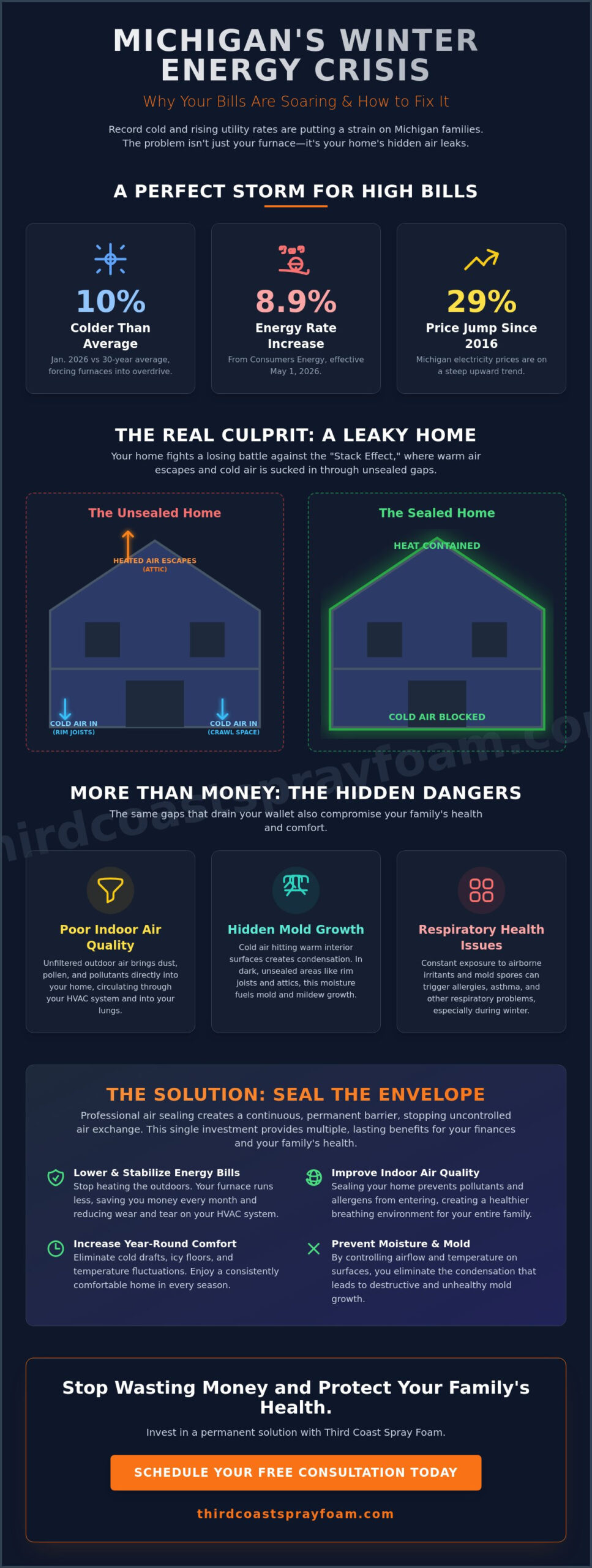
Did you know that January 2026 was 10% colder than the 30-year average? This record chill, combined with the 8.9% rate increase for Consumers Energy effective May 1, 2026, has left many families struggling with high energy bills in winter Michigan. It is a common sight across our communities; homeowners are wearing extra layers indoors while their furnaces run non-stop, yet the floors remain icy and the windows stay drafty.
We understand that watching your monthly utility costs climb while your home feels less comfortable is incredibly stressful. You shouldn’t have to deal with the constant threat of mold growth or poor indoor air quality just because your house can’t hold its heat. It’s frustrating when your hard-earned money vanishes through invisible gaps in your attic and walls.
This guide will explain exactly why your energy costs are spiking and how professional air sealing can save you money while protecting your family’s respiratory health. Our team will walk you through the benefits of a tighter thermal envelope, showing you how to achieve a warmer, more stable environment and better peace of mind for the long term. We will also explore how managing moisture prevents the mildew that often triggers winter allergies.
Key Takeaways
- Understand how regional utility shifts and rising natural gas costs are driving high energy bills in winter Michigan this season.
- Learn why the same gaps that allow heat to escape also invite outdoor pollutants and allergens into your living space, impacting your family’s respiratory health.
- Discover the link between cold surface temperatures and condensation, which can lead to hidden mold growth during the damp Great Lakes winters.
- Identify why traditional insulation often fails to stop the “Stack Effect,” a process that pulls freezing air through your floors while pushing expensive heat out through the attic.
- Find out how sealing your home’s thermal envelope and rim joists creates a permanent barrier that improves indoor air quality and stabilizes your monthly budget.
Why Michigan Winter Energy Bills are Spiking in 2026
Michigan winters are notoriously unforgiving, but the start of 2026 brought a specific set of challenges for local families. January 2026 arrived with temperatures 10% colder than the 30-year average, forcing HVAC systems to work harder than they have in a decade. This sustained cold, often referred to as the “Polar Vortex” effect, is the primary driver behind the high energy bills in winter Michigan that many residents are seeing on their current statements. When your furnace runs constantly to combat sub-zero wind chills, it isn’t just about the weather; it’s often a sign that your home’s structural defenses are failing.
A furnace pushed into overtime does more than just drain your bank account. It can also dry out indoor air to unhealthy levels or, conversely, create damp pockets where poor circulation meets cold walls. These conditions are the perfect breeding ground for mold and can exacerbate respiratory issues for everyone in the household. Understanding the specific economic and structural reasons behind these spikes is the first step toward reclaiming your home’s health and your financial security.
To better understand the current energy landscape and how it affects your monthly costs, watch this helpful video:
The Economic Reality of Michigan Utilities
The Michigan Public Service Commission (MPSC) recently approved a $276.6 million rate increase for Consumers Energy, which took effect on May 1, 2026. This 8.9% hike means the average household using 500 kWh of electricity will see their monthly bill rise by at least $6.46. Since 2016, Michigan electricity prices have jumped approximately 29%, a staggering trend that makes every leak in your home more expensive. Many homeowners in Grand Rapids and Lansing try to offset this by using electric space heaters, but these often create “hidden” costs. Because space heaters are highly inefficient compared to a sealed thermal envelope, they often lead to even higher utility spikes and localized condensation issues that can trigger mold growth.
Defining the Thermal Envelope
The thermal envelope is the physical barrier between your heated living space and the freezing Michigan outdoors. When this envelope is “leaky,” it becomes the leading cause of high energy bills in winter Michigan because your expensive, heated air escapes while cold, unconditioned air is sucked inside. Common failure points include rim joists, unsealed attics, and damp crawl spaces. These gaps don’t just let heat out; they also allow moisture, allergens, and outdoor pollutants to enter your home, compromising your indoor air quality. To identify these specific vulnerabilities, many professionals recommend a home energy audit. By sealing these points of entry, you protect your family’s respiratory health and ensure your furnace doesn’t have to fight a losing battle against the Great Lakes climate.
The Hidden Link Between High Bills, Air Quality, and Respiratory Health
Many homeowners view high energy bills in winter Michigan solely as a financial problem. However, those same drafts that chill your toes are often carrying microscopic threats into your home. When your house has air leaks, it doesn’t just lose heat; it experiences a constant, uncontrolled exchange with the outdoors. This means that for every cubic foot of warm air that escapes through your attic, a cubic foot of cold, unfiltered air is sucked in through your basement or crawl space. This cycle forces your furnace to work harder while simultaneously introducing allergens, dust, and outdoor pollutants directly into your living environment.
Your home should function as a protective shell. When that shell is compromised, your indoor air quality (IAQ) suffers immediately. During the extreme cold of January 2026, which was 10% colder than the 30-year average, many Michigan residents spent more time indoors breathing air that was recycled through damp, unsealed cavities. This lack of control over the air supply is a primary trigger for winter respiratory issues. By addressing the root cause of high energy bills in winter Michigan, you are doing more than saving money. You are actively filtering the air your family breathes and reducing the biological triggers that cause asthma and allergy flare-ups.
Mold and Mildew: The Silent Winter Guests
Temperature differentials are the primary cause of winter moisture. When warm, humid indoor air hits a cold surface like an uninsulated rim joist, condensation forms instantly. This moisture is the lifeblood of mold. Since Michigan winters are notoriously damp, these hidden pockets of condensation can lead to significant mold growth before you ever see a spot on your drywall. Preventing this moisture through proper air sealing is the most effective way to manage long-term respiratory health and avoid the structural damage caused by rot.
Indoor Air Quality and Your Family’s Well-being
The “Stack Effect” is a powerful force in taller or multi-level homes. As heat rises, it creates a vacuum at the bottom of the house, pulling in air from the ground level. This air often carries radon, soil gases, and mold spores from the crawl space. Superior air sealing stops this upward pull, ensuring that the air in your bedroom isn’t coming from your dirt floor basement. Prioritizing a total home health approach ensures your family stays safe and your budget stays intact.
A sealed home environment provides a stable climate that is easier on the lungs. It eliminates the “micro-drafts” that carry dust and pollen, creating a sanctuary for those with sensitive respiratory systems. When you invest in the integrity of your thermal envelope, you are making a permanent investment in your family’s daily comfort and physical wellness.
Beyond the Thermostat: Why Your Michigan Home is Losing Heat
Many homeowners respond to high energy bills in winter Michigan by simply turning down the thermostat and putting on another sweater. While this might save a few dollars, it doesn’t solve the underlying problem of structural heat loss. Your home is a complex system, and if the “thermal envelope” is compromised, your furnace will continue to run in a losing battle against the elements. Most heat loss occurs in three specific areas: the attic, the rim joists, and the crawl space. If these aren’t sealed, you aren’t just losing money; you’re losing control over your home’s air quality and your family’s comfort.
Focusing on drafty windows is often a distraction. While windows can be cold to the touch, they usually account for a small fraction of total energy loss compared to the massive air exchange happening in your attic and basement. When you ignore these structural leaks, you allow the cycle of high energy bills in winter Michigan to repeat every year, regardless of how low you set the temperature. Our team focuses on permanent solutions that address the building as a holistic system, ensuring your home stays warm and your indoor air stays clean.
The Problem with Fiberglass in West Michigan
Traditional fiberglass batt insulation is a common sight in many West Michigan attics, but it’s often the wrong tool for our climate. Fiberglass acts like a filter rather than an air barrier. It allows air to pass through it freely, which means it doesn’t stop the drafts that carry heat away. Even worse, fiberglass is notorious for trapping dust, pet dander, and moisture. When winter condensation occurs, fiberglass becomes damp, causing its R-value to plummet. This moisture creates a perfect environment for mold growth, which can lead to chronic respiratory issues for your family. At Third Coast Spray Foam, we don’t offer fiberglass batts because they don’t provide the air-tight seal required for total home health.
Understanding the Stack Effect
During a Muskegon winter, your home acts much like a chimney through a process called the “Stack Effect.” As your furnace warms the air, that air rises and escapes through unsealed gaps in your attic. This creates a vacuum at the bottom of your house, which pulls in freezing air from your crawl space and rim joists. This cycle doesn’t just chill your floors; it sucks in soil gases, moisture, and mold spores from the ground level. Sealing the attic with a high R-value material (Energy Star recommends R-60 for best performance) and treating the rim joists with spray foam breaks this cycle. This approach keeps the heat in and prevents the upward pull of pollutants, protecting your respiratory health and your budget simultaneously.
Structural Solutions to Lower Bills and Prevent Winter Mold
Stopping the cycle of high energy bills in winter Michigan requires moving beyond temporary fixes like plastic window film or heavy curtains. These are surface-level reactions to a structural problem. To truly stabilize your home’s climate, you must address the gaps in your thermal envelope where heat actually escapes. Our team focuses on sealing the attic and rim joists to create a permanent barrier against the elements. By stopping upward heat loss and blocking the freezing air from the ground level, you reduce the load on your furnace and eliminate the cold spots where moisture likes to collect.
Investing in these structural solutions provides a tangible return on investment that outlasts any seasonal utility hike. While the 8.9% rate increase from Consumers Energy on May 1, 2026, has made energy more expensive, a high-performance envelope ensures you use less of it. This pragmatic approach protects your wallet while simultaneously improving your home’s longevity. Sealing these leaks prevents the condensation that leads to rot, ensuring your property remains a healthy environment for years to come.
Spray Foam: The Gold Standard for Air Sealing
In our demanding Great Lakes climate, spray foam is the most effective tool for achieving a total air seal. Unlike traditional materials, it expands to fill every hairline fracture and structural gap. It is important to understand the difference between open and closed cell spray foam when planning your project. Closed cell foam is particularly effective for Michigan homes because it provides a high R-value and acts as a built-in vapor barrier. This dual functionality is critical for preventing high energy bills in winter Michigan. While DIY kits might seem tempting, professional installation is necessary to ensure the chemical balance is perfect and the coverage is 100% airtight.
Crawl Space Encapsulation as a Health Strategy
Your crawl space is often the most neglected part of your home, yet it has a massive impact on your respiratory health. We utilize a comprehensive approach to crawl space insulation that includes full encapsulation and vapor barrier installation. This process seals out the dampness of the Michigan soil, preventing that “earthy” smell from entering your living areas. By controlling moisture at the source, you stop mold spores from hitching a ride on the air that circulates through your house. This strategy stabilizes basement temperatures and ensures the air your family breathes is clean and dry.
Ready to secure your home’s health and efficiency? You can request a professional insulation assessment from our local experts today.
Investing in Your Home Health with Third Coast Spray Foam
Confronting high energy bills in winter Michigan requires a partner who understands that your house is more than just a shelter; it is a controlled environment that directly affects your family’s health. At Third Coast Spray Foam, we don’t just spray insulation. We take a “Total Home Health” approach. This means we analyze how air moves from your crawl space to your attic, identifying the hidden pathways that allow mold spores and outdoor pollutants to bypass your home’s defenses. By sealing the thermal envelope, we provide a permanent solution that stops the cycle of high utility costs and respiratory irritation.
Navigating the financial side of home upgrades is just as important as the technical application. Our team helps you explore options like the energy efficient home improvement credit to help offset the cost of your investment. While federal incentives like the 25C credit applied to equipment installed through December 31, 2025, and are not available for 2026 installations, new programs like the Michigan Home Energy Rebates (MiHER) offer up to $34,000 for energy-efficient upgrades. With the 8.9% rate hike that hit Consumers Energy customers on May 1, 2026, utilizing these incentives is a pragmatic way to protect your financial well-being.
A Local Partner You Can Trust
We’ve served Kent, Ottawa, Muskegon, and surrounding counties since 2013. This local expertise matters because Michigan’s lake-effect humidity and unique soil conditions require specific insulation strategies that national contractors often overlook. We pride ourselves on a “straight-shooter” service model. We don’t use high-pressure sales tactics. Instead, we offer technical expertise and honest assessments. Our goal is to provide results-oriented insulation that stands the test of time, ensuring your home remains a sanctuary against the 10% colder winters we’ve seen recently.
Get Your Professional Home Energy Assessment
The first step toward a healthier home is a professional consultation. During our visit, we don’t just look at your R-values; we use our expertise to find hidden air leaks and potential health hazards like basement dampness or attic condensation. We’ll show you exactly where your heat is escaping and where mold could be hiding. This comprehensive look at your property ensures that every penny you spend on insulation works toward lowering your high energy bills in winter Michigan and protecting your family’s lungs. Don’t wait for another utility spike to take action. Schedule your free estimate and start saving today to secure your home’s future.
Secure Your Home’s Health and Financial Future
Taking control of your indoor environment is the only way to break the cycle of high energy bills in winter Michigan. Your home’s thermal envelope acts as a vital shield that protects both your budget and your family’s respiratory health. By sealing the gaps in your attic and rim joists, you prevent the moisture and pollutants that trigger mold growth and seasonal allergies. This holistic approach ensures your furnace doesn’t have to work overtime to compensate for structural leaks.
Third Coast Spray Foam brings over a decade of West Michigan expertise to every project. As a local, family-owned business, our team specializes in air quality and mold prevention through high-performance insulation. We don’t believe in temporary fixes. We focus on permanent results that provide peace of mind for years to come. You deserve a home that is warm, dry, and safe for everyone inside.
Stop wasting money on high energy bills; get your free Michigan insulation estimate now!
It’s time to invest in a more comfortable and healthier living space for your loved ones.
Frequently Asked Questions
Why is my energy bill so high in Michigan even if I don’t use much heat?
Your bill remains high because your home is likely losing heat through unsealed gaps in the attic and rim joists; regardless of your thermostat setting. This structural inefficiency forces your furnace to cycle more frequently to maintain a minimum temperature. In January 2026, which was 10% colder than the 30-year average, even minor leaks led to high energy bills in winter Michigan due to constant heat exchange with the freezing outdoors.
Can poor insulation cause respiratory health issues?
Yes, poor insulation is a leading contributor to indoor respiratory issues because it allows moisture to condense on cold surfaces, fueling mold growth. When your thermal envelope is compromised, outdoor pollutants and allergens are pulled into your living space through the Stack Effect. This uncontrolled air exchange can trigger asthma and other chronic lung conditions; making professional air sealing a critical step for total home health.
What is the best type of insulation for a Michigan winter?
Closed cell spray foam is the most effective choice for the Michigan climate because it provides a high R-value and a total air barrier in one application. Unlike fiberglass, which allows air to pass through, spray foam expands to seal every crack and crevice. This prevents the damp lake-effect air from entering your home and stops the condensation that leads to rot and mildew in your walls and attic.
How does crawl space encapsulation lower my energy bills?
Encapsulation lowers your bills by creating a permanent thermal barrier between your home and the frozen ground. By sealing the crawl space with a heavy-duty vapor barrier and spray foam, you stop the upward pull of cold air into your living areas. This stabilization of lower-level temperatures reduces the work your furnace must do, helping to combat the 8.9% rate increase implemented by Consumers Energy on May 1, 2026.
Is spray foam insulation safe for my indoor air quality?
Professional-grade spray foam is safe and actually improves indoor air quality by creating a sealed environment that blocks outdoor pollutants. Once the material has cured, usually within 24 hours, it becomes an inert barrier that prevents the entry of dust, pollen, and soil gases. By eliminating the drafts that carry these irritants, you create a cleaner, more stable atmosphere that supports better respiratory health for your entire family.
Does the government offer tax credits for insulation in Michigan?
While the federal 25C tax credit expired for equipment installed after December 31, 2025, Michigan homeowners can still access significant savings through the Michigan Home Energy Rebates (MiHER) program. This state-run initiative provides up to $34,000 in rebates for energy-efficient upgrades. Eligibility depends on your household income relative to the Area Median Income, making high-performance insulation more accessible for local families looking to reduce high energy bills in winter Michigan.
How long does it take for new insulation to pay for itself in energy savings?
Most homeowners see a return on investment within 3 to 7 years, depending on the current state of their home’s efficiency. With energy rates rising and federal legislation projected to cost Michigan households an additional $160 annually by 2030, the payback period is shrinking. Investing in a tighter envelope is a pragmatic financial move that provides immediate relief from utility spikes while increasing your property value.
Should I remove my old fiberglass insulation before installing spray foam?
Our team recommends removing old fiberglass because it often contains years of accumulated dust, pet dander, and rodent droppings that compromise your air quality. Removing the old material allows us to identify hidden structural issues or mold growth on the subfloor or attic deck. Starting with a clean surface ensures a 100% airtight bond for the spray foam, creating a healthier and more efficient thermal envelope.
Disclaimer
Information provided is for general educational purposes. Individual needs and circumstances vary. Speak to an experienced professional to get the correct information for your situation.