
Last February, a homeowner in East Grand Rapids watched as three foot icicles dangled precariously over their front porch, signaling a much deeper problem than just a frozen gutter. If you’ve spent your winters chipping away at ice or worrying about the brown water spots appearing on your bedroom ceiling, you know that temporary fixes don’t cut it. Effective ice dam prevention Grand Rapids requires more than just a roof rake; it demands a total rethink of your home’s thermal envelope.
We understand the anxiety that comes with every lake-effect snow event, especially when you realize those leaks are likely fueling hidden mold growth in your attic. At Third Coast Spray Foam, we believe your home should be a sanctuary for your family’s respiratory health, not a breeding ground for allergens. You’ll discover how sealing your home with high performance spray foam stops ice dams forever while significantly improving indoor air quality. We’ll walk you through the mechanics of air sealing and how to maximize your 2026 energy tax credits to create a healthier, more efficient living space.
Key Takeaways
- Discover the most effective strategies for ice dam prevention Grand Rapids weather requires to eliminate the moisture traps that trigger toxic mold growth.
- Understand why traditional blown-in insulation often fails and how spray foam creates a permanent air seal to stop the convective heat loss that melts snow.
- Learn about the direct link between attic ice dams and your family’s respiratory health, ensuring your indoor air quality remains protected from hidden dampness.
- Identify hidden thermal bypasses using professional infrared scans to target the “big holes” in your attic that compromise your home’s thermal envelope.
- Shift your perspective to a “total home health” approach that secures your roof’s structural integrity while improving long-term comfort and energy efficiency.
Understanding Ice Dams in West Michigan’s Lake-Effect Zone
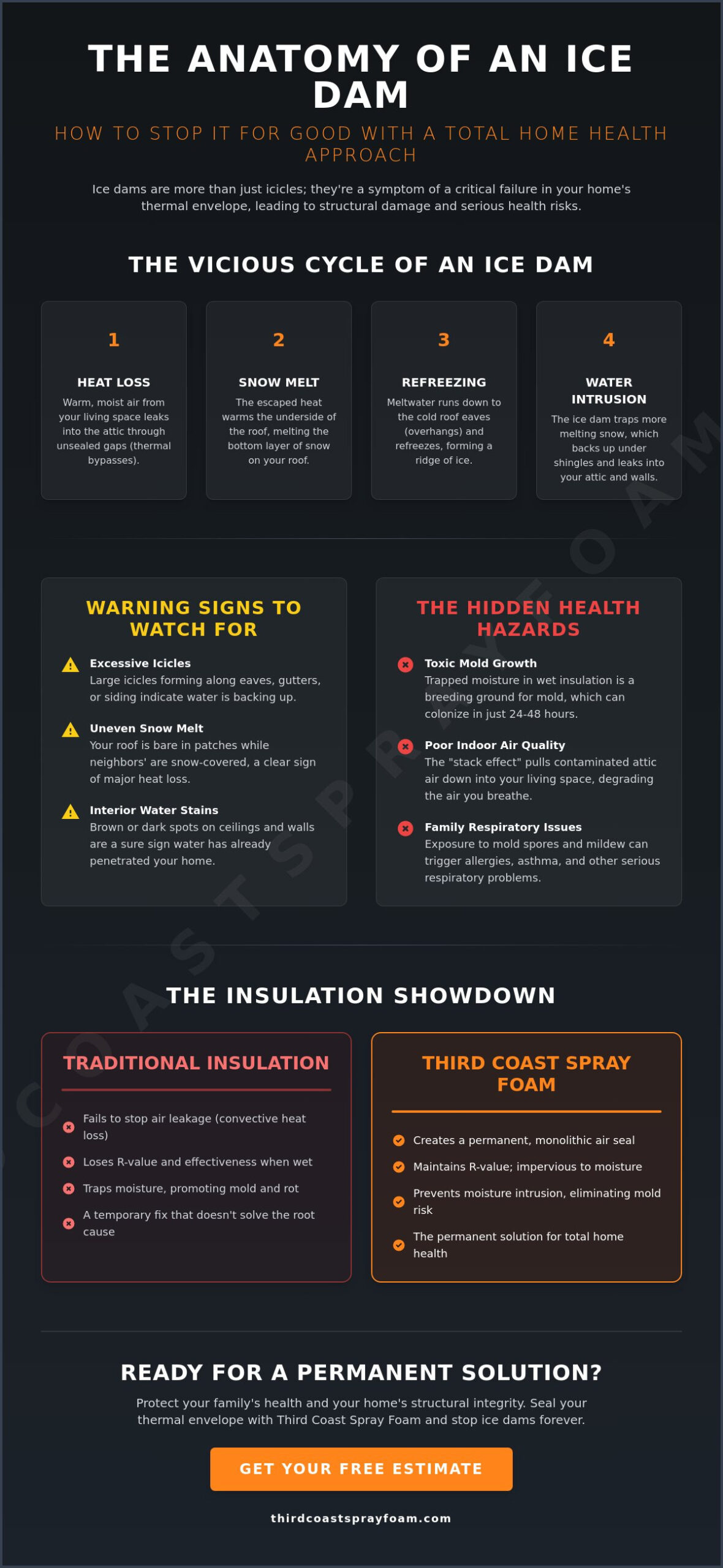
Grand Rapids winters are notoriously relentless. The unique combination of moisture from Lake Michigan and sudden Arctic blasts creates a specific threat to local homes. An ice dam occurs when heat leaks from your living space into the attic, warming the roof deck and melting the bottom layer of snow. This meltwater flows down to the cold eaves and refreezes, creating a solid ridge that traps subsequent runoff. To understand the mechanics of what an ice dam is, you have to look at the temperature differential between your shingles and the outside air.
In our local “Beer City” winter cycle, it’s common to see 15 or 20 inches of lake-effect snow followed by a bitter cold snap. This cycle is the perfect recipe for disaster. Standard roofing repairs, such as installing more vents or replacing shingles, often fail because they don’t address the underlying insulation deficiency. Without effective ice dam prevention Grand Rapids homeowners face recurring structural damage and hidden health risks from trapped moisture. Our team views the home as a holistic system, where a warm attic isn’t just a roofing problem, it’s a failure of the thermal envelope.
To better understand this concept, watch this helpful video:
The Physics of a Warm Attic
Many homeowners believe that adding more fiberglass batts will solve the problem. It won’t. Traditional insulation doesn’t stop air movement. Thermal bypasses around recessed lights, plumbing stacks, and chimney chases allow warm, humid air to escape into the attic. This creates a “warm attic” environment that melts snow and fosters mold growth. When moisture accumulates in these spaces, it compromises indoor air quality and can trigger respiratory health issues for your family. R-value measures heat resistance, but it doesn’t account for air leakage. Sealing the envelope is the only way to ensure total home health and permanent ice dam prevention Grand Rapids residents can rely on.
Identifying Ice Dam Warning Signs
Recognizing early indicators can save you thousands in repairs and protect your respiratory health. Look for these red flags:
- Excessive icicle growth: Icicles forming behind the fascia board or along the siding indicate water is backing up under the shingles.
- Uneven snow melt: If your roof is bare while your neighbor’s roof is still covered in snow, your attic is losing significant heat.
- Interior water stains: Dark spots on ceilings or walls during a thaw mean water has already bypassed your shingles. This moisture often leads to hidden mildew inside wall cavities, which degrades air quality.
The Hidden Health Hazards: How Ice Dams Trigger Mold and Respiratory Issues
Ice dams are more than just heavy icicles hanging from your gutters. They represent a significant breach in your home’s protective shell. When water backs up under shingles and leaks into your attic, it creates a moisture trap that traditional fiberglass or cellulose insulation cannot handle. Wet insulation loses its R-value immediately, but the biological consequences are far more concerning for Grand Rapids families. In the 2026 winter season, we continue to see how these structural failures translate directly into health challenges for local homeowners.
Indoor air quality suffers the moment moisture meets organic material in a dark, poorly ventilated attic. Mold spores can begin to colonize within 24 to 48 hours of a leak. Because of the “stack effect,” this contaminated air doesn’t stay trapped above your ceiling. Your home acts like a chimney; warm air rises and escapes through the roof, creating a vacuum that pulls attic air down through recessed lights, electrical outlets, and plumbing stacks. This means the air your family breathes is directly influenced by the health of your attic environment.
Mold Growth and Attic Contamination
A persistent musty smell in your upper hallway is often the first sign that ice dams have caused hidden damage. Simply knocking down the ice or repairing a few shingles won’t solve the problem if biological growth has already started. Traditional insulation acts like a sponge, holding water against wooden rafters and ceiling drywall. In these cases, professional insulation removal is the only way to ensure you’ve eliminated the source of the mold before installing a permanent solution.
Protecting Your Family’s Respiratory Health
For the millions of Americans living with asthma, a damp attic is a constant trigger. Children and seniors are especially vulnerable to the airborne particulates pulled from a compromised attic space. Effective ice dam prevention Grand Rapids requires more than just stopping the leak; it requires sealing the home’s envelope to stop this dangerous air exchange. Spray foam insulation provides a dual benefit by creating a permanent air barrier that keeps pollutants out while maintaining thermal consistency.
- Allergy Reduction: Sealing gaps prevents pollen and mold spores from entering living zones.
- Humidity Control: Proper air sealing reduces the moisture levels that allow dust mites to thrive.
- Structural Integrity: Keeping the attic dry prevents the wood rot that can lead to further air quality issues.
Total home health is the intersection of thermal comfort and air purity. If you’re concerned about how your roof’s performance is affecting your family, you should consult with a local specialist to evaluate your attic’s seal. Investing in ice dam prevention Grand Rapids ensures that your home remains a sanctuary rather than a source of respiratory stress.
Why Spray Foam Outperforms Blown-In Insulation for Ice Dam Prevention
Grand Rapids homeowners often discover that simply piling more cellulose into an attic doesn’t stop the cycle of melting and freezing. While traditional materials provide thermal resistance, they lack the air-sealing capabilities essential for effective ice dam prevention Grand Rapids. Our team at Third Coast Spray Foam sees this struggle every winter. Standard materials like fiberglass or cellulose are porous; they allow warm, moist air from your living space to bypass the insulation through light fixtures, plumbing stacks, and top plates. This rising heat warms the roof deck, leading directly to the ice dams that damage your gutters and shingles.
The Failure of Blown-In Insulation
Many West Michigan homes rely on blown in insulation, but this material is highly susceptible to wind washing. When cold air enters through soffit vents, it pushes through the loose fibers. This process can reduce the effective R-value of the material by as much as 30 percent. Because these materials are “fluffy,” they don’t stop air movement. They only slow down the transfer of heat through conduction.
This air movement creates a significant health risk. As warm air escapes into the attic, it carries moisture that condenses on the cold underside of the roof. This damp environment is a breeding ground for mold and mildew. For residents with asthma or chronic allergies, these hidden mold colonies can severely degrade indoor air quality and trigger respiratory issues. Adding more cellulose often hides these moisture problems without fixing the convective heat loss that fuels ice dams. As we look toward the 2026 winter season, homeowners need a solution that addresses both thermal performance and air quality.
The Closed-Cell Spray Foam Solution
For a permanent fix, closed cell spray foam stands as the gold standard for ice dam prevention Grand Rapids. It acts as both a high-performance insulator and an airtight seal. This dual-action approach provides several key benefits for your home health and structural safety:
- Complete Air Seal: It stops the convective heat transfer that traditional materials ignore, keeping the roof deck at a consistent outdoor temperature.
- Vapor Management: It creates a built-in vapor barrier. This prevents humid indoor air from reaching the roof deck, protecting your family from mold-related respiratory risks.
- Structural Reinforcement: The foam bonds to the roof assembly. It can increase roof wind uplift resistance by up to 300 percent, which is a critical advantage during heavy Michigan snow loads.
Beyond its impressive R-value of approximately 6.5 to 7 per inch, closed-cell foam eliminates thermal bridging. In a standard attic, heat escapes through the wooden rafters, which have a much lower R-value than the surrounding insulation. We apply spray foam directly over these rafters to create a continuous thermal break. This ensures no “hot spots” exist on your roof, providing the security and peace of mind that your home is protected from the top down.
A Homeowner’s Checklist for Preventing Ice Dams in Grand Rapids
Effective ice dam prevention Grand Rapids homeowners can rely on requires a systematic approach. You can’t just throw more fiberglass at the problem and expect a different result. Instead, you need to treat your home as a single, interconnected system. Following a structured checklist ensures you address the root causes of heat loss while protecting your family’s respiratory health from mold and poor air quality.
- Step 1: Conduct a professional infrared scan. Our team uses thermal imaging to locate hidden heat bypasses. These scans detect temperature variances as small as 0.1 degree, revealing exactly where warm air escapes into your attic.
- Step 2: Seal the “big holes” first. We prioritize sealing attic hatches, plumbing stacks, and light fixtures. These gaps act like chimneys, sucking conditioned air out of your living spaces.
- Step 3: Evaluate your attic’s thermal strategy. You must decide between traditional venting with baffles or a modern “hot roof” conversion using spray foam.
- Step 4: Address the stack effect. Ensure your crawl space insulation isn’t pulling cold air in and pushing warm air out through the roof.
The Role of Rim Joists and Box Sills
Ice dam prevention starts in the basement or crawl space. The “stack effect” creates a pressure vacuum; cold air enters through unsealed rim joists and pushes warm air upward into the attic. By sealing box sills with closed-cell spray foam, we neutralize this pressure. This step is vital for moisture control. It prevents damp, below-grade air from migrating upward, which significantly reduces the risk of mold spores entering your breathing zones. Sealing the envelope at the bottom makes your attic insulation work twice as hard.
Ventilation vs. Conditioned Attics
Grand Rapids building codes have evolved to recognize the efficacy of unvented attic systems. In a traditional setup, you use baffles to maintain airflow over blown-in insulation. This is often a losing battle during a heavy West Michigan winter. A “Hot Roof” conversion involves applying spray foam directly to the underside of your roof deck. This turns your attic into a conditioned space. It eliminates the temperature spikes that melt snow and prevents the condensation that leads to mildew. This approach provides a permanent barrier against the environmental triggers that cause respiratory issues. You get a bone-dry attic and a home that stays comfortable regardless of the lake-effect snow totals.
Don’t wait for the next big freeze to discover your home’s weak spots. Contact Third Coast Spray Foam today to schedule a comprehensive attic inspection and protect your home’s health.
Sealing the Envelope with Third Coast Spray Foam
At Third Coast Spray Foam, we don’t just spray insulation; we engineer a barrier for your family’s long-term safety. Our team treats your home as a holistic system where every component affects your well-being. In West Michigan, where lake-effect snow and rapid temperature swings are the norm, a standard attic setup often fails. By focusing on ice dam prevention Grand Rapids homeowners can rely on, we address the root cause of winter property damage: uncontrolled heat loss. When heat escapes into the attic, it melts snow, creates ice dams, and eventually leads to water intrusion. This moisture is a primary trigger for mold growth and compromised indoor air quality. By sealing the thermal envelope, we prevent the damp conditions that often aggravate respiratory health issues such as asthma and chronic allergies.
2026 Tax Credits and Rebates
The financial landscape for home upgrades is currently very favorable for Michigan residents. In 2026, you can significantly offset your project costs by maximizing your energy efficient home improvement credit. Under federal guidelines, homeowners can claim 30% of the cost of air sealing materials and labor, with an annual limit of $1,200. Residents in Grand Rapids, Lansing, and Kalamazoo can also access local utility rebates through providers like Consumers Energy or DTE. These combined incentives often reduce the payback period of a permanent ice dam prevention Grand Rapids solution to under five years. The long-term ROI is even more substantial. It includes extending your roof’s lifespan by a decade or more and achieving the medical peace of mind that comes from a mold-free environment.
Your Next Steps to a Safer Home
A safer home starts with a precise, professional assessment. During a Third Coast consultation, our specialists conduct a thorough site evaluation to measure your current R-value and identify hidden thermal bridges. Professional installation is essential for health and safety compliance, ensuring the spray foam cures properly to maintain superior indoor air quality. We take immense pride in our “no-nonsense” approach to quality because we understand the unique climate challenges of our region. We’re your local partners in building a more durable, efficient, and healthy home. Schedule your Grand Rapids ice dam prevention assessment today to protect your property and your family’s well-being.
Secure Your Home’s Health Before the Next Lake-Effect Storm
West Michigan winters are relentless, but your home’s defense shouldn’t be a temporary fix. Effective ice dam prevention Grand Rapids homeowners can rely on starts with sealing the thermal envelope. Traditional blown-in insulation often fails to stop the air leaks that melt snow and drive moisture into your attic. When water backs up under shingles, it creates a breeding ground for mold and mildew. These environmental triggers are known to worsen respiratory health and compromise indoor air quality for your entire family.
Our team at Third Coast Spray Foam specializes in high-performance, air-sealing solutions designed for our unique climate. By choosing spray foam, you aren’t just stopping leaks; you’re investing in a permanent barrier against the damp conditions that threaten your home’s structural integrity. We’ll even help you navigate the documentation for the 2026 Energy Tax Credit to maximize your savings. It’s time to stop reacting to winter damage. Start protecting your living space with a health-first approach today.
Protect your home and health: Get a free ice dam prevention estimate from Third Coast Spray Foam
We look forward to helping you create a safer, drier, and more comfortable home for years to come.
Frequently Asked Questions
Is ice dam prevention covered by homeowners insurance in Michigan?
Most Michigan homeowners insurance policies don’t cover the cost of ice dam prevention measures. While the Michigan Department of Insurance and Financial Services (DIFS) confirms that standard policies typically pay for repairs after a leak occurs, they classify insulation and air sealing as routine home maintenance. Investing in spray foam prevents the 15% to 20% deductible costs associated with major water damage claims and mold remediation.
Can I just install heat cables to stop ice dams?
Heat cables don’t solve the underlying thermal bypass issues that cause ice dams. These cables use 5 to 8 watts of electricity per foot, which increases utility bills without addressing the heat loss from your attic. More importantly, they allow moisture to remain trapped against the roof, which can lead to mold growth. Our team focuses on sealing the thermal envelope to stop the problem at its source and protect your respiratory health.
Will spray foam insulation rot my roof deck?
Properly installed closed-cell spray foam won’t rot your roof deck. It acts as a vapor barrier that prevents warm, moist indoor air from reaching the cold wood. By eliminating the dew point within the attic assembly, we stop the condensation cycle that leads to wood rot. Research from the Building Science Corporation shows that air-sealed attics maintain drier roof decks than traditionally vented spaces in cold climates like Michigan.
How much does spray foam cost compared to blown-in for ice dam prevention?
Spray foam typically requires a higher initial investment than blown-in cellulose or fiberglass. According to 2024 industry data from HomeAdvisor, spray foam can cost 2 to 3 times more than traditional materials. However, blown-in insulation doesn’t provide the air sealing necessary for effective ice dam prevention Grand Rapids homes require. The long term savings on energy and mold remediation often offset the initial price within 5 to 7 years.
Does ice dam prevention also help with summer cooling in Grand Rapids?
Yes, ice dam prevention significantly improves summer comfort and indoor air quality. By sealing the thermal envelope, we prevent hot attic air and outdoor pollutants from infiltrating your living space. This reduces the load on your air conditioner by up to 15% during Michigan’s humid July and August months. You’ll notice more consistent temperatures and fewer respiratory irritants like pollen or dust circulating through your home.
What is the best R-value for an attic in West Michigan to prevent ice dams?
The 2015 Michigan Energy Code requires a minimum of R-49 for attic spaces, though we often recommend R-60 for maximum protection in Grand Rapids. While R-value measures thermal resistance, it’s the air sealing properties of spray foam that truly stop ice dams. Even an R-60 layer of blown-in insulation can fail if warm air leaks through bypasses like recessed lights or plumbing stacks.
Can ice dams cause mold growth even if I don’t see a leak inside?
Ice dams frequently cause hidden mold growth in attic spaces before any water stains appear on your ceiling. When water backs up under shingles, it saturates the roof deck and insulation, creating a breeding ground for mold spores. This trapped moisture can degrade indoor air quality and trigger respiratory issues for sensitive occupants. We prioritize a health-first approach by eliminating the moisture traps that allow these fungi to thrive.
How long does it take to install spray foam for ice dam prevention?
Most residential spray foam installations for ice dam prevention Grand Rapids projects take 1 to 2 business days to complete. Our team begins by removing old, contaminated insulation to ensure a clean surface for the foam to adhere to. Once the prep work is finished, the actual application usually wraps up in a single afternoon. This quick turnaround provides an immediate boost to your home’s thermal performance and structural security.
Disclaimer
Information provided is for general educational purposes. Individual needs and circumstances vary. Speak to an experienced professional to get the correct information for your situation.