
What if the insulation that costs less on installation day actually becomes your home’s most expensive liability within five years? If you’ve watched your Consumers Energy or DTE bills spike during a West Michigan January while your upstairs remains drafty, you’re not alone. Most Grand Rapids homeowners expect their insulation to work silently in the background; yet traditional materials often fail to stop the air infiltration that drives up costs. When evaluating the spray foam vs fiberglass cost Grand Rapids families must consider more than just the initial quote. You need a solution that protects your bank account and your family’s physical well-being.
We agree that your home should be a sanctuary, not a source of stress or respiratory irritation. In this 2026 ROI guide, we’ll provide a comprehensive breakdown of upfront investments versus long-term utility savings. According to the EPA, indoor air can be two to five times more polluted than outdoor air, often due to moisture and allergens trapped by failing insulation. We’ll show you how sealing the thermal envelope prevents attic mold and improves indoor air quality. You’ll learn which material offers a permanent fix for damp basements and why a holistic approach to home health is the smartest investment you can make this year.
Key Takeaways
- Learn why the West Michigan “Lake Effect” climate requires a complete air and thermal barrier to ensure consistent comfort and maximum energy efficiency.
- Understand how your choice of insulation impacts indoor air quality and respiratory health by preventing the infiltration of dust, pollen, and outdoor pollutants.
- Compare the upfront spray foam vs fiberglass cost Grand Rapids homeowners encounter and see how long-term ROI is driven by significantly reduced utility bills.
- Pinpoint the “hot spots” where traditional insulation fails, creating moisture traps that lead to mold growth and compromise your home’s structural health.
- Gain a professional perspective on why “sealing the envelope” is a permanent investment in your family’s safety, comfort, and long-term financial well-being.
Understanding the Insulation Gap in West Michigan Homes
Grand Rapids homeowners often face a difficult choice between two very different materials when upgrading their property. Fiberglass acts as a thermal filter, while Spray foam insulation creates a combined air and thermal barrier. In West Michigan, our “Lake Effect” climate brings high humidity and bitter winds that easily bypass traditional materials. Many residents assume that adding more “pink stuff” to an attic solves the problem. However, thickness doesn’t stop air movement. If air can pass through your insulation, your furnace will work overtime regardless of how many layers you install.
To better understand this concept, watch this helpful video:
The thermal envelope is the protective shell of your home. When air leaks through gaps in that shell, your R-value effectively drops. Research from the Department of Energy suggests that air leakage accounts for up to 40% of a home’s energy loss. This leakage also carries allergens, dust, and moisture into your living spaces. This directly impacts your indoor air quality and respiratory health. Our team at Third Coast focuses on sealing this envelope to ensure your home remains a healthy, stable environment.
The Problem with Fiberglass in Cold Climates
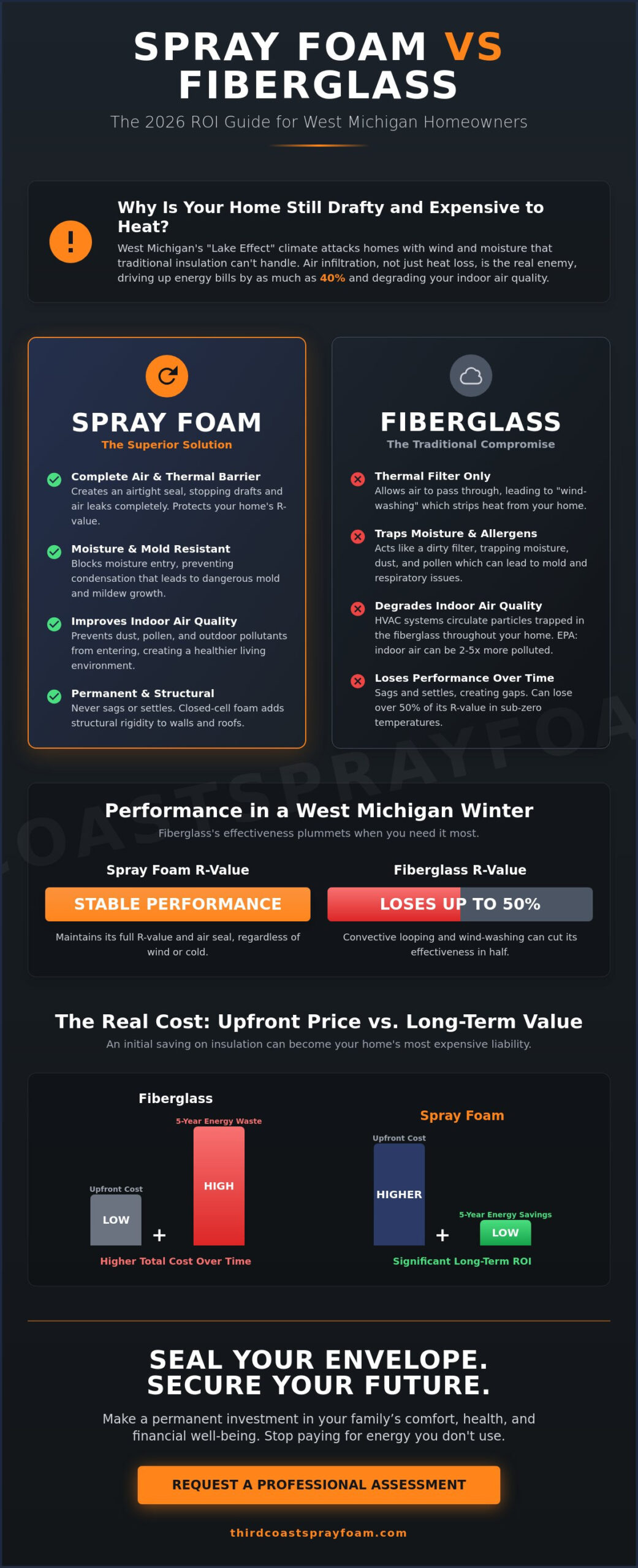
Fiberglass suffers from a phenomenon called wind-washing. This happens when cold Michigan wind penetrates the porous batts and strips away heat. In Grand Rapids attics, a convective loop occurs as warm air rises through the fiberglass and hits the cold roof deck. This process creates a cycle of heat loss that fiberglass cannot stop because it lacks an air seal. Industry data shows that fiberglass can lose over 50% of its effective R-value when temperatures drop below 0°F. This makes it a poor choice for the harsh winters we expect in 2026 and beyond.
The Spray Foam Advantage: Beyond R-Value
Spray foam provides total home health by sealing every crack and crevice. We utilize closed-cell foam for structural strength and moisture resistance, while open-cell foam excels in soundproofing and attic applications. When evaluating the spray foam vs fiberglass cost Grand Rapids families must consider, the real value lies in preventing mold and mildew. By stopping condensation within wall cavities, we protect your family from the respiratory triggers found in damp environments. Insulation should be a permanent structural upgrade that keeps your air clean and your energy bills low. This approach treats your home as a holistic system rather than just a collection of walls.
Air Quality and Respiratory Health: Why the Material Choice Matters
When evaluating the spray foam vs fiberglass cost Grand Rapids families encounter, it’s easy to focus solely on the immediate invoice. However, your home’s thermal envelope directly dictates the quality of the air you breathe every day. Traditional fiberglass batts don’t stop air movement; they act as a passive filter. Over time, these fibers trap dust, pollen, and outdoor pollutants. As your HVAC system runs, it pulls air through these dirty filters and circulates those particles into your living spaces. This process can trigger persistent respiratory issues for occupants.
A sealed home is a controlled environment. By creating an airtight barrier, you stop the uncontrolled transport of allergens from the outside world. The Department of Energy on insulation materials highlights how different products impact air leakage and thermal performance. For those living with asthma or seasonal allergies in West Michigan, the choice of insulation is a health decision. Eliminating drafts means you’re no longer breathing in the particulate matter that hitches a ride on incoming air currents.
Mold, Mildew, and Moisture Management
Michigan’s climate creates a specific challenge: condensation. When warm, humid indoor air meets a cold surface like a rim joist or an attic roof deck, moisture forms instantly. This dampness is a catalyst for mold growth. Mold spores release mycotoxins that can lead to chronic coughing, wheezing, and long term respiratory damage. Closed-cell spray foam serves as a built-in vapor barrier. It prevents air from reaching those cold surfaces, which stops condensation before it starts. This proactive moisture management is essential for maintaining a dry, mold free environment in your basement and attic.
Pest Control and Environmental Safety
Fiberglass is a soft, pliable material that rodents frequently use as a nesting ground. Mice and squirrels leave behind droppings and dander, creating significant biohazards within your walls. These contaminants eventually break down and enter your home’s airflow. Spray foam is dense and offers no food value or nesting appeal to pests. It creates a physical block that discourages entry, further protecting your indoor air quality from biological threats.
At Third Coast Spray Foam, we take environmental safety seriously. Our team follows strict professional protocols to ensure proper application and ventilation. This precision ensures that off-gassing occurs safely and quickly, leaving you with a clean, inert barrier. If you want to protect your family’s health while improving efficiency, consult with our local experts to see how we can seal your home’s envelope for good.
Spray Foam vs. Fiberglass Cost Breakdown in Grand Rapids
Comparing the spray foam vs fiberglass cost Grand Rapids homeowners face requires looking past the initial quote. On average, the upfront price for spray foam is two to three times higher than fiberglass batts or blown-in cellulose. This price reflects the complexity of the installation and the superior performance of the material. Your final estimate depends on the total square footage, the desired thickness in inches, and the accessibility of areas like tight crawlspaces or steeply pitched attics. While fiberglass is cheaper at the register, it often carries hidden costs. You must factor in the price of separate vapor barriers, specialized air sealing tapes, and the extra labor required to cut batts around electrical boxes and plumbing. Without these additions, fiberglass fails to stop air infiltration.
Beyond the financial tally, your choice impacts the health of your indoor environment. Fiberglass can act as a filter for dust and allergens, and if moisture enters the wall cavity, it often leads to mold growth within the insulation. This can compromise respiratory health for sensitive family members. Spray foam provides an airtight seal that prevents humid Michigan air from condensing inside your walls. By eliminating the conditions that allow mold and mildew to thrive, you are investing in better indoor air quality and long-term peace of mind. To help manage the initial investment, many residents utilize the 2026 energy efficient home improvement credit, which can significantly offset the cost of upgrading to high-performance insulation.
Calculating the 10-Year ROI
The return on investment for spray foam becomes clear when you examine monthly utility bills. Homes in West Michigan that switch to spray foam typically see energy savings between 15% and 40%. Because the material seals the building envelope, your furnace and air conditioner don’t have to work as hard to maintain a steady temperature. This reduced load can extend the lifespan of your HVAC system by several years, delaying a replacement that could cost $8,000 or more. Additionally, the West Michigan real estate market increasingly rewards “high-performance” homes. A house with a proven record of low energy costs and superior moisture control often commands a higher resale price than one with standard insulation.
West Michigan Rebates and Incentives
Local utility providers like Consumers Energy and DTE offer various rebates for insulation upgrades that improve a home’s efficiency. To understand the different insulation types explained by the Department of Energy, it’s helpful to look at R-value per inch. Spray foam provides a higher R-value in less space than fiberglass, making it easier to meet Michigan building codes in thin wall cavities. Hiring a professional contractor like Third Coast ensures your project meets the technical requirements for these rebates and federal tax credits. We provide the documentation necessary to prove your home has achieved the required performance standards, ensuring you get every dollar back that you’re entitled to.
Best Use Cases for Grand Rapids Properties
Choosing between materials isn’t just about the initial price tag. It’s about where the material is going. In West Michigan, some areas of the home demand a high-performance seal to protect your respiratory health and property value. When evaluating the spray foam vs fiberglass cost Grand Rapids homeowners must consider the long-term impact of moisture and air infiltration on their specific structure.
Attics and Rim Joists: The Critical Zones
Rim joists are often the biggest culprit for cold feet and high energy bills. These areas sit directly on the foundation where outside air leaks in through small gaps. Fiberglass batts in this zone act like a dirty air filter. They don’t stop the air; they just catch dust and moisture. This creates a breeding ground for mold that can eventually migrate into your living spaces. Using closed cell spray foam at the rim joist creates an airtight barrier that stops drafts and prevents foundation-level fungal growth.
For attics, Grand Rapids winters bring heavy snow loads that lead to unique challenges. Traditional venting can lead to ice dams if heat escapes through the ceiling and warms the roof deck. Encapsulating the attic at the roofline keeps the entire space conditioned. This setup prevents the freeze-thaw cycle that damages shingles and gutters while keeping your furnace from working overtime. It turns a dusty, vented attic into a clean, dry part of your home’s thermal envelope.
Pole Barns and Crawl Spaces
Agricultural and storage buildings face different environmental pressures. Metal buildings often “sweat” when Michigan temperatures fluctuate during the spring and fall. This condensation ruins equipment, rusts vehicles, and compromises structural integrity. High-performance pole barn insulation stops this moisture cycle instantly by preventing warm air from hitting cold metal surfaces.
Crawl spaces in our region frequently deal with high water tables. Damp crawl spaces are the primary source of poor indoor air quality because the “stack effect” pulls allergens and mold spores upward into your bedrooms and kitchen. Professional crawl space encapsulation isolates your home from the earth. This protects your family’s respiratory health and keeps the floorboards warm during January cold snaps.
If you’re on a strict budget for a standard attic floor, blown-in cellulose is a superior alternative to fiberglass batts. It fills gaps more effectively and offers better thermal resistance for the price. However, for total air sealing and moisture control, spray foam remains the gold standard for Grand Rapids properties. When comparing the spray foam vs fiberglass cost Grand Rapids residents should look at the total home health benefits rather than just the R-value per inch.
Investing in Long-Term Home Health with Third Coast Spray Foam
Calculating the spray foam vs fiberglass cost Grand Rapids homeowners face requires looking beyond the initial invoice. True value lies in your family’s respiratory health and the long-term integrity of your structure. While fiberglass remains a common choice, it often fails to provide a complete air barrier. This allows outdoor pollutants, dust, and humidity to bypass your walls. Our team views your home as a holistic system where every gap affects your comfort and your wallet.
We focus on “sealing the envelope” to create a permanent barrier against the elements. Research from the Department of Energy suggests that air leakage accounts for up to 40% of a home’s heating and cooling costs. By choosing a high-performance seal, you eliminate the drafts that force your HVAC system to work overtime. This isn’t just about utility bills. It’s about preventing the moisture buildup that leads to mold and mildew, which are major triggers for asthma and other respiratory issues.
The Third Coast process is built on precision. We handle everything from initial site preparation to the final clean-up. We mask off your living spaces and use advanced ventilation to ensure your home remains safe during and after the application. This professional approach ensures the foam cures correctly, providing a lifetime of stability without the sagging or settling common in traditional materials.
Why Local Expertise Matters
Michigan building codes are specific, and our climate is demanding. We experience temperature swings of over 100 degrees throughout the year. Third Coast understands these local requirements across Grand Rapids, Lansing, and the Lakeshore. We don’t use the low-pressure DIY kits found in big-box stores. Those kits often lack the consistent chemical mix needed for a proper thermal barrier.
- Professional Equipment: We use high-pressure systems that guarantee a 1:1 chemical ratio for maximum R-value.
- Code Compliance: Our installations meet or exceed the latest Michigan energy standards for 2026 and beyond.
- Community Roots: We’ve built a reputation for no-nonsense quality and honest assessments.
Ready to Lower Your Bills and Improve Your Air Quality?
If your current insulation is old, it might be doing more harm than good. Fiberglass and cellulose often trap rodent waste, allergens, and moisture over time. Third Coast handles the professional removal of this contaminated material, clearing the way for a fresh, healthy environment. We invite you to schedule a professional site assessment to see exactly where your home is losing energy.
Don’t settle for a temporary fix that leaves your air quality to chance. Invest in a solution that protects your home’s structure and your family’s health. Get your free insulation estimate from Third Coast Spray Foam today.
Invest in a Healthier, More Efficient West Michigan Home
Deciding on the right insulation is a choice that affects your family’s comfort for decades. While the initial spray foam vs fiberglass cost Grand Rapids residents see on a quote varies, the real value lies in the long-term protection of your property. Data from the Department of Energy indicates that air infiltration can account for 40 percent of a building’s energy loss. By creating an airtight thermal envelope, you don’t just lower those utility bills; you actively block the moisture and allergens that compromise indoor air quality.
Our team at Third Coast Spray Foam focuses on more than just R-values. We prioritize total home health by preventing the mold and mildew growth that often triggers respiratory issues in poorly ventilated spaces. As a local, family-owned operator with over 10 years of West Michigan expertise, we understand how our specific climate impacts your attic and crawl space. We’re committed to providing high-performance solutions that keep your home dry and your air clean. Take the first step toward a permanent investment in your home’s durability and your family’s well-being.
Get Your Free Grand Rapids Insulation Estimate
We look forward to helping you create a safer, more comfortable living space for years to come.
Frequently Asked Questions
Is spray foam insulation worth the extra cost in Grand Rapids?
Yes, spray foam is worth the investment because it provides a total air seal that fiberglass cannot match. In our West Michigan climate, this barrier prevents the 40% energy loss typical in homes with vented attics. It also blocks outdoor allergens from entering your living space, which protects your family’s respiratory health during the spring and fall seasons. You’re paying for permanent comfort and lower bills.
How much does spray foam insulation cost per square foot in Michigan?
The cost of spray foam in Michigan depends on whether you choose open-cell or closed-cell materials to meet state energy codes. When evaluating the spray foam vs fiberglass cost Grand Rapids residents pay, it’s important to look at the lifetime value rather than just the initial quote. Our team provides detailed assessments to ensure your investment covers the entire thermal envelope for maximum efficiency.
Can spray foam insulation improve my family’s respiratory health?
Spray foam insulation significantly improves respiratory health by creating a physical barrier against dust, pollen, and outdoor pollutants. Unlike fiberglass, which can trap airborne particulates and allow them to circulate through your HVAC system, foam seals every gap. This reduction in environmental triggers is essential for family members living with asthma. It ensures your indoor air quality remains clean and safe year-round.
Does spray foam prevent mold better than fiberglass?
Spray foam prevents mold growth much more effectively than fiberglass because it eliminates the air gaps where condensation forms. Fiberglass batts often trap moisture against cold wood surfaces, which leads to hidden mildew and structural rot. Since spray foam is non-porous and lacks organic food sources, it creates an inhospitable environment for mold. This protection is vital for maintaining a healthy, moisture-free home.
Will spray foam insulation lower my Consumers Energy or DTE bills?
You will see a reduction in your Consumers Energy or DTE bills because spray foam stops the stack effect that pulls cold air into your home. Most homeowners report saving 15% or more on their monthly heating and cooling costs after a professional installation. By sealing the building envelope, your HVAC system doesn’t have to work as hard to maintain your desired temperature.
How long does it take for spray foam insulation to pay for itself?
Spray foam insulation typically pays for itself within 3 to 5 years through cumulative energy savings and available federal tax credits. Since the material doesn’t sag or lose its R-value over time, the financial benefits continue for the life of the home. You’re also protecting your HVAC equipment from premature failure, which saves thousands in replacement costs. It’s a pragmatic choice for long-term financial security.
Is it safe to stay in the house during spray foam installation?
It’s not safe to remain in the house during the application, so we require residents to vacate for 24 hours. This window allows the foam to fully cure and ensures that any odors are completely ventilated from the space. Our team uses high-capacity fans to refresh the air during this period. You can return to a home that’s quieter, cleaner, and ready for your family.
Can I install spray foam over existing fiberglass insulation?
You shouldn’t install spray foam over existing fiberglass because the old material prevents the foam from forming a proper airtight seal. Existing insulation often contains decades of dust, rodent waste, and moisture, which can compromise your indoor air quality if left in place. Our team removes the old debris first to ensure the spray foam bonds directly to the surface. This process guarantees a healthy and efficient thermal barrier.
Disclaimer
Information provided is for general educational purposes. Individual needs and circumstances vary. Speak to an experienced professional to get the correct information for your situation.