
Last February, a Grand Rapids homeowner stepped into his workshop only to find his $15,000 tool collection dripping with condensation from a metal ceiling that was effectively “raining” indoors. You shouldn’t have to fight a losing battle against West Michigan’s 80% humidity levels or worry that a musty smell in your barn is the start of a respiratory health crisis. At Third Coast Spray Foam, we know that a damp environment isn’t just uncomfortable; it’s a breeding ground for mold and mildew that compromises your indoor air quality.
This guide shows you how the right pole barn insulation strategy eliminates moisture, slashes your heating bills, and protects your family’s lung health. We’ll explore the science of high-performance air sealing and why a “total home health” approach is the only way to create a truly climate-controlled workspace in 2026. By sealing the envelope of your building, our team ensures your barn remains a dry, safe, and efficient asset for years to come. We’ll break down the specific steps to transform your structure into a professional-grade environment that prioritizes both your comfort and your physical well-being.
Key Takeaways
- Understand the science behind metal building “sweating” and the specific strategies needed to keep your West Michigan structure dry year-round.
- Compare insulation methods to see why closed-cell spray foam is the gold standard for pole barn insulation regarding R-value and moisture resistance.
- Protect your respiratory health by learning how an airtight seal prevents mold growth and blocks the infiltration of outdoor allergens.
- Follow a professional roadmap for site preparation and learn the essential questions to ask when hiring a Grand Rapids insulation contractor.
- Discover the “Total Home Health” approach to ensure your barn remains a safe, energy-efficient, and durable investment for the long term.
Understanding the Pole Barn “Sweating” Crisis in West Michigan
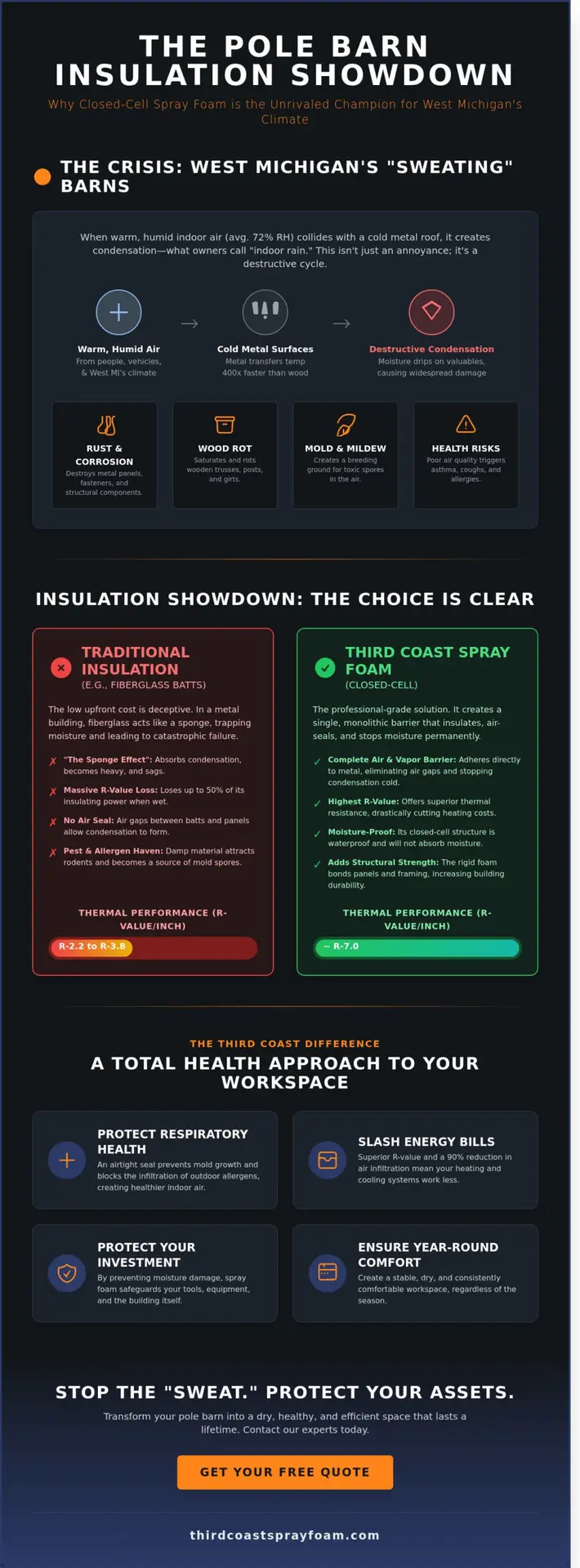
If you own a metal building in Grand Rapids or Lansing, you’ve likely seen the ceiling “rain” on a cold morning. This phenomenon isn’t a roof leak; it’s a symptom of a failing thermal envelope. Proper pole barn insulation is meant to prevent this, but many structures in our region suffer from chronic condensation. When warm, humid air inside your shop meets the cold metal skin of the roof, it reaches the dew point. This causes water vapor to turn into liquid droplets instantly.
A sweating ceiling is the most visible sign that your building lacks an airtight seal. Understanding Building Insulation principles reveals that metal is a high-conductivity material, meaning it transfers temperature 400 times faster than wood. Without a continuous barrier, your building’s structural integrity is at risk. Moisture leads to rust on metal panels and rot in the wooden posts that support your frame.
To better understand this concept, watch this helpful video:
Ignoring these droplets leads to more than just a wet floor. It creates a breeding ground for mold and mildew, which directly impacts your respiratory health. Poor indoor air quality in a workshop can trigger asthma or chronic coughs for anyone spending time inside. We’ve seen buildings where the owner waited five years to address the “sweat,” only to find thousands of dollars in structural damage from oxidized fasteners and rotted trusses. Protecting your investment requires a permanent fix for this moisture cycle.
The Impact of Lake Effect Humidity
Living near Lake Michigan means dealing with an average relative humidity of 72% throughout the year. In cities like Muskegon and Holland, seasonal shifts can cause 40 degree temperature swings within a 24 hour period. These rapid changes overwhelm standard ridge vents and soffits. Ventilation alone cannot stop condensation if the metal surface remains cold. You need a pole barn insulation solution that prevents the air from touching the metal entirely, creating a consistent indoor climate regardless of the lake effect weather outside.
Why Traditional Fiberglass Fails in Pole Barns
Fiberglass batts are often the default choice because of their lower upfront cost, but they act like a sponge in a metal building. Once the dew point is reached, the fiberglass traps that moisture against the steel. This leads to the “Sponge Effect” where the insulation becomes heavy, sags, and loses up to 50% of its R-value when wet. Even worse, damp fiberglass becomes a hotel for rodents and a source of airborne allergens. This compromises the total health of your indoor space and requires expensive replacement every few years.
Comparing Pole Barn Insulation Methods: Spray Foam vs. The Rest
West Michigan winters bring relentless wind and sub-zero temperatures that test the limits of any structure. When choosing pole barn insulation, you aren’t just buying material; you’re investing in a thermal envelope that determines the building’s lifespan and your own physical health. Traditional fiberglass batts and cellulose often fail in metal buildings because they lack an integrated air seal. These materials allow humid air to reach the cold metal panels, leading to condensation and hidden mold growth. This moisture doesn’t just rot your girts and purlins; it releases spores into the air that can cause chronic respiratory health issues and aggravate asthma for anyone working inside.
Professional-grade closed-cell spray foam stands apart by providing a 90% reduction in air infiltration compared to traditional methods. By understanding insulation and R-value, you can see why this matters. Closed-cell foam offers an impressive R-value of roughly 7.0 per inch, whereas fiberglass often sits between 2.2 and 3.8. More importantly, foam adheres directly to the substrate, eliminating the air gaps where “sweating” occurs. This creates a healthier indoor environment by preventing the damp, musty conditions that characterize poorly insulated barns. While DIY kits might seem cost-effective, they often lack the high-pressure delivery systems needed for a consistent chemical mix, leading to off-gassing risks and poor adhesion that compromises your indoor air quality.
Closed Cell vs. Open Cell Foam for Metal Buildings
For agricultural and metal buildings in the Grand Rapids area, closed-cell foam is the superior choice. Unlike open-cell foam, which has a sponge-like structure, closed-cell foam is dense and water-resistant. It acts as its own vapor barrier, which is essential for preventing condensation on metal surfaces. It also adds up to 300% more structural racking strength to your walls. We only recommend open-cell foam in specific, climate-controlled scenarios where a vapor retarder is already present. In most Michigan barns, open-cell foam can actually trap moisture against the metal, leading to premature rust and degraded air quality.
The Problem with Bubble Wrap and Radiant Barriers
Many builders suggest “bubble wrap” or thin radiant barriers as a cheap way to insulate a pole barn, but these products often mislead owners regarding their actual thermal performance. These barriers reflect radiant heat but offer almost zero resistance to conductive heat flow. In the middle of a January freeze, a thin sheet of foil won’t keep your workshop warm or prevent the dew point from reaching your steel panels. True protection requires a thick, airtight barrier that manages the temperature transition between the frozen Michigan exterior and your heated interior. If you want to ensure your building remains a safe, dry, and healthy space, you can consult with our team to evaluate your specific layout.
Prioritizing Respiratory Health and Indoor Air Quality
West Michigan pole barns are no longer just for tractor storage. In 2026, our team sees more Grand Rapids homeowners converting these structures into home gyms, woodshops, and secondary living suites. This shift makes indoor air quality (IAQ) a primary concern rather than an afterthought. When you spend hours lifting weights or running a table saw, the air you breathe impacts your long-term wellness. High-performance pole barn insulation does more than regulate temperature; it acts as the primary defense against respiratory triggers.
The Environmental Protection Agency (EPA) reports that indoor air can be two to five times more polluted than outdoor air. In a metal building, this risk is amplified by condensation. When warm, moist air hits a cold metal panel, it creates liquid water that drips into wall cavities. This moisture cycle is a catalyst for respiratory issues, especially for the 10% of Michigan residents living with asthma. By installing a seamless thermal envelope, we eliminate the dew point and keep the interior dry, ensuring the air remains clean and safe for every occupant.
Mold, Mildew, and Your Health
That familiar “musty barn smell” isn’t a harmless quirk of rural living; it’s a sign of active mold spores and volatile organic compounds (VOCs). Mold thrives when humidity levels exceed 60%, a common occurrence in poorly ventilated West Michigan structures. Unlike traditional types of insulation materials like fiberglass or cellulose, closed-cell spray foam is an inert polymer. It provides no organic food source for mold to consume. By removing the environment where fungi grow, you protect your family from the chronic coughing and sinus congestion associated with damp buildings. The same moisture-driven health risks that affect barns are also common beneath homes, which is why crawl space insulation is equally critical for West Michigan homeowners looking to protect their indoor air quality from the ground up.
Creating a Controlled Environment
Airtight sealing is the secret to managing a healthy workshop or gym. Traditional insulation allows air to leak through gaps, bringing in dust, agricultural pollen, and pests. Our application process creates a monolithic barrier that blocks these external irritants. This is vital for workshops where sawdust is present, as it allows your filtration systems to work efficiently without competing with outdoor allergens. Maintaining a consistent humidity level between 30% and 50% through proper sealing and ventilation creates a stable environment that supports both lung health and the preservation of your equipment.
Air exchange refers to the rate at which indoor air is replaced by outdoor air, a process that must be mechanically managed in an airtight barn to ensure fresh oxygen levels and the removal of stale contaminants.
Our approach at Third Coast Spray Foam focuses on total building health. We don’t just spray foam and leave; we help you understand how your building breathes. This ensures your pole barn remains a productive, healthy space for decades to come.
Planning Your Project: From Site Prep to Contractor Selection
A successful pole barn insulation project starts long before our spray rig arrives at your West Michigan property. Proper preparation is the foundation of a healthy, durable structure. You’ll need to clear a 10 foot perimeter around all interior walls to give the crew unobstructed access to the metal framing. We recommend removing or tightly covering any sensitive items, as this protects your belongings and ensures the workspace remains clean. This stage is also the best time to inspect for existing moisture issues. Sealing a building that already has water trapped behind the panels can lead to mold and mildew, which compromises both the steel and your respiratory health. Our team focuses on creating a pristine surface so the foam adheres perfectly, forming a permanent barrier against outdoor pollutants.
What to Look for in a West Michigan Contractor
Selecting the right team involves more than comparing bottom-line prices. You need a specialist who understands the specific climate demands of Kent, Ottawa, and Muskegon counties. Local knowledge is vital because building codes and fire barrier requirements vary between municipalities. Ask key questions when hiring an insulation contractor to verify they carry full liability insurance and have experience with large scale metal buildings. A professional should always conduct a comprehensive site assessment before providing a quote. This visit allows us to identify potential air quality risks and determine if your barn requires a thermal barrier, such as DC315 fire-protective coating, to comply with the 2023 Michigan Residential Code.
Maximizing Energy Efficiency and Tax Credits
In 2026, Grand Rapids homeowners can still take advantage of the energy efficient home improvement credit. This federal incentive allows you to claim 30% of your insulation material costs, up to a $1,200 annual limit. Beyond the tax benefits, pole barn insulation provides a massive reduction in the energy required to maintain a workspace. By sealing the building envelope, you can often reduce your heating system’s BTU requirements by 40% or more. Combining high quality spray foam with a correctly sized HVAC system is the best way to insulate a pole barn for long term comfort. This holistic approach prevents the “sick building syndrome” often caused by poor ventilation and trapped allergens. If you’re also concerned about energy loss and moisture infiltration beneath your home, exploring professional crawl space insulation in Grand Rapids can deliver similar savings and health benefits by sealing your home’s thermal envelope from the foundation up.
The timeline for a standard project is efficient and predictable:
- Day 1: Site preparation, masking of windows and doors, and equipment calibration.
- Day 2-3: Spray foam application and real-time thickness verification.
- Post-Install: A 24 hour curing period is required. During this time, the space must remain unoccupied to allow for proper ventilation and stabilization of indoor air quality.
Once the curing process is complete, your barn becomes a climate-controlled environment that supports better health and lower utility bills. If you’re ready to upgrade your property with a team that values precision, contact Third Coast Spray Foam for a detailed consultation.
The Third Coast Difference: Expert Pole Barn Solutions
At Third Coast Spray Foam, we don’t just spray insulation; we engineer a controlled environment. Our specialized approach centers on high-density closed-cell spray foam for West Michigan barns. We’ve seen how the high humidity in the Great Lakes region causes traditional materials like fiberglass to sag and trap moisture. This trapped moisture often leads to mold growth, which can trigger asthma and other respiratory issues for anyone working inside. By sealing the building envelope, we eliminate the air infiltration that carries outdoor pollutants and allergens into your space. Our focus on “Total Home Health” means your pole barn remains a safe, dry, and healthy environment regardless of the season.
This level of protection is why we never recommend fiberglass or DIY kits for pole barn insulation in our climate. These inferior materials fail to provide the vapor barrier necessary to prevent condensation on metal walls, which is the primary cause of structural rot and poor air quality. We prioritize long-term durability over cheap, temporary fixes. By choosing a professional closed-cell application, you’re investing in a permanent solution that strengthens your structure and protects your respiratory health for decades.
Our Local Expertise in West Michigan
With over 20 years of experience, our team understands the brutal shifts of Michigan weather. We serve clients across Grand Rapids, Lansing, Kalamazoo, and the Lakeshore. We maintain a no-nonsense approach to quality. We don’t cut corners with sub-par DIY materials that often fail to bond correctly to metal framing. Every project ends with a clean, professional finish because we treat your barn like our own. Our crews ensure that 100% of the overspray is managed, leaving you with a pristine, high-performance workspace. We’ve completed over 1,500 projects in the region, giving us the technical insight to handle any structural challenge.
Get Your Free Pole Barn Assessment
Every barn has a unique purpose, whether it’s a heated workshop, vehicle storage, or a commercial space. During your free on-site consultation, we examine your structure’s specific ventilation needs and thermal requirements. We provide a customized plan for your pole barn insulation that prioritizes both energy efficiency and long-term structural integrity. We look at the building as a holistic system, ensuring that your insulation choice supports healthy respiratory conditions and prevents mildew growth. If you are ready to protect your investment and improve your indoor air quality, Request your free estimate today.
Protect Your West Michigan Investment and Your Health
Don’t let the 40 degree temperature swings common in Grand Rapids compromise your structure. Choosing high quality pole barn insulation is about more than just temperature control; it’s a vital step for your respiratory health. By installing closed cell spray foam, you eliminate the condensation crisis that leads to toxic mold growth and poor indoor air quality. Our team at Third Coast Spray Foam specializes in creating a permanent air seal that shields your building from the high humidity levels found across the Third Coast. We’re a locally owned and operated specialist focused on providing precision moisture prevention for every client. You deserve a workspace that’s as healthy as it is durable. It’s time to seal the envelope and breathe easier in a space built to last. We’re ready to help you transform your pole barn into a safe, efficient environment today.
Get Your Free Pole Barn Insulation Estimate
Frequently Asked Questions
Is spray foam insulation worth the cost for a pole barn?
Spray foam insulation is a high-value investment because it creates a total air seal that traditional fiberglass cannot match. Our team sees utility savings of 15% on average based on Department of Energy data for air-sealed buildings. By sealing the thermal envelope, you prevent moisture from entering the structure. This protects your indoor air quality by stopping the growth of mold and mildew, which are common triggers for respiratory health issues in West Michigan’s humid climate.
Can I insulate my pole barn myself with a DIY kit?
You can purchase DIY kits, but professional application ensures a safer and more effective seal for your property. DIY kits often lack the precise temperature control needed for the chemical reaction, which can lead to a 20% to 30% reduction in effective R-value if misapplied. Improperly mixed foam can also lead to lingering odors and compromised indoor air quality. Third Coast uses specialized equipment to guarantee the product is 100% cured within 24 hours, ensuring a safe environment for your family.
What is the best way to stop my pole barn ceiling from sweating?
Applying closed-cell pole barn insulation directly to the underside of the metal roof is the most effective way to stop condensation. This method eliminates the dew point where warm air meets a cold surface, which is the primary cause of “sweating” in metal buildings. By preventing this moisture buildup, you stop water from dripping onto your equipment and prevent the damp conditions that allow mold spores to thrive. This proactive approach is essential for maintaining a healthy indoor environment and protecting your respiratory health.
How much R-value do I need for a pole barn in Michigan?
The 2021 Michigan Energy Code recommends specific R-values based on how you intend to use and heat your building. For residential-grade structures, the code typically requires R-49 for ceilings and R-21 for exterior walls. Our team often recommends at least 2 inches of closed-cell foam to provide an R-14 rating while simultaneously creating a permanent vapor barrier. This specific thickness stops 90% of heat transfer and prevents the moisture infiltration that leads to structural rot and poor air quality.
Does pole barn insulation help with noise reduction?
Spray foam significantly reduces exterior noise, making your workspace much quieter and more functional. Open-cell foam is particularly effective for this purpose, as it has a Noise Reduction Coefficient of approximately 0.70. This means the material absorbs 70% of the sound that hits it, which is a major benefit if you use power tools or live near a busy West Michigan highway. By creating a denser barrier, we help turn a loud metal shell into a peaceful environment that protects your hearing and peace of mind.
Is spray foam safe for my family and pets?
Spray foam is completely safe for your family and pets once the 24-hour curing period is finished. The materials we use at Third Coast are designed to be low-VOC, ensuring that your indoor air quality remains high and free of harmful chemicals. By sealing out dust, pollen, and outdoor pollutants, the insulation actually creates a cleaner indoor environment. This is especially beneficial for occupants with asthma or other respiratory health concerns who need a controlled, allergen-free space.
How long does it take to insulate a typical pole barn?
Our team can typically complete a standard 1,200-square-foot pole barn in a single 8 to 10-hour workday. Larger or more complex structures might require two days to ensure every corner of the thermal envelope is sealed correctly and safely. We prioritize a clean job site and an efficient workflow so you can get back to using your space quickly. Because the foam cures rapidly, you’ll feel the difference in temperature and air quality almost immediately after we finish the application.
Will insulating my pole barn prevent rust on my vehicles?
High-quality pole barn insulation prevents the rapid temperature swings that cause condensation to form on cold metal surfaces like car frames and engines. By maintaining a consistent internal temperature, you keep the relative humidity below the 50% threshold where oxidation typically accelerates. This protects your classic cars or farm equipment from rust and corrosion. It also prevents the damp conditions that lead to musty odors and mold growth inside vehicle interiors, preserving your investments and your respiratory health.
Disclaimer
Information provided is for general educational purposes. Individual needs and circumstances vary. Speak to an experienced professional to get the correct information for your situation.