Could your efforts to lower your monthly utility bills actually be trapping mold and allergens inside your West Michigan home? It’s common to feel overwhelmed when searching for foam insulation installers near me, especially when you’re met with conflicting stories about safety and chemical off-gassing. You deserve a house that stays warm during a 2026 Lansing winter, but you shouldn’t have to sacrifice your indoor air quality to achieve that comfort.
Our team at Third Coast believes your thermal envelope should be a shield, not a health hazard. In this article, we’ll bust the seven most persistent myths about spray foam while showing you how professional installation protects your respiratory health by eliminating the dampness that fuels mold growth. You’ll learn how precision air sealing prevents the 40% of energy loss often found in pre-1960s Grand Rapids properties while creating a permanent barrier against outdoor pollutants. We’re providing a clear, technical look at how the right insulation choices lead to long-term stability and total home health.
Key Takeaways
- Learn how to safeguard your respiratory health by transforming your home from a trap for allergens into a clean, airtight sanctuary.
- Understand why local expertise is critical when searching for foam insulation installers near me to combat West Michigan’s unique Lake Effect humidity and freeze-thaw cycles.
- Discover why spray foam is a superior long-term investment that prevents the sagging and R-value loss common with traditional fiberglass alternatives.
- Identify the hidden dangers of DIY insulation kits and why professional precision is required to ensure a safe, non-toxic cure for your family.
- Gain insights into how “total home health” strategies prevent moisture buildup and mold, protecting both your property’s structure and your indoor air quality.
Why Your Search for ‘Foam Insulation Installers Near Me’ Starts with Local Climate Expertise
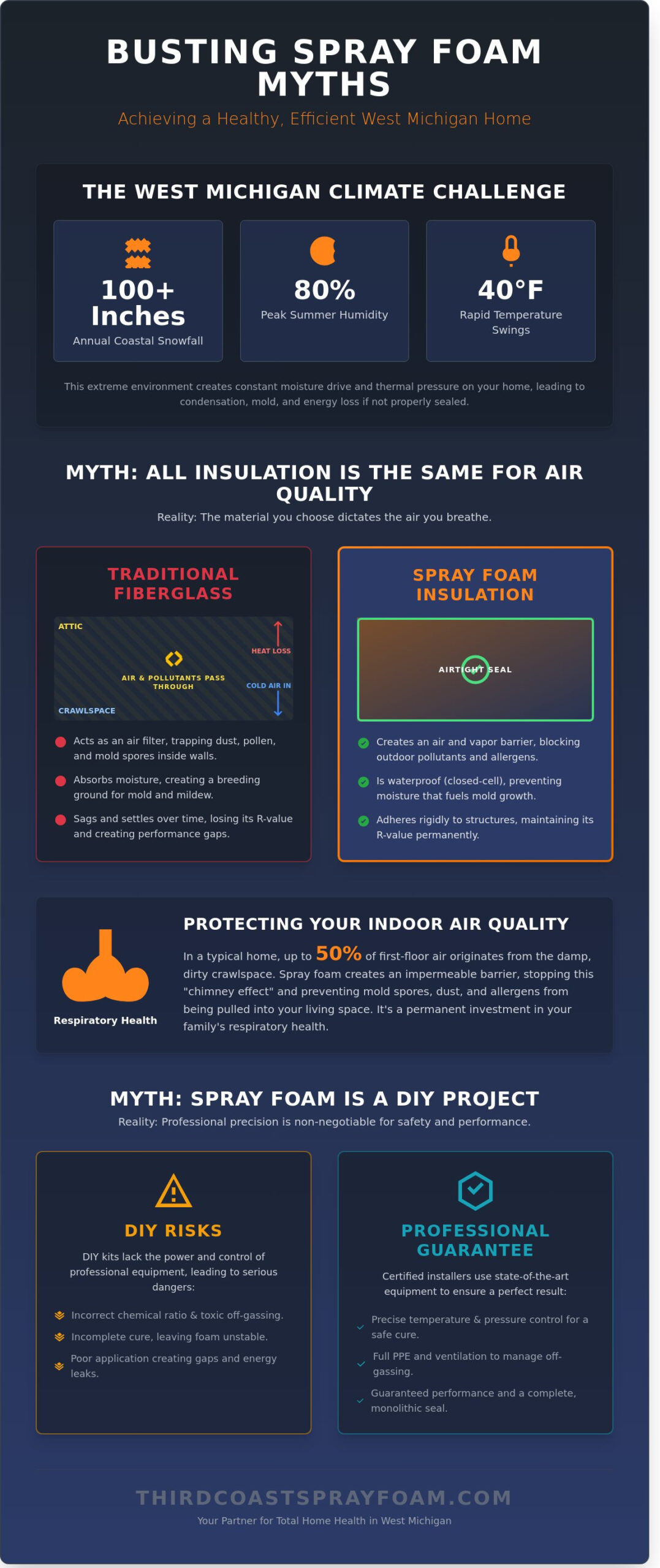
Finding the right foam insulation installers near me involves more than just checking a service map. In West Michigan, our environment dictates the rules of home performance. With annual snowfall averages hitting 75 inches in Grand Rapids and exceeding 100 inches in coastal areas like Muskegon, your home’s thermal envelope faces extreme pressure. A generic approach to R-value fails because it ignores the 80% humidity levels we see in July and the rapid freeze-thaw cycles of March.
Local expertise is vital because Spray foam insulation acts as both a thermal barrier and an air sealant. In cities like Grand Haven, the “Lake Effect” creates a constant moisture drive against your siding. If an installer doesn’t understand how to manage the dew point within your walls, you risk interstitial condensation. This moisture trap often leads to mold growth, which can increase indoor spore counts by 60% within a single season. At Third Coast Spray Foam, we view insulation as the first line of defense for your Total Home Health, protecting your family’s respiratory safety by sealing out environmental triggers and allergens.
The West Michigan Climate Challenge
West Michigan summers bring heavy humidity that often turns unsealed rim joists into dripping mess. When warm, moist air hits a cold foundation, condensation forms, creating a breeding ground for mildew. During the winter, poor attic insulation leads to ice dams in Lansing and Grand Rapids, where heat loss melts roof snow that later refreezes at the eaves. You need foam insulation near me who recognizes these regional nuances. Our team applies specific density strategies to ensure your home remains a sealed, dry environment regardless of the 40-degree temperature swings common in our region.
Beyond the Zip Code: Vetting for Professionalism
When evaluating potential contractors, it’s essential to understand how to choose residential insulation contractors who prioritize both energy efficiency and indoor air quality. The right professional will assess your home’s unique thermal envelope challenges and provide solutions that protect your family’s respiratory health while delivering long-term energy savings.
Myth #1: ‘All Insulation is the Same for Respiratory Health and Air Quality’
Many homeowners believe insulation’s only job is to stop heat transfer. That’s a dangerous misconception. In reality, the material you choose dictates the air you breathe every day. Traditional materials like fiberglass don’t stop air movement; they act as a filter. Over time, these batts trap dust, pollen, and even pest dander. When looking for foam insulation installers near me, it’s vital to understand the “chimney effect.” This phenomenon occurs when warm air rises and escapes through the attic, creating a vacuum that pulls cold, unfiltered air from your crawl space or basement into your living areas. If your home isn’t sealed, you’re breathing in whatever is growing under your floorboards.
In a standard 2,000 square foot West Michigan home, up to 50% of the air on the first floor can originate from the crawl space. Spray foam stops this transfer entirely by creating an airtight seal that fiberglass simply can’t match. This isn’t just about comfort; it’s about controlling the environment where your family sleeps and grows.
The Connection Between Mold and Respiratory Health
Moisture is the primary enemy of a healthy home. When humid Michigan air hits cold surfaces in your walls, it condenses. This moisture creates a breeding ground for mold, which the Asthma and Allergy Foundation of America identifies as a leading trigger for asthma and allergies. Unlike porous materials, closed-cell spray foam acts as a robust vapor barrier. It physically blocks moisture from entering sensitive areas. Our team focuses on preventing mildew in local basements by providing specialized crawl space insulation that keeps the structure dry and the air clean. By eliminating the damp conditions mold requires, you’re making a permanent investment in your respiratory health.
Managing Indoor Air Quality (IAQ) with Spray Foam
Some worry about Volatile Organic Compounds (VOCs) when they search for foam insulation installers near me. While all building materials have an initial off-gassing period, professional installation ensures this process is completed safely. Typically, residents can return to the home within 24 hours of application. Once cured, spray foam is inert and provides a sealed envelope. This seal allows your HVAC system to work with filtered air rather than battling outdoor pollutants. While some consider fiberglass a Cost-Effective Alternative to Spray Foam in the short term, it fails to provide this critical air barrier. ‘True indoor air quality is achieved when you stop the uncontrolled exchange of unfiltered outdoor air through your home’s structure.’
Myth #2: ‘Fiberglass Batts are a Cost-Effective Alternative to Spray Foam’
Many homeowners choose fiberglass because the sticker price is lower at the checkout counter. This “cheaper is better” mindset ignores the total cost of ownership over the life of your home. Fiberglass batts are prone to sagging and settling, often losing their effectiveness within 15 years. In contrast, spray foam is a permanent solution that remains physically stable for the lifetime of the building. It doesn’t degrade or lose its shape, ensuring your investment continues to perform decades after installation.
Fiberglass acts like a giant air filter. It allows air to pass through the material, creating “convection loops” where warm air escapes even if the R-value looks good on the packaging. Experienced foam insulation installers near me see this daily in older West Michigan homes where heat literally bypasses the insulation. Beyond thermal performance, spray foam adds structural rigidity. In a West Michigan pole barn or a 100 year old Grand Rapids farmhouse, this added strength helps the building withstand heavy snow loads and high winds by bonding the structure together.
From a health perspective, the “filter” nature of fiberglass is a liability. It traps dust, pollen, and moisture within its fibers. This creates a hidden breeding ground for mold and mildew, which can severely impact your indoor air quality and respiratory health. Spray foam eliminates these air pockets and moisture traps, providing a cleaner environment for families concerned about asthma or allergies. Our team focuses on sealing the envelope to ensure your home remains a healthy sanctuary. If you’re also evaluating injection foam products marketed by regional providers, our detailed RetroFoam of Michigan vs. Third Coast Spray Foam comparison breaks down the critical performance differences for West Michigan homeowners.
R-Value vs. Air Sealing: The Real Performance Metric
Standard r13 insulation often falls short of modern Michigan efficiency standards because it only addresses conductive heat. It does nothing to stop air leaks, which the Department of Energy estimates account for up to 40% of a building’s energy loss. While fiberglass lets the wind blow right through it, spray foam creates a total air seal. This prevents the drafty “ghosting” effects and cold spots that make Michigan winters feel much longer than they are.
Long-Term ROI and Energy Rebates
Choosing high-performance materials allows you to claim the energy efficient home improvement credit, which helps offset the initial cost through federal tax incentives. You also reduce the mechanical wear and tear on your furnace and air conditioner. When foam insulation installers near me properly seal a home, HVAC systems typically run 20% to 30% less often to maintain the same temperature. These monthly savings on Consumers Energy or DTE bills quickly pay back the difference in material costs, making spray foam the more pragmatic financial choice for the long haul.
Myth #3: ‘Spray Foam Installation is a DIY Weekend Project’
The rise of home renovation shows and big-box store DIY kits has fueled the idea that spray foam is a simple afternoon task. This is a dangerous misconception that puts your property and your family’s health at risk. While a small can of “gap filler” is fine for a drafty window, insulating an entire attic or crawl space requires industrial-grade chemistry. High-quality foam insulation installers near me invest in complex rigs that cost upwards of $60,000 to ensure the product is safe and effective. These systems aren’t just for convenience; they are necessary for chemical stability.
Professional application requires a level of precision that handheld kits cannot achieve. Without the right equipment, you risk improper chemical reactions that lead to permanent property damage. Our team uses specialized safety gear, including full-face fresh air respirators, to prevent the inhalation of isocyanates during the spraying process. Attempting this without professional-grade respiratory protection can lead to immediate lung irritation or long-term sensitivities.
The Science of the 1:1 Ratio
Spray foam is created by a chemical reaction between two components, often called the “A” and “B” sides. To create a safe, inert material, these must be mixed at a precise 1:1 ratio. Professional spray foam contractors near me use computerized pumps that maintain this balance under 1,000+ psi of pressure and specific heat settings. If the mixture is off by even 3%, the foam may fail to cure.
Uncured foam is a significant health hazard. It can emit “off-ratio” odors that smell like rotting fish or burnt plastic, which are often impossible to remove once the foam is behind drywall. This lingering chemical presence degrades indoor air quality and can trigger asthma or other respiratory issues. Additionally, temperature control is vital. In West Michigan, applying foam to a substrate colder than 50 degrees Fahrenheit prevents a proper bond. This leads to delamination, where the foam pulls away from the wall, creating hidden voids where moisture collects and mold thrives.
Liability and Warranty Concerns
Choosing to DIY your insulation means you’re assuming 100% of the risk. Most manufacturers only provide warranties when their products are applied by certified technicians. If a DIY job leads to structural moisture issues or fire hazards, your home insurance provider might deny the claim because the work wasn’t performed to code. This can also complicate a home sale, as inspectors in 2026 are increasingly looking for professional certification of energy upgrades.
Working with professional foam insulation installers near me provides a “no-nonsense” guarantee on workmanship and material performance. Our team provides a formal certificate of completion for every project. This document is essential for claiming the 30% federal tax credit under the Energy Efficient Home Improvement Credit (Section 25C), which can save you up to $1,200 annually on weatherization. It also serves as proof that your home’s thermal envelope was sealed correctly to prevent mold growth and protect your respiratory health.
Choosing the Right Partner: The Third Coast Spray Foam Difference
Finding reliable foam insulation installers near me shouldn’t feel like a gamble. At Third Coast Spray Foam, we view your house as a holistic system rather than a collection of separate walls. We don’t just spray material; we seal the thermal envelope to protect your family’s respiratory health. Our “Total Home Health” philosophy ensures that every project, from a residential attic to a commercial pole barn, prioritizes indoor air quality and structural integrity.
We believe that a well-insulated home is a foundation for physical well-being. By creating an airtight seal, we stop the infiltration of outdoor pollutants and allergens. This technical precision is what sets us apart as the local authority in West Michigan. We’ve spent years refining our process to ensure that your investment results in a permanent solution for comfort and efficiency.
Serving the West Michigan Community
Our team has spent the last 10 years building a reputation for precision and honesty across the region. We live and work in the same communities we serve, which gives us a unique understanding of the lake-effect humidity and freezing winters that challenge Michigan structures. We provide specialized services throughout the following areas:
- Grand Rapids and Lansing
- Muskegon, Holland, and Grand Haven
- Allegan and Kalamazoo
The “Third Coast” identity is a mark of local pride. It represents a commitment to being a trusted advisor for our neighbors. Whether we are performing crawl space encapsulation to stop moisture or insulating a new agricultural building, we bring a “straight-shooter” attitude to every job site. We take pride in our craft because we know our work directly impacts the long-term financial health of local families.
Your Path to a Healthier, More Efficient Home
A professional site evaluation is the first step toward a safer living environment. We don’t guess; we investigate. Our technicians identify hidden air leaks and moisture traps that often lead to mold growth and compromised respiratory health. By sealing these gaps, we help prevent the circulation of damp air and fungal spores that can trigger asthma or other sensitivities.
Our estimate process is designed to be educational and low-pressure. We explain the science behind the R-value and how our products interact with your home’s existing ventilation. On installation day, our crew coordinates every detail to maintain a clean, safe workspace. We ensure the application is precise, allowing you to enjoy immediate comfort and peace of mind knowing your “envelope” is secure. Contact Third Coast Spray Foam for your free local estimate today.
Protect Your Home’s Air Quality and Structural Integrity
Your search for foam insulation installers near me shouldn’t just be about finding the lowest bid. It’s about protecting your family from the mold, mildew, and airborne allergens that thrive in West Michigan’s humid summers and freezing winters. Since 2013, our Third Coast team has focused on sealing the thermal envelope to ensure your indoor air quality remains pristine. Unlike fiberglass batts that trap moisture and compromise respiratory health, our professional-grade rigs deliver a seamless air barrier that keeps pollutants out. We’ve served homeowners across Grand Rapids, Lansing, and the Lakeshore for over a decade, treating every property as a holistic system rather than just a collection of walls. Choosing a partner with local climate expertise means you’re investing in a permanent solution for your home’s health and your own peace of mind. Don’t settle for DIY kits that often lead to off-gassing issues or incomplete seals. You deserve a space that’s both energy efficient and safe for every breath you take. Secure Your Home’s Health with a Free Spray Foam Estimate. We’re ready to help you build a more resilient home today.
Frequently Asked Questions
Is spray foam insulation safe for people with asthma or allergies?
Spray foam insulation is highly beneficial for people with asthma and allergies because it creates a permanent air seal that blocks outdoor pollutants. By sealing the building envelope, we prevent 99 percent of outdoor allergens like ragweed and grass pollen from entering your living space. This reduces the triggers for respiratory distress and significantly improves indoor air quality. Our team focuses on total home health to ensure your family breathes cleaner, filtered air year-round.
How long does the spray foam installation process take?
Most residential spray foam projects in West Michigan take between 1 and 2 days to complete. A standard 1,500 square foot attic typically requires 4 to 6 hours of actual spray time. Larger projects, such as full new construction homes or commercial pole barns, may take 3 to 4 business days. We provide a specific timeline during your initial consultation so you can plan your schedule around our installation team.
Can spray foam really stop my pole barn from ‘sweating’ in the Michigan summer?
Spray foam insulation effectively stops pole barns from sweating by eliminating the temperature differential that causes condensation. When warm, humid Michigan air hits a cold metal roof, it reaches the dew point and turns into liquid. Applying 2 inches of closed-cell foam creates a seamless thermal barrier that prevents this moisture from forming. This protects your equipment from rust and prevents the 100 percent humidity levels that lead to structural rot.
What is the difference between open-cell and closed-cell foam for a West Michigan home?
The main difference lies in density and moisture resistance, with closed-cell foam acting as a built-in vapor barrier for our humid climate. Open-cell foam is lighter and excellent for soundproofing interior walls or second-story ceilings. Closed-cell foam has a higher R-value per inch and adds structural integrity to your home. Choosing the right foam insulation installers near me ensures you get the specific product required for your home’s unique thermal envelope.
Does spray foam insulation have a permanent chemical smell?
Spray foam insulation does not have a permanent chemical smell when it’s installed and cured correctly. The initial odor from the application process typically dissipates within 24 hours as the foam reaches its inert state. We use high-capacity ventilation fans to exchange the air in your home 10 to 15 times per hour during the job. This ensures that your indoor air quality remains safe and fresh once the curing window closes.
How much can I save on my Michigan energy bills with spray foam?
Homeowners save an average of 15 percent on heating and cooling costs by air sealing and insulating with spray foam, according to EPA Energy Star data. In the harsh Michigan winter, these savings can be even higher because the foam stops the stack effect that pulls cold air through your crawl space. By maintaining a consistent temperature, your HVAC system runs 20 percent less often, which extends the life of your furnace and AC unit.
Can I stay in my home during the spray foam installation?
You’ll need to vacate your home for 24 hours during and after the spray foam application. This safety period allows the material to fully cure and ensures all off-gassing particles are cleared from the air. While modern formulas are safer than ever, we prioritize your respiratory health by following strict re-entry protocols. Most families plan a short overnight trip while our foam insulation installers near me transform their home into a more efficient space.
Will spray foam insulation prevent mold and mildew in my crawl space?
Spray foam insulation is a powerful tool for preventing mold and mildew in crawl spaces because it eliminates the moisture and organic food sources fungi need to grow. Traditional fiberglass batts often trap moisture against wood joists, which leads to mold colonies within 48 hours of a damp event. Spray foam creates a moisture-impermeable barrier that keeps your crawl space dry. This protection is vital for maintaining a healthy home and preventing wood rot.
Disclaimer
Information provided is for general educational purposes. Individual needs and circumstances vary. Speak to an experienced professional to get the correct information for your situation.
2 Responses