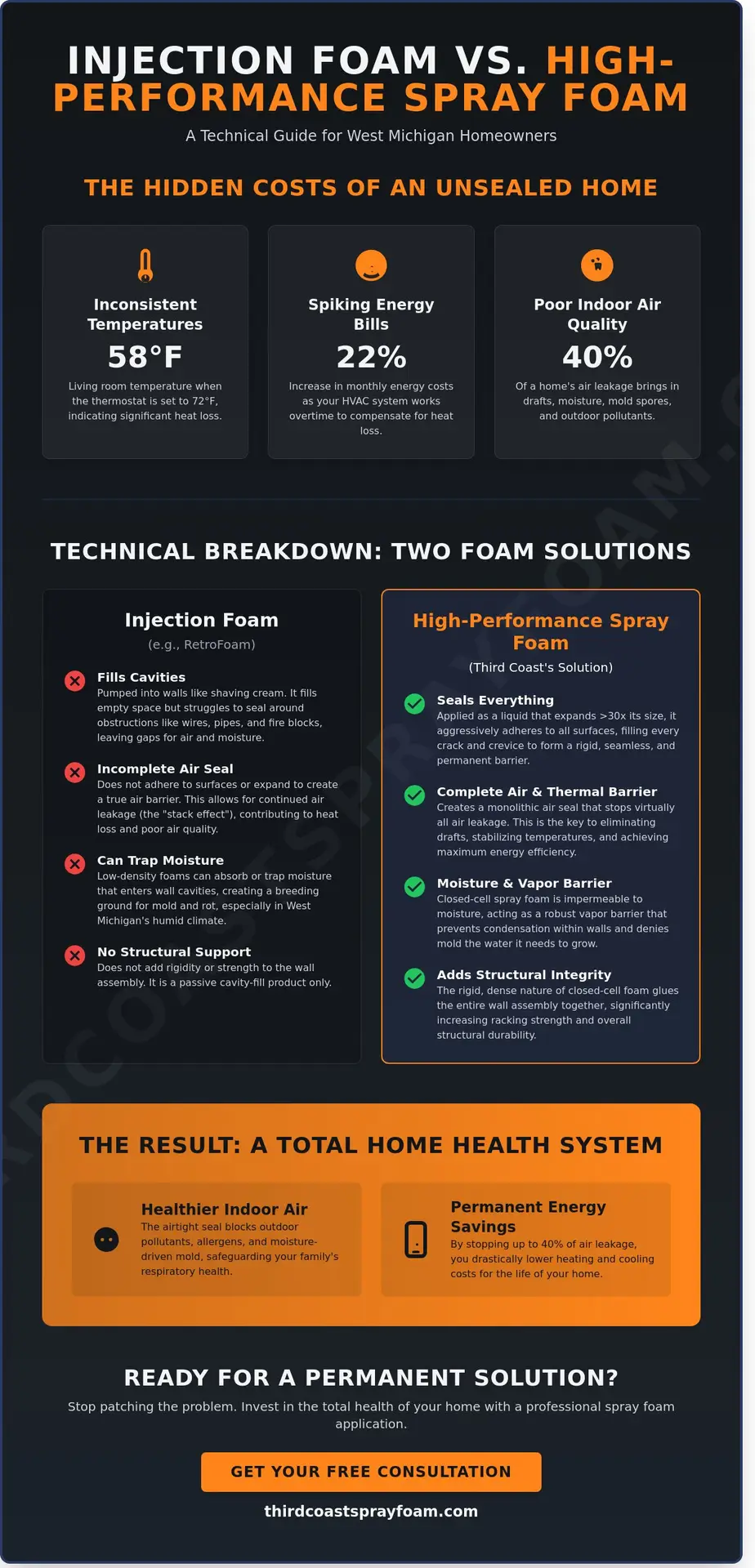
In January 2024, a family in Grand Rapids realized their thermostat was set to 72 degrees, yet their living room stayed at a chilly 58 while their energy bills spiked by 22%. You probably agree that a home should be a sanctuary, but drafty walls and rising costs often make West Michigan winters feel like a losing battle. If you’ve been researching injection foam solutions as a potential remedy, you’re likely looking for more than just warmth. You want a home that protects your family’s respiratory health by keeping out the dampness and mold that thrive in our local climate.
In this guide, you’ll discover the critical differences between traditional injection foam and high-performance spray foam solutions. We’ll show you how sealing the thermal envelope correctly can eliminate the 40% of air leakage common in older homes, which directly improves indoor air quality. Our team at Third Coast Spray Foam breaks down the technical performance and long-term durability of each method to help you achieve a dry, efficient, and mold-free environment. It’s time to move beyond temporary fixes and invest in the total health of your home.
In 2026, West Michigan homeowners face an increasingly volatile climate that demands more from their houses than ever before. If you live in Grand Rapids or Holland, your first instinct when your energy bills spike is likely to search for a familiar name like retrofoam of michigan. This brand recognition is a result of decades of heavy marketing; however, savvy homeowners are beginning to look past the logo to evaluate technical performance. Choosing between a mass-market injection foam and a high-performance Spray foam insulation system is a decision that impacts your property for the next 50 years.
To better understand how injection foam works in existing walls, watch this helpful video:
Our team at Third Coast Spray Foam believes that brand awareness shouldn’t outweigh physical data. While retrofoam of michigan offers a specific product for existing walls, we focus on the structural rigidity and airtight seal provided by professional spray foam applications. The goal isn’t just to fill a cavity. The goal is to create a permanent barrier that withstands the unique pressures of the Great Lakes region.
Living in Muskegon or Holland means dealing with lake effect moisture that can push indoor humidity levels above 60% during the summer months. Standard fiberglass or low-density injection foams often fail to stop this moisture from condensing inside your wall cavities. When moisture gets trapped, it creates a breeding ground for mold. This isn’t just a maintenance issue. It’s a health crisis. Mold spores are a primary trigger for seasonal respiratory issues and asthma in Michigan homes. In a 2024 study of regional housing, nearly 45% of homes with traditional insulation showed signs of moisture-related degradation that compromised indoor air quality.
We don’t just look at R-value. While R-value measures thermal resistance, it doesn’t account for air leakage, which can represent 40% of a home’s heat loss according to Department of Energy data. Third Coast focuses on “total home health” by treating your residence as a holistic system. We prioritize sealing the envelope to prevent pollutants and allergens from entering your living space. Our team creates a permanent thermal envelope that stabilizes your indoor environment. By choosing a solution that stops air movement, you’re protecting your family from the outdoor pollutants that often bypass mass-market insulation products.
Understanding the mechanical differences between insulation types is the first step toward a healthier home. Retrofoam of Michigan primarily utilizes injection foam, a product designed for existing wall cavities. This material has a consistency similar to shaving cream when it’s first pumped into a wall. It fills the space without the high-pressure expansion found in other materials. In contrast, Third Coast specializes in professional-grade open and closed cell spray foam. These products undergo a rapid chemical reaction upon application, expanding and hardening to create a rigid, airtight seal.
The U.S. Department of Energy highlights various Types of Insulation, noting that foam provides both thermal resistance and air sealing. While injection foam is a convenient option for finished walls, it lacks the structural density of spray foam. Spray foam creates a continuous thermal envelope that is vital for Michigan’s climate. By eliminating air gaps, we prevent the “stack effect,” which pulls cold, damp air from crawlspaces into your living areas. This process is essential for maintaining high indoor air quality and protecting your family’s respiratory health.
Injection foam is installed by drilling small holes in the exterior siding and pumping the mixture into the stud bays. While this works for simple cavities, it often struggles with complex obstructions like fire blocks, electrical wires, or horizontal bracing. These hidden hurdles can create “voids” where air still leaks through. Our team often recommends closed cell spray foam for critical areas like rim joists and pole barns. Closed cell foam provides a built-in vapor barrier that prevents moisture from condensing on cold surfaces, which is the primary cause of mold and mildew growth in Michigan homes.
Longevity is where the technical differences become most apparent. Traditional materials and some loose-fill foams can settle over time, leaving the top of your walls uninsulated. High-density spray foam adheres directly to the substrate and does not sag or shrink. This stability is crucial during Michigan’s intense freeze-thaw cycles. When temperatures fluctuate 40 degrees in a single day, materials expand and contract. Spray foam remains flexible enough to maintain its seal without cracking.
Evaluating your long-term ROI is about more than just the initial quote. Studies from the EPA suggest that proper air sealing can save homeowners an average of 15% on heating and cooling costs annually. Over a 10-year period, the durability of a professional spray foam application ensures these savings remain consistent. You won’t need to “top off” your insulation in five years. If you want to ensure your home is protected from the ground up, you can schedule a home assessment with our team to identify your specific air leakage points. Choosing the right material now means a drier, safer, and more efficient home for the next decade.
Homeowners often ask the same vital question: Is this foam safe for my family to breathe? The answer depends on the quality of the product and the precision of the installation. A high-performance air seal does more than lower your bills; it creates a structural barrier against outdoor pollutants, pollen, and dust mites. By sealing the small gaps that traditional materials like fiberglass miss, our team ensures that the air circulating through your vents stays clean. While products from retrofoam of michigan are common for specific wall injections, Third Coast prioritizes a holistic “total home health” approach that seals the entire thermal envelope to prevent unfiltered air from entering your living space.
Our commitment to health-conscious practices means we don’t just spray and leave. We follow strict protocols to ensure every application cures perfectly, providing a permanent solution that won’t degrade or release particles into your home over time. This focus on precision protects your respiratory health by keeping the outdoor irritants out. It’s a pragmatic approach to security that treats your house as a single, interconnected system.
Moisture is the primary enemy of a healthy home. In Michigan, roughly 50 percent of the air you breathe on your first floor originates in your crawl space or basement. When moisture infiltrates these damp areas, it creates a breeding ground for mold spores that can trigger asthma and chronic coughs. Effective crawl space insulation must act as a vapor barrier to stop this cycle. By blocking water vapor, we prevent the dampness that allows mold to thrive, ensuring your home’s foundation remains dry and your family stays healthy.
Modern spray foam chemistry has advanced significantly, meeting rigorous safety standards for indoor air quality. The myth of “permanent smells” usually stems from improper mixing or rushed jobs by inexperienced contractors. Volatile Organic Compounds, or VOCs, are carbon-based chemicals that can evaporate into the air during the initial application and curing process of various building materials. Professional installation ensures these gases dissipate quickly and completely. We follow a strict 24-hour re-occupancy guideline to ensure the foam is fully inert and safe before you return. This technical precision is what separates a standard job from a professional, health-focused installation.
Choosing an insulation partner isn’t just about R-value; it’s about the air your children breathe every night. We take that responsibility seriously, using our regional expertise to solve the unique moisture challenges found in West Michigan homes. By focusing on the mechanical process of proper curing, we deliver peace of mind alongside energy savings.
Selecting the right team for your home in Grand Rapids, Muskegon, or Lansing involves more than comparing prices. You need a partner who understands the specific climate challenges of the Great Lakes region. While a large franchise like retrofoam of michigan has a broad reach, local specialists often possess a deeper understanding of the high humidity levels common in Kent and Ottawa counties. A contractor’s local project history is your best indicator of their reliability. Ask for at least 10 references from homes built in the same decade as yours to ensure they understand your specific framing and ventilation needs.
Your evaluation should focus on three critical pillars: technical precision, crew training, and health safety. High-quality spray foam requires precise temperature control and specific equipment pressure to ensure the chemical reaction is complete. If the mix is off, the foam may not cure properly, leading to lingering odors and compromised indoor air quality. Always ask if their crews undergo annual manufacturer certification and how they monitor air quality during the installation process. This ensures the thermal envelope is sealed without compromising the air you breathe.
Be wary of contractors who suggest insulating your attic but ignore your rim joists or crawl space. These areas are primary entry points for moisture; neglecting them can lead to mold growth that eventually impacts your family’s respiratory health. You should also avoid foam insulation installers who refuse to remove old, contaminated fiberglass or cellulose. Leaving behind dusty, rodent-damaged material prevents a proper air seal and keeps allergens trapped within your home. Vague answers regarding mechanical ventilation are another warning sign. A truly professional contractor will explain how your house “breathes” once it’s sealed tight.
A professional quote should be a detailed roadmap for your home’s health and efficiency. It must include specific R-values and a clear plan for air sealing. In 2026, homeowners can take advantage of the energy efficient home improvement credit to offset a portion of their project costs. This federal incentive makes it easier to invest in premium solutions that offer long-term durability. Ensure your contractor provides a comprehensive warranty that covers both the material performance and the quality of the application. This protection ensures your home remains a safe, comfortable environment for decades to come.
Choosing the right contractor involves more than comparing quotes. While many homeowners research retrofoam of michigan for specific wall needs, Third Coast Spray Foam provides a comprehensive approach to the entire building envelope. We combine technical precision with a deep understanding of the local climate. Our team views your home as a holistic system where insulation, ventilation, and air quality are all connected. We don’t just add material to your walls; we engineer a permanent solution that protects your property and your family’s well-being.
Indoor air quality is a primary concern for families in Grand Rapids and Muskegon. Traditional insulation materials often act as a filter, trapping dust, pollen, and moisture over time. This environment can lead to mold growth and compromised respiratory health. Our high-performance spray foam creates an airtight seal that keeps these outdoor pollutants from entering your living space. By eliminating air infiltration, we significantly reduce the common triggers that cause asthma and other respiratory issues. It’s a proactive step toward a healthier indoor environment that lasts for the life of your home.
We understand the specific challenges of the West Michigan lakeshore. High humidity and lake-effect snow put unique stress on residential structures. Our moisture management strategies prevent condensation within your walls, which is the leading cause of structural rot and mildew. When you work with us, you’re choosing a partner who values the long-term security and financial health of your household. We prioritize results over flashy marketing, ensuring that every project meets our rigorous standards for thermal performance.
Our expertise covers a wide variety of structures across the region. We provide everything from residential attic upgrades to specialized pole barn insulation. If your current insulation is damaged by moisture or pests, we offer safe and professional removal services. This ensures that old, contaminated materials aren’t left behind to compromise your new system. We tailor our methods to the unique architecture found in Lansing and the surrounding communities, ensuring every gap is properly sealed.
Starting your home transformation begins with a personalized, local consultation. We don’t rely on generic estimates. Instead, we examine your home’s specific challenges and document exactly where you’re losing energy. This data-driven approach allows us to prove the efficiency of our work through tangible results. You’ll notice the difference in your utility bills and your daily comfort almost immediately. Ready to breathe easier? Contact us to schedule your free health and efficiency assessment and secure your home’s future.
Investing in your home’s thermal envelope isn’t just about lower utility bills; it’s about protecting your respiratory health for the long haul. While retrofoam of michigan offers a specific injection product, our comparison shows that professional spray foam provides a more complete air seal. This seal acts as your first line of defense against the seasonal allergens and high humidity levels that define West Michigan’s climate. According to the EPA, controlling indoor moisture is essential for preventing mold growth, which is a leading trigger for asthma and other respiratory issues.
Our team operates as 2026 Energy Credit Specialists. We ensure you capture every available federal incentive while strictly adhering to our Health-First Air Sealing Guarantee. As a local, owner-operated business, we look at your home as a holistic system rather than just a series of walls. You deserve a living space that feels consistent and stays free from the pollutants that compromise your family’s well-being. Take the next step toward a more stable and healthy home environment today.
Get Your Free Health & Efficiency Estimate from Third Coast
We’re ready to help you create the safe, efficient, and comfortable Michigan home you’ve always wanted.
Spray foam insulation is safe and often beneficial for people with asthma because it creates a permanent air seal that blocks 99 percent of outdoor allergens and pollutants. By sealing the building envelope, we prevent dust, pollen, and smog from entering your living space through the walls. This reduction in airborne irritants supports better respiratory health. Our team ensures a proper 24 hour curing period to maintain a healthy indoor environment.
The main difference lies in the application method and specialized materials used for different parts of the home. While retrofoam of michigan primarily uses an injection foam for existing walls, Third Coast focuses on high-performance spray foam to seal the entire thermal envelope. Our approach prioritizes a holistic view of home health. We use closed-cell or open-cell spray foam to create a seamless barrier against moisture and air leaks in 100 percent of the targeted area.
Spray foam stops mold growth by eliminating the condensation that occurs when warm air hits cold basement surfaces. Mold requires a 60 percent humidity level to thrive, and closed-cell spray foam acts as a vapor barrier that keeps moisture levels low. This protection is vital for maintaining high indoor air quality and preventing the respiratory issues associated with mold spores. We focus on sealing the rim joists where 40 percent of basement air leakage typically occurs.
The most common mistake is focusing only on R-value rather than the total air seal. Traditional materials like fiberglass allow air to pass through, which leads to a 30 percent loss in energy efficiency. Homeowners often overlook how air leaks bring in moisture and outdoor pollutants. Choosing a solution that seals the envelope ensures long term comfort and protects the home from the structural damage caused by trapped condensation and poor air quality.
A professional crew can typically complete the installation for a 2,000 square foot home in 1 to 2 days. This timeline includes site preparation, the actual application, and a thorough cleanup. We prioritize a precise schedule so your family can return to a more comfortable home quickly. Because the foam cures within 24 hours, you’ll start noticing the improvement in indoor air quality and temperature stability almost immediately after our team finishes the project.
Open-cell spray foam can reduce outdoor noise by up to 40 decibels. This is particularly effective for homes near the US-131 corridor or busy Grand Rapids streets. The dense structure of the foam absorbs sound waves that would otherwise travel through gaps in traditional insulation. It provides a quieter indoor environment while simultaneously sealing out the exhaust fumes and dust that often plague homes in high traffic urban areas, protecting your family’s respiratory health.
Spray foam insulation maintains its R-value for the life of the structure, unlike fiberglass which can settle by 20 percent over its lifespan. It doesn’t sag or degrade, ensuring your thermal envelope remains intact for decades. This stability means your HVAC system won’t have to work harder as the years pass. You get a permanent solution that protects your financial well-being and your home’s air quality without the need for future top-offs or replacements.
Under the Energy Efficient Home Improvement Credit, also known as Section 25C, homeowners can claim 30 percent of the project cost, up to a $1,200 annual limit. This federal incentive, extended through 2032 by the Inflation Reduction Act of 2022, makes upgrading your insulation more affordable. These credits apply to materials that meet the IECC standards for energy efficiency. Our team helps you understand how these savings contribute to the long term ROI of your home health investment.
Information provided is for general educational purposes. Individual needs and circumstances vary. Speak to an experienced professional to get the correct information for your situation.