
What if those sleek recessed lights in your ceiling are actually acting like tiny chimneys, pulling expensive heated air out of your rooms while dumping attic dust and mold spores into your living space? It’s a common frustration for Michigan homeowners who notice drafty spots despite having the thermostat cranked up. You want a comfortable home, but the fear of a fire from overheating fixtures often stops people from taking action. We understand that security and health come first. By properly insulating around recessed lighting in attic spaces, you can stop this energy loss and prevent respiratory triggers from entering your home. This guide explains how to identify your fixture types and use professional air sealing to lower your bills. You’ll learn how a holistic approach to attic efficiency protects your wallet and your indoor air quality.
Key Takeaways
- Identify whether your fixtures are IC-rated or Non-IC rated to ensure fire safety and prevent overheating before adding insulation.
- Learn how insulating around recessed lighting in attic spaces stops the chimney effect from pulling dust, allergens, and mold spores into your home.
- Discover why air sealing these fixtures is a critical step in preventing ice dams and moisture buildup during harsh West Michigan winters.
- Understand why professional spray foam provides a permanent air seal that protects both your respiratory health and your home’s structural integrity.
The Safety and Health Risks of Leaky Recessed Lighting
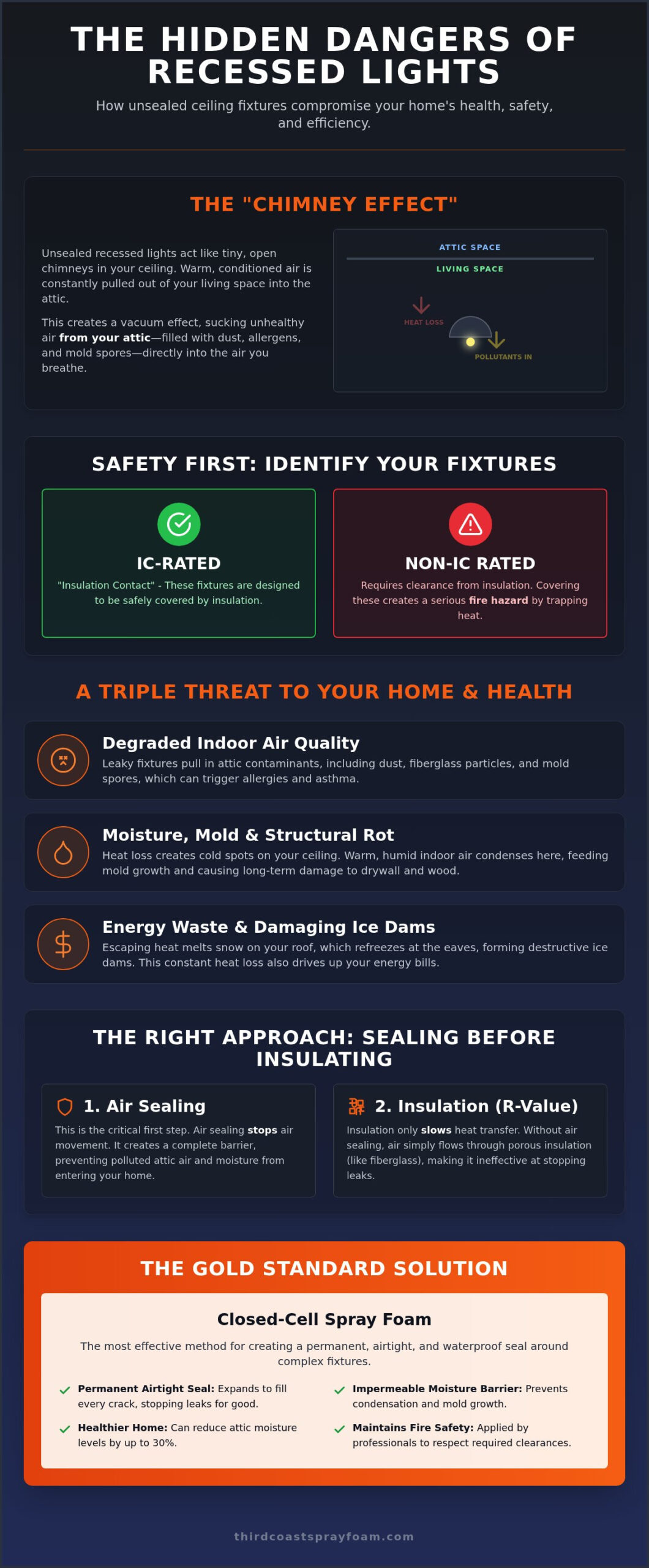
Safety starts with understanding your hardware. Before you begin insulating around recessed lighting in attic spaces, you must verify the rating of your light cans. IC-rated fixtures are those tested and approved for direct contact with insulation. Using the wrong material or covering a non-IC fixture can trap heat, creating a serious fire hazard. In contrast, IC-rated recessed lighting allows for a tighter seal without the risk of overheating. If you aren’t sure what you have, a professional assessment is the safest first step.
Beyond fire safety, leaky lights create a “stack effect.” Warm air naturally rises and escapes through the gaps in your ceiling. This creates a vacuum that pulls air from the lowest levels of your home upward, constantly wasting your furnace’s hard work. This process also leads to thermal bridging. These are specific points where heat transfers rapidly through the fixture, cooling the surrounding drywall. When warm, humid indoor air hits these cold spots, condensation forms. This moisture often leads to localized mold growth. It can damage your ceiling and degrade your home’s structural integrity over time.
How Recessed Lights Impact Your Indoor Air Quality
Unsealed lights don’t just let heat out; they let pollutants in. As the stack effect pulls air through the attic, it carries fine particles with it. This includes attic dust, fiberglass fragments, and mold spores. These contaminants settle into your breathing zone. They often serve as persistent respiratory triggers for family members with allergies or asthma. We see this frequently in older Michigan homes where lights were installed without proper gaskets. Sealing these gaps while insulating around recessed lighting in attic areas is your first line of defense. It creates a healthy indoor environment by ensuring the air you breathe stays separated from the dusty, unconditioned space above.
Choosing the Right Insulation Method for Michigan Winters
Michigan winters demand more than just thick blankets of insulation. In Grand Rapids and Muskegon, unsealed lights are a major source of heat loss that compromises your comfort. This escaping warmth heats the roof deck, melting snow that later refreezes at the eaves. Insulating around recessed lighting in attic floors is vital for preventing this energy drain and protecting your roof.
“In West Michigan, an unsealed recessed light can be the primary culprit behind recurring ice dams.”
Simply piling on more blown-in insulation without addressing the fixtures first is a common mistake. The air simply flows through the loose material, rendering the new insulation less effective. Homeowners often weigh several options for fixing these leaks. Fire-rated covers provide a physical shell, while LED retrofits reduce heat generation. However, professional air sealing offers the most comprehensive solution for long-term savings. When insulating around recessed lighting in attic spaces, we focus on creating a permanent barrier that stops the conditioned air you pay for from escaping into the cold.
The Critical Difference Between R-Value and Air Sealing
R-value measures resistance to heat flow, but it doesn’t account for air movement. Fiberglass batts are porous; they don’t stop the humid air from your kitchen or bathroom from migrating upward. This moisture hitches a ride through your lights and condenses on cold attic rafters, fueling mold growth and wood rot. We prioritize using fire-rated materials that meet Michigan building codes to ensure total safety. If you’re seeing signs of moisture or frost in your attic, a professional attic assessment can help pinpoint exactly where your thermal envelope is failing.
Professional Solutions for Permanent Attic Sealing
Achieving a truly airtight home requires more than just caulk and tape. For complex junction boxes, closed cell spray foam is the gold standard. This material expands to fill every tiny crevice around the fixture, creating a rigid and impermeable barrier. Before we apply any new material, we prioritize a clean work surface. This involves the professional removal of old, dusty insulation that may already be contaminated with mold or pests. By clearing the area, we ensure the foam bonds perfectly to the ceiling deck and light housing.
Safety remains our top priority during this process. Professional air sealing can reduce attic moisture levels by up to 30%, significantly lowering the risk of wood rot and mold growth. Our team ensures that required fire safety clearances are maintained, preventing the light cans from overheating while still maximizing thermal performance. Insulating around recessed lighting in attic spaces this way provides a permanent solution that won’t degrade like temporary DIY fixes.
Integrating Light Sealing into a Holistic Home Health Plan
We treat your home as an integrated system. Sealing your ceiling lights works in tandem with services like crawl space encapsulation to create a complete “sealed envelope.” This prevents the stack effect from pulling damp air from the ground up through your living areas and out through the roof. The long-term benefits are clear:
- Lower monthly energy bills through reduced furnace load.
- A more durable roof structure free from ice dam damage.
- Cleaner indoor air that supports your family’s respiratory health.
For older Michigan homes, a professional attic audit is much safer than a DIY approach. We can identify outdated wiring or hidden moisture issues before they become expensive repairs. Our collective expertise ensures your investment leads to a more secure and efficient home.
Secure Your Home’s Efficiency and Air Quality
Recessed lights are more than just design choices; they are critical points in your home’s thermal envelope. Leaving these fixtures unsealed creates a pathway for heat loss and allows respiratory triggers like attic dust and mold spores to enter your breathing zone. By properly insulating around recessed lighting in attic spaces, you eliminate the chimney effect that drives up energy bills and compromises your indoor environment. Drafty rooms don’t have to be your reality. Our team utilizes specialized West Michigan expertise to provide high-performance air sealing that stands the test of time. We take pride in delivering solutions that prioritize both your financial security and your family’s health. Schedule your professional attic air sealing assessment with Third Coast Spray Foam today. Let’s work together to build a more durable, comfortable, and healthy home for the long term.
Frequently Asked Questions
Can I put insulation directly over my recessed lights if they are LED?
Bulb type alone doesn’t determine safety. Even if you use cool-running LEDs, you can’t place insulation directly over the fixture unless the housing is IC-rated. Michigan building codes require specific clearances for non-IC lights to prevent fire hazards. To learn more about specialist fire-stopping and safety standards, you can discover National Fire Ltd. We recommend a professional inspection for homeowners in Grand Haven or Holland to ensure your lighting setup safely supports insulating around recessed lighting in attic spaces.
How do I know if my recessed lights are IC-rated or Non-IC rated?
You can identify the rating by looking inside the metal housing. First, turn off the power and remove the bulb and decorative trim. Look for a manufacturer’s sticker that explicitly states “IC” or “Insulation Contact.” If the label is missing or says “Non-IC,” you must maintain a three-inch gap. Our team frequently helps families in Kalamazoo and Allegan identify these fixtures during comprehensive attic assessments.
Will insulating my recessed lights cause them to burn out faster?
Insulating around recessed lighting in attic spaces won’t damage your fixtures if they are IC-rated. These housings are designed to handle heat even when covered. However, burying a non-IC light traps heat, which triggers safety switches. This stress can shorten the lifespan of your components. We provide professional sealing for families in Grand Rapids to ensure fixtures stay safe while maximizing thermal performance and structural integrity.
Can leaky recessed lights really cause mold growth in my attic?
Leaky fixtures are a primary source of attic moisture. When humid air from your kitchen or bathroom escapes through unsealed lights, it hits cold roof decks and condenses into water droplets. This moisture creates a breeding ground for mold and mildew on your rafters. For residents in Lansing and Muskegon, this doesn’t just damage wood; it also releases spores that can trigger respiratory issues and allergies.
Disclaimer
Information provided is for general educational purposes. Individual needs and circumstances vary. Speak to an experienced professional to get the correct information for your situation.