
Imagine walking into your West Michigan pole barn on a humid morning only to find your expensive tractor or woodworking tools covered in a layer of “sweat” dripping from the metal ceiling. It’s a frustrating reality for many owners in the Grand Rapids and Holland areas. You already know that moisture isn’t just a nuisance; it’s a direct threat to your property and your family’s respiratory health. We agree that a workspace should be a dry, secure environment, not a breeding ground for mold and mildew. This guide provides a clear breakdown of the pole barn insulation cost Michigan property owners face in 2026. We’ll show you how the right insulation system protects your lungs and your wallet. You’ll learn about the latest state-level rebates and how professional air sealing creates a permanent barrier against the elements.
Key Takeaways
- Understand the primary factors influencing the pole barn insulation cost Michigan property owners see in 2026, including structure dimensions and foam density.
- Discover how spray foam eliminates the “sweating” barn effect to prevent mold growth and protect your family’s respiratory health.
- Identify new savings opportunities through the Michigan Home Energy Rebate (MiHER) program, which provides vital support following the expiration of federal tax credits.
- Evaluate the performance differences between closed-cell and open-cell foam to ensure your investment provides maximum structural integrity and energy efficiency.
Factors Influencing Pole Barn Insulation Cost in Michigan
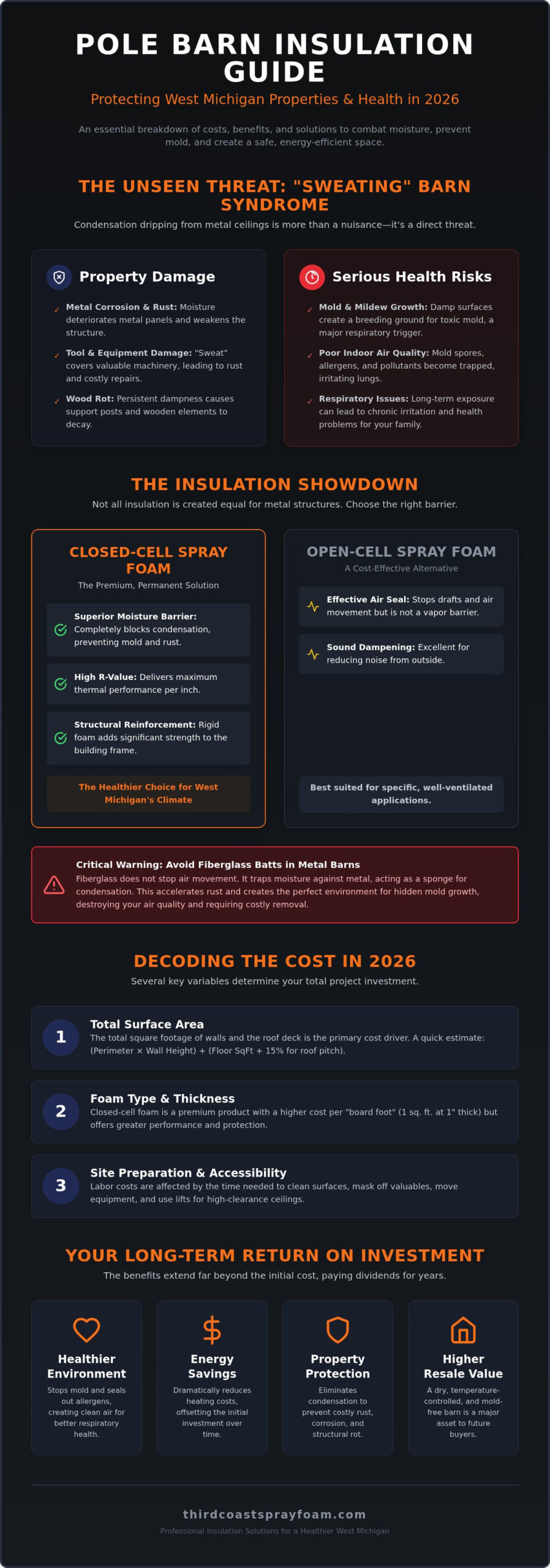
Calculating the total investment for your project involves more than just looking at the footprint of the building. The Building insulation needs of a metal structure are unique, especially regarding how the material bonds to the substrate. Several variables dictate the pole barn insulation cost Michigan contractors quote, starting with the total square footage of the walls and roof deck. We also evaluate the choice between open-cell and closed-cell spray foam based on how you plan to use the space. Closed-cell foam is often preferred for its ability to provide structural reinforcement and a built-in vapor barrier.
It’s common for owners to overlook preparation as a cost driver. For the insulation to create a healthy, mold-free environment, metal surfaces must be free of dust and oils. If your barn is currently filled with equipment, we don’t just spray over it. The time required to mask off valuables or move machinery will impact the labor hours. Additionally, the accessibility of the ceiling and wall cavities matters. High-clearance barns require lifts. This ensures the spray rig can reach every corner for a seamless air seal.
How to Estimate Your Pole Barn’s Surface Area
You can estimate your surface area by multiplying the perimeter of your barn by the wall height. For the roof deck, calculate the floor square footage and add 15 percent to account for the roof pitch. Accurately measuring your space is the first step in determining the pole barn insulation cost Michigan residents can expect for their specific layout. In coastal communities like Muskegon or Grand Haven, “sweating” ceilings are a major threat to indoor air quality and respiratory health. These areas require a specific thickness of foam to move the dew point outside the building envelope. In 2026, board-foot pricing remains the standard, representing the cost for a one-inch thick layer of foam covering one square foot.
Closed-Cell vs. Open-Cell Spray Foam: Pricing and Performance
Choosing between closed-cell and open-cell spray foam is a decision that impacts the longevity of your building. Closed-cell foam is the premium choice for metal structures. It provides an exceptionally high R-value and adds significant structural reinforcement to the frame. While the initial pole barn insulation cost Michigan residents encounter for closed-cell is higher, it’s a permanent investment. Open-cell foam can serve as a cost-effective alternative for ceilings in specific ventilated barns. We always caution against fiberglass batts. They represent a hidden financial burden because they fail to stop air movement. This allows moisture to collect against metal, breeding mold that eventually destroys indoor air quality and requires total removal.
Air sealing is about more than just temperature; it’s about your physical well-being. Proper sealing stops the infiltration of outdoor allergens and pollutants. By creating a monolithic barrier, we prevent the “stack effect” that pulls dust and irritants into your workspace. This creates a controlled environment that supports better respiratory health for anyone spending long hours in the shop.
Why Closed-Cell is the Healthier Choice for West Michigan
West Michigan’s high humidity levels make moisture control a top priority for any property owner. Closed-cell foam acts as a superior moisture barrier. It prevents the condensation that leads to mold and mildew growth on metal surfaces. By stopping these environmental triggers, you protect your lungs from long-term irritation and respiratory issues. This holistic approach to building health is detailed in The Ultimate Guide to Pole Barn Insulation. If you’re ready to secure your property and health, you can consult with our local experts to find the right fit for your barn.
The Long-Term ROI: Savings, Credits, and Health
Investing in your property yields returns that go far beyond daily comfort. In cities like Lansing or Holland, the cost of heating an uninsulated metal building can be staggering. Without a proper thermal envelope, your furnace works overtime just to keep up with the Michigan chill. Professional spray foam reduces these monthly utility expenditures significantly, eventually offsetting the initial pole barn insulation cost Michigan residents face. It also protects the building itself from silent killers like metal corrosion. When metal “sweats,” the resulting moisture leads to rust on the panels and rot in the support posts. By eliminating condensation, you avoid the massive cost of structural repairs that often plague older barns. An insulated barn also commands a higher resale value. Prospective buyers in West Michigan look for spaces that are already temperature-controlled and free from the respiratory triggers associated with mold.
Maximizing the 2026 Energy Efficient Home Improvement Credit
To further enhance your workspace and protect your concrete foundation from wear and chemicals, you can visit Epoxy Solutions™ to explore premium resinous flooring systems that complete your barn’s transformation.
The financial landscape for property upgrades shifted significantly on January 1, 2026. While the federal 25C tax credit was terminated, Michigan residents now have access to the MiHER program. This includes the HOMES and HEAR initiatives funded by the federal government but managed by the state. These rebates provide substantial support, especially for low and moderate-income households in the Grand Rapids area. To qualify for these funds, your insulation project must meet rigorous energy-saving thresholds. We help our clients by providing the precise technical documentation and R-value verification needed for a professional installation. This ensures you receive the maximum financial return while permanently improving your indoor air quality. You can learn more about Maximizing Your Energy Efficient Home Improvement Credit through these new state-administered channels. Choosing the right material helps offset the initial pole barn insulation cost Michigan owners pay by securing these long-term rebates.
Secure Your Property and Health for the Long Term
Your pole barn is a significant investment. Protecting it from the destructive effects of Michigan’s humidity is essential for both structural integrity and your family’s well-being. By understanding the pole barn insulation cost Michigan property owners face, you can make an informed choice that eliminates “sweating” metal and the respiratory health risks associated with mold growth. Our team has served as local Fruitport experts since 2013. We prioritize a health-first approach to mold prevention for neighbors across the region, from Grand Rapids to Muskegon. Choosing professional spray foam ensures your workshop remains a dry, energy-efficient space for decades. It’s time to stop the condensation and start enjoying a cleaner, more stable indoor environment. Get Your Free Pole Barn Insulation Estimate in West Michigan today and take the first step toward a more durable structure.
Frequently Asked Questions
How much does it cost to insulate a 30×40 pole barn in Michigan?
The total pole barn insulation cost Michigan residents pay for a 30×40 structure depends on the wall height and the specific foam density chosen. We calculate the total surface area of your walls and roof deck rather than just the floor square footage. This ensures every metal panel is sealed. Prep work, like moving equipment or cleaning the steel substrate, also influences the final project scope.
Will insulating my pole barn stop the ceiling from sweating?
Yes, professional spray foam stops the “sweating” barn effect by creating a seamless thermal barrier between the cold metal and warm interior air. This prevents condensation from forming and dripping onto your equipment. By keeping the environment dry, you eliminate the moisture needed for mold growth. This is a critical step for maintaining good indoor air quality and protecting your respiratory health.
Is spray foam safe for my respiratory health in a confined workshop?
Spray foam is safe for your workshop environment once the material has fully cured. It actually helps protect your respiratory health by creating an airtight seal that keeps outdoor pollutants, dust, and allergens from entering your space. This results in much cleaner air compared to unsealed buildings. We prioritize high quality installation to ensure your indoor air quality remains at peak levels for years.
Can I insulate only the ceiling of my pole barn to save money?
You can insulate only the ceiling, but we generally recommend a complete building envelope for the best results. Insulating just the roof deck stops the most visible condensation, yet uninsulated walls still allow heat loss and moisture issues. A holistic approach ensures your pole barn insulation cost Michigan investment provides the maximum protection against mold while keeping your heating bills as low as possible.
How long does it take to recoup the cost of pole barn insulation?
Recouping your investment happens through immediate energy savings and long term property value increases. In 2026, the Michigan Home Energy Rebate (MiHER) program provides substantial financial support that speeds up your return on investment. Additionally, you avoid the high costs of structural repairs caused by metal rust and wood rot. Most owners see the value reflected in lower monthly utility expenditures right away.
Does spray foam insulation prevent mold and mildew in metal buildings?
Closed-cell spray foam is exceptionally effective at preventing mold and mildew because it acts as both an air seal and a vapor barrier. It eliminates the damp conditions where mold spores thrive on metal surfaces. By keeping your structure dry and controlled, you prevent the environmental triggers that can lead to long term respiratory health issues. It’s a permanent solution for a healthier workshop.
Disclaimer
Information provided is for general educational purposes. Individual needs and circumstances vary. Speak to an experienced professional to get the correct information for your situation.