
Could your attic be the hidden source of those persistent seasonal allergies? It’s frustrating to pay high heating bills while still noticing a musty, damp odor drifting from upstairs. You likely suspect your old insulation isn’t doing its job anymore, and you’re right to worry about what’s hiding in those dusty layers. Understanding the attic insulation removal cost Michigan homeowners face is the first step toward reclaiming your home’s air quality and structural integrity.
This guide reveals the investment required to clear out contaminated materials and why this “health reset” is vital for your family’s respiratory wellness. We’ll break down 2026 price expectations for West Michigan and explain how professional removal prevents mold spores and rodent pathogens from circulating through your living spaces. Discover how starting with a clean slate leads to lower energy costs and a safer environment for everyone under your roof.
Key Takeaways
- Learn how square footage and attic accessibility influence the attic insulation removal cost Michigan homeowners can expect for 2026 projects.
- Discover how clearing out old, matted material stops the “chimney effect” from pulling mold spores and allergens into your home’s air supply.
- Understand how professional-grade vacuum systems protect your family’s respiratory health by keeping contaminants out of your living areas during the process.
- See why a clean slate is the essential first step for effective air sealing and maximizing the performance of new spray foam or blown insulation.
Factors Influencing Attic Insulation Removal Cost in Michigan
Calculating the attic insulation removal cost Michigan homeowners pay depends on several structural variables. While total square footage provides the baseline, accessibility often dictates the labor hours required. Tight crawl spaces or low roof pitches common in older regional architecture make maneuvering difficult. If our team has to work in confined quarters with limited head height, the project timeline naturally extends to ensure safety and precision. We don’t cut corners because your home’s structural integrity is at stake.
The physical properties of your existing building insulation materials also play a significant role. Loose-fill cellulose is often easier to extract using high-powered vacuum systems. In contrast, old fiberglass batts that have become matted or water-damaged require labor-intensive handling. When these materials are contaminated by rodent droppings or mold, the complexity increases. We treat these scenarios with extreme care. Neglecting contaminated insulation can lead to chronic respiratory issues as spores circulate through your home. Ensuring a clean removal protects your family’s long-term health.
Regional Cost Drivers in West Michigan
Housing stock in Grand Rapids and Muskegon often features unique challenges like lake-effect humidity. This heavy moisture accelerates material degradation and creates a breeding ground for mildew. These environmental triggers are a primary cause of poor indoor air quality in West Michigan. Local factors that shift the attic insulation removal cost Michigan residents see include disposal fees and county-specific regulations. We’ll account for these regional specifics to ensure your attic reset is handled according to current safety standards, prioritizing both structural integrity and your home’s wellness.
Beyond the Price: Why Removal is Critical for Respiratory Health
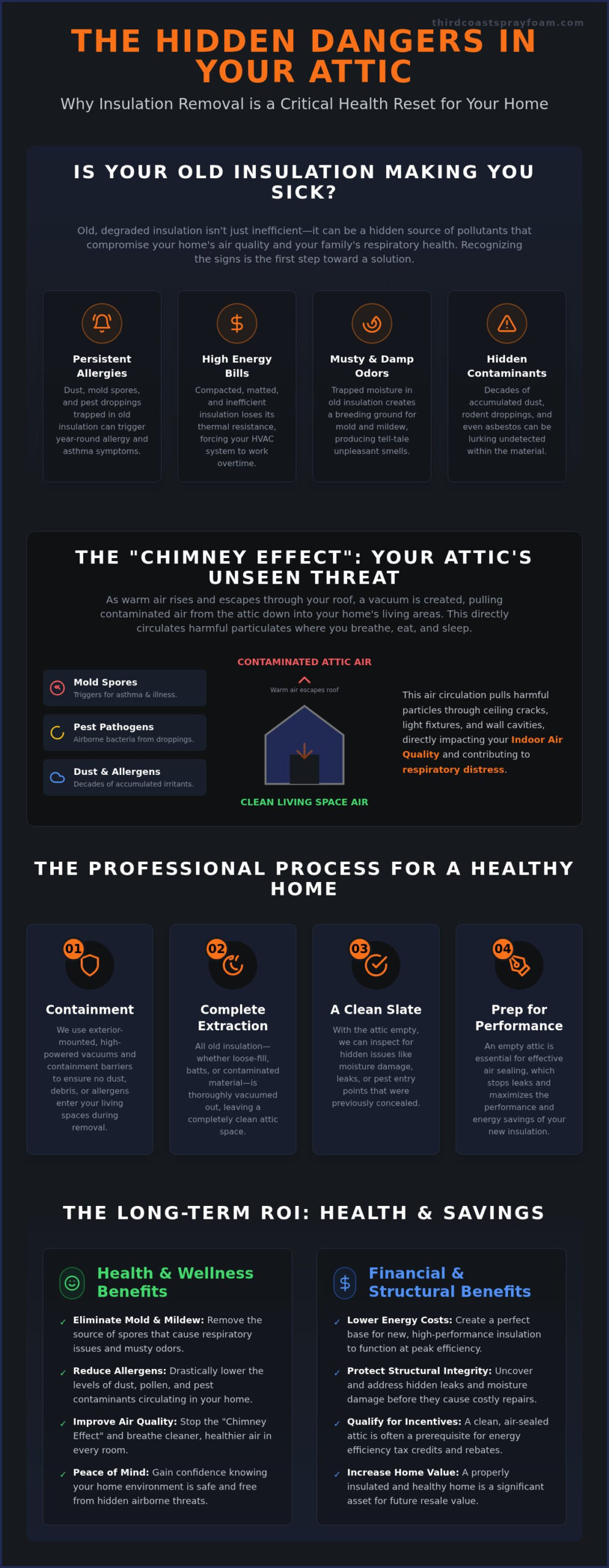
Most homeowners focus on the financial aspect, but the health implications are just as significant. The “Chimney Effect” is a primary concern for local families. As warm air rises and escapes through the roof, it creates a vacuum that pulls attic air down into your living spaces. This process drags dust, allergens, and mold spores directly into the rooms where you sleep and eat. When evaluating the attic insulation removal cost Michigan companies provide, it’s vital to view the project as a health necessity rather than just a utility upgrade.
Old insulation also masks structural issues that threaten your home. It hides roof leaks and moisture buildup that fuel mold colonies. In older homes, you might even encounter asbestos-contaminated vermiculite insulation, which requires specialized handling to protect your lungs. Pest waste is another hidden danger. Rodent droppings and bat guano harbor pathogens that become airborne as insulation fibers break down. Removing these contaminants is the only way to stop the cycle of poor air quality.
Indoor Air Quality and Mold Prevention
Michigan’s humid summers often cause condensation in poorly ventilated attics. This moisture degrades fiberglass and cellulose, turning them into a “food source” for mold. Chronic exposure to attic moisture and mold spores directly correlates with increased risks of asthma and other respiratory illnesses. Professional removal clears this organic debris, ensuring your new insulation removal and replacement project starts with a sanitized foundation. We ensure that every trace of contaminated material is gone before we begin our holistic air-sealing process. By eliminating these triggers, you create a permanent barrier against respiratory distress and improve your home’s total environmental safety. Understanding the total attic insulation removal cost Michigan residents pay involves looking at the value of a clean home air supply.
The Professional Removal Process and Long-Term ROI
Professional extraction is the only way to guarantee that decades of accumulated dust and allergens don’t migrate into your living space. We utilize high-powered vacuum systems located outside the home to pull debris through heavy-duty hoses; this maintains negative pressure in the attic. This containment strategy is a critical factor in the attic insulation removal cost Michigan homeowners pay, as it prevents cross-contamination. Once the space is empty, we achieve a “clean slate.” This allows us to perform precise air sealing on bypasses and top plates, a step that is physically impossible when old material is in the way.
Beyond the immediate health reset, this process prepares your home for significant financial incentives. Removing old, inefficient material is often the prerequisite for qualifying for the Energy Efficient Home Improvement Credit. This federal tax credit helps offset the cost of upgrading to modern, high-performance solutions.
Investing in a Healthier Michigan Home
Our systematic approach ensures every corner of your attic is sanitized. We begin with site preparation, using protective sheeting to create a sealed path from the attic hatch to the exterior. After the bulk material is vacuumed, we perform a detailed hand-clean of the joist bays and treat the floor with antimicrobial agents to kill lingering mold spores.
When comparing the initial attic insulation removal cost Michigan residents face against the long-term savings of new blown-in insulation, the ROI is clear. New materials provide consistent thermal resistance and prevent the trapped moisture that leads to wood rot. Professional handling also identifies potential health risks of asbestos that might be hidden in older layers. This proactive maintenance extends the life of your roof deck and ensures a stable, energy-efficient environment for decades.
Secure Your Home’s Health and Efficiency
Investing in your attic’s health is a pragmatic decision for your family’s long-term well-being. Clearing out old, contaminated material is the only way to stop the circulation of mold spores and allergens through your living spaces. While the attic insulation removal cost Michigan residents encounter depends on specific structural factors, the benefits of a clean slate are undeniable. You’ll enjoy improved respiratory health and a more energy-efficient environment once moisture-trapping debris is gone.
Since 2013, we’ve served West Michigan with a focus on technical precision and local reliability. Our professional-grade dust-containment systems ensure that contaminants stay out of your home during the extraction process. We’re ready to help you transition to a healthier, more durable home starting with a comprehensive, health-focused inspection. Get Your Free Insulation Removal Estimate in West Michigan and take the first step toward a safer indoor environment today.
Frequently Asked Questions
Can I just put new insulation over the old stuff in my Michigan attic?
It’s rarely recommended to layer new material over old, especially in our humid Michigan climate. Doing so often traps moisture and existing mold spores against your attic floor, which can lead to structural rot and poor indoor air quality. Removing the old material first is the only way to perform essential air sealing and ensure your home’s respiratory health isn’t compromised by hidden contaminants.
How do I know if my attic insulation is contaminated with mold?
Look for visible dark spotting, matted textures, or a lingering musty odor that intensifies during humid summer months. If your family experiences unexplained coughing or sneezing when the HVAC runs, mold spores may be circulating from the attic. Identifying these environmental triggers early is vital for protecting your respiratory health and calculating the total attic insulation removal cost Michigan projects require for a safe home.
Is attic insulation removal covered by the Energy Efficient Home Improvement Credit?
While the tax credit primarily targets the installation of energy-efficient materials, professional removal is often an essential component of the qualifying project. Proper air sealing and insulation upgrades, which require a clean attic floor to be effective, fall under the 2026 federal guidelines for the Energy Efficient Home Improvement Credit. We recommend consulting a tax professional to verify how preparation labor fits into your specific claim.
How long does the professional insulation removal process typically take?
Most standard West Michigan residential projects are completed within a single day. Our team uses high-powered vacuum systems to extract debris quickly while maintaining strict dust containment to protect your living areas. Larger homes or those with significant contamination might require a second day to ensure the space is thoroughly sanitized and ready for a fresh installation of blown-in or spray foam insulation.
Disclaimer
Information provided is for general educational purposes. Individual needs and circumstances vary. Speak to an experienced professional to get the correct information for your situation.