
You walk into your West Michigan barn on a humid morning only to find your expensive equipment covered in “sweat” dripping from the metal siding. It’s a common frustration for owners from Grand Rapids to Muskegon, but that moisture isn’t just a nuisance. It’s a threat to your structural integrity and a breeding ground for mold that can compromise your respiratory health. Investing in professional spray foam insulation for pole barn walls is the most effective way to keep your environment dry and safe year-round.
This article explains how closed-cell spray foam creates a permanent air seal to eliminate condensation and improve indoor air quality. We’ll show you how this holistic approach protects your metal walls from corrosion while ensuring a healthy workspace for you and your family. Discover how a properly insulated barn preserves your equipment and your well-being through every Michigan season.
Key Takeaways
- Understand how the West Michigan climate creates a “condensation-mold cycle” in metal buildings that can compromise your respiratory health and equipment.
- Learn why high-performance spray foam insulation for pole barn walls is the only solution that provides a permanent air seal and moisture barrier.
- Get clarity on metal siding warranties and the specific installation methods that protect your structural investment from rust and corrosion.
- Discover the safety and air quality advantages of professional closed-cell applications over DIY kits for multi-purpose spaces like workshops and animal housing.
The Science of Condensation: Why Michigan Pole Barns Sweat
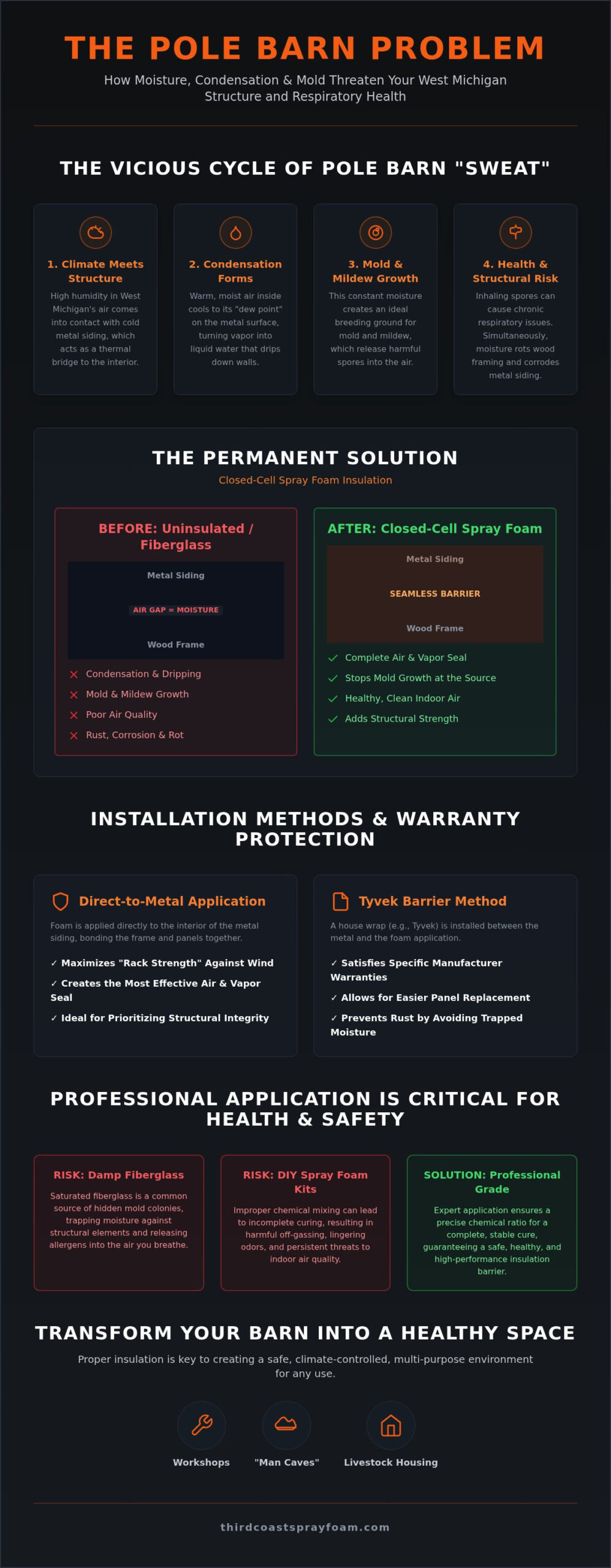
Michigan weather is notoriously unpredictable. In West Michigan, high humidity often meets the cold surface of metal siding, creating a unique set of challenges for property owners. This metal acts as a thermal bridge, quickly transferring outside temperatures to the interior of your structure. When warm, moist air inside the barn touches these cold walls, it reaches the “dew point” and transforms into liquid water. This constant dripping isn’t just a maintenance headache; it initiates a destructive condensation-mold cycle that can rot your wood framing and ruin your equipment.
Trapped moisture behind traditional fiberglass or on bare metal creates the perfect environment for mildew. For barn owners in Grand Rapids or Muskegon, this is a significant health concern that often goes overlooked. Inhaling mold spores can lead to chronic respiratory issues for both humans and livestock, turning your workspace into a hazard. Utilizing professional Spray foam insulation is the most reliable way to break this cycle and protect your indoor air quality. It’s a pragmatic investment in your long-term physical well-being.
How Closed-Cell Foam Stops the Mold Cycle
Closed-cell foam provides a dual benefit by acting as high-performance insulation and a seamless vapor barrier. By adhering directly to the metal, it eliminates the air gap where moisture typically collects. This “health-first” seal prevents the growth of environmental allergens and ensures that your workshop remains a safe place to breathe. Choosing spray foam insulation for pole barn walls turns a damp, “sweating” structure into a controlled, healthy environment. It stops the mold cycle before it starts, providing the security you need for your structural investment.
Navigating Metal Warranties and Best Installation Practices
A primary concern for many Michigan property owners is whether installing spray foam insulation for pole barn walls will void their metal siding warranty. It’s a valid question. While most modern metal manufacturers support spray foam, some require a specific separation between the foam and the metal skin. We prioritize your long-term investment by matching our installation methods to your specific material requirements. This attention to detail ensures your structure remains protected from both the elements and potential legal hurdles with manufacturers.
Applying closed-cell foam directly to the metal provides the highest level of structural support. This process significantly increases “rack strength,” which helps your pole barn withstand the heavy wind loads common in West Michigan. According to the Residential Spray Foam Guide, this application creates a superior air and vapor seal. By bonding the frame and siding together, the foam acts as a structural adhesive. It’s a pragmatic way to add durability to a post-frame building while ensuring a healthy indoor environment.
The Tyvek Barrier: Protecting Your Investment and Air Quality
The barrier method involves a precise three-step process: we secure a house wrap to the girts, install the metal panels, and then apply the foam to the interior side of the wrap. This technique satisfies manufacturer requirements while making it much easier to replace individual metal panels if storm damage occurs. Choosing a barrier method for your spray foam insulation for pole barn walls prevents moisture from being trapped against the metal skin, which stops rust and preserves indoor air quality. It’s always best to consult with a specialist about closed cell spray foam to determine which approach fits your building’s needs.
Transforming Your Barn into a Healthy Multi-Purpose Environment
In cities like Grand Rapids and Lansing, the traditional pole barn is rapidly evolving. Many local owners now utilize these structures as climate-controlled “man caves,” dedicated workshops, or even livestock housing. These multi-purpose uses demand a much higher standard for indoor air quality than a simple storage shed. If your walls currently contain old, damp fiberglass, professional insulation removal is a critical first step. Saturated fiberglass frequently hides established mold colonies that trigger chronic respiratory issues. Replacing these failing materials with professional-grade closed cell spray foam ensures your new workspace remains healthy and moisture-free.
Avoiding the risks of retail DIY kits is essential for a safe environment. These kits often lead to improper chemical mixing and incomplete curing, which results in lingering odors and persistent off-gassing. This can be dangerous in enclosed spaces where people or animals spend significant time. In contrast, professional spray foam insulation for pole barn walls is applied with precision equipment that ensures a stable, inert finish. It’s a secure, long-term choice for the well-being of your family and the longevity of your structure.
Professional Safety Standards for Indoor Air Quality
Respiratory safety remains our primary focus during every application. We employ industrial ventilation systems to manage airflow while the foam cures, facilitating a safe environment for immediate occupancy. Beyond the initial install, the resulting air seal acts as a permanent barrier against dust, pollen, and outdoor pests. This holistic system makes spray foam insulation for pole barn walls a superior choice for those who value clean air and a cleaner workspace. To see how this fits into your specific plans, review The Ultimate Guide to Pole Barn Insulation in Grand Rapids & West Michigan (2026) for a complete project roadmap.
Secure Your Investment and Your Health with Professional Insulation
Protecting your pole barn requires more than just a durable metal shell. You need a controlled environment that prevents structural decay and respiratory hazards. By choosing professional spray foam insulation for pole barn walls, you eliminate the destructive condensation-mold cycle. It’s a permanent fix. This creates a space that is safe for your equipment, your livestock, and your family. We provide health-conscious solutions that integrate structural integrity with superior indoor air quality for your peace of mind.
As a locally owned specialist in Fruitport, Michigan, we use professional-grade equipment to ensure a precise, stable application. We never use DIY kits. Your respiratory health and property value are too important to risk. Take the first step toward a drier, healthier multi-purpose barn today. Get Your Free Pole Barn Insulation Estimate in Fruitport, MI and experience the security of a permanent, expert solution.
Frequently Asked Questions
Does spray foam in a pole barn cause mold or rust?
No, professional closed-cell foam actually prevents mold and rust. It adheres directly to the siding, which eliminates the air gap where condensation forms. Without this “sweat,” the metal cannot oxidize, and mold has no moisture source to grow. This protection is vital for maintaining both structural integrity and a healthy environment for your lungs.
Will spray foam insulation void my pole barn’s metal siding warranty?
Not if you follow the correct installation protocols. Many manufacturers allow spray foam when applied over a barrier like house wrap. This method satisfies warranty conditions while providing the thermal benefits you need. We always verify your specific siding brand’s requirements to ensure your warranty stays intact while your barn stays dry and temperature-controlled.
Can I use open-cell foam for my pole barn walls in Michigan?
We don’t recommend open-cell foam for metal walls in West Michigan. Because open-cell foam is vapor-permeable, moisture can still migrate through it and condense against the cold metal. Closed-cell spray foam insulation for pole barn walls provides a built-in vapor retarder. This is the only way to ensure a moisture-free environment that resists the humid lake-effect air.
How does insulating my pole barn walls improve indoor air quality?
High-performance spray foam insulation for pole barn walls creates a seamless barrier that blocks common environmental triggers. It seals out dust, pollen, and pests that compromise indoor air quality. Most importantly, it eliminates the dampness that leads to mold growth. This reduction in airborne allergens and spores significantly improves respiratory health for anyone spending time inside the structure.
Is it safe to work in a pole barn immediately after spray foam is installed?
You should wait at least 24 hours before returning to work in your barn. While the foam cures, it releases odors and gases that require time to dissipate. We use industrial ventilation during the process to facilitate safe air exchange. Following this waiting period ensures the indoor environment is completely inert and safe for your long-term respiratory health.
Disclaimer
Information provided is for general educational purposes. Individual needs and circumstances vary. Speak to an experienced professional to get the correct information for your situation.