
Did you know that up to one-third of your home’s heat can be lost through an under-insulated attic during a Michigan winter? We understand the frustration of drafty rooms and the rising anxiety that comes with skyrocketing utility bills. Beyond the financial drain, old or insufficient insulation often hides moisture issues that lead to mold, directly impacting your family’s respiratory health and indoor air quality. If you are wondering how much does blown-in insulation cost in Michigan, you are likely looking for a permanent solution that provides both financial security and a healthier living environment.
This 2026 guide provides a clear look at the variables affecting your project, from regional labor trends in areas like Detroit to the specific R-values required for our Climate Zone 5 environment. We’ll explore how professional blown insulation acts as a holistic system to prevent air leakage and manage moisture. You will also find details on current incentives, including the $600 DTE Energy rebate and federal tax credits, to help you make an informed, pragmatic decision for your home’s long-term efficiency and structural integrity.
Key Takeaways
- Understand why Michigan’s Climate Zone 5 requires R-49 to R-60 levels to stop heat loss and protect your home’s structural integrity.
- Discover how much does blown-in insulation cost in Michigan when factoring in 2026 material prices, square footage, and necessary labor for a professional finish.
- Identify the critical link between old insulation and respiratory health by learning how professional removal and replacement prevents mold growth and poor air quality.
- Evaluate the long-term ROI of professional installation over DIY methods to avoid safety hazards like dust inhalation and uneven thermal coverage.
- Learn how to spot high-quality local quotes that prioritize air sealing and safety over “low-ball” bids that skip essential steps.
Understanding Blown-In Insulation Costs in Michigan’s Climate
Michigan’s weather is notoriously unpredictable. From the humid summers along the Lake Michigan shoreline to the sub-zero wind chills that grip the state in January, your home’s thermal envelope is under constant pressure. When you start investigating how much does blown-in insulation cost in Michigan, it’s vital to view the expense as a long-term investment in both structural integrity and family wellness. Our state’s unique climate means that “standard” insulation levels used in milder regions simply won’t cut it here. A project’s total is influenced by the depth of material needed to combat our specific environmental stressors, including the persistent moisture that can compromise indoor air quality.
Professional installation offers a level of precision that retail-grade rental blowers can’t match. High-performance equipment ensures that the material is distributed at the correct density to prevent settling. This density is critical for maintaining a consistent thermal barrier and preventing the “stack effect,” where warm air escapes through the attic and pulls cold, potentially contaminated air from crawl spaces into your living areas. By creating a uniform seal, we help you manage moisture levels that could otherwise lead to mold growth, protecting your family’s respiratory health and ensuring the air you breathe remains clean and safe.
The Michigan R-Value Standard
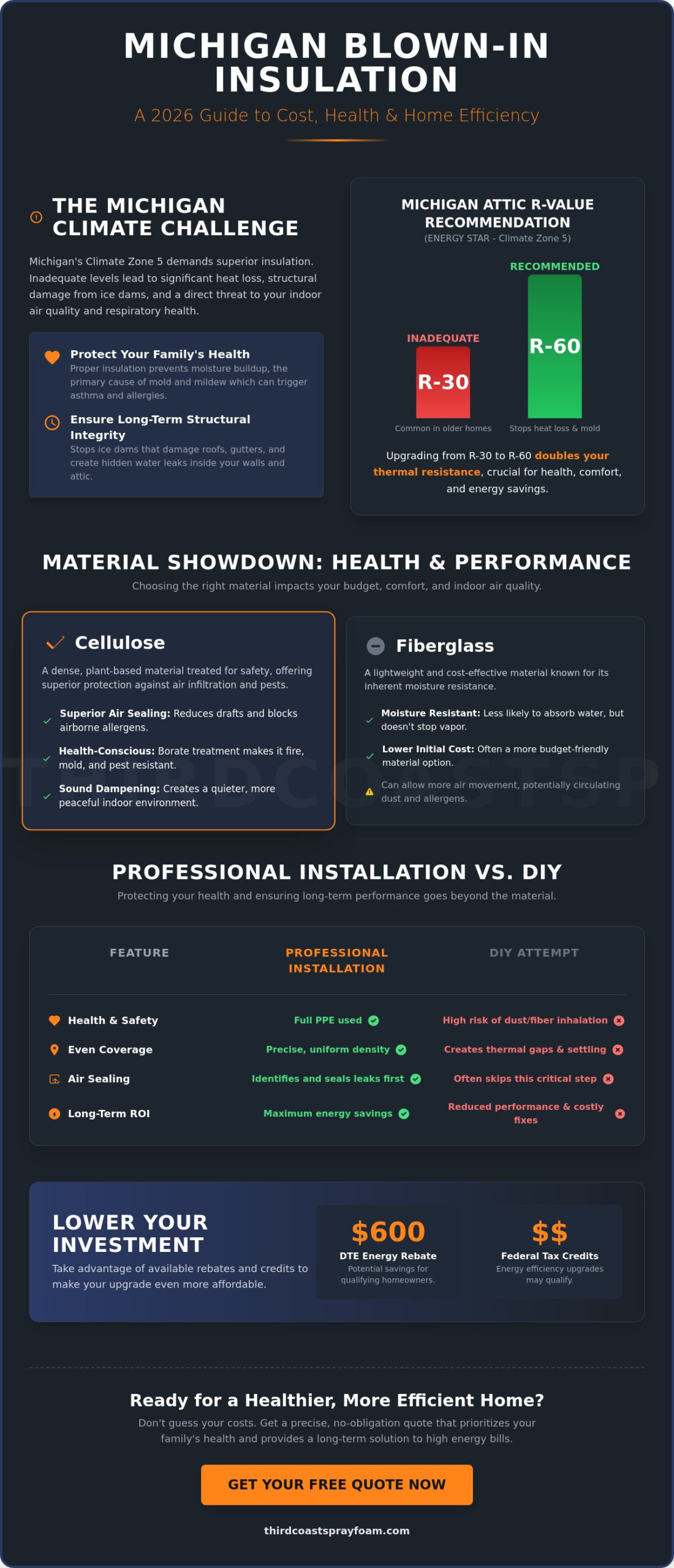
The efficiency of any insulation material is measured by its R-value, which represents its resistance to heat flow. In Michigan, which falls primarily within Climate Zone 5 and Zone 6, the standards are rigorous. While southern states might get by with R-30, ENERGY STAR recommends R-49 to R-60 for Michigan attics. This extra depth is a pragmatic necessity. Without it, heat from your home escapes into the attic, melting snow on the roof and leading to ice damming. This is a common and costly sight in cities like Grand Rapids. These ice dams don’t just damage shingles; they cause water to back up into your soffits, creating damp environments where mildew thrives.
Regional Price Variations: West Michigan vs. National Averages
Local factors play a significant role when calculating how much does blown-in insulation cost in Michigan. In the Detroit metro area, labor costs often sit about 10% above the national average due to the prevalence of skilled trade unions. On the west side of the state, in communities like Muskegon and Holland, prices are influenced by the seasonal rush. Homeowners often wait until the first frost to call, which can impact contractor availability. Additionally, local building codes in Michigan are strictly enforced to ensure homes can withstand heavy snow loads. Investing in a professional who understands these regional requirements ensures your project meets safety standards and provides the maximum possible ROI through lower monthly utility bills.
Primary Cost Factors: Materials, Square Footage, and R-Value
Calculating the total project investment requires looking beyond a simple per-square-foot price. When homeowners ask how much does blown-in insulation cost in Michigan, they often think purely about the floor area of their attic. However, the volume of material is dictated by the depth required to reach modern energy standards. Transitioning from an outdated R-30 layer to a robust R-60 barrier doubles the material volume, but it’s a pragmatic, one-time investment that pays dividends in comfort and health for decades. Beyond raw materials, the complexity of your home’s architecture, such as a steep roof pitch or cramped crawl spaces, influences the labor hours required to ensure every corner is properly sealed.
Cellulose vs. Fiberglass: Performance and Price
Choosing between loose-fill fiberglass and treated cellulose is a decision that impacts both your budget and your indoor environment. Fiberglass is a lightweight, cost-effective option that resists moisture well. In contrast, professional-grade cellulose is denser and often treated with borates. This treatment provides essential fire-retardant properties and acts as a deterrent for pests. For Michigan residents concerned about Poor Air Quality and Mold, cellulose is frequently preferred for its superior sound-dampening qualities and its ability to prevent the air movement that carries allergens. While the material cost per square foot varies, the long-term stability of cellulose makes it a reliable choice for maintaining a healthy respiratory environment.
Labor and Equipment: Why the Pro Bid Differs from DIY
The difference between a professional installation and a weekend DIY project lies in the precision of the equipment and the thoroughness of the preparation. High-volume commercial blowing machines provide a consistent density that rental units simply cannot achieve. This prevents the material from settling prematurely, which would otherwise leave gaps in your thermal defense. Our professional process includes a comprehensive safety audit of your attic’s electrical systems and venting. We don’t just blow in material; we perform essential prep work, such as:
- Sealing hidden air bypasses around chimneys and light fixtures.
- Installing baffles to ensure soffit vents remain unobstructed.
- Protecting mechanical venting to prevent moisture buildup.
This level of detail is what prevents the “stack effect” from pulling pollutants into your living areas. If you’re unsure about your current levels, a professional assessment of your blown insulation can identify hidden gaps that lead to energy loss. Understanding how much does blown-in insulation cost in Michigan means accounting for these critical safety steps that protect your home’s structural integrity and your family’s well-being.
The “Hidden” Costs of Poor Air Quality and Mold
When homeowners evaluate how much does blown-in insulation cost in Michigan, they often overlook the steep price of inaction. Leaving old, degraded, or moisture-damaged material in your attic isn’t just an efficiency issue; it’s a significant health risk for everyone in the home. The “stack effect” describes the natural movement of air through a building. As warm air rises and escapes through the roof, it creates a vacuum that pulls air from the attic and crawl space into your primary living areas. If your attic contains mold spores, dust mites, or degraded fibers, your family breathes those particles every day. This constant exposure can lead to chronic respiratory issues, persistent coughing, and aggravated asthma symptoms.
Professional moisture management is a critical component of the insulation process. We treat the attic as a holistic system where thermal resistance and air quality are intertwined. By addressing the source of dampness and air leakage, we stop the cycle of environmental triggers that compromise your indoor air quality. Investing in a clean, well-regulated attic space is a pragmatic step toward long-term physical well-being and financial security, as it prevents the need for expensive mold remediation in the future.
Insulation Removal: When and Why it is Necessary
Sometimes, adding new material on top of the old is a mistake. Contaminated insulation acts as a reservoir for pollutants. You should consider professional Insulation Removal if you notice signs of pest infestations, such as droppings or nesting materials, or if you spot dark staining on the joists that indicates mold growth. While some might consider a DIY approach to removal, the health risks are substantial. Disturbing old insulation without high-powered, HEPA-filtered vacuum systems releases concentrated pockets of mold spores and allergens into the air. We ensure a clean slate, removing every trace of debris to provide a sanitary foundation for your new thermal barrier.
Preventing Mold and Mildew with Proper Ventilation
A healthy attic requires a balance between heat retention and airflow. Without proper ventilation, the warm, moist air from your showers and cooking can condense on the underside of your roof deck. This moisture is the primary fuel for mildew. We utilize baffles and soffit vents to maintain a clear channel for air to move from the eaves to the peak. This intentional airflow regulates the temperature of the roof deck and carries away excess humidity before it can settle into the insulation. By maintaining a dry environment, you effectively eliminate the moisture-rich conditions that serve as mold-related respiratory triggers, protecting both your roof’s structural integrity and your family’s lungs.
Professional Installation vs. DIY: Safety and Long-Term ROI
The lure of big-box store rentals and “free” blower promotions often masks the true complexity of an attic upgrade. When you calculate how much does blown-in insulation cost in Michigan, it’s vital to weigh the upfront savings of a DIY project against the potential for long-term health and structural costs. Attics are hazardous environments. Beyond the risk of falling through ceiling joists or suffering heat exhaustion in a cramped space, DIYers frequently lack the industrial-grade equipment needed for uniform distribution. Without precise R-value distribution, you end up with “thin spots” that lead to thermal bridging and higher energy bills, negating your initial savings within just a few seasons.
Professional labor includes a critical step that most homeowners skip: air sealing. Simply blowing new material over existing air leaks is like putting on a heavy coat without zipping it up. We identify and seal hidden bypasses around plumbing stacks, recessed lights, and top plates. This meticulous prep work ensures your new blown insulation performs at its peak efficiency. It also prevents the “stack effect” mentioned earlier, ensuring that your home’s thermal envelope remains a solid barrier against both cold air and airborne pollutants. Professional warranties further secure your investment, providing peace of mind that your home’s structural integrity is protected for decades.
Respiratory Health and Safety During Installation
Respiratory health is a primary concern during any insulation project. Older attics often contain decades of accumulated dust, pest debris, or degraded fibers that become airborne the moment they’re disturbed. Professional teams utilize high-capacity, HEPA-filtered vacuum systems and specialized personal protective equipment (PPE) to contain these particulates. We use specific techniques to maintain negative pressure, which prevents a “dust cloud” from drifting into your living room during the process. This attention to detail protects your family’s lungs and ensures that the indoor air quality of your home is improved, not compromised, by the installation work.
Maximizing Your Energy Efficient Home Improvement Credit
The financial benefits of a professional upgrade extend into tax season. Under the Federal 25C tax credit, homeowners can receive a credit of 30% for insulation materials, up to a maximum of $1,200 per year. Claiming this credit requires specific documentation and a clear breakdown of material costs that meet energy efficiency standards. Our professional team provides the necessary records to help you claim the maximum available credit. For a deeper look at how to navigate these incentives, read our guide on Maximizing Your Energy Efficient Home Improvement Credit in Grand Rapids, MI. To ensure your home is both healthy and efficient, request a professional attic audit today.
Getting a Precise Blown-In Insulation Quote in West Michigan
Finding a reliable answer to how much does blown-in insulation cost in Michigan requires a personalized assessment of your home’s unique structure. While online calculators provide rough estimates, they can’t account for the specific challenges found in West Michigan homes. A professional quote should be a comprehensive scope of work that prioritizes your family’s safety and comfort. When we visit your property in Muskegon or Grand Rapids, we look at the attic as an integrated system. We evaluate the existing material, check for moisture indicators, and ensure your ventilation is functioning correctly to prevent the moisture buildup that leads to mold.
It’s vital to be wary of “low-ball” bids. In the insulation industry, a significantly lower price often indicates that a contractor is cutting corners. They might skip the essential air sealing process or fail to install proper baffles. These skipped steps lead to poor indoor air quality and allow humid air to condense against your roof deck. This moisture creates a breeding ground for mildew, which eventually triggers respiratory health issues for the occupants below. A pragmatic investment in a qualified local partner ensures that the job is done right the first time, protecting your property’s value and your family’s long-term well-being.
To prepare for a professional estimate, ensure there’s a clear path to your attic access point. We’ll need to inspect the current insulation depth and the condition of the roof deck. Having your recent utility bills handy can also help us understand your home’s current energy performance and calculate the potential ROI of your upgrade.
Questions to Ask Your West Michigan Estimator
To ensure you’re hiring a specialist who values precision, we recommend asking direct questions during the walkthrough. You want to confirm that the team understands the specific environmental challenges of Kent and Ottawa counties. Consider these points:
- Do you include air sealing and baffle installation in the quote? These steps are non-negotiable for preventing the stack effect and managing attic moisture.
- How do you handle existing mold or moisture issues? A true professional won’t blow new material over active mold; they’ll recommend a clean slate to ensure a healthy foundation.
- Can you provide references from other homeowners in Kent or Ottawa county? Local reliability is the hallmark of a trusted advisor who understands our regional climate.
Why Third Coast Spray Foam is the Health-First Choice
We take immense pride in our role as a local partner dedicated to improving the living standards of our community. Our approach to Blown-In Insulation in Grand Rapids, MI: The Complete Attic Guide emphasizes a holistic solution. We don’t just sell a service; we provide a permanent investment in your home’s structural integrity. By combining technical expertise in both blown-in and spray foam solutions, we ensure your indoor air quality is protected from allergens and pollutants. We’re ready to help you achieve a more efficient, health-conscious home. Request your free, health-focused insulation estimate today and discover the difference of working with a team that values your security.
Securing Your Home’s Future Efficiency and Health
Investing in your attic is a pragmatic choice for the long-term stability of your Michigan home. We have explored how regional factors like the lake effect and specific R-value requirements influence how much does blown-in insulation cost in Michigan. A successful project balances upfront material costs with the lasting benefits of lower utility bills and improved indoor air quality. By prioritizing professional air sealing and moisture management, you prevent the mold growth that often triggers chronic respiratory issues. It’s about more than just numbers; it’s about the security of a dry, healthy living space.
Our team brings deep West Michigan expertise to every project, focusing on holistic solutions that treat your home as a single, integrated system. We ensure your attic is a clean, dry space that supports your family’s well-being rather than a source of allergens or pollutants. Whether you need old material removed or a fresh layer of blown insulation, we are here to act as your trusted local advisor. Take the first step toward a more secure and comfortable indoor environment today. Get Your Free Health-First Insulation Quote and let us help you build a more resilient home for years to come.
Frequently Asked Questions
Is blown-in insulation cheaper than spray foam in Michigan?
Blown-in insulation typically requires a lower initial investment compared to spray foam. While spray foam provides a superior air seal and higher R-value per inch, blown-in cellulose or fiberglass is a cost-effective way to achieve necessary thermal resistance. Homeowners often choose this option when they need to bring an attic up to code without the higher price point of chemical-based foam solutions. It remains a pragmatic choice for many budget-conscious families.
Can blown-in insulation help prevent mold growth in my attic?
Blown-in insulation prevents mold growth when it’s paired with professional air sealing and proper ventilation. By keeping warm, moist indoor air from entering the cold attic, it eliminates the condensation that fuels mildew. Professional installation ensures that soffit vents remain clear. This consistent airflow is essential for maintaining a dry environment, which protects your roof deck and prevents the development of mold-related respiratory triggers.
How long does it take to install blown-in insulation in an average Michigan home?
Most professional installations for a standard Michigan attic take between four to six hours to complete. This timeframe includes essential prep work, such as installing baffles and sealing air bypasses around light fixtures. Larger projects or those requiring the removal of old, contaminated material may extend into a full day. Our teams work efficiently to minimize disruption to your daily routine while ensuring a thorough, high-density application.
Will new insulation improve my home’s indoor air quality?
New insulation significantly improves indoor air quality by reducing the “stack effect.” When we seal air leaks and install fresh material, we prevent dust, allergens, and mold spores from being pulled from the attic into your living spaces. This creates a much cleaner breathing environment for your family. It’s a vital step for homeowners concerned about respiratory health and the long-term cleanliness of their indoor environment.
How much can I save on my Michigan energy bills with new blown-in insulation?
Homeowners typically see a reduction in heating and cooling costs of up to 15% to 20% after a professional upgrade. In the harsh Michigan climate, where winter temperatures frequently drop below freezing, these savings add up quickly. By reducing the workload on your furnace, you also extend the life of your HVAC system. It’s a results-oriented investment that pays for itself through lower monthly utility expenses over time.
Is it safe to stay in the house while blown-in insulation is being installed?
It’s perfectly safe for residents to remain inside during the installation process. Unlike some chemical applications, blown-in cellulose and fiberglass don’t require you to evacuate the premises. Our professionals use HEPA-filtered equipment to contain dust and particulates within the attic space. We take great care to ensure that the air in your living areas remains clean and that the entire process is as non-invasive as possible.
Does the state of Michigan offer specific rebates for attic insulation?
Michigan homeowners can access several financial incentives, including a $600 rebate from DTE Energy for the 2026 program year. Consumers Energy also offers rebates for upgrades that reach an R-49 rating. When you factor in these local utility programs alongside the 30% federal tax credit, the total investment becomes much more manageable. We recommend checking with your specific utility provider for current availability and their specific application requirements.
How do I know if my existing insulation needs to be removed before adding more?
Removal is necessary if your current material shows signs of moisture damage, mold, or pest infestations. If you’re researching how much does blown-in insulation cost in Michigan, remember that adding fresh material over contaminated layers can trap pollutants. If the old insulation is simply thin but dry and clean, we can often blow new material directly over it. A professional inspection is the only way to ensure a healthy result.
Disclaimer
Information provided is for general educational purposes. Individual needs and circumstances vary. Speak to an experienced professional to get the correct information for your situation.