
Address moisture before insulating. When insulating a finished basement in Michigan, first repair foundation cracks, direct outdoor water away from the home, and complete waterproofing if water has entered. Then choose a wall insulation system that manages moisture as well as heat loss.
A finished basement can still feel cold and damp. Covering up a moisture problem may contribute to mold, mildew, and poor indoor air quality. This guide explains how to address moisture, compare basement wall insulation options, and assess the factors that affect project costs and energy efficiency. It also outlines how insulation fits into a durable basement assembly, helping you make a practical decision for your Michigan home.
Key Takeaways
- Compare wall insulation by thermal performance and moisture management; closed-cell spray foam provides about R-6 to R-7 per inch.
- Before insulating, address water entry and create a continuous air barrier to help limit dampness, mold, and indoor air quality concerns.
- Basement project costs depend on the wall assembly, moisture repairs, access, and the finishing work involved.
- Proper basement insulation can reduce heating costs by 10-30% in typical Southeast Michigan homes, with energy savings depending on the home and project.
What is the best insulation for basement walls in Michigan?
Compare basement insulation by R-value, moisture control, and how the wall will be finished. Closed-cell spray foam is an option for foundation walls and rim joists.
Spray Foam Options
Closed-cell spray foam provides about R-6 to R-7 per inch, sealing gaps along concrete walls and rim joists. A minimum of 2 inches delivers roughly R-12 to R-14, while Michigan basement walls are commonly recommended at R-15 to R-19. Foam board offers another interior option at R-5 per inch. Fiberglass batts need a framed wall and an adequate air barrier; at rim joists, they can allow air movement and perform poorly. Before drywall, complete electrical and plumbing work, prepare the wall, apply insulation continuously, then frame for drywall.
Interior Versus Exterior Placement
Interior insulation is often practical in an existing finished basement because it avoids excavating around the foundation. Exterior insulation can shield the foundation from outdoor temperature swings, but requires access around the home. For interior walls, compare closed-cell spray foam and foam board based on available space, the target R-value, and moisture conditions. Properly installed insulation can warm wall surfaces and help reduce condensation and mold risk in cold corners.
Michigan Code and Inspection Requirements
Basement wall insulation needs can vary with a home’s location and construction. In Climate Zones 5 and 6, requirements specify R-15 continuous insulation or R-19 cavity insulation. Local jurisdiction and project scope can affect permit and inspection steps, so establish the local process before covering insulation with drywall. Where inspections apply, schedule them before the wall assembly is closed. Requirements can differ by climate zone and municipality, so don’t assume one home’s approval applies elsewhere. Check the planned assembly’s R-value against the applicable requirement.
How do I prevent moisture problems when insulating my basement?
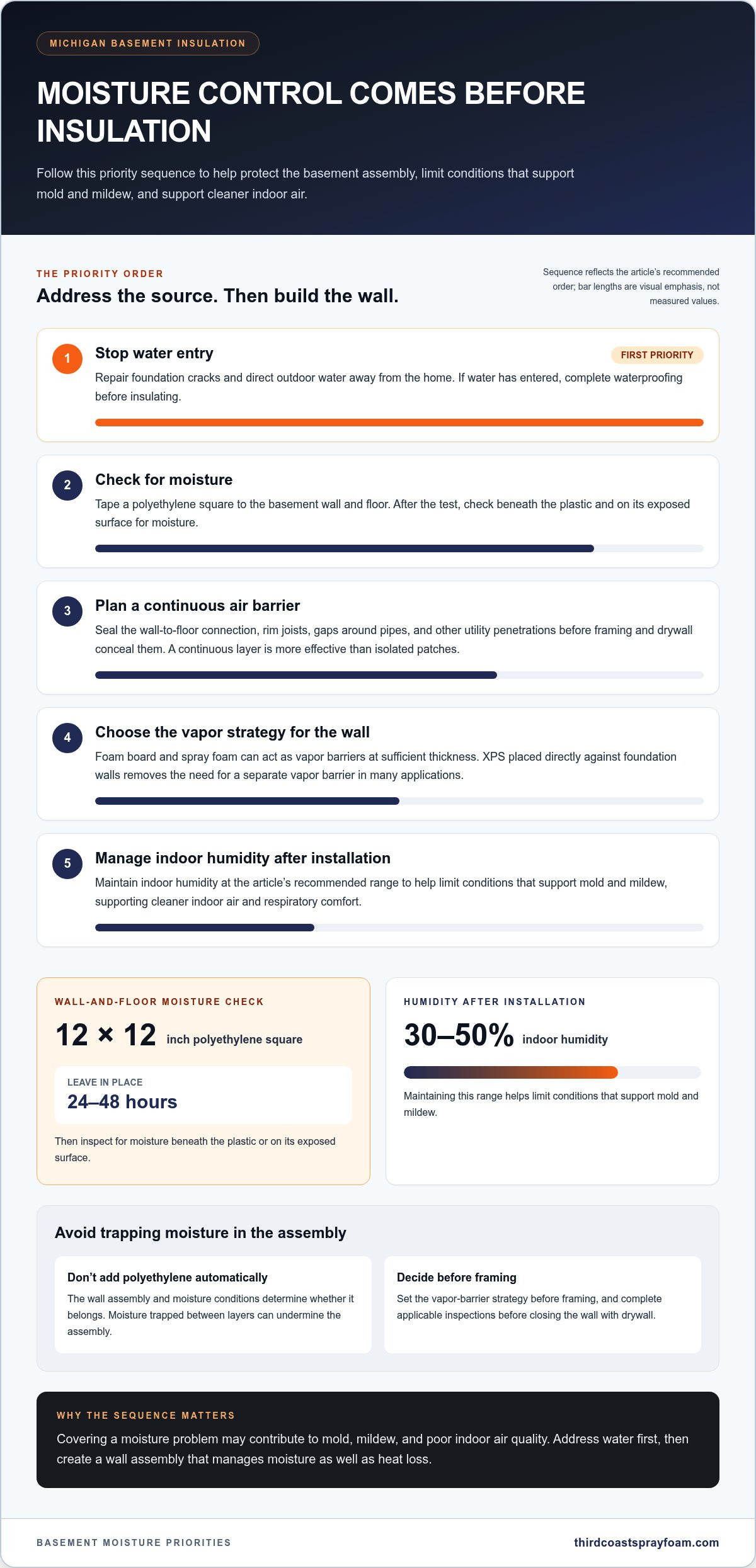
Before closing basement walls, consider bulk water, air leaks, and water vapor. Check for moisture and plan a continuous air barrier before framing and drywall conceal potential problems.
Basement Insulation Air Barriers
An air barrier limits drafts through gaps around framing, floor edges, and utility penetrations. Fiberglass batts next to concrete need an adequate air barrier; otherwise, air can reach cold surfaces and contribute to condensation. Seal the wall-to-floor connection and rim joists, and close gaps around pipes before finishing. A continuous layer is more effective than isolated patches.
Vapor Barrier Placement
Foam board and spray foam can act as vapor barriers when installed at sufficient thickness. XPS placed directly against foundation walls removes the need for a separate vapor barrier in many applications. Don’t add polyethylene automatically: the wall assembly and moisture conditions determine whether it belongs, and trapped moisture between layers can undermine the assembly. Decide on the barrier strategy before framing, not after drywall installation.
Before insulation, tape a 12-by-12-inch polyethylene square to the basement wall and floor. Leave it in place for 24-48 hours, then look for moisture beneath the plastic or on its exposed surface. Repair foundation cracks, and make sure grading, gutters, and downspouts direct water away from the home. If water has entered, complete waterproofing before insulation.
After installation, maintain indoor humidity at 30-50% to help limit conditions that support mold and mildew. That supports cleaner indoor air and helps protect respiratory comfort. For a continuous approach to sealing basement surfaces, review basement spray foam insulation as part of the wall plan.
Basement insulation costs and energy efficiency
Basements can account for 15-25% of a home’s total heat loss. Insulation can limit heat moving through concrete walls and help reduce air leakage, supporting more efficient heating. The energy effect depends on the existing wall assembly, gaps, basement size, and how consistently the home is heated.
Project costs depend on the full scope, not just the insulation material. A basement with exposed concrete, existing insulation, or hard-to-reach wall sections may need different preparation and finishing work. Moisture repairs and rim joist condition can also affect what’s needed for a complete insulation system.
A project quote depends on the basement’s wall area, existing materials, preparation, access, and finishing needs. Energy benefits come from controlling heat flow and air leakage across the basement envelope. Resolving moisture issues can also help protect indoor air quality and reduce conditions that support mold growth.
Michigan rebates and tax incentives depend on current program terms and whether the home and work qualify. Confirm eligibility before including an incentive in your budget, and weigh it against the project’s expected energy savings.
For a project-specific view of insulation scope and energy performance, request a basement insulation quote.
Third Coast Spray Foam: Closed Cell Spray Foam Insulation
Third Coast Spray Foam installs closed-cell spray foam for basement projects where insulation is integrated with the wall assembly. The team also insulates rim joists, where gaps around floor framing can contribute to drafts and heat loss. Consider this option after addressing water intrusion and planning the basement wall assembly.
Closed-cell foam provides about R-6 to R-7 per inch and can help limit air movement when properly applied. The right approach depends on the foundation surface, available space, moisture conditions, and planned drywall framing. A coordinated assembly can support steadier indoor comfort while helping reduce conditions associated with condensation and mold.
Contact Third Coast Spray Foam to discuss basement wall or rim joist insulation for your home.
Plan Your Basement’s Next Step
Before work begins, note where the basement feels cold, where dampness has appeared, and which walls or rim joists need attention. This creates a clear starting point and helps align the insulation plan with the finished room, rather than treating each surface as a separate fix. A well-planned assembly can support lasting comfort and a healthier indoor environment by addressing conditions that contribute to mold and poor air quality.
For homeowners considering insulating a finished basement in Michigan, Third Coast Spray Foam offers Closed Cell Spray Foam Insulation, Open Cell Spray Foam Insulation, and Pole Barn Insulation. Discuss the basement conditions and the areas you want to improve to determine a practical next step for your home.
Contact Third Coast Spray Foam to discuss your basement project and move forward with confidence.
Frequently Asked Questions
Should I use a vapor barrier in my Michigan basement?
A separate vapor barrier isn’t automatic; the wall assembly and moisture conditions determine whether it belongs. Foam board or spray foam can provide vapor control when installed at sufficient thickness, while an added plastic sheet can trap moisture if placed incorrectly. Assess the concrete surface and planned framing together before closing the wall, rather than adding polyethylene by default.
What are the best insulation materials for finishing a basement in Michigan: foam board, spray foam, or fiberglass?
Choose an approach based on the foundation, available space, and finished wall design. Foam board creates a continuous layer against concrete, while spray foam can seal irregular surfaces and penetrations. Fiberglass batts fit framed cavities but require an effective air barrier and careful moisture control. For instance, an uneven foundation with many gaps may call for a different approach than a straight, framed wall.
How should basement walls and rim joists be insulated to prevent condensation and mold?
Create a continuous insulation and air-control layer across the basement wall, then seal transitions at the floor, corners, and rim joists. Gaps at these junctions can let indoor air reach cold surfaces, creating conditions for condensation and mold. Before enclosing the assembly, check corners and framing edges for dampness or musty odors that may affect indoor air quality.
What moisture and waterproofing steps should be completed before insulating a basement?
Identify and resolve active water entry before covering the foundation. Repair visible cracks, check that exterior grading slopes away from the home, and use functioning gutters and downspouts to direct roof runoff away. If water has entered, complete waterproofing before insulating. Recheck the wall after repairs: a dry-looking surface alone doesn’t rule out a recurring leak or moisture source.
How much does it cost to insulate a finished basement in Michigan per square foot?
There is no reliable per-square-foot cost that applies to every basement. The price depends on wall area, existing insulation, access, moisture repairs, and finishing needs. Homeowners in Grand Rapids, Lansing, Muskegon, Holland, Allegan, Kalamazoo, and Grand Haven can request a free, no-obligation evaluation and quote for exact project details. This information is based on Third Coast Spray Foam’s own statements.
Disclaimer
Information provided is for general educational purposes. Individual needs and circumstances vary. Speak to an experienced professional to get the correct information for your situation.