
What if the damp crawl space behind recurring insect activity matters as much as the insects themselves? Crawl space encapsulation for insect control can reduce moisture conditions that may attract some pests, but it does not replace treatment for an active infestation. For West Michigan homeowners, separating a moisture concern from an insect problem is a useful first step.
Dampness or gaps around the foundation may contribute to pest activity, while crawl space conditions can also raise concerns about mold, indoor air quality, and respiratory comfort. Encapsulation addresses moisture and may help make the space less inviting to moisture-dependent pests. It is a moisture-control measure, not a way to remove insects already present. Here is how to assess the concern and decide whether encapsulation could be part of your home’s maintenance plan.
Key Takeaways
- Crawl space encapsulation for insect control focuses on moisture conditions that may make the space more appealing to some pests.
- Encapsulation manages moisture; it does not exterminate insects or resolve an active infestation.
- Moisture control, limiting pest access, and responding to observed activity address different conditions. One approach may not replace the others.
- Third Coast Spray Foam provides crawl space encapsulation in West Michigan to help control moisture, prevent mold, and improve indoor air quality. A free, no-obligation quote provides exact project details.
How Crawl Space Moisture and Encapsulation Relate to Insect Control
When insects appear near your home, consider two separate questions: are pests entering through gaps, and are crawl space conditions making the area more inviting? Persistent dampness may suit some pests, but moisture is only one factor. Entry points and an existing infestation require separate attention, so controlling dampness alone cannot promise a pest-free home.
Crawl space encapsulation helps limit ground moisture entering the space. Because air can move between the area beneath a home and its living spaces, dampness, musty odors, and mold or mildew concerns below the home may also matter to indoor air quality and respiratory comfort. Moisture management can help prevent mold, but it does not establish that mold is absent or address every indoor-air concern.
What encapsulation can address, and what it cannot promise
Third Coast Spray Foam provides crawl space encapsulation as a moisture-control service intended to help prevent mold and improve indoor air quality. That makes crawl space encapsulation for insect control a preventive measure focused on conditions that may contribute to pest activity, not an insect-killing treatment. It does not promise to remove pests already present or block every possible route into your home.
If you see active pest activity, treat it as a separate issue from moisture management. Encapsulation may address one part of the conditions around your home, while active insects need direct attention. The concerns can overlap, but resolving one does not automatically resolve the other. Professional installation by licensed technicians is required. Improper installation can cause off-gassing or expansion damage. A free, no-obligation quote provides exact project details.
Compare Encapsulation With Other Crawl Space Insect-Prevention Measures
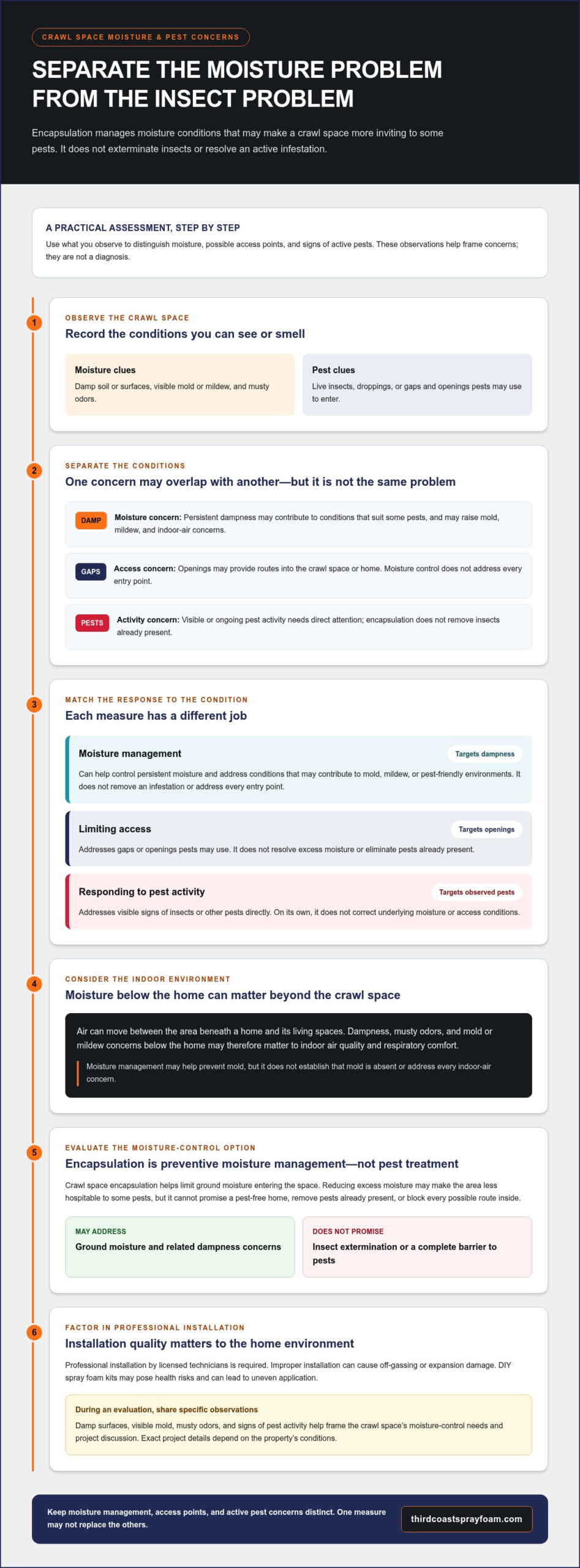
Moisture, possible entry points, and signs of active pests point to different parts of the problem. Use this comparison to set realistic expectations and identify which conditions need attention.
| Approach | What it addresses | What it doesn’t do by itself |
|---|---|---|
| Moisture management | Persistent dampness that may contribute to pest-friendly conditions, mold, or mildew. | Remove an existing infestation or address every entry point. |
| Limiting access | Gaps or openings pests may use to enter the crawl space or home. | Resolve excess moisture or eliminate pests already present. |
| Addressing observed pest activity | Visible signs of insects or other pests that need direct attention. | Correct underlying moisture or access conditions on its own. |
How to decide whether moisture control is part of the problem
Start by noting what you can observe: damp soil or surfaces, visible mold or mildew, musty odors, live insects, or droppings. Dampness and odor can point to moisture concerns; visible pest evidence indicates a separate issue to address. These observations are not a diagnosis, but they help distinguish the conditions you have noticed.
Consider the crawl space as part of the home’s broader moisture and indoor-air picture. If you are concerned about dampness or mold, encapsulation may address that part of the problem. If pest activity is ongoing, moisture control alone is not a substitute for direct treatment. For West Michigan homeowners considering crawl space encapsulation for insect control, a project-specific evaluation can help determine whether moisture management fits the conditions. Information about Third Coast Spray Foam’s services is based on the company’s own statements, and a free, no-obligation quote is required for exact project details. You can request a crawl space encapsulation evaluation to discuss moisture control for your home.
Consider West Michigan Crawl Space Encapsulation for Moisture Management
Moisture management can be one part of caring for a home in West Michigan. Third Coast Spray Foam provides crawl space encapsulation intended to help control moisture, prevent mold, and improve indoor air quality. Reducing excess moisture may also make a crawl space less hospitable to some pests, but encapsulation is not a substitute for addressing an active infestation or a guarantee against insects.
Third Coast Spray Foam serves communities including Grand Rapids, Lansing, Muskegon, Holland, Allegan, Kalamazoo, and Grand Haven. If crawl space dampness is part of wider concerns about mold, mildew, or the air circulating through your home, encapsulation may be worth considering. The potential benefit depends on the property’s conditions, so think of the service as moisture management rather than a stand-alone pest treatment.
What to expect from a professional evaluation
Share specific observations, such as damp surfaces, visible mold, or musty odors, during an evaluation. These details help frame the crawl space’s moisture-control needs and the project discussion. Information about Third Coast Spray Foam’s services is based on the company’s own statements; a free, no-obligation quote is required for exact project details.
Professional installation by licensed technicians is required. DIY spray foam kits may pose health risks and can lead to uneven application. Improper installation can also cause off-gassing or expansion damage. Professional application matters when the goal is to manage moisture without creating new problems for the home’s indoor environment.
If moisture concerns are part of your decision about crawl space encapsulation for insect control, a free, no-obligation evaluation can help clarify the project’s fit. Request a crawl space encapsulation evaluation to discuss moisture management for your West Michigan home.
Make a Confident Next Move for Your Home
Make the crawl space part of your home-maintenance plan rather than treating every insect sighting as proof that encapsulation is the answer. An evaluation can help clarify whether moisture management belongs among your priorities and what project details matter. This approach keeps expectations realistic and focuses attention on the conditions affecting your home.
Third Coast Spray Foam brings 15+ years of Michigan insulation expertise to crawl space projects. If moisture is a concern, a free, no-obligation evaluation and transparent quote can help you understand whether crawl space encapsulation for insect control fits your property. Request a free, no-obligation crawl space evaluation to discuss a practical next step for your home.
Frequently Asked Questions
What is the downside of spray foam insulation?
Improper installation can cause off-gassing or expansion damage, so spray foam requires installation by licensed technicians. This caution also applies to crawl space encapsulation for insect control, but spray foam is not an insect treatment. Information about Third Coast Spray Foam’s services is based on the company’s own statements; a free, no-obligation quote is required for exact project details.
Is DIY spray foam insulation recommended?
No. DIY kits are not recommended because they can cause uneven application, inadequate sealing, and health risks. Professional installation is the recommended approach. For homes in Grand Rapids, Lansing, Muskegon, Holland, Allegan, Kalamazoo, and Grand Haven, consistent application matters because missed or poorly sealed areas can undermine the intended insulation work.
What is the difference between closed-cell and open-cell spray foam?
Closed-cell foam is denser, has a higher R-value, resists moisture, and adds structural support. Open-cell foam is lighter and more flexible, making it better suited to interior walls and soundproofing. The right option depends on the project’s purpose and location within the building. Neither type kills insects, so foam selection should not be treated as pest extermination.
Disclaimer
Information provided is for general educational purposes. Individual needs and circumstances vary. Speak to an experienced professional to get the correct information for your situation.