
A hollow interior partition does far more than leak sound across the hallway; it functions as an open corridor for damp air, odors, and airborne irritants. While many homeowners assume thermal barriers belong only on exterior perimeters, insulating interior walls with spray foam directly resolves the daily frustrations of living in an unsealed house. If you are tired of intrusive office chatter or worried about bathroom humidity seeping through drywall framing, you aren’t alone.
Here, you’ll discover how modern spray foam applications dramatically improve room-to-room acoustic privacy, block moisture migration, and safeguard your family’s respiratory health against hidden mold growth. We explore the functional differences between foam densities to help you maintain clean indoor air and enjoy lasting quiet across every living space.
Key Takeaways
- Insulating interior walls with spray foam creates defined thermal and acoustic separation, preventing noise, drafts, and allergens from traveling between rooms.
- Open-cell spray foam absorbs sound vibrations naturally, making it ideal for quiet home offices, nurseries, and media spaces.
- Dense closed-cell foam blocks vapor transfer in laundry rooms and bathrooms to prevent moisture accumulation and mold growth behind drywall.
- Professional installation techniques ensure accurate chemical ratios and active mechanical ventilation to protect household indoor air quality during curing.
Why Insulate Interior Walls with Spray Foam in Modern Homes?
Most building guides treat thermal barriers strictly as an exterior defense. In a busy home, however, hollow interior partition walls create unintended breezeways for noise, damp air, and airborne debris. Choosing to begin insulating interior walls with spray foam solves these hidden performance gaps by isolating distinct living zones. Whether separating an unconditioned bonus room over a garage or isolating a laundry suite, spray foam insulation expands directly within stud cavities, creating an airtight boundary that empty wall framing simply cannot match.
To see how professional installation seals interior framing cavities effectively, watch this demonstration:
Acoustic Dampening, Mold Prevention, and Respiratory Health Benefits
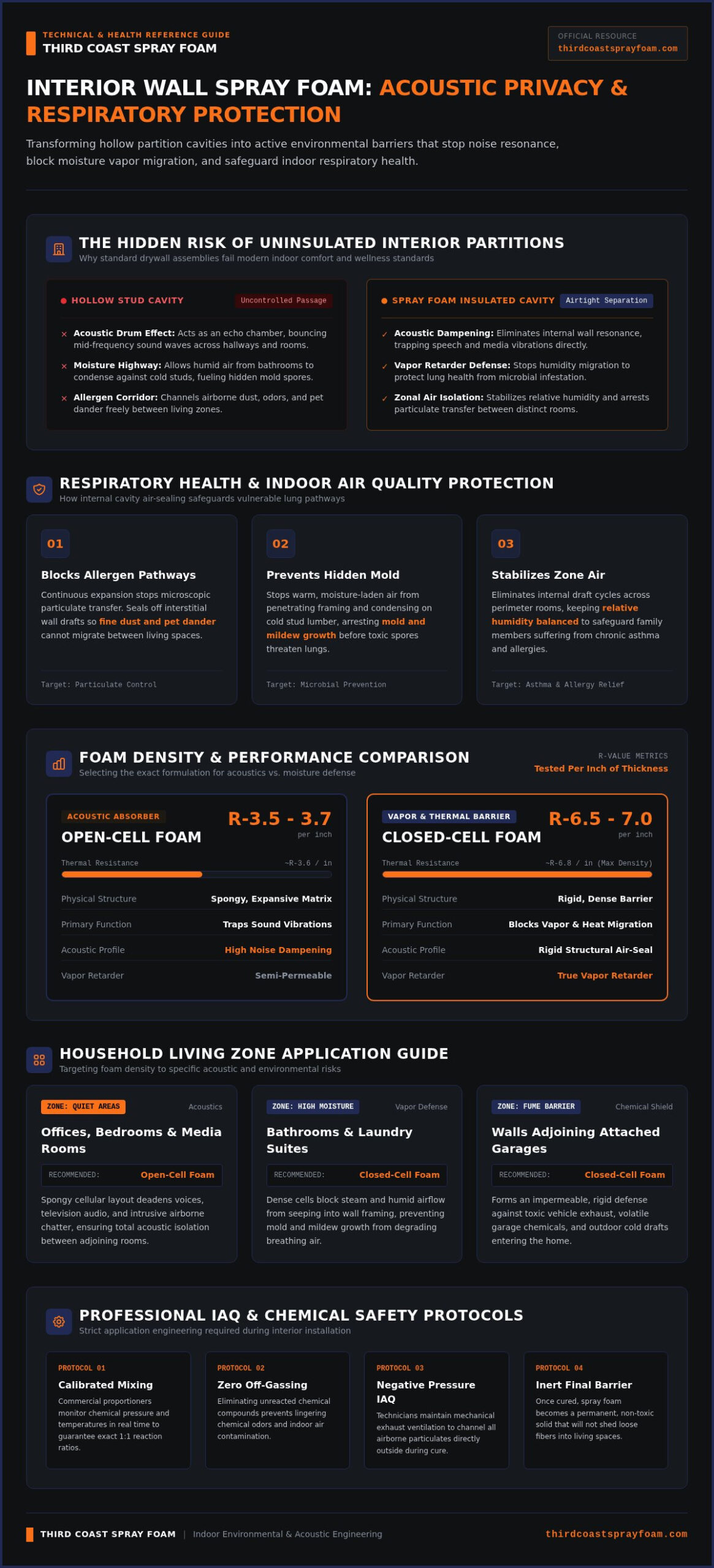
Standard hollow drywall assemblies act like acoustic drums, bouncing mid-frequency sound waves from televisions and home offices directly down the hallway. Fully filling these partitions eliminates internal resonance, dampening intrusive airborne noise between bedrooms and common areas.
Beyond acoustic separation, insulating interior walls with spray foam addresses critical respiratory wellness factors across the home:
- Blocks Allergen Pathways: Fully sealed interior wall cavities stop fine dust and pet dander from traveling between living zones.
- Prevents Hidden Mold: Sealing bathroom and laundry perimeters stops warm, humid air from condensing on cold lumber inside the wall, arresting mold and mildew spores before they threaten lung health.
- Stabilizes Zone Air: Eliminating internal airflow drafts helps keep indoor relative humidity balanced, protecting family members with chronic asthma or seasonal allergies.
Open Cell vs. Closed Cell Foam for Interior Wall Applications
Selecting the right formulation determines whether you solve acoustic bleed, control moisture transfer, or eliminate persistent drafts. While both products create continuous air seals, their physical density dictates where they perform best. When insulating interior walls with spray foam, treating your home as an interconnected system ensures each room receives the exact environmental barrier it requires.
Open-cell foam features a spongy, expansive matrix with an R-value of roughly R-3.5 to R-3.7 per inch. Its pliable structure traps airborne sound vibrations rather than reflecting them. Conversely, closed-cell foam cures into a rigid, dense barrier delivering R-6.5 to R-7.0 per inch. Because closed-cell material acts as a true vapor retarder, it stops humidity in its tracks, making it the superior choice for moisture defense.
Selecting the Right Foam Density for Specific Household Living Zones
Every living area faces unique moisture and acoustic challenges. Mapping the correct material to the correct room creates a healthier, quieter indoor environment:
- Home Offices, Bedrooms, and Media Rooms: Choose open-cell foam. Its sound-absorbing cellular layout deadens voices and entertainment noise, delivering quiet acoustic isolation between adjoining rooms.
- Bathrooms and Laundry Areas: Install closed-cell foam. Dense cells block steam and humid air from migrating into interior framing, preventing hidden mold and mildew spores from degrading indoor air quality.
- Walls Adjoining Attached Garages: Apply closed-cell foam to form an impermeable defense against vehicle exhaust, volatile chemicals, and outdoor cold pockets.
If you need tailored guidance on selecting densities across your floor plan, consulting Third Coast Spray Foam helps establish the right acoustic and moisture boundaries for your family’s health.
Professional Installation Standards to Safeguard Indoor Air Quality
Executing interior chemical air sealing demands exact chemical science and careful environmental control. Insulating interior walls with spray foam requires precise mixing ratios and calibrated temperatures to ensure the two-part chemical reaction cures completely. Professional contractors use commercial proportioners that monitor pressure in real time, eliminating the unreacted compounds that cause lingering odors or off-gassing. During application, technicians establish negative air pressure containment and run active mechanical ventilation, safely exhausting airborne particulates directly outside.
Once fully cured, the material transforms into an inert, non-toxic barrier that permanently improves household air quality. It neither sheds fibers nor breaks down over time, creating a stable enclosure inside your living spaces.
Protecting Respiratory Health Through Professional Application Over DIY Kits
Off-the-shelf DIY spray foam kits present severe risks to indoor environmental safety. Without commercial heating elements and pressure calibration, disposable kits frequently dispense off-ratio chemical mixes. Uncured chemical residues can release airborne volatile compounds indefinitely, triggering asthma flare-ups, eye redness, and persistent respiratory irritation for building occupants.
Relying on experienced professionals protects your home through exacting installation practices:
- Cavity Inspection: Trained specialists inspect stud framing before spraying, identifying hidden moisture pockets and bypasses around plumbing runs.
- Seamless Air Barriers: Professional guns deliver consistent expansion, completely closing hidden channels where dust mites and pollen circulate.
- Permanent Moisture Starvation: An airtight barrier stops indoor humidity from contacting cool structural studs, starving mold of the dampness it needs to thrive.
Proper execution turns interior insulation into a permanent health asset, keeping your living environment dry, quiet, and safe for every breath.
Build a Healthier, Quieter Home from the Inside Out
Choosing to begin insulating interior walls with spray foam transforms how your living spaces perform every day. By sealing interior partition cavities with the proper foam density, you effectively stop intrusive room-to-room noise, halt moisture migration from damp utility areas, and prevent hidden mold colonies from compromising your family’s respiratory wellness.
As locally owned West Michigan insulation specialists, we apply advanced open-cell and closed-cell formulations backed by strict ventilation protocols that protect your indoor air quality at every step. You don’t have to settle for echoing drywall or airborne drafts between rooms. Schedule your health-first interior insulation assessment with Third Coast Spray Foam to secure lasting comfort and peace of mind across your home.
Frequently Asked Questions
Is spray foam safe for interior walls?
Yes, spray foam is completely safe for interior walls when installed by certified professionals using proper ventilation. Once the chemical reaction cures over a standard 24-hour period, it becomes fully inert and non-toxic. Unlike fibrous insulation materials that break down into airborne irritants, cured foam won’t shed particles into your living spaces or compromise your household’s respiratory health.
Which spray foam is best for interior soundproofing?
Open-cell spray foam is the best option for interior soundproofing. Its soft, flexible cellular structure naturally traps and absorbs mid-frequency airborne vibrations instead of letting them bounce through empty framing. When insulating interior walls with spray foam between bedrooms, home offices, or media rooms, open-cell material provides superior acoustic dampening that keeps adjacent living zones distinctly quiet.
Can interior wall spray foam prevent mold and mildew?
Yes, closed-cell spray foam actively prevents mold and mildew by creating an impermeable moisture and vapor barrier. Bathrooms, laundry rooms, and basements generate significant humidity that easily migrates through drywall. Applying closed-cell foam blocks warm vapor from reaching cold wood studs, eliminating the hidden condensation pockets where toxic mold spores breed and threaten family respiratory wellness.
Does insulating interior walls improve energy efficiency?
Yes, it boosts energy efficiency by establishing distinct thermal zones throughout your floor plan. While exterior insulation handles outside weather, insulating interior walls with spray foam prevents conditioned air from leaking into unheated spaces like bonus rooms, attached garages, or utility corridors. This strategic thermal zoning reduces the workload on your HVAC system across changing West Michigan seasons.
Disclaimer
Information provided is for general educational purposes. Individual needs and circumstances vary. Speak to an experienced professional to get the correct information for your situation.